This comprehensive comparison analyzes CEEK and XTZ as emerging blockchain investments, examining their distinct market positions, historical performance, and growth potential. CEEK focuses on AR/VR content distribution with a market cap of $4.50 million, while XTZ serves as a self-amending blockchain infrastructure platform valued at $560.87 million. The article evaluates price trends from 2018 launch through January 2026, projects forecasts through 2031, and provides tailored investment strategies for conservative and aggressive investors. Technical ecosystems, tokenomics, liquidity profiles, and regulatory risks are assessed to address critical investment decisions. Conservative investors may favor XTZ's established infrastructure and governance mechanisms, while experienced investors can diversify across both assets based on risk tolerance and sector exposure preferences.
Introduction: Investment Comparison Between CEEK and XTZ
In the cryptocurrency market, the comparison between CEEK vs XTZ remains a recurring topic among investors. Both assets exhibit notable differences in market cap ranking, application scenarios, and price performance, representing distinct positioning within the crypto asset landscape.
CEEK (CEEK): Launched in 2018, this token has carved out a niche by focusing on AR/VR wearable devices and blockchain-based content distribution, enabling artists and creators to connect with audiences through virtual reality experiences.
Tezos (XTZ): Introduced in 2017, Tezos has established itself as a self-amending blockchain platform, emphasizing formal verification and on-chain governance mechanisms that allow the protocol to evolve without hard forks.
This article will provide a comprehensive analysis of CEEK vs XTZ investment value comparison, examining historical price trends, supply mechanisms, adoption patterns, technical ecosystems, and future outlook to address the question investors care about most:
"Which represents a more suitable investment consideration based on current market conditions?"
I. Historical Price Comparison and Current Market Status
CEEK and XTZ Historical Price Trends
- 2018: CEEK launched with an initial offering price of $0.03, establishing its presence in the AR/VR blockchain space.
- 2018: XTZ (Tezos) entered the market at $0.40, positioning itself as a self-amending blockchain platform focused on governance and smart contracts.
- 2021: CEEK experienced significant price movement, reaching a notable level of $1.19 in November 2021 during the broader cryptocurrency market rally.
- 2021: XTZ recorded its peak price of $9.12 in October 2021, reflecting strong market interest in its proof-of-stake mechanism and governance features.
- Comparative Analysis: During the 2021-2022 market cycle, CEEK declined from its peak of $1.19 to lower levels, while XTZ demonstrated a similar pattern, moving from $9.12 to substantially reduced valuations. Both assets experienced significant corrections following their respective peaks.
- Historical Low Points: CEEK recorded its lowest price of $0.00074146 in February 2020, whereas XTZ reached its minimum of $0.350476 in December 2018.
Current Market Status (January 29, 2026)
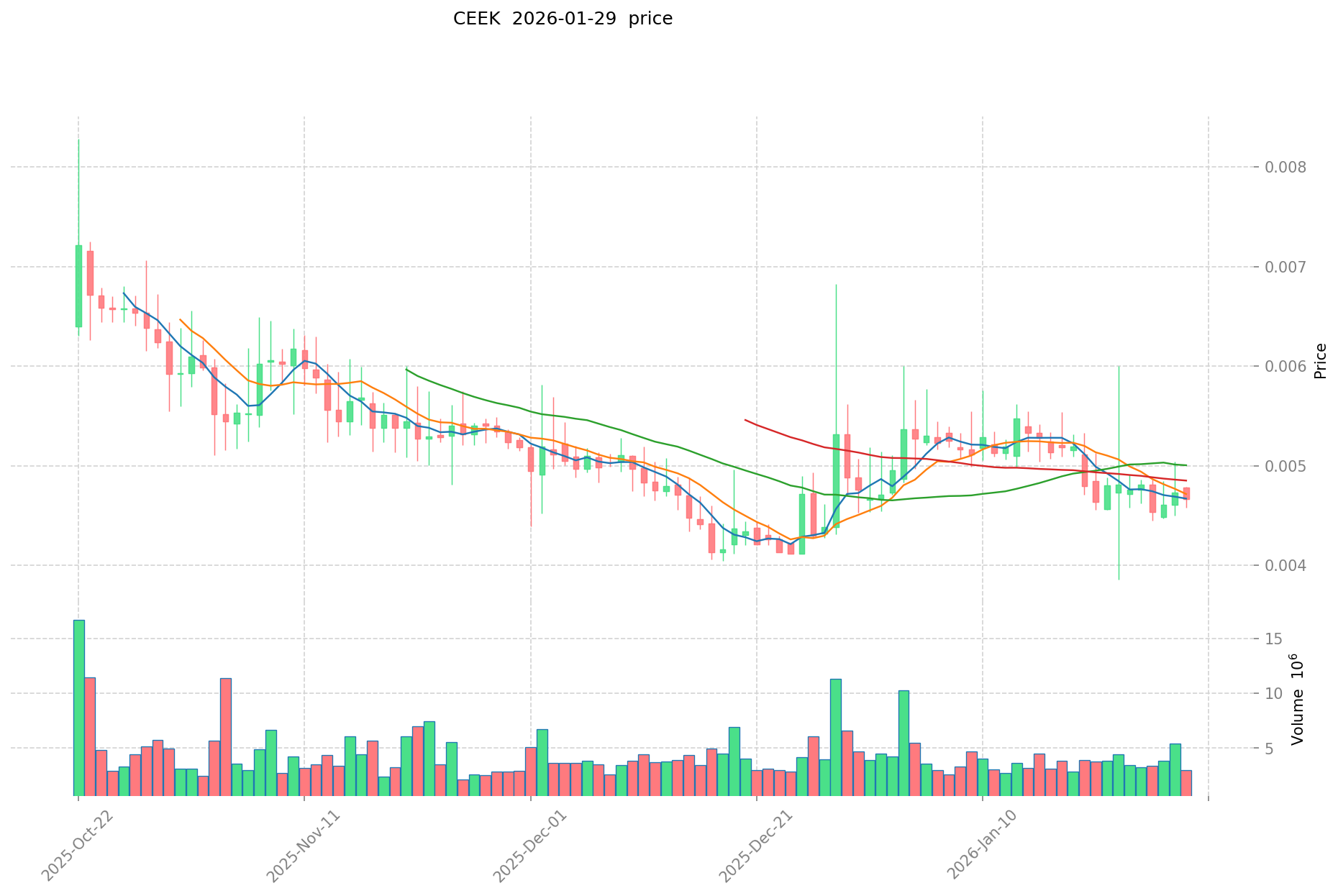
- CEEK Current Price: $0.004501
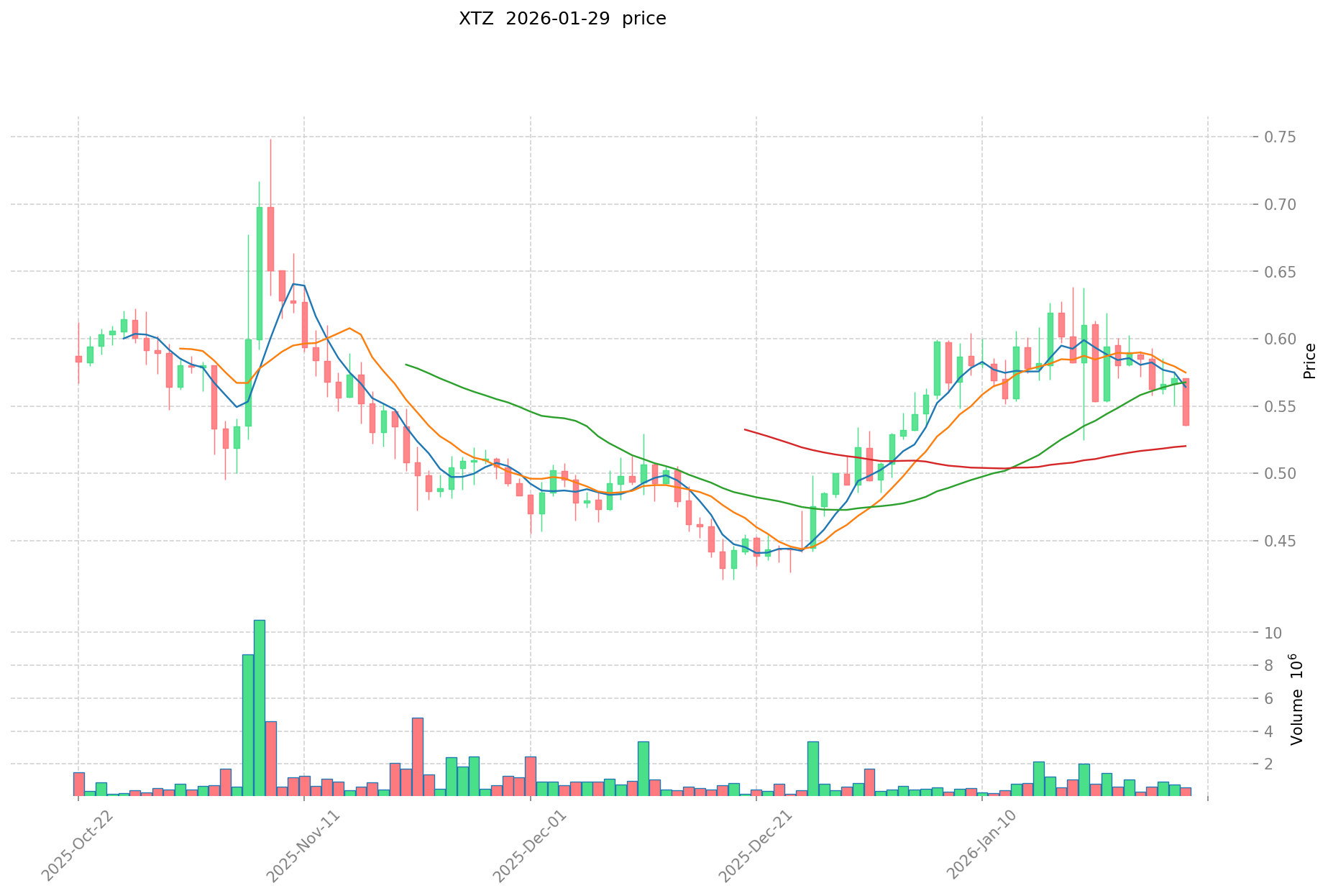
- XTZ Current Price: $0.5224
- 24-Hour Trading Volume: CEEK at $14,139.22 compared to XTZ at $346,077.47
- Market Sentiment Index (Fear & Greed Index): 26 (Fear)
- Price Performance: CEEK showed a 24-hour change of -3.43%, while XTZ recorded -7.02% over the same period.
- Market Capitalization: CEEK holds a market cap of approximately $4.50 million with a ranking of 1595, whereas XTZ maintains a market cap of $560.87 million, ranked at 116.
View Real-Time Prices:
- Check CEEK Current Price Market Price
- Check XTZ Current Price Market Price
II. Core Factors Influencing CEEK vs XTZ Investment Value
Supply Mechanism Comparison (Tokenomics)
- CEEK: Based on the available materials, specific supply mechanism details were not provided. The token is associated with a VR social platform ecosystem.
- XTZ: The materials mention XTZ's role within blockchain infrastructure, though detailed supply mechanism information was not available in the provided sources.
- 📌 Historical Pattern: Supply mechanisms have historically influenced price cycles through controlled issuance and scarcity dynamics, though specific data for these tokens requires additional research.
Institutional Adoption and Market Applications
- Institutional Holdings: The provided materials do not contain specific data comparing institutional preference between CEEK and XTZ.
- Enterprise Adoption: Application scenarios in cross-border payments, settlement systems, and investment portfolios were not detailed in the available materials for either token.
- National Policies: Regulatory attitudes toward these specific tokens across different jurisdictions were not covered in the source materials.
Technical Development and Ecosystem Construction
- CEEK Technical Progress: The token is tied to VR social platform development, though specific technical upgrades were not detailed in the materials.
- XTZ Technical Development: References indicate blockchain infrastructure involvement, but detailed technical advancement information was not provided.
- Ecosystem Comparison: Specific implementation data regarding DeFi, NFT, payment systems, and smart contract deployment for both tokens was not available in the source materials.
Macroeconomic Environment and Market Cycles
- Performance in Inflationary Environments: Comparative inflation-hedging properties were not addressed in the provided materials.
- Macroeconomic Monetary Policy: The specific impact of interest rates and dollar index movements on these tokens was not covered in the available sources.
- Geopolitical Factors: Cross-border transaction demand and international situation influences were not detailed for these specific tokens in the materials.
III. 2026-2031 Price Forecast: CEEK vs XTZ
Short-term Forecast (2026)
- CEEK: Conservative $0.00334 - $0.00451 | Optimistic $0.00451 - $0.00542
- XTZ: Conservative $0.387 - $0.522 | Optimistic $0.522 - $0.721
Mid-term Forecast (2028-2029)
- CEEK may enter a phase of moderate growth with volatility, with projected prices ranging from $0.00448 to $0.00929
- XTZ may enter a phase of expansion with increased adoption, with projected prices ranging from $0.410 to $1.032
- Key drivers: institutional capital inflows, ETF developments, ecosystem expansion
Long-term Forecast (2030-2031)
- CEEK: Baseline scenario $0.00429 - $0.00794 | Optimistic scenario $0.00794 - $0.0119
- XTZ: Baseline scenario $0.630 - $0.875 | Optimistic scenario $0.875 - $1.063
View detailed price predictions for CEEK and XTZ
Disclaimer
CEEK:
| Year |
Predicted High Price |
Predicted Average Price |
Predicted Low Price |
Price Change |
| 2026 |
0.0054156 |
0.004513 |
0.00333962 |
0 |
| 2027 |
0.007347164 |
0.0049643 |
0.004120369 |
10 |
| 2028 |
0.00701753448 |
0.006155732 |
0.00560171612 |
36 |
| 2029 |
0.0092871528684 |
0.00658663324 |
0.0044789106032 |
46 |
| 2030 |
0.009603640595582 |
0.0079368930542 |
0.004285922249268 |
76 |
| 2031 |
0.011927562881851 |
0.008770266824891 |
0.007717834805904 |
94 |
XTZ:
| Year |
Predicted High Price |
Predicted Average Price |
Predicted Low Price |
Price Change |
| 2026 |
0.720774 |
0.5223 |
0.386502 |
0 |
| 2027 |
0.65882922 |
0.621537 |
0.48479886 |
18 |
| 2028 |
0.7938270564 |
0.64018311 |
0.4097171904 |
22 |
| 2029 |
1.032487319808 |
0.7170050832 |
0.602284269888 |
37 |
| 2030 |
1.05844290381984 |
0.874746201504 |
0.62981726508288 |
67 |
| 2031 |
1.063254007928112 |
0.96659455266192 |
0.918264825028824 |
85 |
IV. Investment Strategy Comparison: CEEK vs XTZ
Long-term vs Short-term Investment Strategies
- CEEK: May appeal to investors focused on niche VR/AR content distribution ecosystems and speculative opportunities in emerging technology sectors
- XTZ: May appeal to investors seeking exposure to established blockchain infrastructure with governance mechanisms and proof-of-stake features
Risk Management and Asset Allocation
- Conservative Investors: CEEK 10-15% vs XTZ 85-90%
- Aggressive Investors: CEEK 30-40% vs XTZ 60-70%
- Hedging Tools: stablecoin allocation, options strategies, cross-asset diversification
V. Potential Risk Comparison
Market Risk
- CEEK: Subject to elevated volatility due to lower market capitalization ($4.50 million) and limited trading volume ($14,139.22 daily), which may result in liquidity constraints
- XTZ: Experiences market fluctuations influenced by broader blockchain infrastructure sentiment, though benefits from higher liquidity with $346,077.47 in daily trading volume
Technical Risk
- CEEK: Scalability and network stability considerations related to VR platform integration
- XTZ: Protocol evolution through on-chain governance may introduce implementation uncertainties
Regulatory Risk
- Global regulatory frameworks may affect both assets differently, with established blockchain platforms potentially receiving clearer guidance while niche VR tokens face sector-specific considerations
VI. Conclusion: Which Is the Better Buy?
📌 Investment Value Summary:
- CEEK Characteristics: Positioning in AR/VR content distribution sector, lower market capitalization with corresponding risk-reward profile
- XTZ Characteristics: Established blockchain infrastructure, self-amending protocol features, proof-of-stake mechanism, governance capabilities
✅ Investment Considerations:
- Novice Investors: May consider XTZ for exposure to established blockchain infrastructure with documented governance features
- Experienced Investors: Portfolio diversification between infrastructure-focused assets (XTZ) and sector-specific opportunities (CEEK) based on risk tolerance
- Institutional Investors: Evaluation of liquidity profiles, market depth, and alignment with portfolio objectives
⚠️ Risk Disclosure: Cryptocurrency markets exhibit substantial volatility. This content does not constitute investment advice.
VII. FAQ
Q1: What are the main differences between CEEK and XTZ in terms of use cases?
CEEK focuses on AR/VR content distribution and virtual reality experiences connecting creators with audiences, while XTZ serves as a self-amending blockchain infrastructure platform emphasizing governance and smart contracts. CEEK operates in the niche sector of blockchain-powered wearable devices and immersive experiences launched in 2018, whereas XTZ, introduced in 2017, provides a foundational blockchain layer with formal verification capabilities and on-chain governance mechanisms that enable protocol evolution without hard forks. The fundamental distinction lies in CEEK's content-distribution orientation versus XTZ's infrastructure-platform positioning.
Q2: How do the market capitalizations of CEEK and XTZ compare as of January 2026?
XTZ significantly outperforms CEEK in market capitalization, with XTZ at $560.87 million (ranked 116) compared to CEEK's $4.50 million (ranked 1595). This substantial difference reflects XTZ's established position in the blockchain infrastructure space with daily trading volume of $346,077.47, while CEEK maintains a smaller presence with $14,139.22 in daily volume. The market cap differential indicates differing levels of market adoption, liquidity depth, and institutional recognition between these two assets.
Q3: What were the all-time high prices for CEEK and XTZ during the 2021 bull market?
CEEK reached its peak price of $1.19 in November 2021, while XTZ recorded its all-time high of $9.12 in October 2021. Both assets experienced significant corrections following these peaks, with CEEK declining substantially from its $1.19 high and XTZ moving down from $9.12 to much lower valuations. As of January 29, 2026, CEEK trades at $0.004501 (down -3.43% in 24 hours) and XTZ at $0.5224 (down -7.02% in 24 hours), representing considerable retracement from their 2021 peak levels.
Q4: Which asset presents higher liquidity risk?
CEEK presents substantially higher liquidity risk compared to XTZ based on current market metrics. With a daily trading volume of only $14,139.22 and market capitalization of $4.50 million, CEEK demonstrates limited market depth that may result in liquidity constraints and elevated price slippage during transactions. In contrast, XTZ maintains considerably higher liquidity with $346,077.47 in daily trading volume and $560.87 million market capitalization, providing greater ease of entry and exit for investors without significant price impact.
Q5: What are the projected price ranges for CEEK and XTZ by 2030?
For 2030, CEEK's baseline scenario projects prices between $0.00429 and $0.00794, with an optimistic scenario ranging from $0.00794 to $0.0119. XTZ's 2030 baseline scenario forecasts prices between $0.630 and $0.875, with an optimistic scenario spanning $0.875 to $1.063. These projections suggest XTZ may achieve a 67% price increase from current levels under baseline conditions, while CEEK could experience a 76% increase. However, these forecasts depend on numerous variables including institutional adoption, ecosystem development, and broader market conditions.
Q6: How should conservative versus aggressive investors approach CEEK and XTZ allocation?
Conservative investors may consider an allocation of 10-15% CEEK versus 85-90% XTZ, prioritizing the more established blockchain infrastructure asset with higher liquidity and lower volatility risk. Aggressive investors seeking higher risk-reward profiles might allocate 30-40% to CEEK versus 60-70% to XTZ, accepting greater exposure to the smaller-cap, higher-volatility AR/VR sector asset. Both strategies should incorporate hedging tools such as stablecoin allocation, options strategies, and cross-asset diversification to manage portfolio risk effectively.
Q7: What technical features distinguish XTZ's blockchain mechanism?
XTZ distinguishes itself through its self-amending blockchain protocol that enables evolution without hard forks, formal verification capabilities for smart contract security, and on-chain governance mechanisms allowing stakeholder participation in protocol decisions. The proof-of-stake consensus mechanism provides energy efficiency and staking opportunities for token holders. These technical features position XTZ as blockchain infrastructure focused on adaptability and democratic governance, contrasting with CEEK's application-specific focus on VR platform integration and content distribution.
Q8: What is the current market sentiment for cryptocurrency investments as of January 2026?
The market sentiment index (Fear & Greed Index) stands at 26, indicating "Fear" conditions as of January 29, 2026. This bearish sentiment context affects both CEEK and XTZ, as evidenced by their recent 24-hour price declines of -3.43% and -7.02% respectively. The fear-dominated environment suggests investor caution and potential opportunities for strategic accumulation, though heightened volatility and downside risk remain present. Market participants should consider this sentiment backdrop when evaluating entry timing and position sizing for both assets.
* The information is not intended to be and does not constitute financial advice or any other recommendation of any sort offered or endorsed by Gate.