This comprehensive analysis examines whether OpenGPU (OGPU) represents a viable investment opportunity in decentralized GPU computing infrastructure. As of February 2026, OGPU trades at $0.08353 with a market capitalization of $1.64 million, having surged from $0.035 to $3.41 in December 2024 before declining 92.15% annually. The article evaluates OGPU's investment fundamentals, including its 21-million token maximum supply (93.52% in circulation), utility within the OPEN GPU Network Services platform for AI research and graphics processing, and current holder base of 6,164 addresses on Gate exchange. It presents price forecasts ranging from conservative ($0.045-$0.084 in 2026) to optimistic scenarios ($0.162-$0.220 by 2031), alongside critical risk assessments covering market volatility, regulatory uncertainty, and technical vulnerabilities. Tailored investment strategies address beginners, experienced traders, and institutional investors, emphasizing portfolio allocation ratios (2-15%) and security protocol
Introduction: OpenGPU (OGPU)'s Investment Position and Market Prospects
OGPU is a notable asset in the cryptocurrency space, launched in 2024, focusing on decentralized GPU computing infrastructure for AI research and graphics processing tasks. As of February 2026, OpenGPU holds a market capitalization of approximately $1.64 million, with a circulating supply of around 19.64 million tokens, and the current price stands at approximately $0.08353. Positioned as a decentralized computing power aggregator, OGPU has gradually become a focal point for investors discussing "Is OpenGPU (OGPU) a good investment?" This article provides a comprehensive analysis of OGPU's investment value, historical performance, future price predictions, and associated investment risks to offer reference for investors.
The OPEN GPU Network Services platform leverages decentralized computing to enhance AI research and graphical processing tasks globally. By aggregating idle GPU resources from various nodes across the network, it enables scalable, efficient, and cost-effective computing power accessible to developers, researchers, and companies. With a total supply capped at 21 million tokens and approximately 93.52% already in circulation, OGPU operates on the Ethereum blockchain under the ERC-20 standard. The token serves as the native utility token within this decentralized GPU network ecosystem, with current holder count reaching 6,164 addresses.
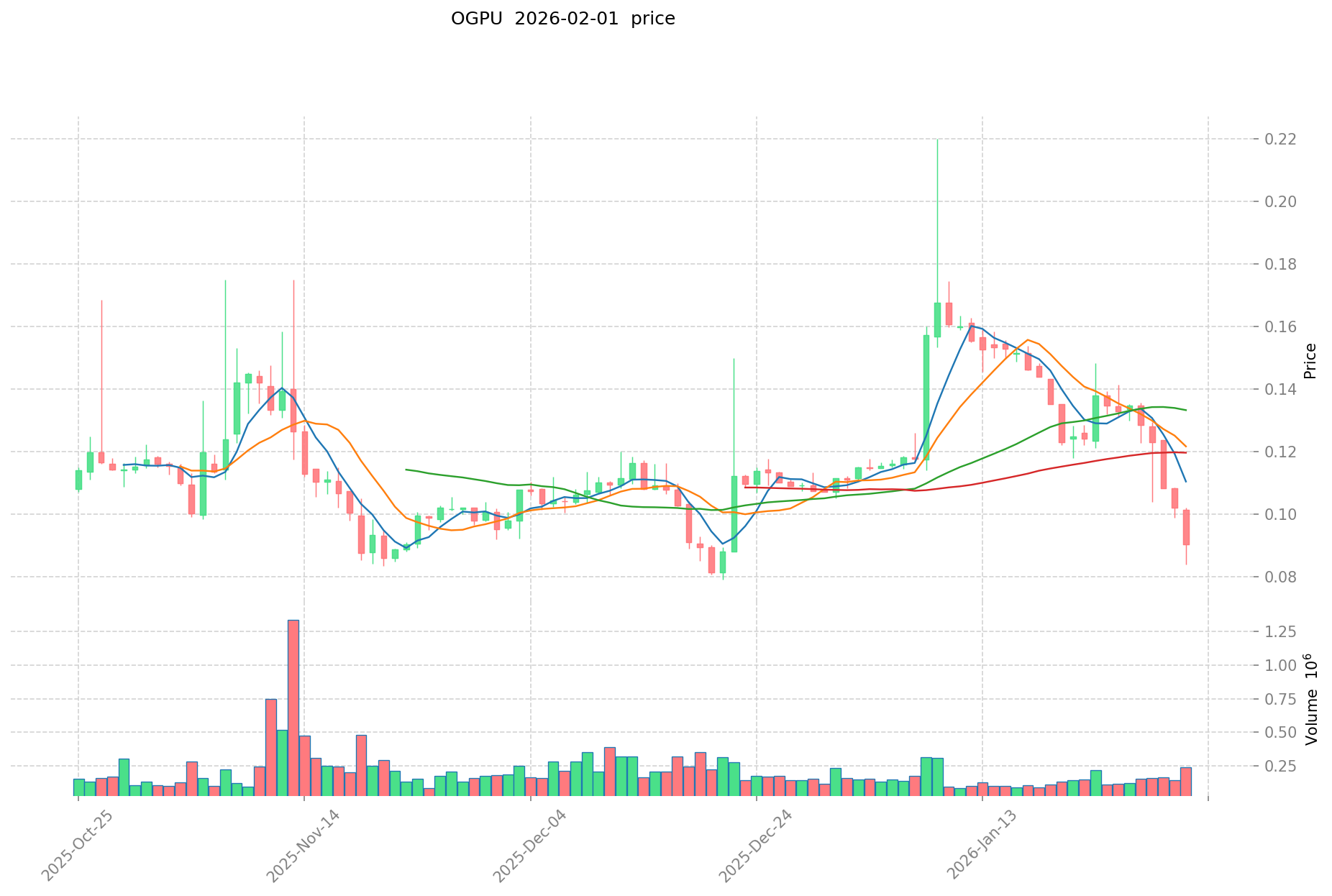
Since its launch at $0.035, OGPU has experienced significant price volatility. The token reached a peak price of $3.41 in December 2024, but has since experienced substantial corrections, with recent performance showing a decline of 4.31% over 24 hours, 37.03% over 7 days, and 92.15% over the past year. The 24-hour trading volume stands at approximately $24,223, reflecting current market activity levels. Currently ranked at position 2,169 by market capitalization, with a market dominance of 0.000064%, OGPU represents a relatively small-cap project within the broader cryptocurrency ecosystem.
I. OGPU Price History Review and Current Investment Value
- 2024: Reached a significant price level of $3.41 on December 22 → Early investors experienced substantial returns
- 2025: Price adjusted to $0.1406 by October, with market capitalization exceeding $2.76 million → OGPU experienced notable price volatility
- 2025-2026: Price declined from higher levels to $0.08353 as of February 2, 2026 → Market participants observed a correction phase
Current OGPU Investment Market Status (February 2026)
- Current OGPU price: $0.08353
- 24-hour trading volume: $24,223.10
- Circulating supply: 19,639,104.82 OGPU (93.52% of total supply)
- Market capitalization: $1,640,454.43
- Fully diluted valuation: $1,754,130.00
Click to view real-time OGPU market price
II. Core Factors Affecting Whether OGPU is a Good Investment
Supply Mechanism and Scarcity (OGPU Investment Scarcity)
- Total Supply: OpenGPU (OGPU) has a maximum supply of 21,000,000 tokens, with a current circulating supply of approximately 19,639,104.82 tokens (representing about 93.52% of the total supply). This limited supply structure creates a foundation for potential scarcity value.
- Supply Impact on Price: The circulating supply ratio of 93.52% indicates that most tokens are already in circulation, which may reduce the dilution risk typically associated with tokens with lower circulation ratios. However, the remaining 6.48% of tokens could still enter the market, potentially affecting price dynamics.
- Investment Significance: The finite supply mechanism, similar to other deflationary models, positions OGPU with inherent scarcity characteristics. This design may support long-term value retention, though market demand and adoption remain critical variables.
Institutional Investment and Mainstream Adoption (Institutional Investment in OGPU)
- Holder Distribution: As of the latest data, OGPU has approximately 6,164 holders. While this indicates a growing user base, the relatively modest holder count suggests that institutional adoption may still be in early stages.
- Market Presence: OGPU is currently listed on 2 exchanges, which limits its accessibility compared to more widely traded assets. Broader exchange listings could enhance liquidity and attract institutional interest.
- Ecosystem Application: The OPEN GPU Network Services platform leverages decentralized computing to support AI research and graphical processing tasks by aggregating idle GPU resources. This utility-driven approach provides a clear use case, which may attract enterprise and developer adoption over time.
Macroeconomic Environment's Impact on OGPU Investment
- Market Volatility: OGPU has experienced significant price fluctuations, with a 1-year decline of approximately 92.15%. Such volatility reflects sensitivity to broader market conditions and investor sentiment in the cryptocurrency sector.
- Risk Factors: The token's performance is influenced by macroeconomic factors, including interest rate policies, inflation trends, and risk appetite in global financial markets. During periods of economic uncertainty or tightening monetary policies, speculative assets like OGPU may face downward pressure.
- Correlation with Crypto Market: OGPU's price movements are likely correlated with the overall cryptocurrency market. Changes in regulatory environments, technological developments, and investor confidence in digital assets can significantly impact its investment outlook.
Technology and Ecosystem Development (Technology & Ecosystem for OGPU Investment)
- Platform Utility: The OPEN GPU Network Services platform aggregates decentralized GPU resources to provide scalable, efficient, and cost-effective computing power for AI research and graphics processing. This infrastructure addresses growing demand in the AI and machine learning sectors.
- Technical Standard: OGPU operates as an ERC-20 token on the Ethereum blockchain, which provides compatibility with a wide range of wallets, exchanges, and decentralized applications (DApps).
- Ecosystem Growth Potential: The expansion of decentralized computing use cases, including AI training, rendering, and data processing, could drive long-term demand for OGPU. However, competitive dynamics in the decentralized GPU market and the pace of ecosystem development will be key determinants of investment value.
- Documentation and Transparency: OpenGPU has published a whitepaper outlining its technical framework and vision, which provides transparency for investors assessing the project's fundamentals and long-term viability.
III. OGPU Future Investment Forecast and Price Outlook (Is OpenGPU(OGPU) worth investing in 2026-2031)
Short-term Investment Forecast (2026, short-term OGPU investment outlook)
- Conservative forecast: 0.045 - 0.084 USD
- Neutral forecast: 0.084 - 0.120 USD
- Optimistic forecast: 0.120 - 0.150 USD
Mid-term Investment Outlook (2027-2029, mid-term OpenGPU(OGPU) investment forecast)
- Market stage expectation: OGPU may experience gradual development during this phase, with projected average prices ranging from 0.102 USD in 2027 to 0.138 USD in 2029, reflecting potential market maturation and ecosystem expansion.
- Investment return forecast:
- 2027: 0.074 - 0.137 USD
- 2028: 0.067 - 0.158 USD
- 2029: 0.096 - 0.158 USD
- Key catalysts: Decentralized GPU computing adoption, AI research application expansion, and network node resource aggregation growth.
Long-term Investment Outlook (Is OGPU a good long-term investment?)
- Base scenario: 0.077 - 0.148 USD (assuming steady ecosystem development and sustained demand for decentralized computing resources)
- Optimistic scenario: 0.162 - 0.220 USD (assuming accelerated mainstream adoption and favorable market conditions for AI and GPU computing sectors)
- Risk scenario: Below 0.045 USD (under conditions of technological competition intensification or market sentiment deterioration)
View OGPU long-term investment and price forecast: Price Prediction
2026-02-02 - 2031 Long-term Outlook
- Base scenario: 0.077 - 0.148 USD (corresponding to steady progress and gradual mainstream application improvement)
- Optimistic scenario: 0.162 - 0.220 USD (corresponding to large-scale adoption and favorable market environment)
- Transformative scenario: Above 0.220 USD (in case of breakthrough ecosystem progress and mainstream popularization)
- 2031-12-31 forecast high: 0.220 USD (based on optimistic development assumptions)
Disclaimer: The forecasts presented are based on available data and analytical models as of February 2026. Cryptocurrency markets involve substantial volatility and risk. These projections do not constitute investment advice, and actual performance may differ materially from forecasts due to market dynamics, technological changes, regulatory developments, and other factors beyond prediction.
| Year |
Predicted High Price |
Predicted Average Price |
Predicted Low Price |
Price Change |
| 2026 |
0.1203984 |
0.08361 |
0.0451494 |
0 |
| 2027 |
0.136685628 |
0.1020042 |
0.074463066 |
22 |
| 2028 |
0.15753528648 |
0.119344914 |
0.06683315184 |
42 |
| 2029 |
0.1578217142736 |
0.13844010024 |
0.0955236691656 |
65 |
| 2030 |
0.185163634071 |
0.1481309072568 |
0.077028071773536 |
77 |
| 2031 |
0.219974397276348 |
0.1666472706639 |
0.161647852543983 |
99 |
IV. OpenGPU Investment Strategy and Risk Management (How to invest in decentralized GPU computing tokens)
Investment Methodology (OpenGPU investment strategy)
-
Long-term Holding (HODL OGPU): Suitable for conservative investors who believe in the long-term growth potential of decentralized computing infrastructure. This approach involves acquiring OGPU tokens and holding them through market fluctuations, based on the fundamental value proposition of the OpenGPU network's utility in AI research and graphics processing.
-
Active Trading: Relies on technical analysis and swing trading operations. Traders may capitalize on OGPU's price movements by monitoring support and resistance levels, volume patterns, and broader market trends in the AI and decentralized computing sectors.
Risk Management (Risk management for OGPU investment)
V. OpenGPU Investment Risks and Challenges (Risks of investing in decentralized GPU computing tokens)
-
Market Risk: OGPU exhibits significant volatility, with 24-hour price fluctuations and substantial drawdowns observed in various timeframes. The relatively low market capitalization and trading volume may contribute to price instability and potential susceptibility to large order impacts.
-
Regulatory Risk: The decentralized computing sector faces evolving regulatory frameworks across different jurisdictions. Changes in cryptocurrency regulations, data privacy laws, or AI governance policies in various countries could impact the adoption and operation of decentralized GPU networks.
-
Technical Risk: Potential vulnerabilities include smart contract security issues inherent to ERC-20 tokens, network congestion on the Ethereum blockchain affecting transaction costs, and technical challenges in maintaining decentralized GPU node operations. Platform upgrades or protocol changes could introduce unforeseen complications.
VI. Conclusion: Is Decentralized GPU Computing Token a Good Investment?
-
Investment Value Summary: OpenGPU presents potential long-term value based on its positioning in the decentralized computing infrastructure sector, particularly as AI and graphics processing demands continue growing. However, the token demonstrates substantial short-term price volatility and faces competition in an evolving market landscape.
-
Investor Recommendations:
✅ Beginners: Consider dollar-cost averaging (DCA) approach with secure wallet storage, starting with small allocations to understand market dynamics
✅ Experienced Investors: Employ swing trading strategies combined with diversified portfolio allocation across blockchain infrastructure projects
✅ Institutional Investors: Evaluate strategic long-term positioning as part of broader decentralized infrastructure exposure
⚠️ Disclaimer: Cryptocurrency investment carries substantial risk. This content is for informational purposes only and does not constitute investment advice. Conduct thorough research and consider your risk tolerance before making investment decisions.
VII. FAQ
Q1: What is the maximum supply of OGPU tokens, and how does scarcity affect its investment value?
OpenGPU has a maximum supply of 21,000,000 tokens, with approximately 93.52% (19,639,104.82 tokens) already in circulation as of February 2026. This limited supply mechanism creates inherent scarcity similar to deflationary models in cryptocurrency. With only 6.48% of tokens remaining to enter the market, dilution risk is relatively lower compared to projects with larger unvested supplies. The finite supply structure provides a foundation for potential long-term value retention, though actual investment value depends critically on market demand, adoption rates of the OPEN GPU Network Services platform, and competition in the decentralized computing sector.
Q2: How has OGPU performed historically, and what returns have early investors experienced?
OGPU launched in 2024 at $0.035 and reached a peak price of $3.41 on December 22, 2024, representing approximately 9,643% returns for earliest investors. However, the token has experienced significant corrections since then, declining to $0.08353 as of February 2, 2026—a 97.55% drop from its all-time high. Recent performance shows a 4.31% decline over 24 hours, 37.03% over 7 days, and 92.15% over the past year. This volatility pattern demonstrates the high-risk nature of OGPU investment, with substantial gains possible during bullish periods but equally significant drawdowns during corrections.
Q3: What are the primary use cases for OGPU within the decentralized computing ecosystem?
OGPU serves as the native utility token for the OPEN GPU Network Services platform, which aggregates idle GPU resources from decentralized nodes globally. The platform's primary applications include AI research, machine learning model training, graphics rendering, and data processing tasks. By leveraging blockchain technology on the Ethereum network (ERC-20 standard), OGPU enables scalable, efficient, and cost-effective computing power accessible to developers, researchers, and companies. This utility-driven approach addresses growing demand in the AI and computational sectors, positioning OGPU as an infrastructure token rather than purely speculative asset.
Q4: What price forecasts exist for OGPU between 2026 and 2031?
Short-term forecasts for 2026 range from a conservative $0.045-$0.084 to an optimistic $0.120-$0.150. Mid-term projections suggest gradual growth with average prices of $0.102 (2027), $0.119 (2028), and $0.138 (2029), reflecting potential ecosystem maturation. Long-term forecasts for 2031 range from a base scenario of $0.077-$0.148 to an optimistic scenario of $0.162-$0.220, with transformative scenarios potentially exceeding $0.220 if breakthrough adoption occurs. These forecasts assume varying degrees of decentralized GPU computing adoption, AI research expansion, and favorable market conditions. However, investors should note that cryptocurrency markets involve substantial volatility, and actual performance may differ materially from projections.
Q5: What are the main risks associated with investing in OGPU?
OGPU investment carries three primary risk categories: Market Risk—significant volatility with 92.15% annual decline, low market capitalization ($1.64 million) susceptible to large order impacts, and limited trading volume ($24,223 daily) affecting liquidity; Regulatory Risk—evolving frameworks for decentralized computing, cryptocurrency regulations, and AI governance policies across jurisdictions that could impact platform operations; and Technical Risk—smart contract vulnerabilities inherent to ERC-20 tokens, Ethereum network congestion affecting transaction costs, and challenges in maintaining decentralized GPU node infrastructure. The relatively small holder base (6,164 addresses) and listing on only 2 exchanges further contribute to liquidity and adoption risks.
Q6: What investment strategies are appropriate for different types of OGPU investors?
Conservative investors should employ dollar-cost averaging (DCA) with 2-5% portfolio allocation, focusing on long-term holding (HODL) in secure cold wallets like Ledger Nano X or Trezor Model T. Aggressive investors may allocate 10-15% with active trading strategies based on technical analysis, utilizing hot wallets for trading flexibility while maintaining security protocols. Professional investors should implement dynamic allocation strategies based on market conditions, combining OGPU with diversified blockchain infrastructure projects to mitigate sector-specific risks. All investors should prioritize secure storage solutions appropriate to their trading frequency and conduct thorough research on the decentralized computing sector before committing capital.
Q7: How does OGPU's market position compare to competitors in the decentralized GPU computing space?
OGPU currently ranks at position 2,169 by market capitalization with 0.000064% market dominance, indicating it is a relatively small-cap project within the broader cryptocurrency ecosystem. With only 6,164 holders and listings on 2 exchanges, OGPU has limited mainstream adoption compared to larger decentralized infrastructure projects. However, the platform's specific focus on aggregating GPU resources for AI research and graphics processing provides a clear use case differentiation. The competitive landscape in decentralized computing continues evolving, with OGPU's success dependent on ecosystem development pace, technological advantages, network effect achievement, and ability to attract enterprise and developer adoption relative to competing solutions.
Q8: What allocation percentages should investors consider based on their risk tolerance?
Risk-appropriate allocation guidelines include: Conservative investors (low risk tolerance) should limit OGPU exposure to 2-5% of total portfolio, prioritizing secure cold storage and long-term holding strategies; Moderate investors (medium risk tolerance) may allocate 5-10% with diversified cryptocurrency holdings and regular portfolio rebalancing; Aggressive investors (high risk tolerance) could allocate 10-15% while implementing active management and swing trading strategies. Institutional investors should employ dynamic allocation models based on technical indicators, market conditions, and broader blockchain infrastructure thesis. Regardless of risk profile, no investor should allocate more capital than they can afford to lose entirely, given the high volatility and speculative nature of small-cap cryptocurrency projects like OGPU.
* The information is not intended to be and does not constitute financial advice or any other recommendation of any sort offered or endorsed by Gate.