This comprehensive analysis evaluates whether Phala (PHA), the native token of Phala Network, represents a viable investment opportunity within the Web3.0 privacy computing sector. Currently trading at $0.04117 with a market capitalization of $33.99 million, PHA serves multiple functions including purchasing trusted computing resources, staking for network security, and governance participation through Phala DAO. The article examines historical price movements, technological differentiation via Trusted Execution Environment (TEE) architecture integrated with Polkadot, supply dynamics with 82.58% circulating supply, and institutional accessibility across 29 exchanges including Gate. Investment scenarios range from conservative ($0.0268-$0.0605) to optimistic ($0.0550-$0.0861) through 2031, depending on privacy computing adoption and ecosystem expansion. Critical considerations include significant price volatility (-83.67% annual decline), regulatory uncertainties surrounding privacy infrastructure, and technic
Introduction: Phala (PHA) Investment Position and Market Prospects
PHA is a notable asset in the cryptocurrency space, launched in September 2020 as the native token of Phala Network, a privacy-preserving infrastructure project within the Web3.0 ecosystem. As of January 2026, PHA holds a market capitalization of approximately $33.99 million, with a circulating supply of around 825.76 million tokens, and trades at approximately $0.04117. Positioned as a privacy computing parachain within the Polkadot ecosystem, PHA has garnered attention among investors exploring opportunities in decentralized privacy solutions. The token serves multiple functions including purchasing trusted computing resources, facilitating data exchange, securing network operations through staking mechanisms, and enabling governance participation through Phala DAO. This article provides a comprehensive analysis of PHA's investment value, historical price movements, future price projections, and associated investment risks, offering reference material for those considering exposure to privacy-focused blockchain infrastructure tokens.
I. Phala (PHA) Historical Price Review and Current Investment Value
- 2020: Initial token launch at $0.01 → Early participants experienced significant price appreciation
- 2021: Peak valuation period in May → PHA price reached elevated levels during the broader market uptrend
- 2025: Market consolidation phase → Price declined from higher ranges to lower levels, with December recording lower price points
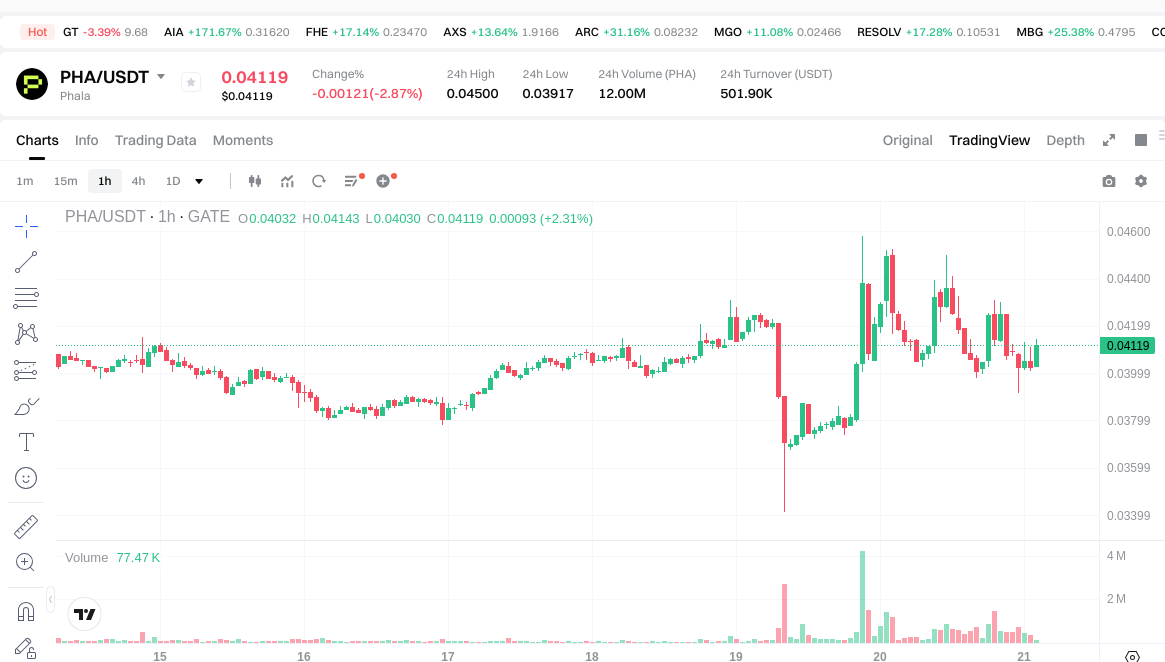
Current PHA Investment Market Status (January 2026)
- PHA current price: $0.04117
- Market sentiment (Fear & Greed Index): Data not available in provided materials
- 24-hour trading volume: $501,141.38
- Institutional investor holdings: Data not available in provided materials
Click to view real-time PHA market price
II. Core Factors Affecting Whether PHA is a Good Investment (Is Phala(PHA) a Good Investment)
Supply Mechanism and Scarcity (PHA investment scarcity)
- Fixed supply mechanism → Impacts price and investment value
- PHA has a maximum supply of 1,000,000,000 tokens, with current circulating supply of approximately 825,759,133 tokens (82.58% of total supply)
- Historical patterns: Supply dynamics have influenced PHA price movements, with the token reaching $1.39 on May 15, 2021
- Investment significance: The controlled supply structure serves as a fundamental element supporting long-term investment considerations
Institutional Investment and Mainstream Adoption (Institutional investment in PHA)
- Current holder base: Approximately 26,348 holders as of January 21, 2026
- Exchange presence: Listed on 29 exchanges, indicating accessibility for institutional participants
- Market capitalization: $33,996,503.51 with a market dominance of 0.0012%
- Gate.com listing status: Available for trading on Gate.com platform
Macroeconomic Environment's Impact on PHA Investment
- Monetary policy and interest rate changes → Alter investment attractiveness across risk assets
- Market volatility: PHA experienced -4.53% change in 24 hours and -83.67% decline over one year, reflecting broader crypto market sensitivity
- Trading volume: 24-hour trading volume of $501,141.38 indicates current market liquidity levels
- Price range fluctuation: Trading between $0.03917 and $0.045 within 24 hours demonstrates market volatility characteristics
Technology and Ecosystem Development (Technology & Ecosystem for PHA investment)
- Substrate-based development: Built on Substrate framework for Polkadot ecosystem integration
- TEE blockchain architecture: Implements confidential smart contracts through Trusted Execution Environment technology
- Privacy computing infrastructure: Provides privacy computing services for the Polkadot ecosystem
- Economic incentive model: Utilizes PoW-like economic incentive structure to release privacy computing power from CPUs
- Application ecosystem: pLibra and Web3 Analytics applications have received Web3 Foundation grants
- DeFi and data services: Infrastructure supports DeFi applications and data services within the Polkadot parallel chain ecosystem
- Contract-based data exchange: Offers standardized protocols for data collection, analysis, and trading
III. PHA Future Investment Forecast and Price Outlook (Is Phala(PHA) worth investing in 2026-2031)
Short-term Investment Forecast (2026, short-term PHA investment outlook)
- Conservative forecast: $0.0268 - $0.0380
- Neutral forecast: $0.0380 - $0.0412
- Optimistic forecast: $0.0412 - $0.0486
Mid-term Investment Outlook (2027-2028, mid-term Phala(PHA) investment forecast)
-
Market phase expectation: PHA may enter a gradual growth phase during 2027-2028, with potential price appreciation driven by broader adoption of privacy computing solutions within the Polkadot ecosystem and expanded application scenarios in DeFi and data services.
-
Investment return forecast:
- 2027: $0.0345 - $0.0538
- 2028: $0.0439 - $0.0607
-
Key catalysts: Expansion of privacy computing applications within Polkadot parachains, increased adoption of confidential smart contracts, and potential partnerships with DeFi protocols and data service providers.
Long-term Investment Outlook (Is PHA a good long-term investment?)
- Base scenario: $0.0401 - $0.0605 (assuming steady development of privacy computing infrastructure and moderate ecosystem growth)
- Optimistic scenario: $0.0550 - $0.0861 (assuming accelerated adoption of TEE-based solutions and favorable market conditions for privacy-focused projects)
- Risk scenario: $0.0268 - $0.0401 (under scenarios of limited ecosystem expansion or intensified competition in privacy computing sector)
View PHA long-term investment and price forecast: Price Prediction
2026-01-21 - 2031 Long-term Outlook
- Base scenario: $0.0400 - $0.0618 USD (corresponding to steady progress and gradual mainstream application growth)
- Optimistic scenario: $0.0550 - $0.0861 USD (corresponding to large-scale adoption and favorable market environment)
- Transformative scenario: Above $0.0861 USD (if ecosystem achieves breakthrough developments and mainstream popularization)
- 2031-12-31 predicted high: $0.0861 USD (based on optimistic development assumptions)
Disclaimer: The above forecasts are based on historical data and market analysis models. Cryptocurrency markets are highly volatile and subject to multiple risk factors. These predictions do not constitute investment advice, and investors should conduct thorough research and risk assessment before making investment decisions.
| Year |
Predicted High Price |
Predicted Average Price |
Predicted Low Price |
Price Change |
| 2026 |
0.0485688 |
0.04116 |
0.026754 |
0 |
| 2027 |
0.05383728 |
0.0448644 |
0.034545588 |
8 |
| 2028 |
0.0607015332 |
0.04935084 |
0.0439222476 |
19 |
| 2029 |
0.06052880526 |
0.0550261866 |
0.04126963995 |
33 |
| 2030 |
0.0618219206451 |
0.05777749593 |
0.0444886718661 |
40 |
| 2031 |
0.086111579934072 |
0.05979970828755 |
0.040065804552658 |
45 |
IV. Phala (PHA) Investment Strategy and Risk Management (How to invest in privacy computing tokens)
Investment Methodology (PHA investment strategy)
Long-term Holding (HODL PHA): Suitable for Conservative Investors
For investors seeking long-term exposure to privacy computing infrastructure within the Polkadot ecosystem, a buy-and-hold strategy may be considered. This approach involves acquiring PHA tokens and maintaining positions through market cycles, based on the belief in the long-term development of Web3.0 privacy protection infrastructure. Conservative investors might accumulate positions during periods of price consolidation, focusing on the project's technological development and ecosystem expansion rather than short-term price movements.
Active Trading: Relying on Technical Analysis and Swing Operations
Active traders may utilize technical indicators and chart patterns to identify entry and exit points. Given PHA's historical price volatility, swing trading strategies could involve monitoring support and resistance levels, volume patterns, and momentum indicators. Traders should note the token's 24-hour trading volume patterns and liquidity across the 29 exchanges where it is listed.
Risk Management (Risk management for PHA investment)
Asset Allocation Ratios: Conservative / Aggressive / Professional Investors
- Conservative Investors: May consider allocating a small percentage (1-3%) of their crypto portfolio to PHA, given its position as a mid-cap token (ranking #654) with relatively lower liquidity compared to major cryptocurrencies.
- Aggressive Investors: Could allocate 5-10% of their crypto portfolio, accepting higher volatility in exchange for potential upside in the privacy computing sector.
- Professional Investors: May take larger positions (10-15%) while implementing sophisticated hedging strategies and maintaining flexibility to adjust allocations based on market conditions and project developments.
Risk Hedging Solutions: Multi-asset Portfolio + Hedging Tools
Investors might consider diversifying across different sectors within the cryptocurrency market, including established assets alongside privacy-focused tokens. Portfolio construction could include:
- Combining PHA with other Polkadot ecosystem tokens to diversify parachain exposure
- Balancing with major cryptocurrencies to reduce overall portfolio volatility
- Considering stablecoin allocations for liquidity management
Secure Storage: Hot and Cold Wallets + Hardware Wallet Recommendations
Given that PHA is an ERC-20 token on the Ethereum network (contract address: 0x6c5ba91642f10282b576d91922ae6448c9d52f4e), investors should prioritize secure storage solutions:
- Hardware wallets supporting ERC-20 tokens for long-term holdings
- Cold storage solutions for the majority of holdings
- Hot wallets only for active trading amounts
- Regular security audits of wallet addresses and backup procedures
V. Phala (PHA) Investment Risks and Challenges (Risks of investing in privacy computing tokens)
Market Risk: High Volatility and Price Manipulation
PHA exhibits considerable price volatility, with 24-hour price fluctuations ranging from $0.03917 to $0.045. The token has experienced significant price swings, including a -4.53% change in the past 24 hours and a -83.67% decline over the past year. With a relatively modest 24-hour trading volume of approximately $501,141, the token may be susceptible to price volatility from large orders. The market capitalization to fully diluted valuation ratio of 82.58% indicates that a portion of the total supply remains unvested, which could create selling pressure as tokens are released.
Regulatory Risk: Policy Uncertainty Across Different Countries
As a privacy-focused blockchain infrastructure project, Phala Network may face heightened regulatory scrutiny in jurisdictions implementing stricter privacy and data protection regulations. The evolving regulatory landscape for privacy coins and confidential computing solutions varies significantly across regions, creating uncertainty for long-term investment prospects. Changes in regulatory frameworks governing TEE (Trusted Execution Environment) technology, confidential smart contracts, or privacy-preserving computation could impact the project's operational capabilities and market adoption.
Technical Risk: Network Security Vulnerabilities and Upgrade Failures
As a blockchain platform utilizing TEE technology and operating as a Polkadot parachain, Phala Network faces several technical risks:
- Potential vulnerabilities in the TEE implementation or secure enclave technology
- Smart contract risks associated with confidential computation protocols
- Dependencies on the Polkadot relay chain infrastructure and parachain slot renewals
- Challenges in maintaining network security as the distributed computation network scales
- Risks associated with protocol upgrades and potential compatibility issues
VI. Conclusion: Is Privacy Computing Infrastructure a Good Investment?
Investment Value Summary
Phala (PHA) represents exposure to the privacy computing infrastructure sector within the Polkadot ecosystem. The project addresses specific technical needs for confidential computation in Web3.0 applications. However, investors should note the token's significant price volatility, with substantial declines observed over longer time horizons. The circulating supply represents 82.58% of the maximum supply of 1 billion tokens, with approximately 26,348 holders.
Investor Recommendations:
✅ Beginners: Consider dollar-cost averaging with small allocations + secure wallet storage. Start with minimal exposure to understand the privacy computing sector before increasing position sizes.
✅ Experienced Investors: Implement swing trading strategies + portfolio allocation within a diversified cryptocurrency portfolio. Monitor Polkadot ecosystem developments and privacy computing sector trends.
✅ Institutional Investors: Evaluate strategic long-term allocation as part of a broader Web3.0 infrastructure thesis, with appropriate risk management frameworks and compliance considerations.
⚠️ Disclaimer: Cryptocurrency investments carry substantial risk and volatility. This content is for informational purposes only and does not constitute investment advice. Investors should conduct their own research and consult with financial advisors before making investment decisions.
VII. FAQ
Q1: What is the primary use case of PHA tokens within the Phala Network ecosystem?
PHA serves multiple functions including purchasing trusted computing resources, facilitating data exchange, securing network operations through staking, and enabling governance participation through Phala DAO. As the native token of Phala Network, PHA operates as the economic foundation for the privacy computing infrastructure within the Polkadot ecosystem. Token holders can stake PHA to secure the network and earn rewards, while developers and users utilize PHA to access confidential computing resources powered by Trusted Execution Environment (TEE) technology.
Q2: How does Phala Network's TEE technology differentiate it from other privacy-focused blockchain projects?
Phala Network implements Trusted Execution Environment (TEE) technology to enable confidential smart contracts, offering hardware-based security guarantees for private computation. Unlike cryptographic privacy solutions that rely solely on software-based encryption, TEE provides a secure enclave within CPU hardware where sensitive data can be processed without exposure to the operating system or other applications. This approach allows Phala to offer privacy-preserving computation services for DeFi applications and data services within the Polkadot parachain ecosystem, creating a distinct technical architecture compared to zero-knowledge proof or secure multi-party computation solutions.
Q3: What factors contributed to PHA's significant price decline from its 2021 peak?
PHA experienced an -83.67% decline over the past year, with the token trading at approximately $0.04117 as of January 2026, substantially below its May 2021 peak of $1.39. Multiple factors contributed to this price movement, including the broader cryptocurrency market correction following the 2021 bull market, reduced trading volumes (24-hour volume of approximately $501,141), and general market sentiment shifts away from altcoin projects. Additionally, the privacy computing sector has faced competition from alternative solutions, and the token's relatively modest market capitalization of $33.99 million makes it susceptible to volatility from large orders or selling pressure.
Q4: How does Phala Network's integration with the Polkadot ecosystem impact PHA's investment outlook?
Phala operates as a privacy computing parachain within the Polkadot ecosystem, built on the Substrate framework for seamless integration with other parachains. This positioning provides both opportunities and dependencies: Phala can serve as privacy infrastructure for other Polkadot projects, potentially driving demand for PHA tokens as the ecosystem grows. However, the project's success is partially tied to Polkadot's overall adoption and the renewal of parachain slots. The integration enables Phala to leverage Polkadot's security model and cross-chain communication capabilities, but also creates technical dependencies on the relay chain infrastructure.
Q5: What are the key risks investors should consider before allocating capital to PHA?
Investors should evaluate several risk dimensions: (1) Market risk - PHA exhibits high volatility with 24-hour fluctuations and limited liquidity relative to major cryptocurrencies; (2) Regulatory risk - privacy-focused infrastructure may face heightened scrutiny as jurisdictions implement data protection regulations; (3) Technical risk - dependencies on TEE technology, Polkadot infrastructure, and smart contract security create potential vulnerabilities; (4) Competition risk - the privacy computing sector includes alternative solutions using different technological approaches; (5) Supply risk - with 82.58% of the 1 billion total supply already circulating, remaining token releases could create selling pressure. The token's ranking at #654 by market capitalization indicates relatively limited mainstream adoption compared to established cryptocurrencies.
Q6: How can investors implement appropriate position sizing for PHA investments?
Position sizing should reflect individual risk tolerance and investment objectives. Conservative investors might consider allocating 1-3% of their cryptocurrency portfolio to PHA, recognizing its mid-cap status and lower liquidity profile. Aggressive investors could allocate 5-10%, accepting higher volatility in exchange for potential upside in the privacy computing sector. Professional investors may take 10-15% positions while implementing hedging strategies. Regardless of allocation size, investors should employ dollar-cost averaging during accumulation phases, maintain secure storage through hardware wallets supporting ERC-20 tokens, and regularly rebalance positions based on portfolio performance and changing market conditions.
Q7: What milestones or developments could positively impact PHA's price trajectory?
Several catalysts could drive price appreciation: (1) Expansion of privacy computing applications within Polkadot parachains and increased adoption of confidential smart contracts; (2) Strategic partnerships with DeFi protocols and data service providers requiring privacy-preserving infrastructure; (3) Technical upgrades enhancing TEE implementation or expanding computation capabilities; (4) Growing demand for Web3.0 privacy solutions as regulatory frameworks evolve; (5) Successful parachain slot renewals and deeper integration with the Polkadot ecosystem; (6) Increased institutional adoption of privacy computing infrastructure. However, investors should note that price forecasts range from conservative estimates of $0.0268-$0.0605 to optimistic scenarios of $0.0550-$0.0861 by 2031, with actual outcomes dependent on multiple execution and market factors.
Q8: What security measures should PHA token holders implement for asset protection?
Given PHA's status as an ERC-20 token (contract address: 0x6c5ba91642f10282b576d91922ae6448c9d52f4e), investors should prioritize comprehensive security protocols. Long-term holdings should be stored in hardware wallets supporting ERC-20 tokens, with cold storage solutions for the majority of positions. Hot wallets should only contain amounts designated for active trading. Investors should implement regular security audits of wallet addresses, maintain secure backup procedures for recovery phrases, and verify contract addresses before transactions. Additionally, when utilizing PHA for staking or governance participation, investors should assess the security credentials of validator nodes and governance platforms to minimize exposure to smart contract vulnerabilities or malicious actors.
* The information is not intended to be and does not constitute financial advice or any other recommendation of any sort offered or endorsed by Gate.