This comprehensive analysis examines whether Yala (YALA) represents a viable cryptocurrency investment opportunity in 2026. YALA is a Bitcoin-based asset protocol launched in 2025, currently trading at $0.01516 with a market capitalization of $3.73 million. The article evaluates YALA's investment potential through multiple dimensions: price history showing significant volatility (down 66.14% from launch), supply mechanics with only 24.64% of tokens circulating, and ecosystem development as a Bitcoin-collateralized stablecoin facilitating DeFi integration. Price projections range from conservative to optimistic scenarios through 2031, with considerations for market adoption and regulatory factors. The analysis details investment strategies for different investor profiles—conservative HODL approaches, moderate portfolio allocations, and active trading tactics—alongside essential risk management techniques. Critical investment risks include market volatility, regulatory uncertainty, technical vulnerabilities acr
Introduction: Yala (YALA) Investment Position and Market Outlook
Yala (YALA) represents a notable asset in the cryptocurrency sector, launched in 2025 with a focus on enhancing Bitcoin liquidity through its Bitcoin-collateralized stablecoin protocol. As of January 30, 2026, YALA maintains a market capitalization of approximately $3.73 million, with a circulating supply of 246.36 million tokens and a current price around $0.01516. Positioned as a Bitcoin-based asset protocol that facilitates DeFi integration, YALA has attracted attention from investors evaluating "Is Yala (YALA) a good investment?" This article provides a comprehensive analysis of YALA's investment characteristics, historical price movements, future price projections, and associated risks to offer reference points for potential investors.
The token is deployed across multiple blockchain networks including Ethereum (ETH) and Binance Smart Chain (BSC) using ERC20 and BEP20 standards, with contract address 0xf970706063b7853877f39515c96932d49d5ac9cd. Currently ranked #1692 by market capitalization, YALA holds approximately 0.00050% market dominance with a fully diluted valuation of $15.16 million. The token is listed on 8 exchanges and has attracted 3,321 holders since its launch at $0.25.
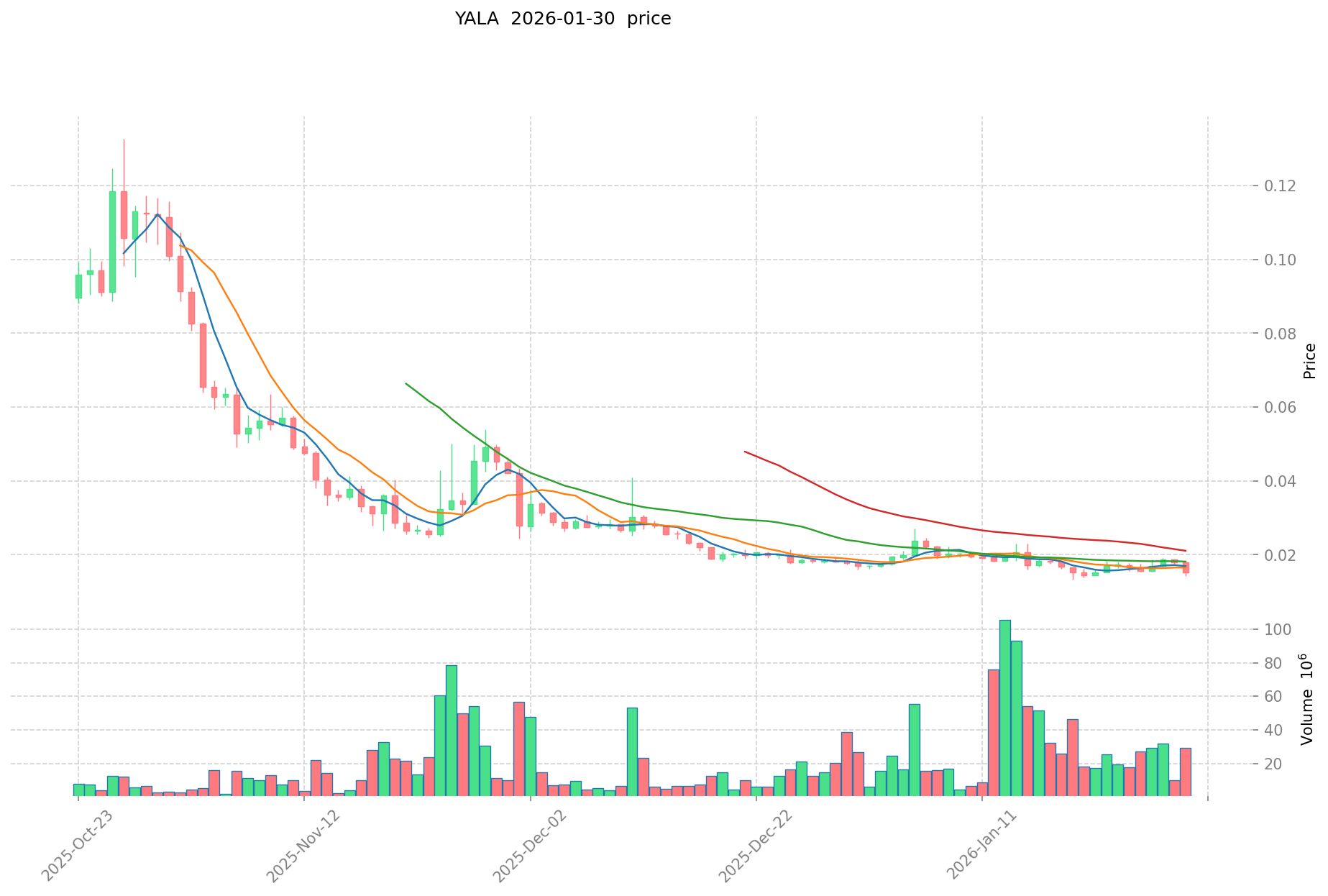
Recent price performance shows volatility, with declines of 0.21% over 1 hour, 15.42% over 24 hours, 10.73% over 7 days, and 15.4% over 30 days. The token's price trajectory from its August 8, 2025 peak of $0.4628 to its January 19, 2026 low of $0.01322 reflects broader market dynamics. With 24.64% of maximum supply currently in circulation and $483,688 in 24-hour trading volume, YALA presents a case study in emerging DeFi infrastructure tokens.
I. Yala (YALA) Price History Review and Current Investment Value
- 2025: Token launched in February with an initial offering price of $0.25, followed by significant price volatility throughout the year → early investors experienced notable fluctuations in returns
- 2025 August: Price reached a peak of $0.4628 during the summer period → YALA showed upward momentum amid market activities
- 2026 January: Market correction brought the price down to approximately $0.01322 → reflecting broader market adjustments and trading dynamics
Current YALA Investment Market Status (January 2026)
- YALA current price: $0.01516
- 24-hour trading volume: $483,688.18
- Market capitalization: $3,734,817.60
- Circulating supply: 246,360,000 YALA (24.64% of total supply)
- Total supply: 1,000,000,000 YALA
- Holder count: 3,321 addresses
Click to view real-time YALA market price
II. Core Factors Influencing Whether YALA is a Good Investment
Supply Mechanism and Scarcity (YALA investment scarcity)
- Supply Structure → Impacts price and investment value
- Maximum supply: 1,000,000,000 YALA
- Current circulating supply: 246,360,000 YALA
- Circulation ratio: 24.64%
- Investment Significance: The controlled supply mechanism represents a foundational element for evaluating long-term investment potential, with approximately 75% of tokens yet to enter circulation
Institutional Investment and Mainstream Adoption (Institutional investment in YALA)
- Holder Distribution Trends: As of January 2026, YALA has 3,321 holders
- Exchange Accessibility: Listed on 8 exchanges, with availability on Gate.com
- Liquidity Metrics: 24-hour trading volume of $483,688.18, indicating active market participation
Macroeconomic Environment Impact on YALA Investment
- Market Position: Market capitalization of $3,734,817.60 with market dominance of 0.00050%
- Price Volatility: YALA has experienced notable price fluctuations, with 24-hour changes of -15.42% and 7-day changes of -10.73%
- Historical Performance Context: Price has declined 66.14% over one year, reflecting broader market dynamics
Technology and Ecosystem Development (Technology & Ecosystem for YALA investment)
- Protocol Foundation: Yala operates as a Bitcoin-based asset protocol designed to enhance Bitcoin liquidity across multiple ecosystems through $YU, a Bitcoin-collateralized stablecoin pegged to the U.S. dollar
- DeFi Integration: The protocol facilitates Bitcoin's integration into the broader decentralized finance landscape, enabling various yield-generating opportunities while maintaining capital efficiency
- Multi-Chain Deployment: Token contracts deployed on both Ethereum (ETH) and Binance Smart Chain (BSC) networks, supporting ERC20 and BEP20 standards
- Documentation and Community: Project maintains technical documentation at docs.yala.org and community engagement through Discord channels
III. YALA Future Investment Prediction and Price Outlook (Is Yala(YALA) worth investing in 2026-2031)
Short-term Investment Prediction (2026, short-term YALA investment outlook)
- Conservative Prediction: $0.010591 - $0.01513
- Neutral Prediction: $0.01513 - $0.018156
- Optimistic Prediction: $0.018156 - $0.021182
Mid-term Investment Outlook (2027-2028, mid-term Yala(YALA) investment forecast)
- Market Stage Expectation: Gradual growth phase with potential market expansion as the protocol enhances Bitcoin liquidity across DeFi ecosystems
- Investment Return Prediction:
- 2027: $0.01071204 - $0.02233188
- 2028: $0.0103244094 - $0.0299610312
- Key Catalysts: Integration progress of Bitcoin-collateralized stablecoin $YU into broader DeFi platforms, capital efficiency improvements, and yield-generating opportunities expansion
Long-term Investment Outlook (Is YALA a good long-term investment?)
- Base Scenario: $0.021588137616 - $0.036147579264 (assuming steady protocol development and moderate market adoption through 2029)
- Optimistic Scenario: $0.0290937808104 - $0.048173176015536 (assuming accelerated Bitcoin DeFi integration and favorable regulatory environment through 2031)
- Risk Scenario: Below $0.010591 (under extreme market downturns or significant protocol challenges)
Click to view YALA long-term investment and price prediction: Price Prediction
2026-01-30 - 2031 Long-term Outlook
- Base Scenario: $0.018156 - $0.030625032432 (corresponding to steady progress and gradual mainstream application growth)
- Optimistic Scenario: $0.0299610312 - $0.048173176015536 (corresponding to large-scale adoption and favorable market conditions)
- Transformative Scenario: Above $0.048173176015536 (if ecosystem achieves breakthrough progress and mainstream popularization)
- 2031-12-31 Predicted High: $0.048173176015536 (based on optimistic development assumptions)
Disclaimer: Price predictions are based on historical data analysis and market models. Cryptocurrency investments carry substantial risks, and actual prices may differ significantly from predictions due to market volatility, regulatory changes, and other unforeseen factors. This information does not constitute investment advice.
| Year |
Predicted High Price |
Predicted Average Price |
Predicted Low Price |
Price Change |
| 2026 |
0.021182 |
0.01513 |
0.010591 |
0 |
| 2027 |
0.02233188 |
0.018156 |
0.01071204 |
19 |
| 2028 |
0.0299610312 |
0.02024394 |
0.0103244094 |
33 |
| 2029 |
0.036147579264 |
0.0251024856 |
0.021588137616 |
65 |
| 2030 |
0.0367500389184 |
0.030625032432 |
0.0290937808104 |
102 |
| 2031 |
0.048173176015536 |
0.0336875356752 |
0.02189689818888 |
122 |
IV. YALA Investment Strategy and Risk Management (How to invest in cryptocurrency)
Investment Methodology (YALA investment strategy)
-
Long-term Holding (HODL YALA): Suitable for conservative investors seeking to participate in Bitcoin-collateralized stablecoin ecosystem development over an extended period. This approach minimizes transaction costs and reduces exposure to short-term volatility.
-
Active Trading: Relies on technical analysis and swing trading strategies. Traders may monitor key support levels (such as the recent low of $0.01322) and resistance zones (24-hour high of $0.018292) to execute position entries and exits based on price momentum and volume patterns.
Risk Management (Risk management for YALA investment)
-
Asset Allocation Ratios:
- Conservative investors: Allocate 1-3% of crypto portfolio to YALA
- Moderate investors: Consider 3-7% allocation with active monitoring
- Aggressive investors: May allocate up to 10-15% while maintaining diversification
-
Risk Hedging Solutions: Implement multi-asset portfolio strategies combining Bitcoin, established stablecoins, and traditional defensive assets. Consider using dollar-cost averaging to mitigate entry point risk.
-
Secure Storage: Utilize cold wallet solutions for long-term holdings (hardware wallets such as Ledger or Trezor). Hot wallets may be appropriate for active trading portions with enhanced security protocols including two-factor authentication.
V. YALA Investment Risks and Challenges (Risks of investing in cryptocurrency)
-
Market Risk: YALA has demonstrated notable volatility, with a 15.42% decline over 24 hours and a 66.14% decrease over the past year from its launch price of $0.25. The token's market capitalization of approximately $3.73 million and relatively modest trading volume of $483,688 suggest liquidity constraints that may amplify price fluctuations.
-
Regulatory Risk: As a Bitcoin-collateralized stablecoin protocol, YALA operates in an evolving regulatory landscape. Different jurisdictions maintain varying approaches to crypto-collateralized stablecoins and DeFi protocols, creating potential compliance uncertainties that could affect operations and adoption.
-
Technical Risk: The protocol's reliance on smart contracts deployed across multiple chains (ETH and BSC based on contract addresses) introduces potential vulnerabilities including smart contract exploits, bridge security issues, and cross-chain operational complexities. Protocol upgrades and Bitcoin collateral management mechanisms require ongoing technical maintenance.
-
Project-Specific Risk: With a circulating supply of 246.36 million tokens (24.64% of maximum supply), future token unlocks could create selling pressure. The project's market share of 0.00050% and listing on 8 exchanges indicates limited market penetration relative to established stablecoin protocols.
VI. Conclusion: Is Cryptocurrency a Good Investment?
-
Investment Value Summary: YALA presents an innovative approach to Bitcoin liquidity through its collateralized stablecoin mechanism, potentially offering opportunities in the growing Bitcoin DeFi ecosystem. However, the token has experienced substantial price decline since launch, with current price of $0.01516 representing significant depreciation from its all-time high of $0.4628. The project's relatively small market capitalization and limited liquidity suggest higher risk exposure.
-
Investor Recommendations:
✅ Beginners: Consider small allocation through dollar-cost averaging approach, store assets in secure hardware wallets, and thoroughly understand the protocol's collateralization mechanism before investing.
✅ Experienced Investors: May explore swing trading opportunities based on technical indicators while maintaining strict position sizing discipline. Consider portfolio diversification across multiple stablecoin and DeFi protocols.
✅ Institutional Investors: Conduct comprehensive due diligence on collateral management, smart contract audits, and protocol governance before considering strategic allocation.
⚠️ Disclaimer: Cryptocurrency investments carry substantial risk including potential loss of principal. This content is for informational purposes only and does not constitute investment advice. Conduct thorough research and consider consulting financial professionals before making investment decisions.
VII. FAQ
Q1: What is Yala (YALA) and how does it generate investment value?
Yala is a Bitcoin-based asset protocol that enhances Bitcoin liquidity through $YU, a Bitcoin-collateralized stablecoin pegged to the U.S. dollar. The investment value proposition stems from its role in facilitating Bitcoin's integration into the broader DeFi ecosystem, enabling yield-generating opportunities while maintaining capital efficiency. The protocol is deployed across multiple blockchain networks including Ethereum (ETH) and Binance Smart Chain (BSC), with a maximum supply of 1 billion tokens and current market capitalization of approximately $3.73 million.
Q2: What is YALA's historical price performance since launch?
YALA launched in February 2025 at $0.25 and reached an all-time high of $0.4628 on August 8, 2025. However, the token has experienced significant correction, declining to a low of $0.01322 on January 19, 2026. As of January 30, 2026, YALA trades at approximately $0.01516, representing a 66.14% decrease from its launch price. Recent performance shows declines of 15.42% over 24 hours and 10.73% over 7 days, reflecting substantial volatility and broader market dynamics affecting emerging DeFi tokens.
Q3: What are the key risks associated with investing in YALA?
The primary risks include market risk evidenced by high volatility and 66.14% price decline over one year, regulatory risk due to evolving frameworks for crypto-collateralized stablecoins, technical risk from smart contract vulnerabilities across multi-chain deployments, and project-specific risk from limited market penetration (0.00050% market dominance) and potential selling pressure from token unlocks (only 24.64% of supply currently circulating). The relatively modest trading volume of $483,688 also indicates liquidity constraints that may amplify price fluctuations.
Q4: What is the long-term price prediction for YALA through 2031?
Conservative projections estimate YALA could reach $0.036147579264 by 2029 under steady protocol development scenarios, while optimistic scenarios project $0.048173176015536 by 2031 assuming accelerated Bitcoin DeFi integration and favorable market conditions. The 2026 short-term outlook ranges from $0.010591 to $0.021182 depending on market sentiment and adoption progress. However, these predictions carry substantial uncertainty given the token's current volatility and early-stage market position.
Q5: What investment strategies are recommended for YALA?
For conservative investors, a long-term holding (HODL) approach with 1-3% portfolio allocation is recommended, utilizing cold wallet storage for security. Moderate investors may consider 3-7% allocation with active monitoring of protocol development milestones. Active traders can employ technical analysis strategies monitoring key support levels ($0.01322) and resistance zones ($0.018292), while implementing dollar-cost averaging to mitigate entry point risk. All strategies should maintain strict position sizing discipline and portfolio diversification across multiple DeFi protocols.
Q6: How does YALA's liquidity and exchange accessibility affect investment potential?
YALA demonstrates limited liquidity with 24-hour trading volume of $483,688 and availability on 8 exchanges, including Gate.com. This modest liquidity profile compared to established stablecoins suggests potential challenges with large position entries or exits and increased susceptibility to price slippage. The holder count of 3,321 addresses indicates relatively limited adoption compared to mainstream DeFi protocols. These liquidity constraints present both risks through price volatility and potential opportunities if broader adoption materializes over time.
Q7: What role does token supply dynamics play in YALA's investment outlook?
With only 24.64% of maximum supply (246.36 million of 1 billion tokens) currently in circulation, YALA faces potential selling pressure from future token unlocks. This controlled supply mechanism represents a double-edged consideration: while restricted circulation may theoretically support price appreciation if demand grows, the substantial remaining supply could create downward pressure as tokens vest. Investors should monitor unlock schedules and distribution patterns when evaluating position timing and sizing decisions.
Q8: How should beginners approach YALA investment compared to experienced investors?
Beginners should start with minimal allocation (1-2% of crypto portfolio), employ dollar-cost averaging to reduce timing risk, store assets in hardware wallets (Ledger or Trezor), and thoroughly understand the Bitcoin-collateralization mechanism before investing. Experienced investors may explore swing trading opportunities using technical analysis while maintaining 3-7% allocation limits and implementing multi-asset hedging strategies. Both categories should prioritize comprehensive due diligence on smart contract audits, collateral management protocols, and ongoing protocol governance before committing capital to this early-stage DeFi infrastructure project.
* The information is not intended to be and does not constitute financial advice or any other recommendation of any sort offered or endorsed by Gate.