This comprehensive analysis compares POKT and LTC, two fundamentally different blockchain assets serving distinct market needs. POKT operates as decentralized infrastructure for Web3 applications, while LTC functions as an established payment-focused cryptocurrency since 2011. The comparison examines critical factors including historical price performance—POKT trading at $0.0115 versus LTC at $68.92—trading liquidity disparities, tokenomics structures, and institutional adoption patterns. Key findings reveal LTC's significantly higher liquidity ($4.4M daily volume versus POKT's $252K) and established regulatory framework, contrasting with POKT's higher growth potential in emerging infrastructure segments. Investment strategies vary by risk tolerance: conservative investors favor LTC's stability, while aggressive investors may consider POKT's exposure to Web3 development. Price projections through 2031 suggest modest growth for both assets, though POKT carries elevated volatility and execution risks. Check rea
Introduction: POKT vs LTC Investment Comparison
In the cryptocurrency market, the comparison between POKT and LTC has been a topic that investors cannot avoid. The two not only differ significantly in market cap ranking, application scenarios, and price performance, but also represent different positioning within the crypto asset landscape.
POKT (POKT): Launched in 2022, it has gained market recognition with its positioning as a decentralized blockchain API infrastructure for Web3 applications, transmitting data across blockchains through a network of thousands of nodes.
LTC (LTC): Since its launch in 2011, it has been hailed as digital silver and remains one of the cryptocurrencies with the highest trading volume and market capitalization globally.
This article will comprehensively analyze the investment value comparison between POKT and LTC around historical price trends, supply mechanisms, institutional adoption, technical ecosystems, and future forecasts, attempting to answer the question investors care about most:
"Which is the better buy right now?"
I. Historical Price Comparison and Current Market Status
Price Trends of POKT (Coin A) and LTC (Coin B)
- 2022: POKT reached a price peak around January 2022, corresponding to its all-time high of $3.11, reflecting early market enthusiasm for decentralized infrastructure protocols.
- 2021: LTC experienced significant price movement during the broader cryptocurrency market cycle, with its all-time high of $410.26 recorded in May 2021, driven by increased institutional interest and market-wide momentum.
- Comparative Analysis: Throughout the 2022-2025 market cycle, POKT declined from its peak of $3.11 to a low of $0.00883573 in April 2025, while LTC showed relative price resilience, maintaining a broader range between its historical high and its low point of $1.15 (recorded in January 2015).
Current Market Situation (2026-01-22)
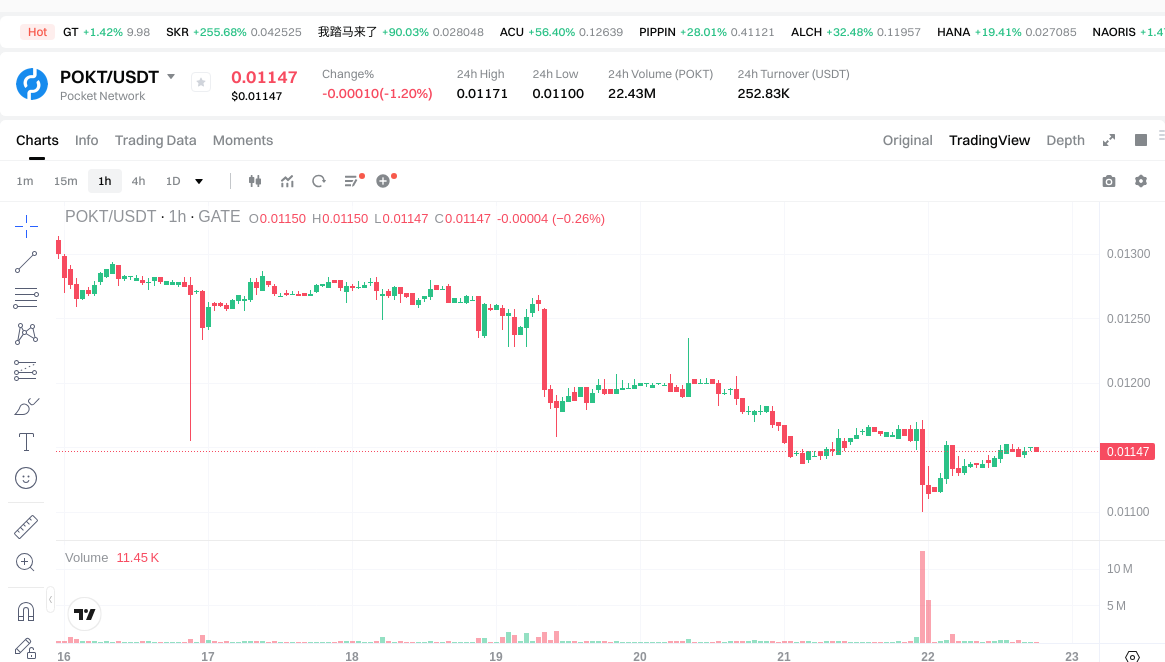
- POKT current price: $0.0115
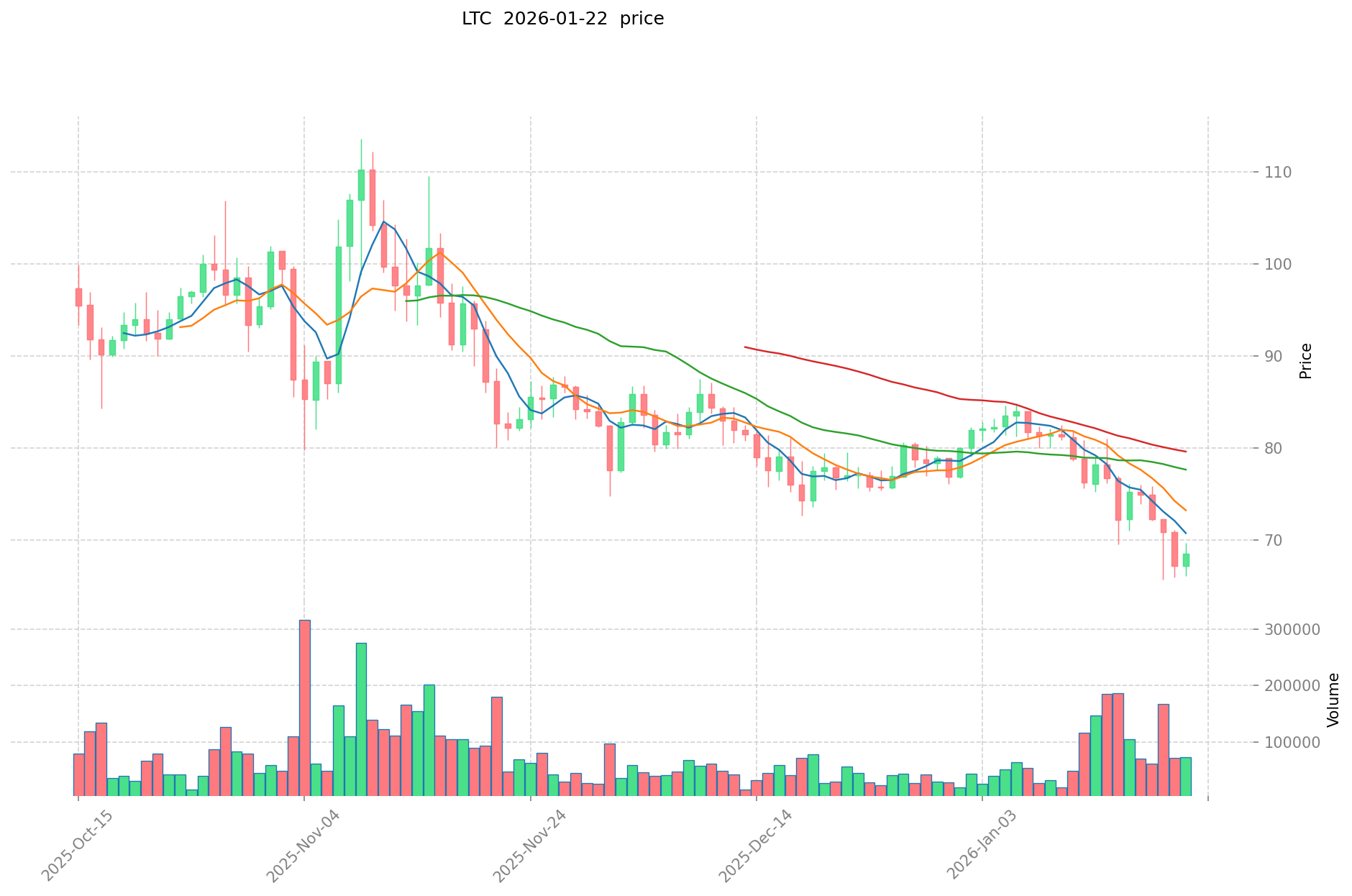
- LTC current price: $68.92
- 24-hour trading volume: POKT $252,849.20 vs LTC $4,441,556.21
- Market sentiment index (Fear & Greed Index): 20 (Extreme Fear)
View real-time prices:
II. Core Factors Affecting POKT vs LTC Investment Value
Supply Mechanism Comparison (Tokenomics)
-
POKT: The specific supply mechanism details are not available in the provided materials. General market observations suggest various cryptocurrency projects implement different emission schedules and staking reward structures.
-
LTC: Litecoin employs a halving mechanism similar to Bitcoin, where block rewards are reduced by half approximately every four years. This creates a predictable supply schedule that may influence long-term price dynamics.
-
📌 Historical Pattern: Supply mechanisms with programmed scarcity, such as halving events, have historically been associated with increased market attention and potential price appreciation cycles, though past performance does not guarantee future results.
Institutional Adoption and Market Application
-
Institutional Holdings: Current institutional preference data between POKT and LTC is not available in the reference materials.
-
Enterprise Adoption: Both assets serve different market segments. LTC has been utilized in payment processing and cross-border settlement scenarios by various merchants and payment providers. POKT's enterprise adoption in decentralized infrastructure remains an evolving area.
-
National Policy: Regulatory approaches vary by jurisdiction. LTC, as an established cryptocurrency, has received clearer regulatory treatment in multiple regions. Specific policy stances toward POKT are still developing in various markets.
Technical Development and Ecosystem Building
-
POKT Technical Upgrades: Specific recent technical upgrade information is not available in the provided materials.
-
LTC Technical Development: Litecoin continues to implement protocol improvements, including privacy features and scalability enhancements. These developments aim to maintain network efficiency and user functionality.
-
Ecosystem Comparison: LTC has established presence in payment systems and exchange integrations. Its application in DeFi remains limited compared to smart contract platforms. POKT focuses on decentralized infrastructure services, operating in a different ecosystem niche. Neither project has significant NFT ecosystem development.
Macroeconomic Factors and Market Cycles
-
Performance in Inflationary Environments: Cryptocurrencies with fixed or declining supply schedules are often discussed in the context of inflation hedging, though their actual performance varies significantly based on multiple market factors.
-
Macroeconomic Monetary Policy: Interest rate changes and U.S. dollar index movements typically affect cryptocurrency markets broadly. Higher interest rates may reduce speculative demand for digital assets, while dollar weakness sometimes correlates with increased cryptocurrency interest.
-
Geopolitical Factors: Cross-border transaction demand and international developments can influence cryptocurrency adoption patterns. Assets with established payment infrastructure may see increased utility during periods of financial system stress or capital control concerns.
III. 2026-2031 Price Projections: POKT vs LTC
Short-term Outlook (2026)
- POKT: Conservative $0.011155-$0.0115 | Optimistic $0.0115-$0.01334
- LTC: Conservative $61.33-$68.91 | Optimistic $68.91-$99.92
Mid-term Outlook (2028-2029)
- POKT may enter a gradual growth phase, with projected price range of $0.010808-$0.022166
- LTC may enter a consolidation and expansion phase, with projected price range of $68.90-$127.96
- Key drivers: institutional capital flows, ETF developments, ecosystem growth
Long-term Outlook (2030-2031)
- POKT: Baseline scenario $0.011300-$0.018833 | Optimistic scenario $0.018833-$0.027118
- LTC: Baseline scenario $98.63-$117.42 | Optimistic scenario $117.42-$156.57
View detailed price predictions for POKT and LTC
Disclaimer
POKT:
| Year |
Predicted High Price |
Predicted Average Price |
Predicted Low Price |
Price Change |
| 2026 |
0.01334 |
0.0115 |
0.011155 |
0 |
| 2027 |
0.0160218 |
0.01242 |
0.0072036 |
8 |
| 2028 |
0.016780662 |
0.0142209 |
0.010807884 |
23 |
| 2029 |
0.02216611683 |
0.015500781 |
0.01441572633 |
34 |
| 2030 |
0.0259901595027 |
0.018833448915 |
0.011300069349 |
63 |
| 2031 |
0.027118283092708 |
0.02241180420885 |
0.015688262946195 |
94 |
LTC:
| Year |
Predicted High Price |
Predicted Average Price |
Predicted Low Price |
Price Change |
| 2026 |
99.9195 |
68.91 |
61.3299 |
0 |
| 2027 |
94.54452 |
84.41475 |
48.1164075 |
22 |
| 2028 |
127.95587805 |
89.479635 |
68.89931895 |
29 |
| 2029 |
126.112597569 |
108.717756525 |
102.1946911335 |
57 |
| 2030 |
129.1566947517 |
117.415177047 |
98.62874871948 |
70 |
| 2031 |
156.5731385921745 |
123.28593589935 |
101.094467437467 |
78 |
IV. Investment Strategy Comparison: POKT vs LTC
Long-term vs Short-term Investment Strategies
-
POKT: May suit investors interested in emerging decentralized infrastructure protocols with higher risk tolerance. The asset's focus on Web3 API services positions it within the infrastructure layer of blockchain technology, though its relatively smaller market presence suggests higher volatility potential.
-
LTC: May appeal to investors seeking exposure to established cryptocurrency assets with longer operational history. Its positioning as a payment-focused cryptocurrency and broader market recognition could attract those prioritizing relative stability within the volatile digital asset space.
Risk Management and Asset Allocation
-
Conservative Investors: A potential allocation framework might consider LTC 70-80% vs POKT 20-30%, emphasizing the more established asset while maintaining limited exposure to emerging infrastructure protocols.
-
Aggressive Investors: A more growth-oriented allocation could involve POKT 40-50% vs LTC 50-60%, accepting higher volatility in pursuit of potential returns from early-stage infrastructure development.
-
Hedging Tools: Portfolio risk management may incorporate stablecoin positions for liquidity preservation, options contracts where available for downside protection, and cross-asset diversification to reduce concentration risk.
V. Potential Risk Comparison
Market Risk
-
POKT: Faces elevated market risk due to lower liquidity, with 24-hour trading volume of $252,849.20 as of January 22, 2026. The asset's smaller market presence may result in wider bid-ask spreads and increased price sensitivity to order flow. Additionally, its correlation with broader cryptocurrency market cycles could amplify volatility during market downturns.
-
LTC: While maintaining significantly higher liquidity with 24-hour volume of $4,441,556.21, LTC remains subject to cryptocurrency market cycles and sentiment shifts. The current Fear & Greed Index reading of 20 (Extreme Fear) indicates challenging market conditions that may affect price performance across the sector.
Technical Risk
-
POKT: Technical considerations include network scalability as adoption grows, node infrastructure stability, and the ongoing development of decentralized API services. The relatively newer protocol may face implementation challenges as it matures.
-
LTC: Potential concerns involve mining concentration patterns, network security maintenance, and competition from newer payment-focused protocols. As an established network, upgrade coordination across the validator community presents its own implementation considerations.
Regulatory Risk
- Global regulatory developments may affect POKT and LTC differently based on their distinct use cases. LTC's classification and treatment vary by jurisdiction, with established regulatory frameworks in some regions but evolving approaches in others. POKT's infrastructure-focused model may encounter different regulatory considerations as authorities develop frameworks for decentralized service protocols. Both assets remain subject to changing compliance requirements, tax treatment variations, and potential operational restrictions across different markets.
VI. Conclusion: Which Is the Better Buy?
📌 Investment Value Summary:
-
POKT Considerations: Exposure to decentralized infrastructure development, positioning within Web3 service layer, potential for ecosystem expansion as blockchain adoption grows. However, these come with higher volatility, lower liquidity, and execution challenges common to emerging protocols.
-
LTC Considerations: Longer operational track record since 2011, established payment infrastructure integration, broader exchange availability and trading liquidity. These attributes may offer relative stability within the cryptocurrency sector, though growth potential may differ from emerging protocols.
✅ Investment Considerations:
-
New Investors: May consider starting with more established assets like LTC while developing understanding of cryptocurrency market dynamics, technical fundamentals, and risk management practices. Limiting initial exposure and focusing on education could help build foundation for informed decision-making.
-
Experienced Investors: Could evaluate portfolio diversification across different cryptocurrency segments, considering both established payment-focused assets and emerging infrastructure protocols based on individual risk tolerance, investment timeline, and market outlook. Position sizing and rebalancing strategies may help manage exposure.
-
Institutional Investors: Might assess regulatory compliance requirements, custody solutions, liquidity depth, and correlation with existing portfolio holdings when evaluating allocation to either asset. Due diligence on governance structures, technical roadmaps, and market positioning could inform strategic decisions.
⚠️ Risk Disclosure: Cryptocurrency markets exhibit extreme volatility and substantial risk of loss. This content does not constitute investment advice, financial guidance, or trading recommendations. Investors should conduct independent research, consult qualified financial advisors, and only allocate capital they can afford to lose. Past performance does not indicate future results.
VII. FAQ
Q1: What is the main difference between POKT and LTC in terms of their core function?
POKT serves as decentralized blockchain API infrastructure for Web3 applications, while LTC functions primarily as a payment-focused cryptocurrency. POKT transmits data across blockchains through a network of thousands of nodes, positioning itself within the infrastructure layer of blockchain technology. In contrast, LTC has been operating since 2011 as "digital silver," focusing on payment processing, cross-border settlement, and merchant adoption. This fundamental difference means POKT targets developers and Web3 service providers, whereas LTC appeals to users seeking a medium of exchange and store of value.
Q2: How do the liquidity levels of POKT and LTC compare, and why does this matter for investors?
LTC demonstrates significantly higher liquidity with 24-hour trading volume of $4,441,556.21 compared to POKT's $252,849.20 as of January 22, 2026. This approximately 17.5x difference in trading volume has substantial implications for investors. Higher liquidity in LTC typically results in tighter bid-ask spreads, reduced slippage on larger orders, and easier entry/exit positions. POKT's lower liquidity may lead to wider spreads, increased price sensitivity to individual trades, and potential difficulty executing larger orders without significant price impact. For institutional investors or those trading substantial positions, liquidity considerations become critical risk factors.
Q3: What allocation strategy should conservative versus aggressive investors consider between POKT and LTC?
Conservative investors might consider a 70-80% LTC / 20-30% POKT allocation, emphasizing the more established asset while maintaining limited exposure to emerging infrastructure protocols. This approach prioritizes relative stability through LTC's longer operational history and broader market recognition. Aggressive investors could evaluate a more balanced 50-60% LTC / 40-50% POKT allocation, accepting higher volatility in pursuit of potential returns from early-stage infrastructure development. The key distinction lies in risk tolerance: conservative portfolios favor proven track records, while aggressive strategies embrace growth potential with corresponding uncertainty.
Q4: How have POKT and LTC performed from their all-time highs, and what does this indicate about their risk profiles?
POKT declined from its all-time high of $3.11 (around January 2022) to a low of $0.00883573 in April 2025, representing a drawdown of approximately 99.7%. LTC's all-time high of $410.26 (May 2021) compares to its historical low of $1.15 (January 2015), showing significantly smaller percentage decline from peak levels in recent cycles. Currently, POKT trades at $0.0115 (96.3% below ATH), while LTC trades at $68.92 (83.2% below ATH). These historical patterns suggest POKT exhibits higher volatility and drawdown risk, typical of emerging protocols, whereas LTC demonstrates relatively greater price resilience characteristic of established cryptocurrencies.
Q5: What regulatory considerations differentiate POKT and LTC for potential investors?
LTC benefits from clearer regulatory treatment in multiple jurisdictions due to its longer operational history since 2011 and established classification patterns. Many regions have developed specific frameworks addressing payment-focused cryptocurrencies like LTC, providing investors with greater regulatory certainty. POKT's infrastructure-focused model may encounter different regulatory considerations as authorities develop frameworks for decentralized service protocols. The evolving nature of Web3 infrastructure regulation introduces additional uncertainty. Both assets remain subject to changing compliance requirements, tax treatment variations, and potential operational restrictions, but LTC's regulatory pathway appears more established at present.
Q6: How do the supply mechanisms of POKT and LTC potentially affect their long-term value proposition?
LTC employs a Bitcoin-similar halving mechanism where block rewards reduce by half approximately every four years, creating a predictable supply schedule with programmed scarcity. This deflationary pressure has historically been associated with increased market attention during halving cycles, though past performance doesn't guarantee future results. POKT's specific supply mechanism details are not fully available in current materials, though various cryptocurrency projects implement different emission schedules and staking reward structures. For long-term investors, understanding supply dynamics becomes crucial: assets with programmed scarcity may appeal to those seeking inflation hedges, while those with ongoing emission may prioritize network security through sustained validator incentives.
Q7: What are the projected price ranges for POKT and LTC by 2030, and what factors could influence these outcomes?
According to baseline scenarios, POKT is projected to range between $0.011300-$0.018833 by 2030, while LTC could reach $98.63-$117.42 during the same period. Optimistic scenarios suggest POKT might extend to $0.027118 and LTC to $156.57. Key factors influencing these projections include institutional capital flows, potential ETF developments, ecosystem growth, macroeconomic monetary policy shifts, and broader cryptocurrency adoption patterns. However, these projections carry substantial uncertainty given the cryptocurrency market's extreme volatility, technological developments, regulatory changes, and macroeconomic conditions that remain difficult to forecast over multi-year horizons.
Q8: Given the current market sentiment of "Extreme Fear" (Fear & Greed Index: 20), how should this influence investment decisions between POKT and LTC?
The current Fear & Greed Index reading of 20 indicates "Extreme Fear" in cryptocurrency markets, suggesting widespread negative sentiment and potential capitulation. Historically, extreme fear periods have sometimes preceded market bottoms, though timing remains uncertain. For POKT, extreme fear conditions may exacerbate liquidity challenges and amplify volatility given its smaller market presence. LTC's higher liquidity may provide relatively better execution during fearful markets, though it remains fully exposed to sector-wide sentiment. Contrarian investors might view extreme fear as potential accumulation opportunity, while risk-averse participants may prefer waiting for sentiment stabilization. Regardless of approach, extreme fear environments demand strict risk management, position sizing discipline, and realistic assessment of further downside potential before capital deployment.
* The information is not intended to be and does not constitute financial advice or any other recommendation of any sort offered or endorsed by Gate.