This comprehensive analysis compares UMA and ICP, two innovative blockchain platforms with distinct market positioning. UMA operates as a decentralized financial contract platform enabling synthetic asset creation within the DeFi ecosystem, while ICP functions as a decentralized cloud blockchain for hosting applications and enterprise systems. The article examines historical price trends, tokenomics, institutional adoption, technological infrastructure, and risk profiles. Current market data and trading volumes reveal ICP's greater liquidity at $2.49M daily volume versus UMA's $26.34K. Through detailed investment strategy recommendations, price forecasts spanning 2026-2031, and risk assessments, this guide helps investors determine optimal allocation between DeFi innovation exposure (UMA) and blockchain infrastructure investment (ICP) based on individual risk tolerance and investment objectives.
Introduction: Investment Comparison Between UMA and ICP
In the cryptocurrency market, the comparison between UMA vs ICP has become a topic that investors cannot overlook. The two differ significantly in market cap ranking, application scenarios, and price performance, representing distinct positions within the crypto asset landscape.
UMA (UMA): Launched in 2020, it has gained market recognition as a decentralized financial contract platform that enables the creation of unique standardized products and promotes various financial innovations through its open-source protocol.
ICP (ICP): Introduced in 2019, Internet Computer has been positioned as a decentralized cloud blockchain that hosts secure applications, websites, and enterprise systems while enabling trustless multi-chain interactions and AI-driven application creation.
This article will provide a comprehensive analysis of the investment value comparison between UMA vs ICP, focusing on historical price trends, supply mechanisms, institutional adoption, technological ecosystems, and future predictions, attempting to address the question that investors care about most:
"Which is the better buy right now?"
I. Historical Price Comparison and Current Market Status
UMA and ICP Historical Price Trends
- 2021: UMA experienced significant price volatility, with its price reaching a peak of $41.56 in February 2021 during the broader cryptocurrency market surge.
- 2021: ICP launched in May 2021 with considerable market attention, achieving an all-time high of $700.65 shortly after its debut.
- Comparative Analysis: During the 2021-2025 market cycle, UMA declined from its historical high of $41.56 to a low of $0.303625 in April 2020, while ICP fell from $700.65 to $2.23 in October 2025, representing a more substantial percentage decline.
Current Market Status (January 18, 2026)
- UMA Current Price: $0.7776
- ICP Current Price: $3.982
- 24-Hour Trading Volume: UMA $26,342.59 vs ICP $2,487,091.53
- Market Sentiment Index (Fear & Greed Index): 49 (Neutral)
Click to view real-time prices:
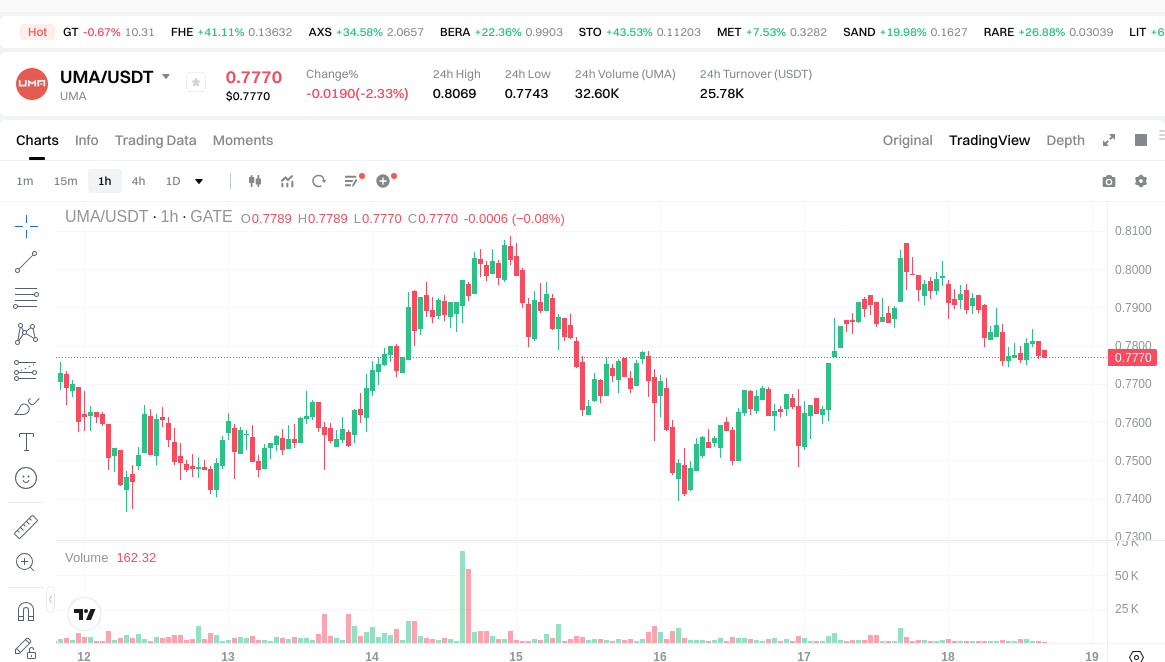
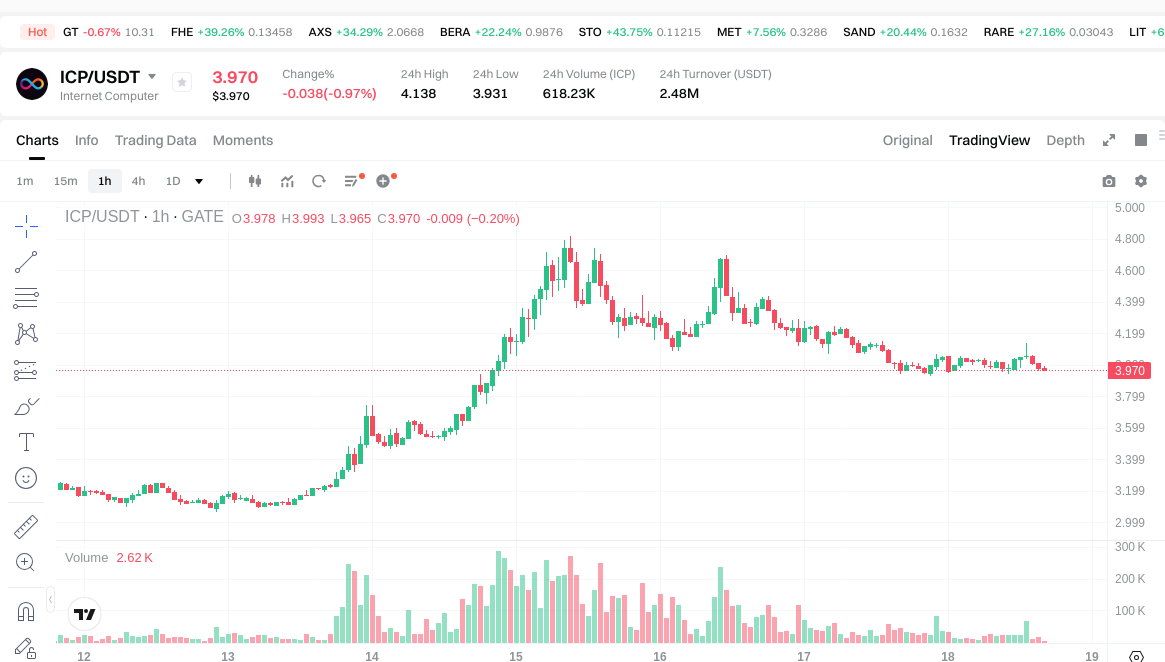
II. Core Factors Influencing UMA vs ICP Investment Value
Tokenomics Comparison
-
UMA: The protocol operates with a token model designed to facilitate synthetic asset creation and governance participation. UMA's core functionality enables users to create and trade synthetic assets through smart contracts, which can replicate real-world assets such as stocks, bonds, commodities, and indices.
-
ICP: The token supply mechanism is structured to support the decentralized prediction protocol's operational requirements and ecosystem development.
-
📌 Historical Pattern: Supply mechanisms play a role in shaping price cycles, with market adoption and ecosystem development serving as key determinants of token value trajectories.
Institutional Adoption and Market Application
-
Institutional Holdings: Market demand and technology innovation represent central factors in evaluating investment potential for both assets.
-
Enterprise Adoption: UMA's synthetic asset functionality has attracted attention from market participants seeking exposure to diverse asset classes through decentralized mechanisms. The protocol's application in creating customizable financial instruments demonstrates potential utility in the broader DeFi ecosystem.
-
Regulatory Landscape: Regulatory considerations remain relevant factors as jurisdictions continue to develop frameworks for decentralized financial protocols.
Technology Development and Ecosystem Building
-
UMA Technical Evolution: The protocol's decentralized prediction mechanism and smart contract infrastructure enable the creation of synthetic assets, contributing to its positioning within the DeFi landscape.
-
ICP Technical Development: The platform incorporates decentralized prediction mechanisms that support its operational framework.
-
Ecosystem Comparison: Both protocols operate within the broader DeFi infrastructure, with varying degrees of integration across different applications. Historical price trends and market adoption patterns serve as evaluation metrics for assessing ecosystem development progress.
Macroeconomic Environment and Market Cycles
-
Inflationary Context: Market conditions and macroeconomic factors influence the performance characteristics of digital assets, with varying degrees of correlation to traditional asset classes.
-
Monetary Policy Dynamics: Macroeconomic variables, including interest rate environments and currency strength indicators, contribute to shaping market sentiment and capital flows within the crypto asset space.
-
Geopolitical Considerations: Global economic uncertainties and cross-border transaction requirements represent contextual factors that may influence market dynamics for decentralized protocols.
III. 2026-2031 Price Forecast: UMA vs ICP
Short-term Forecast (2026)
- UMA: Conservative $0.53-$0.78 | Optimistic $0.78-$0.82
- ICP: Conservative $2.66-$3.97 | Optimistic $3.97-$4.20
Mid-term Forecast (2028-2029)
- UMA may enter a growth phase, with estimated price range of $0.52-$1.32
- ICP may enter an expansion phase, with estimated price range of $2.76-$6.85
- Key drivers: institutional capital inflows, ETF developments, ecosystem expansion
Long-term Forecast (2030-2031)
- UMA: Baseline scenario $0.63-$1.23 | Optimistic scenario $1.20-$1.77
- ICP: Baseline scenario $3.37-$6.82 | Optimistic scenario $6.53-$9.54
View detailed price predictions for UMA and ICP
Disclaimer
UMA:
| Year |
Predicted High Price |
Predicted Average Price |
Predicted Low Price |
Price Change |
| 2026 |
0.81585 |
0.777 |
0.52836 |
0 |
| 2027 |
0.91588875 |
0.796425 |
0.7167825 |
2 |
| 2028 |
1.16437335 |
0.856156875 |
0.52225569375 |
10 |
| 2029 |
1.323447297375 |
1.0102651125 |
0.939546554625 |
29 |
| 2030 |
1.225199015184375 |
1.1668562049375 |
0.653439474765 |
50 |
| 2031 |
1.770120862890187 |
1.196027610060937 |
0.633894633332296 |
53 |
ICP:
| Year |
Predicted High Price |
Predicted Average Price |
Predicted Low Price |
Price Change |
| 2026 |
4.2029 |
3.965 |
2.65655 |
0 |
| 2027 |
5.7583695 |
4.08395 |
3.022123 |
2 |
| 2028 |
6.397507675 |
4.92115975 |
2.75584946 |
23 |
| 2029 |
6.847793792125 |
5.6593337125 |
4.697246981375 |
42 |
| 2030 |
6.816384490020625 |
6.2535637523125 |
3.37692442624875 |
57 |
| 2031 |
9.541062216903181 |
6.534974121166562 |
3.72493524906494 |
64 |
IV. Investment Strategy Comparison: UMA vs ICP
Long-term vs Short-term Investment Strategies
- UMA: Suitable for investors focused on DeFi innovation and synthetic asset exposure, particularly those seeking participation in decentralized financial contract platforms with governance mechanisms.
- ICP: Suitable for investors interested in decentralized cloud infrastructure and blockchain-based application hosting, with focus on multi-chain interaction capabilities.
Risk Management and Asset Allocation
- Conservative Investors: UMA 30% vs ICP 70%
- Aggressive Investors: UMA 55% vs ICP 45%
- Hedging Tools: stablecoin allocation, options strategies, cross-asset portfolio diversification
V. Potential Risk Comparison
Market Risk
- UMA: Price volatility influenced by DeFi market cycles, with historical trading ranges demonstrating significant fluctuation patterns. Lower trading volume ($26,342.59) may contribute to liquidity considerations.
- ICP: Market performance subject to broader blockchain infrastructure adoption trends, with historical price movements showing correlation to platform development milestones. Higher trading volume ($2,487,091.53) indicates relatively greater market depth.
Technical Risk
- UMA: Scalability considerations related to synthetic asset creation mechanisms, network stability dependent on underlying smart contract infrastructure.
- ICP: Platform complexity associated with decentralized cloud architecture, technical implementation challenges related to multi-chain interaction frameworks.
Regulatory Risk
- Global regulatory frameworks continue to evolve for decentralized financial protocols and blockchain infrastructure platforms, with varying approaches across jurisdictions that may influence operational parameters and market accessibility for both assets.
VI. Conclusion: Which Is the Better Buy?
📌 Investment Value Summary:
- UMA Advantages: Established presence in synthetic asset creation space, governance participation mechanisms, positioning within DeFi ecosystem infrastructure.
- ICP Advantages: Decentralized cloud blockchain architecture, multi-chain interaction capabilities, enterprise application hosting potential.
✅ Investment Recommendations:
- Novice Investors: Consider starting with smaller position allocations across both assets, prioritizing understanding of underlying protocol mechanics and market dynamics before increasing exposure.
- Experienced Investors: Evaluate portfolio positioning based on exposure to DeFi protocols versus blockchain infrastructure, considering correlation factors and diversification objectives.
- Institutional Investors: Assess strategic alignment with synthetic asset exposure versus decentralized cloud infrastructure, incorporating due diligence on technical architecture, ecosystem development trajectories, and regulatory landscape considerations.
⚠️ Risk Disclosure: The cryptocurrency market exhibits high volatility characteristics. This content does not constitute investment advice.
VII. FAQ
Q1: What are the main differences between UMA and ICP's use cases?
UMA functions primarily as a decentralized financial contract platform enabling synthetic asset creation, while ICP operates as a decentralized cloud blockchain for hosting applications and enterprise systems. UMA focuses on DeFi innovation through customizable financial instruments that replicate real-world assets like stocks, bonds, and commodities. In contrast, ICP emphasizes blockchain infrastructure, supporting secure application hosting, multi-chain interactions, and AI-driven application development. These distinct technological focuses result in different market positioning and adoption patterns.
Q2: Which asset has experienced greater price volatility historically?
ICP has demonstrated more substantial price volatility in percentage terms. Following its May 2021 launch at an all-time high of $700.65, ICP declined to $2.23 by October 2025, representing a decline of approximately 99.7%. UMA, which reached its peak of $41.56 in February 2021, fell to $0.303625 in April 2020, representing a smaller percentage decline. Current trading volumes also reflect this difference, with ICP's 24-hour volume at $2,487,091.53 significantly exceeding UMA's $26,342.59, indicating greater market depth but also potentially higher volatility exposure.
Q3: What are the price predictions for UMA and ICP through 2031?
Short-term forecasts for 2026 suggest UMA trading between $0.53-$0.82, while ICP ranges from $2.66-$4.20. Mid-term projections (2028-2029) estimate UMA reaching $0.52-$1.32 and ICP achieving $2.76-$6.85. Long-term predictions for 2030-2031 project UMA between $0.63-$1.77 and ICP ranging from $3.37-$9.54 under various scenarios. These forecasts assume continued ecosystem development, institutional adoption, and favorable macroeconomic conditions. However, the cryptocurrency market's inherent volatility means actual outcomes may differ significantly from projections.
Q4: How should investors allocate between UMA and ICP based on risk tolerance?
Conservative investors seeking lower risk exposure might consider a 30% UMA / 70% ICP allocation, leveraging ICP's relatively higher market depth and established infrastructure positioning. Aggressive investors with higher risk tolerance could adopt a 55% UMA / 45% ICP ratio, capitalizing on UMA's DeFi innovation potential and synthetic asset exposure. Both strategies should incorporate stablecoin allocations, options strategies, and cross-asset diversification to manage downside risk. Portfolio allocation should align with individual investment objectives, time horizons, and understanding of each protocol's technical architecture.
Q5: What are the key risks associated with investing in UMA versus ICP?
UMA's primary risks include DeFi market cycle exposure, lower liquidity evidenced by smaller trading volumes, scalability considerations for synthetic asset mechanisms, and smart contract infrastructure dependencies. ICP faces challenges related to blockchain infrastructure adoption trends, platform complexity associated with decentralized cloud architecture, technical implementation hurdles for multi-chain interactions, and correlation to broader platform development milestones. Both assets are subject to evolving global regulatory frameworks for decentralized protocols, which vary significantly across jurisdictions and may impact operational parameters and market accessibility.
Q6: Which asset is more suitable for institutional investors?
The choice depends on institutional investment mandates and strategic objectives. UMA aligns with institutions seeking DeFi protocol exposure, synthetic asset capabilities, and governance participation mechanisms within the decentralized finance ecosystem. ICP suits institutions focusing on blockchain infrastructure investments, decentralized cloud computing exposure, and enterprise application hosting potential. Institutional investors should conduct comprehensive due diligence on technical architecture, ecosystem development trajectories, regulatory compliance frameworks, and correlation factors within existing portfolio holdings before allocation decisions.
Q7: How do macroeconomic conditions affect UMA and ICP differently?
Both assets exhibit correlation to broader cryptocurrency market cycles, but their sensitivity to macroeconomic variables differs based on use case positioning. UMA's performance ties closely to DeFi sector dynamics, synthetic asset demand, and decentralized financial innovation adoption, making it potentially more responsive to interest rate environments affecting leveraged positions. ICP's valuation connects to enterprise blockchain adoption trends, cloud computing infrastructure demand, and technological innovation cycles, potentially showing correlation to technology sector performance. Monetary policy dynamics, inflationary contexts, and geopolitical considerations influence both assets through capital flows and risk sentiment in the crypto asset space.
Q8: What factors should novice investors prioritize when choosing between UMA and ICP?
Novice investors should begin by understanding each protocol's core functionality—UMA's synthetic asset creation mechanisms versus ICP's decentralized cloud infrastructure. Start with smaller position allocations to limit downside exposure while gaining practical market experience. Prioritize learning about tokenomics, governance structures, and ecosystem development progress before increasing investment size. Consider liquidity differences, with ICP's higher trading volume potentially offering easier entry and exit points. Evaluate personal interest alignment with DeFi innovation (UMA) versus blockchain infrastructure (ICP), as sustained engagement requires understanding of underlying technology and market dynamics. Implement risk management through diversification and avoid concentration in single assets.
* The information is not intended to be and does not constitute financial advice or any other recommendation of any sort offered or endorsed by Gate.