Bitlayer (BTR) is a Bitcoin Layer 2 solution launched by Bitlayer Labs in 2024, representing the first BitVM implementation that addresses Bitcoin's scalability and DeFi limitations. As a utility token, BTR enables transactions, governance participation, and ecosystem rewards within Bitlayer's decentralized finance infrastructure, which combines Bitcoin's native security with high-throughput smart contract execution. As of January 2026, BTR demonstrates active market performance with 34,677 token holders and trading on Gate.com and 15 other exchanges, featuring a circulating supply of 261.6 million tokens against a 1 billion maximum cap. Backed by $30 million in funding from prominent investors including Polychain Capital and Franklin Templeton, Bitlayer is expanding its ecosystem through yield-bearing assets like YBTC and Bitcoin Rollup technology. Despite market volatility and competitive pressures, BTR's innovative technical architecture and strategic roadmap position it as foundational infrastructure for
Bitlayer's Positioning and Significance
In 2024, Bitlayer Labs launched Bitlayer (BTR), aiming to address limitations in Bitcoin's native DeFi capabilities and cross-chain interoperability challenges.
As the first BitVM implementation, Bitlayer plays a critical role in Bitcoin DeFi and Layer 2 scalability.
As of 2026, Bitlayer has established itself as a key infrastructure provider in the Bitcoin ecosystem, with 34,677 holders and an active development community.
This article will provide an in-depth analysis of its technical architecture, market performance, and future potential.
Origin and Development History
Background
Bitlayer was created by Bitlayer Labs in 2024, aiming to solve Bitcoin's scalability constraints and limited smart contract functionality.
It emerged during the growing demand for Bitcoin-native DeFi solutions, with the goal of unlocking Bitcoin's full potential through trust-minimized bridging and high-throughput execution to transform the landscape.
Bitlayer's launch brought new possibilities to Bitcoin users and DeFi developers.
Key Milestones
- 2024: Mainnet launch, achieving BitVM-based trust-minimized bridging and high-performance smart contract execution.
- 2025: Token (BTR) listing on exchanges including Gate.com on April 26, 2025.
- 2024-2025: Secured $30 million in total funding from prominent investors including Polychain Capital, Franklin Templeton, Framework, ABCDE, StarkWare, and Alliance.
- Ongoing: Ecosystem expansion with development of yield-bearing asset YBTC and Bitcoin Rollup infrastructure.
With support from leading venture capital firms and the Bitcoin developer community, Bitlayer continues to enhance its technology, security, and real-world applications.
How Bitlayer Works
Decentralized Architecture
Bitlayer operates on Bitcoin's native security architecture through a decentralized network of nodes, eliminating reliance on centralized intermediaries.
These nodes collaborate to validate transactions and maintain system integrity, ensuring transparency and attack resistance while granting users greater autonomy and enhancing network resilience.
Blockchain Foundation
Bitlayer's infrastructure is built as a Bitcoin Layer 2 solution, utilizing a public and immutable digital ledger to record transactions.
Transactions are processed through the BitVM framework, enabling complex computations while maintaining Bitcoin-level security.
Anyone can verify records without intermediaries, establishing trust through cryptographic proofs.
Bitcoin Rollup technology further enhances performance by batching transactions off-chain while inheriting Bitcoin's security guarantees.
Security Model
Bitlayer employs trust-minimized bridging mechanisms to ensure secure cross-chain operations and prevent fraudulent activities such as double-spending.
Validators and bridge operators maintain network security through transaction verification and BitVM proof generation, while users can interact with smart contracts on the platform.
Its innovation includes combining Bitcoin's security with high-throughput execution capabilities.
Secure Transactions
Bitlayer utilizes cryptographic techniques to protect transactions:
- Private keys (similar to secret passwords) are used to sign transactions
- Public keys (similar to account numbers) are used to verify ownership
This mechanism ensures fund security while maintaining pseudonymous transaction privacy.
The platform incorporates BitVM's verification framework and cross-chain bridge protocols to provide additional security layers for asset transfers and smart contract interactions.
Circulation Overview
As of January 24, 2026, Bitlayer's circulating supply stands at 261,600,000 BTR tokens, with a total supply of 1,000,000,000 BTR, operating under a fixed supply model with a maximum cap of 1,000,000,000 BTR.
The current circulation ratio is approximately 26.16%, indicating a controlled token release mechanism that influences supply-demand dynamics.
New tokens enter the market through structured distribution channels, though specific allocation details across community, team, and foundation segments are not disclosed in available materials.
Price Volatility
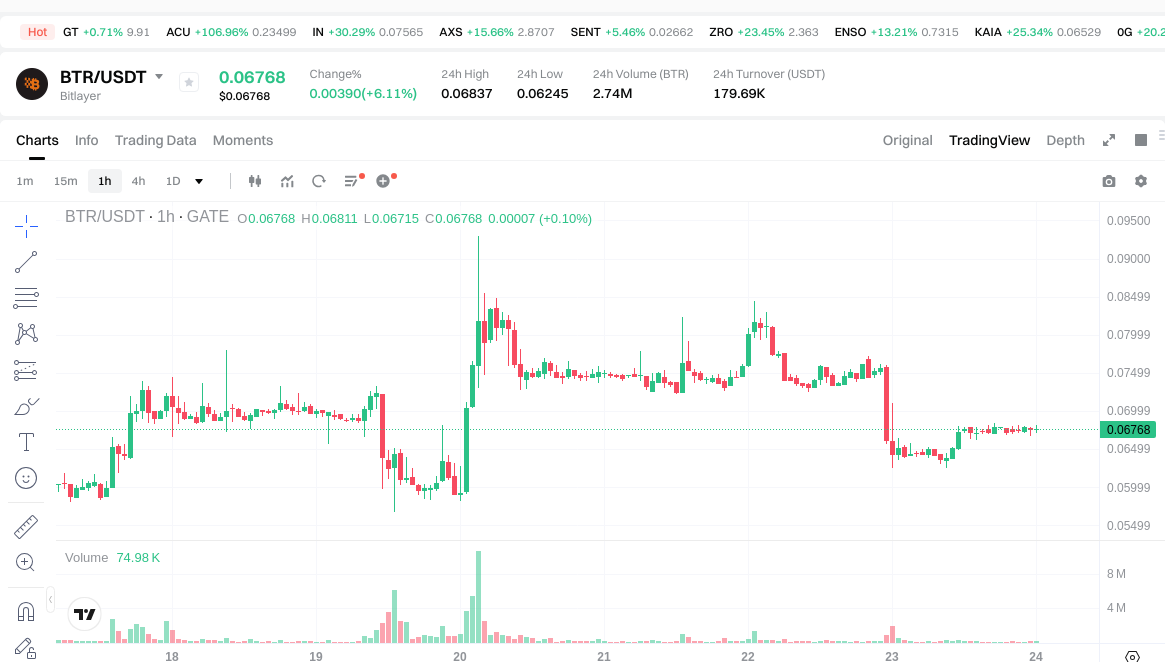
Bitlayer reached an all-time high of $0.176 on September 14, 2025, driven by favorable market conditions during the period.
The token experienced its lowest price of $0.02345 on December 15, 2025, reflecting broader market corrections.
As of the latest update, BTR trades at $0.06738, showing notable short-term gains with a 5.85% increase over 24 hours, 13.19% over 7 days, and 143.77% over 30 days. However, the year-over-year performance indicates a decline of approximately 67.04%, reflecting the volatility inherent in emerging cryptocurrency assets. These price movements demonstrate the influence of market sentiment, adoption trends, and external factors on token valuation.
Click to view the current BTR market price
On-Chain Metrics
- Market Capitalization: $17,626,608 (representing 0.0021% market dominance)
- Fully Diluted Valuation: $67,380,000
- 24-Hour Trading Volume: $189,168.80 (indicating active market participation)
- Token Holders: 34,677 addresses (reflecting growing user base engagement)
- Exchange Listings: Available on 16 cryptocurrency exchanges, enhancing liquidity and accessibility
Bitlayer Ecosystem Applications and Partners
Core Use Cases
Bitlayer's ecosystem supports multiple applications:
- DeFi: The platform provides decentralized finance infrastructure, enabling yield-bearing assets through YBTC and trust-minimized cross-chain solutions via BitVM Bridge.
- Bitcoin Layer 2 Solutions: Bitlayer operates a high-throughput Bitcoin Rollup, bringing composability and speed to Bitcoin's ecosystem.
Strategic Partnerships
Bitlayer has established collaborations with Polychain Capital, Franklin Templeton, Framework, ABCDE, StarkWare, and Alliance, enhancing its technical capabilities and market influence through a total fundraising of $30 million.
These partnerships provide a solid foundation for Bitlayer's ecosystem expansion.
Controversies and Challenges
Bitlayer faces the following challenges:
- Technical Complexity: Implementing the first BitVM solution requires sophisticated technical infrastructure and ongoing development.
- Market Competition: Operating in a competitive Bitcoin Layer 2 landscape with other scaling solutions.
- Adoption Barriers: Building trust and attracting users to new Bitcoin DeFi infrastructure.
These issues have sparked discussions within the community and market, while also driving Bitlayer's continuous innovation.
Bitlayer's community demonstrates notable activity, with 34,677 holders as of January 24, 2026.
On X platform, relevant posts and hashtags (such as #Bitlayer) generate significant engagement.
Price movements and feature launches have ignited community enthusiasm.
Sentiment on X presents diverse perspectives:
- Supporters praise Bitlayer's Bitcoin-native security architecture and BitVM implementation, viewing it as infrastructure for Bitcoin's DeFi future.
- Critics focus on price volatility and the complexity of new technology adoption.
Recent trends show mixed sentiment as the project develops its ecosystem.
Popular Topics
X users actively discuss Bitlayer's BitVM technology, Bitcoin Layer 2 scaling, and DeFi infrastructure development,
showcasing both its transformative potential and the challenges on the path to mainstream adoption.
- Official Website: Visit Bitlayer Official Website for features, use cases, and latest updates.
- White Paper: Bitlayer White Paper details its technical architecture, objectives, and vision.
- X Updates: On X platform, Bitlayer maintains an active presence through @BitlayerLabs,
sharing content about technical upgrades, community activities, and partnership news.
Bitlayer Future Roadmap
- Ongoing Development: Advancing BitVM implementation and trust-minimized bridge technology, enhancing security and throughput
- Ecosystem Goals: Building comprehensive DeFi infrastructure for the Bitcoin ecosystem
- Long-term Vision: Becoming foundational infrastructure for Bitcoin's decentralized finance ecosystem
How to Participate in Bitlayer?
- Purchase Channels: Buy BTR on Gate.com and other cryptocurrency exchanges
- Storage Solutions: Securely store BTR using compatible wallets that support BTRBTC or BSC networks
- Participate in Governance: Engage with the community through Discord at Bitlayer Discord
- Build Ecosystem: Visit developer documentation to develop DApps or contribute to the ecosystem
Summary
Bitlayer is redefining Bitcoin's capabilities through blockchain technology, providing enhanced security, high-speed smart contracts, and DeFi infrastructure.
Its active community, substantial funding from prominent investors, and clear technical vision position it distinctively in the cryptocurrency space.
Despite facing implementation challenges and market competition, Bitlayer's innovative approach and focused roadmap establish its important position in Bitcoin's decentralized technology future.
Whether you are a newcomer or an experienced participant, Bitlayer deserves attention and engagement.
FAQ
What is BTR? What is its full name and basic definition?
BTR is a cryptocurrency token designed for the Web3 ecosystem. It functions as a utility token enabling transactions, governance participation, and ecosystem rewards. BTR represents a digital asset built on blockchain technology, facilitating decentralized finance activities and community-driven development within its network.
What are the uses of BTR? What are its main functions and application scenarios?
BTR serves as a utility token for decentralized finance protocols, enabling governance participation, transaction fee payments, and staking rewards. Its primary applications include liquidity provision in DeFi markets, cross-chain interoperability, and ecosystem incentives for network participants and developers.
How to obtain BTR? Which exchanges can I buy BTR on?
BTR can be acquired through major cryptocurrency exchanges by depositing fiat currency or trading other digital assets. You can purchase BTR on leading platforms that support trading pairs. Check official BTR channels for current exchange listings and liquidity options.
What are the risks of BTR? What should I pay attention to when investing in BTR?
BTR carries market volatility risk and liquidity risk. Monitor regulatory changes, diversify your portfolio, invest only what you can afford to lose, and stay updated on project developments. Price fluctuations are normal in crypto markets.
What are the differences between BTR and other mainstream cryptocurrencies like BTC and ETH?
BTR distinguishes itself through innovative tokenomics, enhanced transaction efficiency, and a focus on practical utility within the web3 ecosystem. Unlike BTC's store-of-value model or ETH's smart contract platform, BTR offers optimized performance, lower fees, and specialized features designed for next-generation decentralized applications and cross-chain interoperability.
What are BTR's development prospects and technical characteristics?
BTR demonstrates strong growth potential with innovative blockchain infrastructure. Key technical features include high-speed transaction processing, enhanced security protocols, and scalable smart contract capabilities. The token is positioned for significant adoption in decentralized finance applications through its efficient consensus mechanism and cross-chain interoperability solutions.
* The information is not intended to be and does not constitute financial advice or any other recommendation of any sort offered or endorsed by Gate.