Cetus Protocol is a pioneering decentralized exchange and concentrated liquidity protocol launched in 2023 on Sui and Aptos blockchains, addressing liquidity fragmentation and inefficient trading in decentralized finance. Built with Move programming language, Cetus delivers enhanced capital efficiency through innovative concentrated liquidity mechanisms while maintaining transparent, decentralized operations secured by Proof of Stake consensus. As of 2026, the protocol serves approximately 24,698 holders with a market capitalization of $21.4 million, offering users superior trading experiences and liquidity provision opportunities. The article examines Cetus's technical architecture, market performance metrics, active community engagement, and ecosystem partnerships while exploring competitive challenges and market volatility considerations. Whether through Gate.com or other platforms, participants can engage with Cetus's DeFi ecosystem, stake tokens, or contribute to its expanding developer community. Cetus
Cetus Protocol's Position and Significance
In 2023, the Cetus team launched Cetus Protocol (CETUS), aiming to address liquidity fragmentation and inefficient trading experiences in decentralized finance.
As a pioneer DEX and concentrated liquidity protocol built on Sui and Aptos blockchains, Cetus Protocol plays a key role in DeFi trading and liquidity provision.
As of 2026, Cetus Protocol has established itself as a significant liquidity infrastructure in emerging blockchain ecosystems, with approximately 24,698 holders and an active developer community.
This article will provide an in-depth analysis of its technical architecture, market performance, and future potential.
Origin and Development History
Birth Background
Cetus Protocol was created by its founding team in 2023, aiming to solve inefficient liquidity utilization and suboptimal trading experiences in decentralized exchanges.
It emerged during the rapid expansion of Move-based blockchain ecosystems, with the goal of providing the best trading experience and superior liquidity efficiency to DeFi users through innovative technology.
Cetus Protocol's launch brought new possibilities for traders and liquidity providers in Sui and Aptos ecosystems.
Important Milestones
- 2023: Mainnet launch on May 10, establishing concentrated liquidity protocol functionality on Sui blockchain.
- 2023: Token listing on Gate.com and other exchanges, expanding accessibility to global users.
- 2026: The protocol continues to develop its ecosystem, with the token price experiencing fluctuations reflective of market conditions.
With the support of its community and development team, Cetus Protocol continues to optimize its technology, security, and real-world applications.
How Cetus Protocol Works?
No Central Control
Cetus Protocol operates on decentralized blockchain networks (Sui and Aptos), eliminating control by traditional intermediaries.
These distributed nodes collaborate to validate transactions, ensuring system transparency and attack resistance, granting users greater autonomy and enhancing network resilience.
Blockchain Core
Cetus Protocol's underlying blockchains maintain public, immutable digital ledgers that record every transaction.
Transactions are grouped into blocks and cryptographically linked to form a secure chain.
Anyone can view the records, establishing trust without intermediaries.
The protocol leverages Move programming language and object-centric architecture to enhance performance and flexibility.
Ensuring Fairness
Cetus Protocol operates on Proof of Stake (PoS) consensus mechanisms utilized by Sui and Aptos to validate transactions and prevent fraudulent activities.
Validators maintain network security through staking native tokens and processing transactions, receiving rewards for their participation.
The innovation includes concentrated liquidity design that improves capital efficiency for liquidity providers.
Secure Transactions
Cetus Protocol utilizes public-private key cryptography to protect transactions:
- Private keys (similar to secret passwords) are used to authorize transactions
- Public keys (similar to account numbers) are used to verify ownership
This mechanism ensures fund security while transactions maintain transparency characteristic of public blockchains.
The protocol implements smart contract-based security features and audited code to protect user assets.
Circulation Overview
As of January 23, 2026, CETUS has a circulating supply of 897,101,449 tokens, with a total supply of 1,000,000,000 tokens under a fixed supply model.
The circulating supply represents approximately 89.71% of the total supply, indicating a relatively high level of tokens already in circulation.
Price Fluctuations
CETUS reached its highest price of $0.5 on May 10, 2023, driven by initial market enthusiasm following its launch and early adoption within the Sui ecosystem.
Its lowest price was $0.01855, occurring on October 10, 2025, influenced by broader market corrections and reduced trading activity during bearish market conditions.
These fluctuations reflect evolving market sentiment, adoption patterns, and external macroeconomic factors affecting the cryptocurrency sector.
Click to view current CETUS market price
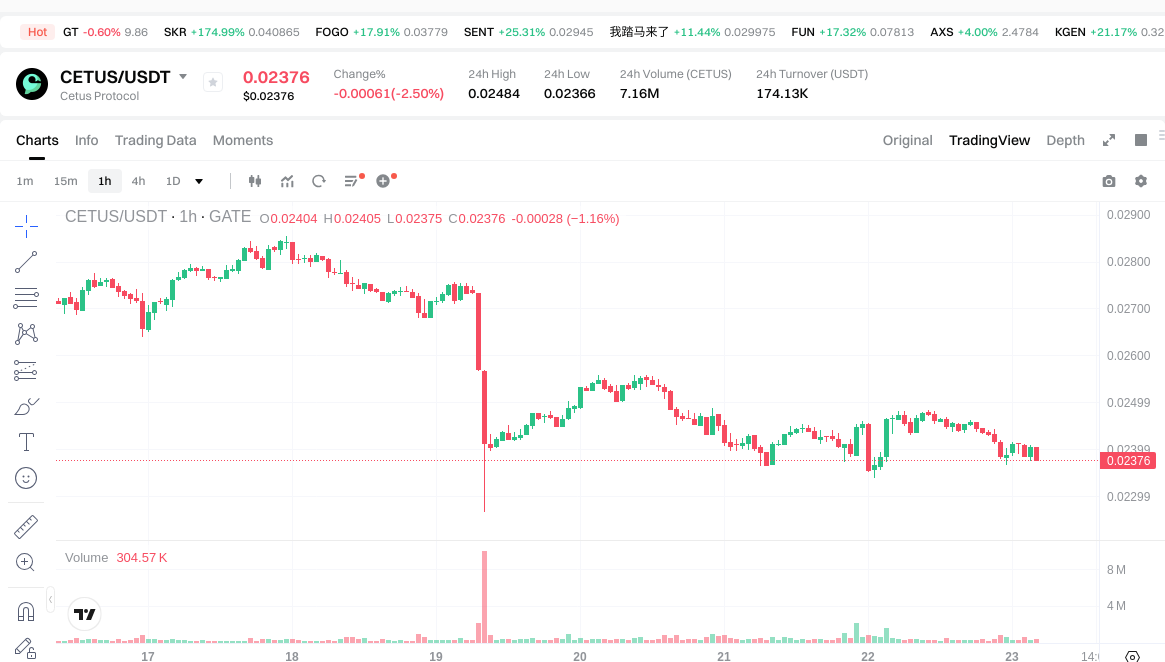
On-Chain Metrics
- Holder Count: 24,698 addresses (reflecting user participation and token distribution)
- 24-Hour Trading Volume: $174,591.07 (indicating current market activity levels)
- Market Capitalization: $21,368,956.52 (representing the token's current valuation)
Cetus Protocol Ecosystem Applications and Partners
Core Use Cases
Cetus Protocol's ecosystem supports multiple applications:
- DeFi: As a pioneer DEX and concentrated liquidity protocol, Cetus provides decentralized trading and liquidity provision on Sui and Aptos blockchains.
- Liquidity Infrastructure: The protocol offers enhanced capital efficiency through concentrated liquidity mechanisms, enabling users to optimize their trading strategies.
Strategic Partnerships
Cetus has established its presence on Sui and Aptos blockchains, leveraging these platforms' technical capabilities to enhance liquidity efficiency.
These partnerships provide a solid foundation for Cetus's ecosystem expansion.
Controversies and Challenges
Cetus Protocol faces the following challenges:
- Competition Pressure: The rise of other blockchain platforms and DEX protocols creates competitive dynamics in the DeFi space.
- Market Volatility: Price fluctuations present ongoing considerations for participants.
These issues have sparked community discussions and continue to drive Cetus's innovation efforts.
Cetus Protocol's community demonstrates notable activity, with approximately 24,698 holders as of January 2026.
The project maintains an active presence across social platforms, with the community engaging around developments and protocol updates.
Sentiment on X displays varied perspectives:
- Supporters praise Cetus's concentrated liquidity features and cross-chain capabilities, viewing it as an innovative solution for DeFi users.
- Critics focus on market dynamics and competitive positioning within the broader DEX landscape.
Recent trends reflect evolving market conditions and community engagement patterns.
Popular Topics
X users discuss Cetus's liquidity efficiency, trading experience, and multi-chain deployment strategy,
showcasing both its innovative potential and the considerations for mainstream adoption.
- Official Website: Visit Cetus Protocol Official Site for features, use cases, and latest updates.
- X Updates: On X platform, Cetus Protocol uses @CetusProtocol, sharing content about protocol developments, community activities, and ecosystem growth.
- Blockchain Explorer: Track transactions and contract activity on Sui Explorer.
Cetus Protocol Future Roadmap
- Ongoing Development: Continue enhancing concentrated liquidity protocol and interoperable functional modules
- Ecosystem Goals: Expand the underlying liquidity network to serve diverse users and assets
- Long-term Vision: Establish a robust and flexible liquidity infrastructure for the DeFi ecosystem
How to Participate in Cetus Protocol?
- Purchase Channels: Acquire CETUS on Gate.com and other supported platforms
- Storage Solutions: Store tokens securely using compatible wallets that support Sui blockchain
- Engage with Protocol: Utilize Cetus's DEX features for trading and liquidity provision
- Build Ecosystem: Access development resources to contribute to the protocol's growth
Summary
Cetus Protocol redefines decentralized trading through blockchain technology, offering concentrated liquidity, enhanced capital efficiency, and superior trading experience.
Its active community, multi-chain presence, and focused development approach position it distinctively in the DeFi landscape.
Despite facing competitive dynamics and market volatility, Cetus's innovation-driven approach and clear development path establish its relevance in decentralized finance.
Whether you're new to DeFi or an experienced participant, Cetus Protocol presents opportunities worth exploring.
FAQ
What is CETUS? What are its uses and features?
CETUS is a decentralized exchange protocol built on Sui blockchain, enabling efficient token swaps and liquidity provision. It features low transaction costs, fast settlement, and capital efficiency through concentrated liquidity mechanisms. CETUS token governs the protocol and facilitates ecosystem participation.
How to buy and trade CETUS tokens? Where can I purchase them?
You can purchase CETUS tokens on major cryptocurrency exchanges through spot trading pairs. Simply create an account, complete verification, deposit funds, and place buy orders. CETUS is actively traded on multiple platforms with high liquidity and trading volume.
What is the total supply of CETUS? How does the tokenomics model work?
CETUS has a maximum total supply of 1 billion tokens. The tokenomics allocates tokens to community rewards, team incentives, ecosystem development, and treasury reserves to ensure sustainable growth and long-term value.
What is the team background and development roadmap of the CETUS project?
CETUS is built by experienced Web3 developers focused on DeFi innovation. The team emphasizes sustainable growth with milestones including protocol upgrades, ecosystem expansion, and enhanced liquidity solutions. Regular updates drive continuous platform improvement and community engagement.
What are the risks of investing in CETUS and what should I pay attention to?
CETUS carries market volatility risk, liquidity risk, and smart contract risk. Monitor price fluctuations, ensure sufficient trading volume, and research the project fundamentals before investing. Diversify your portfolio and only invest what you can afford to lose.
* The information is not intended to be and does not constitute financial advice or any other recommendation of any sort offered or endorsed by Gate.