Radiant (RDNT) is the native governance token of the first omnichain money market protocol, launched in 2022 on LayerZero to solve cross-chain liquidity fragmentation. This comprehensive guide explores RDNT's technical architecture, market performance, and ecosystem applications across Arbitrum, BSC, and Ethereum networks. The article covers how Radiant enables seamless cross-chain lending and borrowing, examines its tokenomics with circulating supply and price dynamics, discusses strategic partnerships and core use cases, and addresses market challenges and competition. Whether you are a DeFi participant or investor evaluating omnichain protocols, this guide provides essential insights into RDNT's positioning as a leading decentralized finance solution for cross-chain capital efficiency and liquidity optimization.
Radiant's Positioning and Significance
In 2022, Radiant launched Radiant (RDNT) on the LayerZero foundation, aiming to address the fragmentation of liquidity across multiple blockchain ecosystems and the inefficiency of cross-chain lending.
As the first omnichain money market, Radiant plays a critical role in decentralized finance (DeFi).
As of 2026, Radiant has established itself as a notable omnichain lending protocol, with support across multiple major blockchains including Arbitrum, BSC, and Ethereum and an active development community.
This article will provide an in-depth analysis of its technical architecture, market performance, and future potential.
Origin and Development History
Birth Background
Radiant was created in 2022, aiming to solve the isolation of lending markets across different blockchains and the inability for users to seamlessly access liquidity across chains.
It emerged during the expansion of multi-chain ecosystems and the growing demand for cross-chain interoperability, with the goal of enabling users to deposit assets on any major chain and borrow supported assets across multiple chains to transform the status quo.
Radiant's launch brought new possibilities to DeFi users and liquidity providers seeking cross-chain capital efficiency.
Important Milestones
- 2022: Platform launch, establishing the first omnichain money market built on LayerZero technology.
- 2022: Token reached a notable price level of $0.585268.
- 2026: Continued ecosystem development with deployment across Arbitrum, BSC, and Ethereum networks.
With the support of its community and development team, Radiant continues to optimize its technology, security, and real-world applications.
How Does Radiant Work?
No Central Control
Radiant operates on a decentralized network of computers (nodes) distributed globally, free from bank or government control.
These nodes collaborate to verify transactions, ensuring the system remains transparent and resistant to attacks, granting users greater autonomy and enhancing network resilience.
Blockchain Core
Radiant's blockchain is a public, immutable digital ledger that records every transaction.
Transactions are grouped into blocks and linked through cryptographic hashes to form a secure chain.
Anyone can view the records, establishing trust without intermediaries.
Built on LayerZero's omnichain technology, Radiant enables seamless cross-chain communication and asset transfers, further enhancing performance and interoperability.
Ensuring Fairness
Radiant utilizes smart contract-based lending protocols to validate transactions and prevent fraudulent activities such as double spending.
Lenders, borrowers, and liquidity providers maintain network operations through depositing assets, borrowing against collateral, and providing RDNT/WETH liquidity, earning RDNT token rewards.
Its innovation includes enabling cross-chain deposits and borrowing without bridging assets manually.
Secure Transactions
Radiant employs public-private key cryptography to protect transactions:
- Private keys (similar to secret passwords) are used to sign transactions
- Public keys (similar to account numbers) are used to verify ownership
This mechanism ensures fund security while transactions maintain pseudonymous privacy.
The protocol incorporates collateralization mechanisms and risk management parameters to enhance security.
Circulating Supply Overview
As of January 26, 2026, Radiant's circulating supply stands at 1,292,073,967 tokens, with a total supply of 1,500,000,000 tokens. The circulating supply represents approximately 86.14% of the total supply, indicating a relatively high distribution level. RDNT tokens are distributed to users who provide utility to the platform as lenders, borrowers, and RDNT/WETH liquidity providers, creating a utility-driven emission model that influences its supply-demand dynamics.
Price Fluctuations
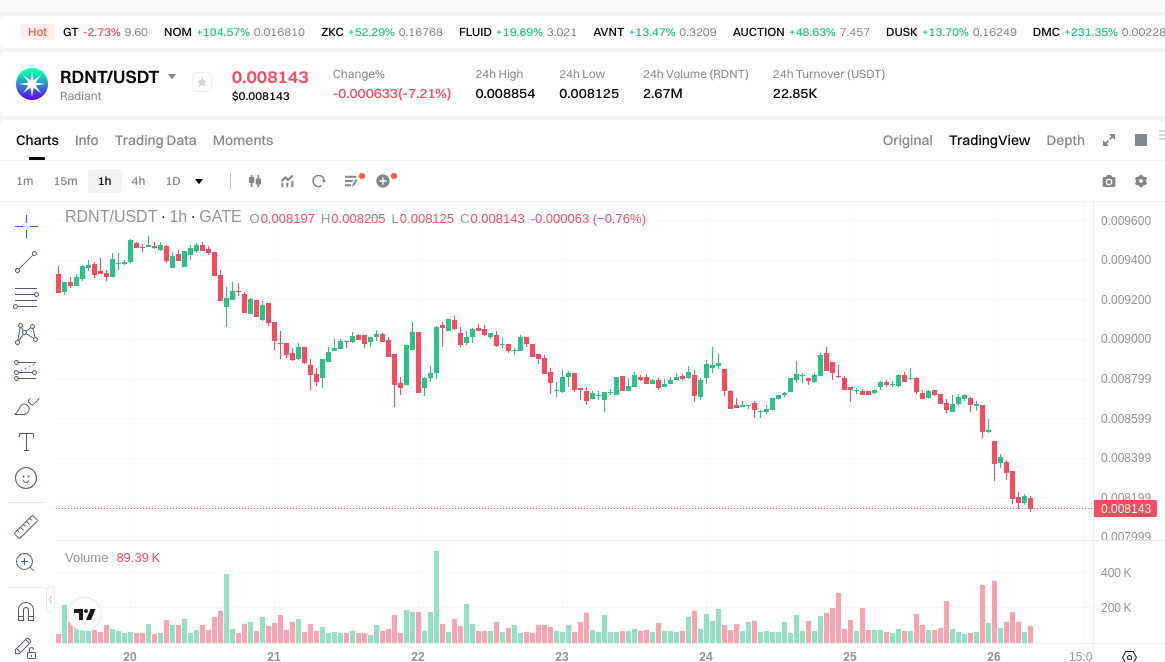
Radiant reached its all-time high price of $0.585268 on September 16, 2022. However, the token has experienced significant price corrections since then. As of January 26, 2026, the price stands at $0.008149, marking a -82.93% decline over the past year. Recent performance shows a -7.24% decrease over 24 hours and a -19.78% drop over the past 7 days. The 24-hour trading range has been between $0.008134 (low) and $0.008854 (high). These fluctuations reflect broader market sentiment, adoption trends, and the evolving DeFi landscape.
Click to view current RDNT market price
On-chain Metrics
- 24-hour Trading Volume: $22,487.71 (indicating current market activity levels)
- Token Holders: 1,921 addresses (reflecting the user base size)
- Market Capitalization: $10,529,110.76 (representing current market valuation)
- Fully Diluted Valuation: $12,223,500 (indicating potential maximum market cap at full supply circulation)
Radiant Ecosystem Applications and Partners
Core Use Cases
Radiant's ecosystem supports diverse applications:
- DeFi: As a cross-chain money market, Radiant enables decentralized lending and borrowing across multiple blockchain networks. Users can deposit assets on one chain and borrow supported assets on various other chains.
- Liquidity Provision: RDNT/WETH liquidity providers contribute to the platform's liquidity depth, earning RDNT token emissions as rewards for their participation.
Strategic Partnerships
Radiant is built on LayerZero, a cross-chain messaging protocol that enables its omnichain functionality.
This technical foundation allows Radiant to operate seamlessly across major blockchain networks, providing users with flexible cross-chain lending and borrowing capabilities.
Challenges and Controversies
Radiant faces several challenges:
- Technical Complexity: Operating as an omnichain protocol requires maintaining security and stability across multiple blockchain networks
- Market Volatility: The token has experienced significant price fluctuations, with recent performance showing declines across various timeframes
- Competition: Other DeFi lending platforms continue to emerge, creating competitive pressure in the decentralized finance space
These issues have generated ongoing discussions within the community and drive continuous platform development.
Radiant maintains an active community with 1,921 token holders participating in the ecosystem.
The platform distributes RDNT tokens to users who provide utility as lenders, borrowers, and liquidity providers.
Radiant maintains presence on X platform through its official account, sharing updates about platform development and community activities.
Community discussions reflect various perspectives on the protocol's cross-chain functionality and market performance.
Key Topics
X users discuss Radiant's cross-chain lending mechanism, token economics, and DeFi innovation,
highlighting both its technological potential and the challenges of operating in a competitive DeFi landscape.
- Official Website: Visit Radiant Official Website for features, use cases, and latest updates.
- X Updates: Radiant is active on X platform through @RDNTCapital, sharing content about platform updates, community events, and protocol developments.
- GitHub: Explore technical documentation and code at Radiant GitHub.
Radiant Future Roadmap
- Ongoing Development: Continue enhancing cross-chain lending functionality and improving platform security and user experience
- Ecosystem Goals: Expand supported assets and blockchain networks to increase protocol utility
- Long-term Vision: Establish itself as a leading omnichain money market enabling seamless cross-chain DeFi operations
How to Participate in Radiant?
- Purchase Options: Acquire RDNT on Gate.com and other supported exchanges
- Storage Solutions: Store tokens securely using compatible Web3 wallets that support Arbitrum, BSC, or Ethereum networks
- Platform Participation: Engage with the protocol by becoming a lender, borrower, or liquidity provider to earn RDNT emissions
- Ecosystem Building: Visit the official website and GitHub repository to explore development opportunities
Summary
Radiant leverages blockchain technology to create an omnichain money market, offering cross-chain lending flexibility, decentralized operations, and liquidity incentives.
Its innovative approach to cross-chain DeFi, active development community, and LayerZero integration distinguish it in the cryptocurrency space.
Despite facing market volatility and competitive pressures, Radiant's omnichain vision and technical foundation position it as a noteworthy player in decentralized finance.
Whether you are new to DeFi or an experienced participant, Radiant's cross-chain capabilities merit attention and exploration.
FAQ
What is the RDNT token? What is the basic introduction to Radiant Capital project?
RDNT is the governance token of Radiant Capital, a decentralized lending protocol on multiple blockchains. It enables users to borrow and lend crypto assets while earning yields. RDNT holders can stake tokens to earn rewards and participate in protocol governance decisions.
What is the purpose of RDNT tokens and what role do they play in the Radiant ecosystem?
RDNT tokens serve as Radiant's governance token, enabling holders to participate in protocol decisions and earn yields through lending and borrowing activities. They incentivize liquidity provision, secure the ecosystem, and grant voting rights on platform upgrades and risk parameters management.
How to obtain RDNT tokens? On which exchanges can I purchase RDNT?
You can acquire RDNT tokens through decentralized exchanges (DEX) like Uniswap, or purchase directly from major centralized platforms. RDNT is actively traded with significant daily trading volume across multiple blockchain networks including Arbitrum and Ethereum.
What are the investment risks of RDNT? What are the main risks of DeFi lending protocol tokens?
RDNT faces smart contract vulnerabilities, liquidity risks, and market volatility. DeFi lending tokens are exposed to protocol hacks, collateral liquidation risks, interest rate fluctuations, and regulatory uncertainty affecting the ecosystem.
What is the difference between RDNT and other DeFi lending protocol tokens such as AAVE and COMP?
RDNT differentiates itself through its multi-chain lending infrastructure, superior capital efficiency, and native integration with Arbitrum ecosystem. Unlike AAVE and COMP, RDNT offers dynamic interest rate optimization and enhanced yield farming opportunities with lower liquidation risks for users across multiple chains.
Which blockchain networks does Radiant Capital support? How does RDNT's cross-chain functionality work?
Radiant Capital operates across multiple networks including Ethereum, Arbitrum, Optimism, Polygon, and BNB Chain. RDNT enables seamless cross-chain liquidity through bridge protocols, allowing users to transfer assets and maintain unified protocol governance across different blockchains efficiently.
* The information is not intended to be and does not constitute financial advice or any other recommendation of any sort offered or endorsed by Gate.