Gate TradFi Gold Lucky Bag Event Overview: Win 1g of Gold Every 10 Minutes—Simply Trade to Join

Last Updated 2026-03-25 14:45:10
Reading Time: 1m
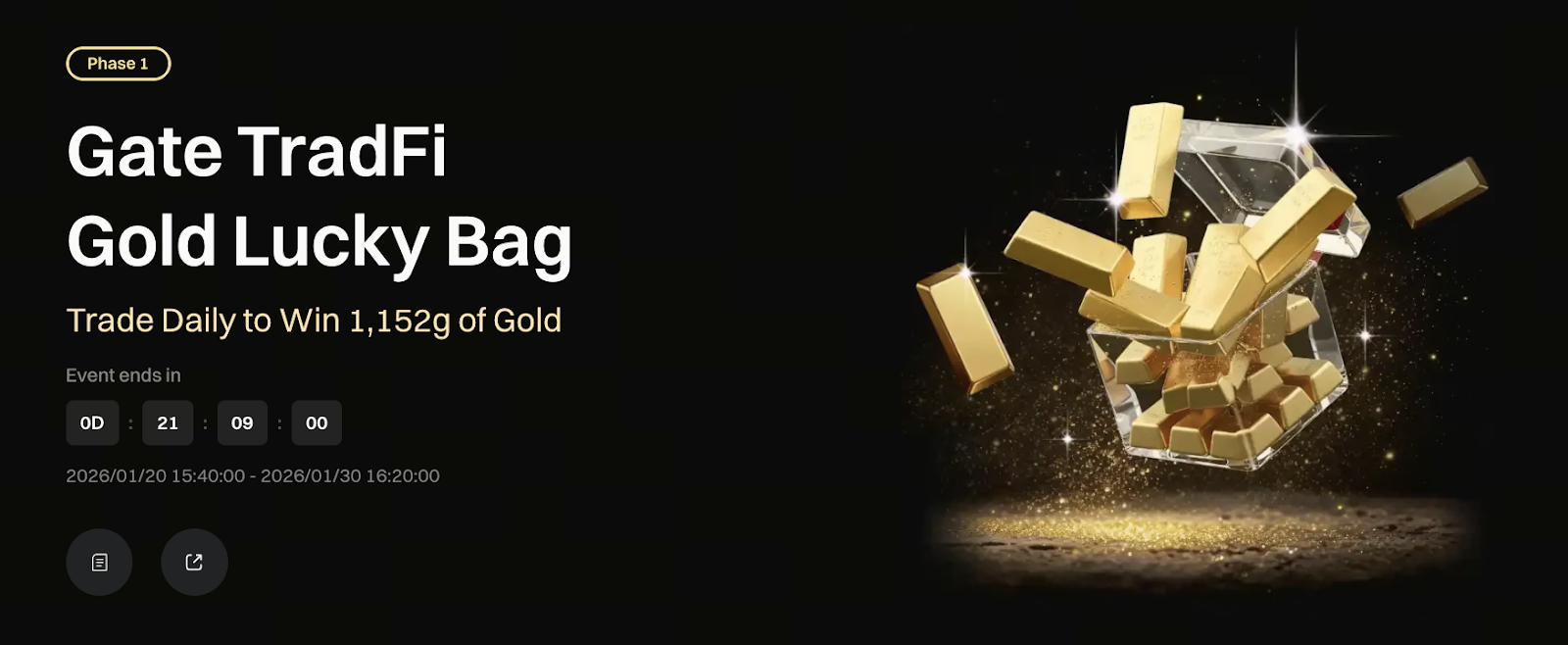
Gate TradFi has introduced the Gold Lucky Bag promotion, where users automatically enter a prize draw by engaging in TradFi trading. Drawings occur every 10 minutes, and each round offers assets equivalent to 1 gram of gold as the reward. This article delivers a comprehensive breakdown of the event’s mechanics, participation criteria, reward structure, and key considerations, enabling new users to quickly grasp the essential features of the Gate TradFi Gold event.


Image: https://www.gate.com/campaigns/4-gold-lucky-draw

Gate TradFi Gold Lucky Bag Event Overview

Gate has officially launched its TradFi section and introduced the "Gold Lucky Bag" event, featuring gold as the central reward. Throughout the event, both new and existing users automatically qualify for the lucky draw simply by engaging in TradFi trading—no extra registration required.

This event stands out for its high-frequency draws and straightforward participation. Users can enter the lucky draw while conducting regular trades, enabling seamless “trading + lucky draw” engagement.

Event Rewards and Draw Mechanism

The Gold Lucky Bag event features a rapid draw system:

  • Draws occur every 10 minutes
  • Each round awards assets equivalent to 1g of gold
  • A maximum of 1,152g of gold can be awarded daily during the event

For each draw, one eligible user is randomly selected as the winner. Users may participate multiple times and win repeatedly during the event, boosting both certainty and engagement.

How to Participate in the Lucky Draw via TradFi Trading

Participation is simple, with the main requirements centered on trading behavior:

  • Complete a transaction in the TradFi section
  • Each transaction must total at least 100 USDT
  • Complete your trade before the relevant draw to receive five consecutive lucky draw entries

Once you meet these criteria, the system will automatically recognize and assign your lucky draw eligibility—no manual registration needed. Even if there’s a delay in system data, qualifying users will still be able to participate in subsequent draws.

Gold Reward Distribution and Settlement

Please note, the rewards for this event are not physical gold, but XAUT (Tether Gold):

  • XAUT is a digital asset pegged 1:1 to physical gold
  • Rewards are converted to gold tokens according to the market price at the time of distribution
  • Winners must manually claim their rewards within 24 hours
  • All rewards will be credited to spot accounts after the event ends

This method maintains the value of gold assets and aligns with digital asset settlement practices.

Key Considerations Before Participating

Before joining the Gate TradFi Gold Lucky Bag event, users should keep the following in mind:

  • Currently, only transactions via the Gate App are supported
  • TradFi products have fixed trading breaks
  • Certain account types are not eligible to participate
  • TradFi products carry price volatility and leverage risks

We recommend users fully review TradFi product rules and risk disclosures before participating.

Significance of Gate TradFi’s Gold Event

From a product standpoint, the Gold Lucky Bag event serves not only as a short-term incentive but also highlights Gate’s strategic direction for TradFi:

  • Lowering barriers for traditional financial assets on the platform
  • Enhancing user awareness and usage of TradFi products
  • Strengthening Gate’s position as a multi-asset trading platform

By leveraging gold—a classic safe-haven asset—Gate is building a bridge between TradFi and the crypto market.

Author: Max
Disclaimer
* The information is not intended to be and does not constitute financial advice or any other recommendation of any sort offered or endorsed by Gate.
* This article may not be reproduced, transmitted or copied without referencing Gate. Contravention is an infringement of Copyright Act and may be subject to legal action.

Related Articles

AI-Native Settlement Layers: How United Stables Is Building the Next Financial Rail
Beginner

AI-Native Settlement Layers: How United Stables Is Building the Next Financial Rail

Stablecoins were originally designed as dollar substitutes within exchanges, primarily used for asset pricing and trade settlement. As on-chain financial ecosystems have matured, their role has expanded beyond simple payments to include collateral assets, cross-chain liquidity mediums, and unified settlement units. In particular, as AI systems and automated agents begin to participate directly in economic activity, demand has risen sharply for programmable value units capable of instant settlement. This shift is pushing stablecoins toward the role of foundational financial infrastructure.
2026-03-25 03:16:17
The ve(3,3) Flywheel Explained: How AERO Tokenomics Powers Aerodrome’s DeFi Economy
Beginner

The ve(3,3) Flywheel Explained: How AERO Tokenomics Powers Aerodrome’s DeFi Economy

In the competition for DeFi liquidity, high-inflation mining alone is no longer enough to build lasting advantages. Aerodrome applies the ve(3,3) economic model to redesign token emissions, voting mechanisms, and revenue distribution, creating a liquidity flywheel centered on governance and cash flow. This article examines AERO tokenomics, the veAERO locking mechanism, and protocol revenue models to explain how Aerodrome builds a sustainable DeFi economic system.
2026-03-25 06:41:58
Aerodrome Tokenomics: How ve(3,3) Powers Base's Most Profitable DEX
Beginner

Aerodrome Tokenomics: How ve(3,3) Powers Base's Most Profitable DEX

AERO is the native token of Aerodrome Finance, a core decentralized exchange and liquidity protocol in the Base ecosystem. It is primarily used for liquidity incentives and ecosystem operations. veAERO is a governance NFT that users receive by locking AERO, representing both voting power and the right to share protocol revenue. Through a dual track structure of AERO as a utility token and veAERO as a governance credential, Aerodrome separates liquidity usage value from long term governance power, allowing participants to act as liquidity providers, governance decision makers, and revenue sharers within the same system.
2026-03-25 06:40:31
How Does PAXG Work? In-Depth Overview of the Physical Gold Tokenization Mechanism
Beginner

How Does PAXG Work? In-Depth Overview of the Physical Gold Tokenization Mechanism

PAXG (Pax Gold) is a tokenized asset backed by physical gold, issued by the fintech company Paxos and traded on the Ethereum blockchain as an ERC-20 token. The core concept is to tokenize physical gold on-chain, with each PAXG token representing ownership of a certain amount of gold. This structure enables investors to hold and trade gold in the form of a digital asset.
2026-03-24 19:12:51
How is the price of PAXG determined? Pegging mechanism, trading depth, and influencing factors
Beginner

How is the price of PAXG determined? Pegging mechanism, trading depth, and influencing factors

PAXG (Pax Gold) is a tokenized asset backed by physical gold reserves, launched by fintech firm Paxos and issued as an ERC-20 token on the Ethereum blockchain. The core concept is to digitally represent real-world gold assets, allowing investors to hold and trade gold via the blockchain network. Because each PAXG token corresponds to a specific quantity of physical gold, its price is theoretically expected to closely track the global gold market.
2026-03-24 19:11:40
How Does GoldFinger Work? Gold Asset Tokenization, Proof of Reserve, and on-chain Circulation Explained
Beginner

How Does GoldFinger Work? Gold Asset Tokenization, Proof of Reserve, and on-chain Circulation Explained

GoldFinger operates through a process that includes asset custody, Proof of Reserve, token minting, and on-chain circulation. By placing physical gold within a compliant custody framework and mapping it on-chain through ART tokens, GoldFinger turns gold into a digital, programmable asset. At the same time, its Proof of Reserve mechanism ensures that on-chain tokens correspond to the underlying assets, supporting trading, collateralization, and redemption in DeFi scenarios.
2026-04-15 03:01:54