In today's blockchain ecosystem, most storage solutions still depend on ongoing payments or off-chain systems, making "long-term data availability" a central concern. Arweave addresses issues like data loss, censorship risk, and unpredictable long-term storage costs by redesigning its data structure and incentive model.
From a blockchain infrastructure perspective, Arweave is more than just a storage protocol—it acts as a "data persistence layer." Using Blockweave, Proof of Access, and the Endowment model, Arweave integrates storage, verification, and incentives into a sustainable system, providing decentralized applications with reliable, long-term data assurance.
Overview of Arweave's Storage Mechanism: How Arweave Delivers Permanent Data Storage
Arweave's primary goal is to enable "permanent data availability," leveraging a storage mechanism fundamentally different from traditional blockchain or cloud storage systems. Rather than simply writing data on-chain, Arweave achieves lasting preservation through a combination of structural design, incentive mechanisms, and data availability strategies.
At its core, Arweave tightly integrates "storage" and "incentives". Users pay a one-time fee to upload data, while the network continuously incentivizes nodes to retain that data through an economic model. This eliminates the need for ongoing payments typical of traditional storage, making "permanent storage" a practical system design.
Arweave utilizes content addressability, distributed storage, and cryptographic verification to ensure data can be accurately located and validated across the network. Even as network topology evolves, data remains accessible via its content hash.
Arweave's approach to permanent storage is a comprehensive solution built on "data structure + consensus mechanism + economic model + data propagation strategy," rather than a single technology.
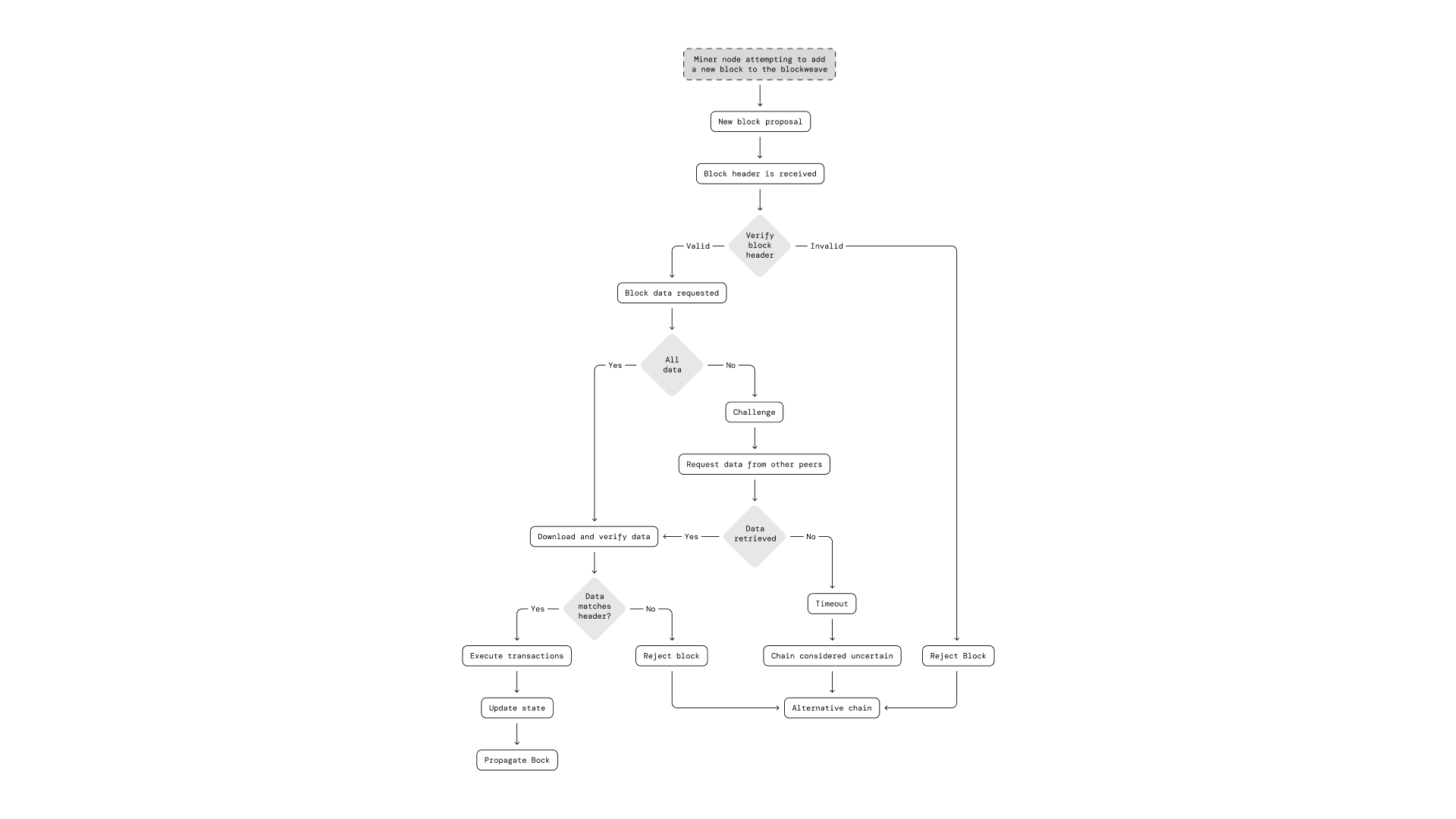
Source: arweave.com
What Is Arweave's Blockweave Structure: How Its Data Architecture Differs from Traditional Blockchains
Arweave employs a data structure called Blockweave, which sets it apart from conventional blockchains. In standard blockchains, each block links only to its predecessor, whereas Blockweave introduces "random historical block references."
Each new block not only connects to the previous block but must also reference a randomly chosen historical block (Recall Block). This design requires the network to access historical data when producing new blocks, reinforcing the availability of older data.
The key innovation here is that historical data becomes a mandatory requirement for network participation, rather than optional storage. Nodes that do not store historical data are unable to participate in block creation or earn rewards.
Essentially, Blockweave embeds "historical data access" into the consensus process, making data persistence a core function of the network rather than a supplemental feature.
Arweave's Proof of Access Mechanism Explained
One of Arweave's foundational consensus mechanisms is Proof of Access (PoA), or "storage proof." Unlike traditional Proof of Work, which relies on hash power, PoA emphasizes a node's capacity to access historical data.
To generate a new block, nodes must verify the current block state and demonstrate their ability to access a randomly selected historical block. This requirement ensures nodes actually store or can quickly retrieve historical data.
This mechanism alters incentives: nodes storing more data have a higher likelihood and efficiency in block production, earning greater rewards. Thus, storage capacity becomes a critical resource within the network.
Combined with the SPoRA (Succinct Proof of Random Access) mechanism, the system further incentivizes "data read speed," requiring nodes not only to store data but to retrieve it efficiently, enhancing overall network performance.
How Arweave Ensures Long-Term Data Preservation: Storage Process and Persistence Mechanism
Arweave's storage process begins with the user uploading data. After submitting data and paying the required fee, the data is packaged into a transaction and written into the Blockweave structure.
The data is then quickly distributed across nodes using network propagation mechanisms like Blockshadow and Wildfire. Blockshadow uses transaction IDs to propagate data references instead of transmitting full data, improving efficiency.
Wildfire, meanwhile, uses a node scoring system to optimize data propagation. Nodes that respond quickly and actively share data are prioritized, boosting overall data availability.
Through multi-node replication and distributed storage, data is redundantly backed up across the network. Even if some nodes go offline or fail, data can be retrieved from other nodes, ensuring persistent, long-term storage.
Arweave's Storage Incentive Model: Sustaining Long-Term Storage with AR
Arweave's ability to provide permanent storage hinges on its economic model, centered around the "Endowment (storage fund) mechanism." User fees are not immediately distributed to miners; most are allocated to a long-term pool.
This pool releases rewards gradually based on network demand, compensating miners for storage costs. Even if new storage demand ceases, the network can maintain incentives for data retention via the fund.
This model rests on a key assumption: storage costs will decrease over time. Early payments can therefore support longer-term data storage in the future.
By converting "one-time payments" into "long-term incentives," Arweave achieves economic sustainability—a major innovation distinguishing it from other storage protocols.
Advantages and Limitations of Arweave's Storage Mechanism
Arweave's greatest strength is its "true permanent storage model." By integrating structural and economic mechanisms, it preserves data long-term without recurring payments and guarantees immutability.
Its data availability design (PoA, Wildfire) ensures data is not only stored but efficiently accessible—crucial for scenarios like audits, copyright, and archiving that require long-term verification.
However, the model has limitations. One-time storage fees can be substantial, posing barriers for large-scale uploads. Permanent storage also makes data deletion difficult, which may challenge privacy and compliance requirements.
The system relies on a long-term economic model and the assumption of declining costs. If future storage costs diverge from expectations, incentive balance could be affected. Thus, sustainability must be validated through ongoing practice.
Summary
Arweave establishes a comprehensive permanent storage system through its Blockweave data structure, Proof of Access consensus mechanism, and Endowment economic model.
Its core innovation is embedding "data storage" into network consensus and incentives, so data persistence no longer depends on centralized services or ongoing payments.
This approach expands blockchain's capabilities and provides Web3 with a new infrastructure: a "verifiable, immutable, and persistent data layer."
FAQ
Why can Arweave achieve permanent storage?
Because it uses a one-time payment plus a long-term incentive model, and ensures continual data retention and accessibility through Blockweave and PoA.
How is Blockweave different from traditional blockchains?
Blockweave links to the previous block and also references random historical blocks, structurally enhancing data persistence.
What is Proof of Access?
A mechanism requiring nodes to prove their ability to access historical data, ensuring long-term data availability.
Can Arweave data be deleted?
Generally, it cannot be deleted, which is integral to its "permanent storage" feature.
Is Arweave's storage fully decentralized?
Yes, data is distributed across multiple nodes and sustained by incentive mechanisms for long-term operation.







