SEC Chair Clarifies Crypto Asset Categories: NFTs, Network Tokens, and Digital Tools Are Not

Beginner
Quick Reads
Last Updated 2026-03-27 20:28:40
Reading Time: 1m
The new token classification framework redefines the Howey Test into four distinct categories. Only security tokens must maintain ongoing compliance with securities regulations. The remaining three categories are exempt, providing Web3 with a clear and predictable regulatory pathway. This change marks a pivotal shift in U.S. cryptocurrency regulation. It transforms the environment, shifting it from constraint to encouragement of innovation.

SEC Chairman Outlines Clear Regulatory Classification Framework


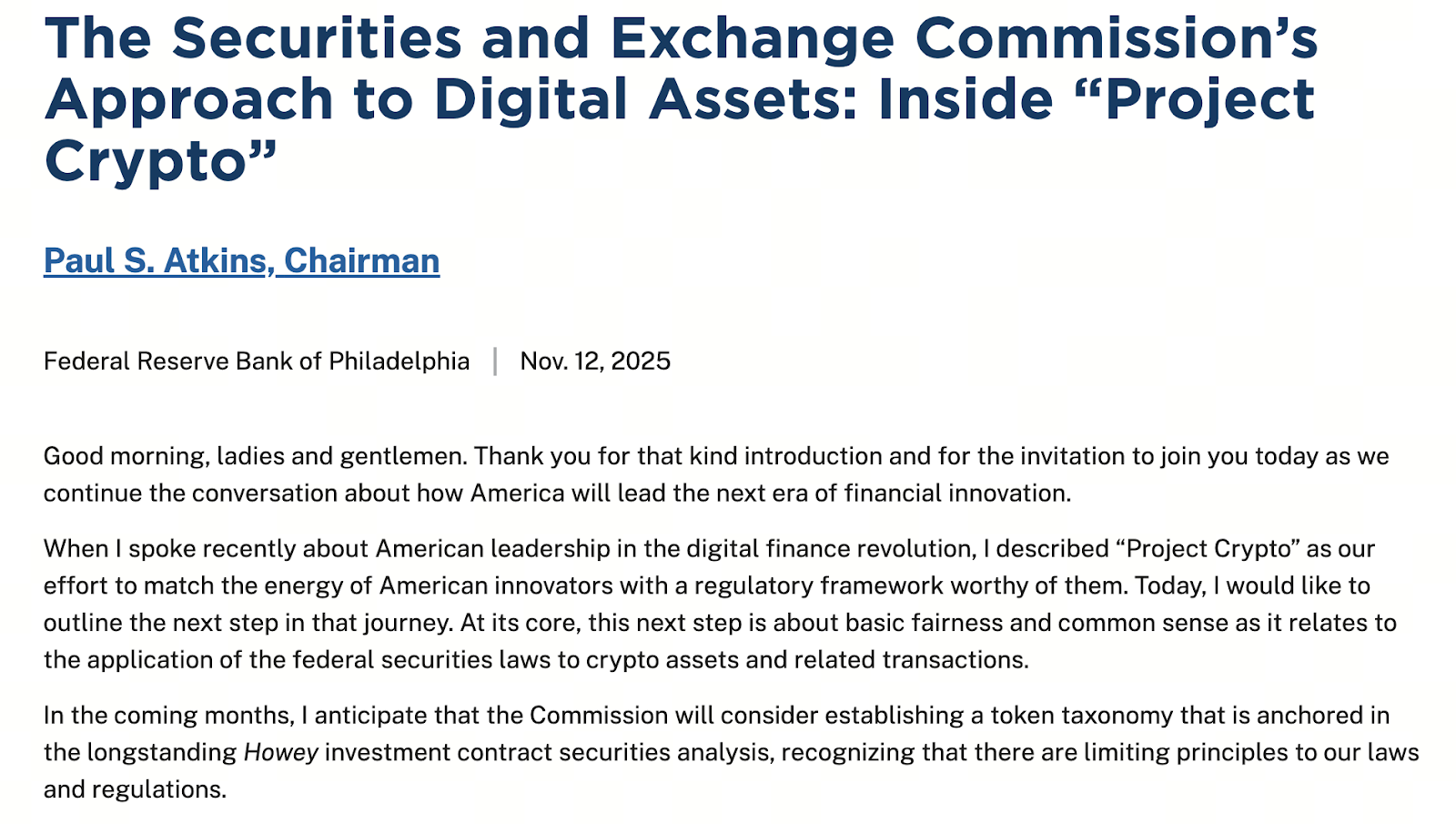
(Source: SEC / Paul S. Atkins, Chairman)

The Chairman of the U.S. Securities and Exchange Commission (SEC) recently delivered a landmark address, clarifying that not all crypto assets should be classified as securities. Specifically, NFTs (Non-Fungible Tokens), Network Tokens, and Digital Tools are characterized by utility and functional value rather than investment characteristics. This announcement signals a significant shift in the SEC’s regulatory stance toward Web3 and the broader crypto industry, aiming to establish a foundation that supports both innovation and compliance.

SEC Introduces Token Classification Framework

During his remarks, the Chairman emphasized that the SEC is developing a definitive token classification framework centered on the established Howey Test to re-evaluate which crypto assets fall under securities regulation. He noted that, for years, the market has operated under the misconception that any token issued as part of an investment contract is permanently deemed a security.

This viewpoint contradicts established legal principles and impedes market innovation. The Chairman underscored, “An investment contract is a relationship, not a label. Once that relationship concludes, the asset itself should no longer be considered a security.”

Four Primary Categories of Crypto Assets

Under the Chairman’s proposed framework, crypto assets are broadly divided into four categories:

  1. Digital Commodities / Network Tokens
    These tokens are integral to blockchain system operations, deriving value from the decentralized network itself rather than managerial efforts, and thus are excluded from securities classification.
  2. Digital Collectibles
    Assets such as artwork, music, and gaming items possess cultural or entertainment value. Buyers do not expect investment returns, so these are not considered securities.
  3. Digital Tools
    Examples include memberships, tickets, credentials, or identity verifications—utility tokens designed for functional use rather than investment purposes.
  4. Tokenized Securities
    These represent traditional financial instruments (like stocks or bonds) represented on the blockchain, remaining subject to securities law oversight.

This classification aims to eliminate regulatory ambiguity, enabling innovators and investors to operate within a transparent legal environment.

A New Take on the Howey Test

The SEC Chairman stressed that investment contracts are not perpetual. As projects mature, code is completed, and governance is decentralized, market reliance on the issuer naturally diminishes. This ends the original investment relationship. At this point, tokens should lose their securities status.

He referenced the Howey case: once the Florida orange grove investment plan concluded, the land itself ceased to be part of the investment contract; likewise, when a blockchain project achieves decentralization, its tokens should no longer be treated as securities. The market has widely accepted this perspective, viewing it as an encouraging signal from the SEC to the crypto sector.

Clear Rules Foster Innovation

The SEC Chairman also stated that regulation is not intended to stifle innovation but to establish predictable, actionable guidelines. Moving forward, the SEC will advance a series of exemptions and support measures. This will allow developers to issue tokens within a well-defined regulatory framework, rather than dealing with regulatory uncertainty.

This reform enables innovators to concentrate on technology and products instead of dealing with regulatory uncertainty. The Chairman emphasized, “Our objective is not to expand our jurisdiction, but to ensure capital formation can thrive while safeguarding investor interests.”

To learn more about Web3, click to register: https://www.gate.com/

Conclusion

The SEC Chairman’s remarks mark a pivotal shift in U.S. regulatory attitudes—from skepticism to understanding, and from vague oversight to clear categorization. The SEC no longer automatically classifies NFTs, Network Tokens, and Digital Tools as securities, which brings unprecedented clarity and confidence to the blockchain industry. Token economies and decentralized applications are evolving rapidly. Transparent regulation will drive innovation and support shared investment growth. As the Chairman stated, “Our mission is not to let the future remain bound to the past, but to ensure that freedom and innovation flourish under sound rules.”

Author: Allen
Disclaimer
* The information is not intended to be and does not constitute financial advice or any other recommendation of any sort offered or endorsed by Gate.
* This article may not be reproduced, transmitted or copied without referencing Gate. Contravention is an infringement of Copyright Act and may be subject to legal action.

Related Articles

The ve(3,3) Flywheel Explained: How AERO Tokenomics Powers Aerodrome’s DeFi Economy
Beginner

The ve(3,3) Flywheel Explained: How AERO Tokenomics Powers Aerodrome’s DeFi Economy

In the competition for DeFi liquidity, high-inflation mining alone is no longer enough to build lasting advantages. Aerodrome applies the ve(3,3) economic model to redesign token emissions, voting mechanisms, and revenue distribution, creating a liquidity flywheel centered on governance and cash flow. This article examines AERO tokenomics, the veAERO locking mechanism, and protocol revenue models to explain how Aerodrome builds a sustainable DeFi economic system.
2026-03-25 06:41:58
AI-Native Settlement Layers: How United Stables Is Building the Next Financial Rail
Beginner

AI-Native Settlement Layers: How United Stables Is Building the Next Financial Rail

Stablecoins were originally designed as dollar substitutes within exchanges, primarily used for asset pricing and trade settlement. As on-chain financial ecosystems have matured, their role has expanded beyond simple payments to include collateral assets, cross-chain liquidity mediums, and unified settlement units. In particular, as AI systems and automated agents begin to participate directly in economic activity, demand has risen sharply for programmable value units capable of instant settlement. This shift is pushing stablecoins toward the role of foundational financial infrastructure.
2026-03-25 03:16:17
Aerodrome Tokenomics: How ve(3,3) Powers Base's Most Profitable DEX
Beginner

Aerodrome Tokenomics: How ve(3,3) Powers Base's Most Profitable DEX

AERO is the native token of Aerodrome Finance, a core decentralized exchange and liquidity protocol in the Base ecosystem. It is primarily used for liquidity incentives and ecosystem operations. veAERO is a governance NFT that users receive by locking AERO, representing both voting power and the right to share protocol revenue. Through a dual track structure of AERO as a utility token and veAERO as a governance credential, Aerodrome separates liquidity usage value from long term governance power, allowing participants to act as liquidity providers, governance decision makers, and revenue sharers within the same system.
2026-03-25 06:40:31
How Does PAXG Work? In-Depth Overview of the Physical Gold Tokenization Mechanism
Beginner

How Does PAXG Work? In-Depth Overview of the Physical Gold Tokenization Mechanism

PAXG (Pax Gold) is a tokenized asset backed by physical gold, issued by the fintech company Paxos and traded on the Ethereum blockchain as an ERC-20 token. The core concept is to tokenize physical gold on-chain, with each PAXG token representing ownership of a certain amount of gold. This structure enables investors to hold and trade gold in the form of a digital asset.
2026-03-24 19:12:51
How is the price of PAXG determined? Pegging mechanism, trading depth, and influencing factors
Beginner

How is the price of PAXG determined? Pegging mechanism, trading depth, and influencing factors

PAXG (Pax Gold) is a tokenized asset backed by physical gold reserves, launched by fintech firm Paxos and issued as an ERC-20 token on the Ethereum blockchain. The core concept is to digitally represent real-world gold assets, allowing investors to hold and trade gold via the blockchain network. Because each PAXG token corresponds to a specific quantity of physical gold, its price is theoretically expected to closely track the global gold market.
2026-03-24 19:11:40
DePIN Identity Network and Real World Applications: How Humanity Protocol Brings on-chain Identity Into the Physical World
Beginner

DePIN Identity Network and Real World Applications: How Humanity Protocol Brings on-chain Identity Into the Physical World

Most Web3 identity systems remain confined to on-chain environments and struggle to achieve meaningful adoption in real world settings. Through a DePIN architecture and physical verification hardware, Humanity Protocol aims to bring decentralized identity into access control systems, hospitality, public services, and offline events, allowing on-chain identity to function not just as a digital credential, but as foundational infrastructure for real world access.
2026-03-25 07:40:53