Unlike the traditional model of “one chain, one explorer, with separate accounts and APIs,” the data fragmentation of the multi-chain era raises development costs and user learning hurdles. Block explorers serve as the “public ledger interface” of Web3, handling transaction tracking, contract verification, address profiling, and ecosystem analysis. Alltoscan aggregates explorer functionality across multiple chains, and layers on features like wallets, domain resolution, and unified fees, aiming to elevate “chain browsing” from a standalone tool to an infrastructure layer.
From an industry evolution standpoint, Alltoscan’s path uses the explorer as a data hub, with ATS as the settlement and incentive medium, connecting wallets, swaps, and cross-chain scenarios. The sections below cover the project background, tokenomics, technical architecture, infrastructure buildout, use cases, competitive differentiation, decentralization vision, investment risks, and future potential, ending with a FAQ.
What Is Alltoscan (ATS)? Project Background and Milestones
Alltoscan was founded in 2022 by blockchain professionals with software engineering backgrounds, positioning itself as Web3 infrastructure to empower builders rather than a single public chain project. The team emphasizes “New Age DeFi Solutions”—reducing friction in multi-chain DeFi by simplifying cross-chain gas and unifying data entry points.
Development Milestones (based on public sources):
| Stage |
Key Milestone |
| Dec. 2022 |
Multi-chain block explorer launched, supporting BNB Chain, Ethereum, Avalanche, Polygon, Arbitrum, Fantom, Cronos, and others |
| Funding |
Raised ~3 million USDT during presale |
| Apr. 2024 |
Startup/IEO on Gate.com, airdropped ~120,000 ATS to eligible users |
| Ecosystem Expansion |
Integrated opBNB, Solana SNS, AVAX; partnered with Unstoppable Domains for Web3 domain wallet tracking |
| Product Evolution |
Launched Wats Wallet (Non-Custodial multi-chain wallet); advanced open-source explorer and Swap plans |
| Partnerships |
Reported collaborations with nearly 40 entities, including BNB Chain, Avalanche, Polygon, and Floki |
The project also deployed capabilities on the BNB Greenfield testnet and boosted visibility through community events and wallet launches. As of May 2026, ATS ranked approximately #984 by market cap on CoinMarketCap, with a circulating supply of ~74.95 million (total cap 100 million). Its all-time high of ~$2.50 occurred on April 20, 2024, followed by volatility in line with market and project rhythms.
ATS Tokenomics and Ecosystem Incentives
ATS is a BEP-20 token on BNB Chain. The contract address is available on CoinMarketCap and other trackers. The maximum supply is 100,000,000 ATS, with a planned ongoing burn from the gas fee pool until the cap drops to ~30 million.
Token Allocation (typical funding doc structure):
| Use |
Percentage |
Unlock Summary |
| Team |
10% |
Locked for 15 months post-TGE, then quarterly over 3 years |
| Public Sale |
20% |
10% unlocked at TGE, remaining quarterly over 6 months |
| Treasury |
10% |
Linear unlock over 4 years |
| Liquidity |
10% |
Released at TGE |
| Staking |
20% |
0% at TGE, linear unlock over 1 year |
| Marketing |
10% |
Linear unlock over 3 years |
| Ecosystem |
20% |
Linear unlock over 4 years |
Incentive Highlights:
-
Unified Gas: Users holding ATS pay fees with ATS across multiple network swaps/trades, reducing the need to hold native gas for each chain.
-
Deflationary Burn: ATS entering the Gas fee pool is burned as planned, creating an expectation of long-term supply contraction.
-
Staking & Ecosystem: Staking pools and ecosystem funds support user incentives, partnerships, and product development.
-
Governance Potential: As a core ecosystem asset, ATS may eventually participate in governance of fees, chain listings, and partner integrations (subject to official final rules).
Note: Unlock schedules, market liquidity, and token price volatility collectively affect incentive attractiveness; long-term value cannot be judged by white paper allocations alone.
Alltoscan’s Core Technology and Multi-Chain Data System
Alltoscan’s tech stack can be summarized as “multi-chain indexing + unified frontend + node services + wallet layer”:
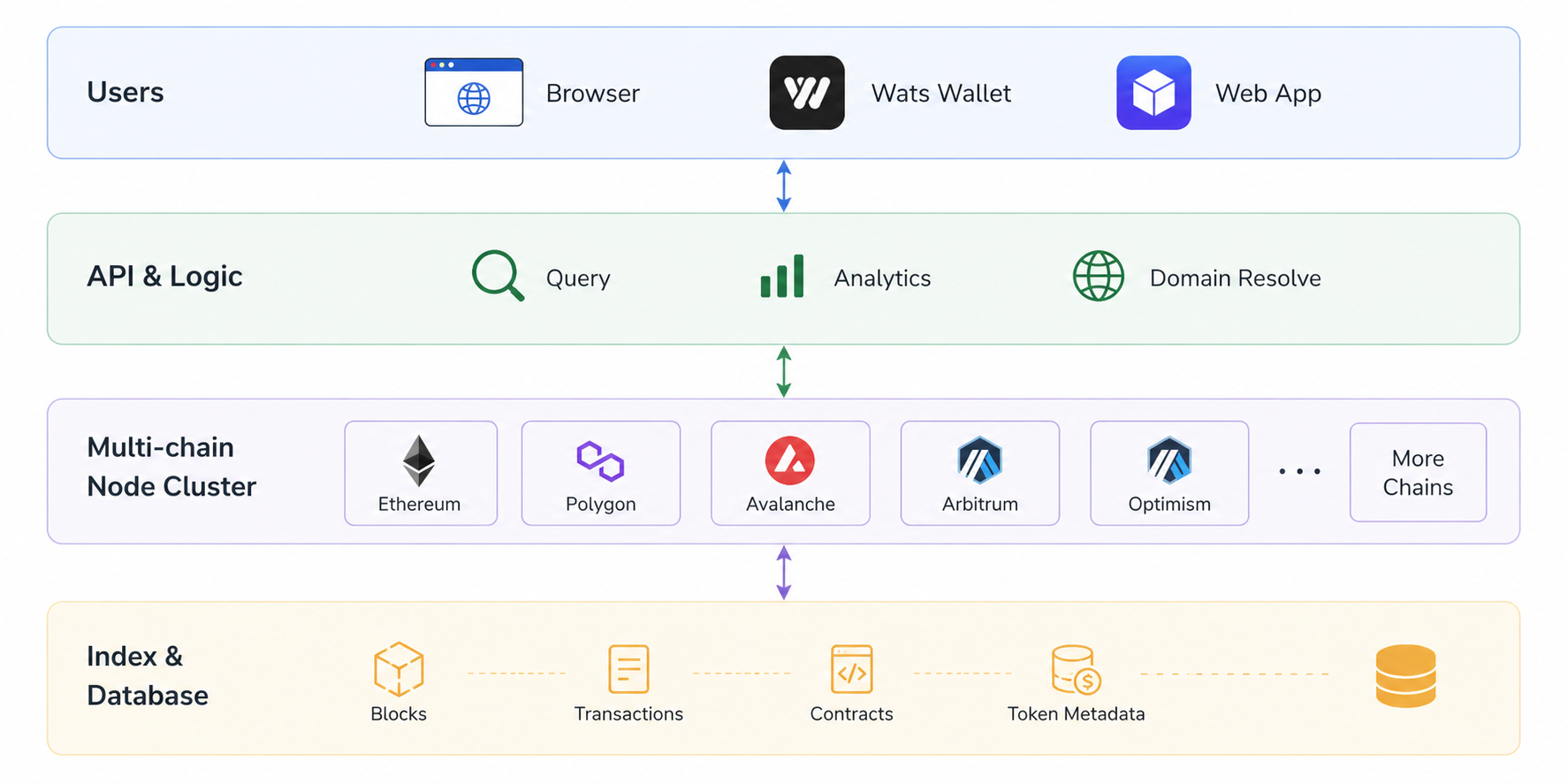
Multi-Chain Data Capabilities:
-
Full Rollup Compatibility: Supports various Rollups, making L2 transaction details and batch info easy to view.
-
High-Performance Nodes: Nodes deployed in globally independent data centers for low-latency queries serving dApps and analysts.
-
Domains & Human Interaction: Integrated domain search lets users replace long addresses with readable names (including partnerships like Unstoppable Domains).
-
Secure Login & Key Vault: Key Vault and secure login, combined with a non-custodial wallet, minimize Private Key exposure.
-
Cross-Chain Bridge Narrative: ATS serves as a bridge token to “eliminate the complexity of gas across hundreds of chains,” linking wallets and swaps.
Technically, a multi-chain explorer is an ETL for heterogeneous chain data—pulling blocks and event logs from each chain’s RPC/archive nodes, then standardizing into a unified schema for search, charts, and APIs. Alltoscan differentiates by betting on both a consumer-facing wallet and unified gas settlement, rather than offering read-only queries alone.
How Alltoscan Builds a Web3 Block Explorer Infrastructure
Block explorers are Web3’s “infrastructure interface.” Alltoscan’s buildout spans four layers:
-
Data Transparency Layer
Queries for block height, transaction status, address flows, contract bytecode, and token holdings—serving retail investors verifying transfers, projects analyzing on-chain operations, and developers debugging contracts.
-
Developer Service Layer
APIs and open-source explorer plans (per roadmap) reduce integration costs for third-party dApps and analytics platforms. Integration with ecosystems like BNB Greenfield attracts testnet and storage-related traffic.
-
User Entry Layer
Wats Wallet merges “browsing chains” with “using chains”: supports 70+ chains, displays tens of millions of assets, and offers mobile, web, and NFC physical card form factors. Employs AES256, biometrics, and local encrypted private key storage.
-
Economic Coupling Layer
Unifies fees through ATS combined with burning, linking infrastructure usage frequency to token demand in a “use → fee pool → burn” cycle.
Additionally, a planned Swap platform aims to create a closed loop of “check wallet activity + trade” within the explorer—a different philosophy from Etherscan’s federated sites, OKLink’s unified dashboard, and Blockscout’s open-source self-hosting.
ATS Use Cases in Multi-Chain Ecosystem and On-Chain Data Services
| Use Case |
Role of ATS / Alltoscan |
| Cross-Chain Trading & DeFi |
Pay multi-chain swap fees with ATS, reducing needed token variety |
| On-Chain Due Diligence |
Track fund flows and contract interactions via multi-chain explorer |
| Developer Debugging |
Query transaction receipts, event logs, and contract verification status |
| Web3 Domains |
Bind domain names to addresses for query, improving transfer UX |
| Wallet Asset Management |
Wats Wallet aggregates holdings, NFTs, and Approval records |
| Ecosystem Partnerships |
Joint promotions and data interoperability with BNB Chain, Polygon, etc. |
| Data Commercialization (Potential) |
API subscriptions, enterprise on-chain analysis (contingent on official productization) |
For institutions, multi-chain explorers reduce costs of building proprietary indexing. For individuals, the core value is one-stop readability and unified payments. Note: On-chain data services are highly competitive; retention depends on accuracy, update latency, and value-added features.
| Dimension |
Etherscan Family |
OKLink et al. |
Blockscout |
Alltoscan |
| Architecture |
Each chain independent, API family |
Unified Account and UI, 40+ chains |
Open-source, self-deploy for 100+ EVM chains |
Multi-chain aggregation + Wallet + ATS Gas |
| Business Model |
Ads, API subscriptions |
Exchange ecosystem traffic |
Chain/project hosting or sponsorship |
Tokenomics + fee burns |
| Open Source |
Partially closed |
Platform-based |
Emphasizes open-source |
Plans open-source explorer |
| Wallet |
Requires external (e.g., MetaMask) |
Varies |
Usually not built-in |
Built-in Wats Wallet |
| Gas Experience |
Native gas per chain |
Native gas per chain |
No unified gas |
Promotes paying with ATS only |
Key Differences:
-
Not just “read chains” but “use chains” (Wallet + Swap plans).
-
Unifies multi-chain fees with ATS and combines with a burning narrative.
-
Emphasizes deep ties with ecosystems like BNB Chain rather than being a neutral indexer.
Disadvantages: Brand awareness lags Etherscan/OKLink; unified gas depends on partner chains and routing, increasing implementation complexity; token price volatility may affect actual cost expectations.
Alltoscan’s Decentralized Infrastructure Vision
The official narrative positions Alltoscan as infrastructure “empowering a decentralized future”: open-source block explorer, non-custodial wallet, user-controlled private keys and data sharing permissions.
Three Layers:
-
Data Layer: Open-source explorer lets the community audit indexing logic, reducing operator opacity.
-
Account Layer: Wats Wallet generates keys locally, refuses custodial signing, reducing exchange-like counterparty risk.
-
Economic Layer: Through token burns and ecosystem funds, aligns interests of users, developers, and token holders.
Realistically, node deployment, chain listings, and fee rules are still primarily project-led with limited on-chain governance. “Decentralization” today manifests more in product design (non-custodial, transparent queries) and long-term roadmap than full DAO operation. Investors should differentiate marketing language from verifiable on-chain governance rights.
Key Risks When Investing in ATS Tokens
-
Market Risk: High volatility, significant drawdown from 2024 peak, liquidity concentrated on few exchanges, spread and depth issues may amplify slippage.
-
Unlock & Selling Pressure: Team, ecosystem, and marketing shares unlock over multiple years—monitor Token Unlocks calendar.
-
Regulatory Risk: Multi-chain wallets and swaps face KYC/AML requirements across jurisdictions; policy changes could affect product scope.
-
Technical & Security Risk: Cross-chain aggregation, private key management, and Smart Contract vulnerabilities are industry-wide; users should watch for phishing and fake apps.
-
Competition Risk: Etherscan Blockscan, OKLink, Blockscout, and others keep iterating; Alltoscan must maintain data quality and developer stickiness.
-
Narrative Delivery: Unified gas, open-source explorer, and Swap depend on sustained development and partnerships; delays affect token logic.
-
Information Transparency: Limited public info on founding team; reliance on on-chain data and third-party audits.
Disclaimer: This content is for research reference only and does not constitute investment advice. Crypto assets are high-risk; make decisions based on your own risk tolerance.
Future Direction and Market Potential of Alltoscan Ecosystem
Development Directions (based on official roadmap and industry trends):
-
Open-Source Multi-Chain Explorer: Boost developer trust and third-party integration.
-
Wats Wallet Adoption: Expand NFC physical cards, DeFi modules, and more L2s.
-
Swap & Trading Closed Loop: Enable direct trading from the query interface to increase ATS consumption.
-
API & Enterprise Services: Paid data for projects, Risk Control and compliance.
-
Deeper Ecosystem Partnerships: Continue adding new chains, rollups, and storage networks (e.g., Greenfield-like scenarios).
Market Potential:
-
Positives: Growing multi-chain user base, real demand for “unified gas/entry”; BNB Chain ecosystem traffic and partner network provide cold-start resources.
-
Challenges: Strong Matthew effect in browser/wallet space; token market cap small vs. leading infrastructure projects; sustained product milestones needed to support valuation.
If it builds a reputation for data accuracy, API stability, and wallet security, Alltoscan could become a regionally strong multi-chain toolkit. To become global infrastructure, it needs long-term investment in open-source community, developer docs, and neutrality.
Summary
Alltoscan (ATS) uses a multi-chain block explorer as a springboard into wallets, unified gas, and DeFi tools, aiming to solve the multi-chain era’s pain points of scattered chain browsing, cumbersome gas preparation, and fragmented entry points. The ATS token creates an economic loop through staking, ecosystem incentives, and gas burns, collaborating with nearly 40 ecosystem partners.
Compared to Etherscan’s federation, OKLink’s unified dashboard, and Blockscout’s open-source self-hosting, Alltoscan emphasizes token-driven consumer-side integration. Its advantages: comprehensive product suite, BNB Chain synergy, and unified fee narrative. Risks: fierce competition, high token volatility, and parts of the roadmap still pending.
For researchers: Track open-source progress, Wats Wallet user data, ATS burn records on-chain, and unlock calendars. For investors: Treat the token as high-risk; assess based on fundamentals and liquidity, not single-narrative decisions.
FAQ
-
Q1: What is the relationship between Alltoscan and ATS?
Alltoscan is the project name; ATS is its native ecosystem token, used for fees, incentives, and potential governance.
-
Q2: Which chain is ATS on?
ATS is primarily a BEP-20 token on BNB Chain, with a maximum supply of 100 million.
-
Q3: Which blockchains does Alltoscan support?
Public sources indicate support for BNB Chain, Ethereum, Avalanche, Polygon, Arbitrum, Fantom, Cronos, opBNB, and more, with ongoing expansion. See the official website for the complete list.
-
Q4: What is Wats Wallet?
Wats Wallet is Alltoscan’s non-custodial multi-chain wallet, available on mobile, web, and NFC cards, with local key storage and AES256 encryption.
-
Q5: How does “paying gas only with ATS” work?
Backend settlement and a fee pool mechanism let users pay unified fees with ATS on the frontend; native gas is handled by the system. Users should monitor exchange rates and applicable scope.