


European Securities and Markets Authority: Crypto "Perpetual Futures" Cannot Circumvent CFD Restrictions
The European Securities and Markets Authority (ESMA) issued a notice on February 25, 2026, warning that cryptocurrency derivatives sold under the names “perpetual futures” or “perpetual contracts” must comply with existing CFD intervention measures if their characteristics meet the legal definition of Contracts for Difference (CFDs). These measures include leverage limits, mandatory risk warnings, margin close-out requirements, and negative balance protection.
Key Clarification: Regulatory Scope of CFD Rules
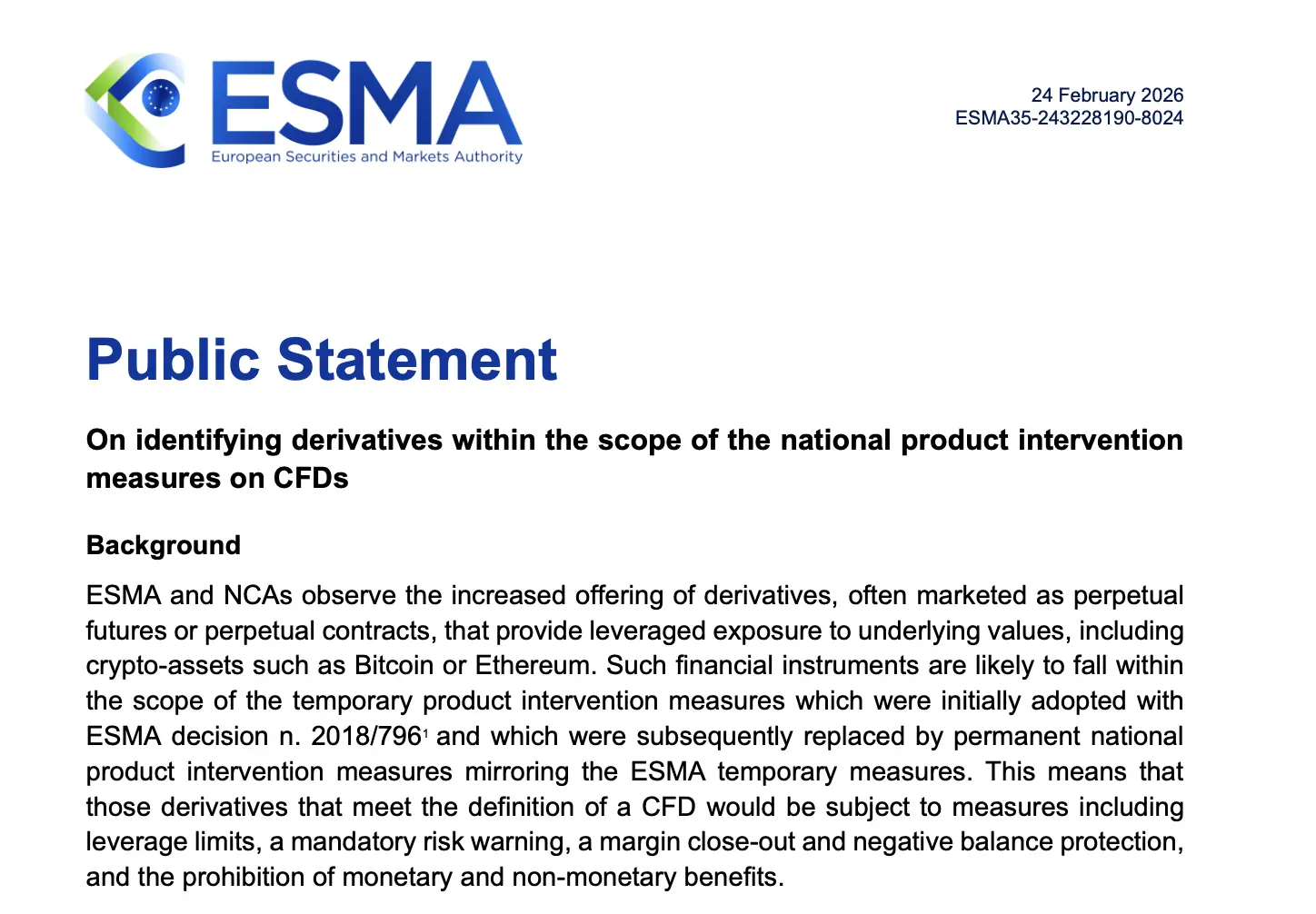
(Source: European Securities and Markets Authority)
This announcement does not introduce new regulations but clarifies the boundaries of the current CFD intervention measures. According to the notice, derivatives involving leveraged exposure to cryptocurrencies such as Bitcoin or Ethereum—regardless of how they are packaged, including “perpetual contracts,” “perpetual futures,” or other derivative labels—must adhere to the relevant regulatory requirements if their contract features meet the legal definition of CFDs.
ESMA also reminds firms to “take appropriate measures to identify, prevent, or manage conflicts of interest that may arise from offering these products,” covering distribution strategies, product governance frameworks, and client suitability assessments.
ESMA’s Clear CFD Regulatory Requirements
Leverage Limits: Set maximum leverage ratios for retail clients based on the underlying asset class (up to 2:1 for crypto assets CFDs).
Mandatory Risk Warnings: Clearly disclose loss risk ratios in marketing materials and trading interfaces.
Margin Close-Out: Enforce mandatory close-out when account margin falls below specified levels.
Negative Balance Protection: Prohibit clients’ accounts from going negative; platforms must absorb excess losses.
Prohibition of Currency and Non-Currency Benefits: Cannot incentivize account opening or trading through fee discounts, cashbacks, or gifts.
Regulatory Background and Industry Response
Established in 2011, ESMA oversees investor protection mechanisms in the EU financial markets and monitors compliance with the Markets in Crypto-Assets Regulation (MiCA). This announcement continues ESMA’s focus on crypto asset regulation—earlier in January 2026, ESMA issued a similar warning regarding the promotion of “volatile crypto assets” by industry opinion leaders.
Bill Hughes, Senior Legal Counsel and Global Regulatory Affairs Director at Consensys, responded on X platform: “If a product’s features meet the definition of a CFD, simply relabeling it as ‘perpetual futures’ does not exempt it from CFD restrictions. Companies offering leveraged derivatives to EU retail clients must reassess their product analysis, distribution strategies, and governance frameworks—otherwise, regulators will enforce compliance.”
Frequently Asked Questions
Does this ESMA announcement represent new regulation, or is it just a reiteration of existing rules?
This announcement is not new legislation but a clarification from ESMA regarding the scope of current CFD intervention measures. Its core message is that crypto derivatives providers cannot evade CFD compliance obligations merely by renaming products as “perpetual futures” or “perpetual contracts.” Regulatory authorities will assess products based on their actual features, not their labels.
What are the main regulatory restrictions on CFDs, and how do they impact crypto trading platforms?
Under ESMA’s current CFD intervention measures, retail clients’ leverage on crypto asset CFDs is limited to 2:1, with mandatory negative balance protection, margin close-out mechanisms, and risk disclosures. These requirements directly affect how exchanges and derivative platforms design, market, and comply with products offered to EU customers.
Does MiCA regulation cover crypto derivatives, and why is ESMA issuing this warning?
MiCA primarily targets the issuance and trading of spot crypto assets, with limited scope over derivatives. ESMA’s announcement fills this gap by clarifying that crypto derivatives meeting the CFD definition fall under the scope of MiFID II CFD regulation. The two regulatory frameworks are complementary, and operators must comply with both MiCA and CFD requirements.
Related Articles
Ethereum Treasury Company ETHZilla rebrands to Forum Markets and transforms into an RWA digital asset platform
Analysis: The assets under management for Ethereum ETF have evaporated by approximately 65% over four months.
Why is Ethereum's ability to replicate the Q2/2025 growth rate more difficult compared to Bitcoin