


Offshore Renminbi CNHT Enters History! Tether Withdraws in Two Phases, Redemption Window Closes in 2027
On February 21, 2026, the world’s largest stablecoin issuer, Tether, officially announced the termination of all support for the offshore Chinese yuan stablecoin CNHT (CNH₮). Starting immediately, new tokens will no longer be minted, and February 2027 has been set as the final redemption deadline. Existing holders will have a one-year transition period to convert their assets.
CNHT Delisting Mechanism: Detailed Two-Phase Timeline
The delisting process for CNHT is divided into two clear phases. The first phase took effect immediately upon announcement (February 21), with Tether fully halting the minting and issuance of CNHT. Market supply will no longer increase, and existing circulating tokens will enter a one-year transition period. The second phase is set for February 2027, at which point Tether will completely cease support for CNHT redemptions. After this date, holders will no longer be able to exchange their tokens for any assets.
Before the final deadline, current holders can still redeem tokens according to Tether’s terms of service. The company has stated that reminders will be sent, and it is advised that holders arrange their asset conversions early to avoid issues related to liquidity or technical problems.
Tether admits that demand for CNHT has been weak over the long term, with community adoption far below expectations. CNHT was initially designed to track the offshore RMB (CNH) exchange rate for transactions outside mainland China, providing international investors with a non-USD stablecoin option. However, its trading volume has never been sufficient to sustain ongoing technical maintenance costs, ultimately leading Tether to streamline its product line and reallocate resources to core business areas.
Stablecoin Market Landscape: USDT Under Pressure and USDC Gaining Strength
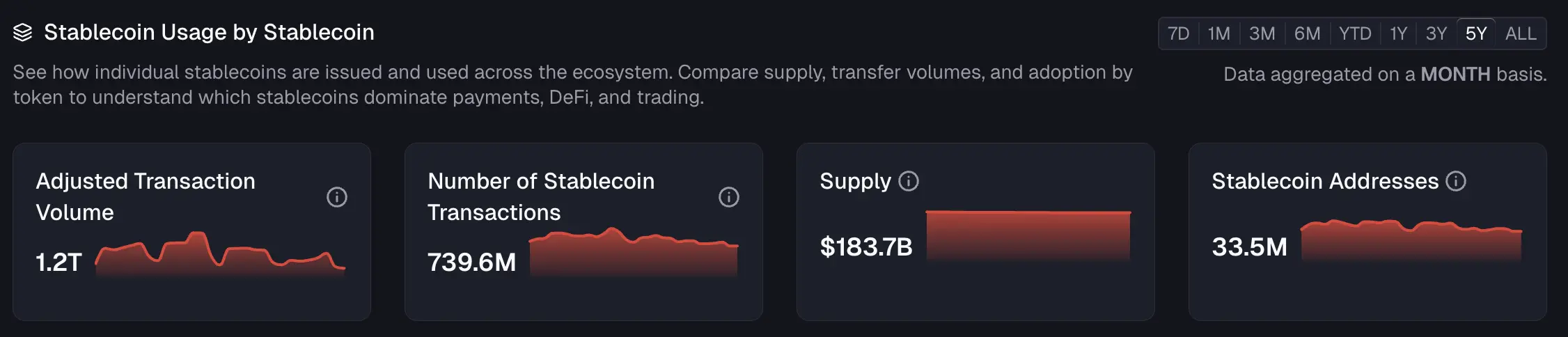
(Source: Artemis Analytics)
The delisting of CNHT occurs amid a broader restructuring of the stablecoin market. According to Artemis Analytics data, the supply of Tether’s flagship USDT saw a significant contraction in February 2026, dropping below 184 billion USD as of February 22, down from a peak of about 187 billion USD in early January—a decrease of over 3 billion USD. If this trend continues, February could mark the largest monthly decline since the FTX collapse at the end of 2022.
Meanwhile, Circle’s USDC supply grew to 76.4 billion USD in February, with a monthly increase of nearly 5%. Application data shows that in 2025, total global stablecoin transfer volume grew by 72%, reaching 33 trillion USD. USDC accounted for 18.3 trillion USD of this volume, while USDT handled 13.3 trillion USD. In transfer applications, USDC is gaining a clear competitive advantage over USDT, prompting Tether to manage its token portfolio more cautiously.
Recent Key Financial and Expansion Data for Tether
Q4 2025 Reserve Report: As of September 30, 2025, reserve assets totaled 181.2 billion USD, exceeding total liabilities of 174.4 billion USD by about 6.8 billion USD, indicating a high asset coverage ratio.
CNHT Delisting Timeline: Minting stopped on February 21, 2026; redemptions will cease in February 2027.
Personnel Expansion Plans: Currently 300 employees, with plans to add 150 engineering and technical staff within 18 months.
Diversification Strategy: Actively developing gold tokens (Tether Gold, XAU₮) and stablecoin infrastructure, with headquarters in El Salvador and offices in Switzerland.
Frequently Asked Questions
What is CNHT, and what is the core reason for Tether’s termination?
CNHT (CNH₮) is a stablecoin issued by Tether, pegged 1:1 to offshore Chinese yuan (CNH). It aims to provide a digital liquidity tool for international investors holding yuan-denominated assets. The main reasons for Tether’s termination include long-term low market demand, insufficient community adoption, and ongoing maintenance costs exceeding business benefits, leading the company to streamline its product offerings.
How should current CNHT holders handle their assets, and what is the deadline?
Existing CNHT holders can redeem their tokens before February 2027, following Tether’s terms of service. Tether will send reminders before the final deadline, and it is recommended that holders arrange their asset conversions early to avoid issues related to liquidity or technical difficulties near the deadline. After February 2027, redemption services will be fully discontinued.
Is the CNHT delisting directly related to USDT facing competition from USDC?
There is a temporal correlation. USDT’s supply significantly contracted in February 2026, while USDC’s supply grew by nearly 5% in the same month. Additionally, in 2025, USDC’s total transaction volume surpassed USDT’s, with USDC handling 18.3 trillion USD compared to USDT’s 13.3 trillion USD. Tether’s decision to streamline low-demand products and focus resources on core operations is viewed by analysts as a strategic product portfolio optimization in response to market competition, rather than an isolated decision.
Related Articles
Tether Decline Raises Concerns Over Crypto Market Liquidity
Tether announces investment in Whop, the largest internet marketplace in the world
Tether CEO releases teaser video, possibly launching cryptocurrency debit card services
U.S. Seizes $61 Million USDT, "Pig Butchering" Scam Money Laundering Chain Crumbles
Tether Offshore Renminbi Stablecoin Enters History! CNHT Issuance and Redemption Removed Within 1 Year