This comprehensive analysis compares 1INCH and BAT, two leading tokens representing distinct sectors within cryptocurrency markets. 1INCH functions as a DeFi exchange aggregation utility token launched in 2020, currently priced at $0.1552 with $150,958.49 daily trading volume on Gate, while BAT operates as a digital advertising token within the Brave browser ecosystem, trading at $0.192. The article examines historical price trends, supply mechanisms, institutional adoption, and technical ecosystems for both assets. With forecasted growth potential through 2031 and differentiated risk profiles, investors can leverage this comparison to determine optimal portfolio allocation strategies. Whether prioritizing DeFi infrastructure exposure through 1INCH or digital advertising transformation via BAT depends on individual investment objectives and risk tolerance.
Introduction: 1INCH vs BAT Investment Comparison
In the cryptocurrency market, the comparison between 1INCH vs BAT has consistently been a topic of interest for investors. These two assets differ significantly in market cap ranking, application scenarios, and price performance, representing distinct positioning within the crypto asset landscape.
1INCH (1INCH): Launched in 2020, this functional token has gained market recognition through its role in maintaining permissionless protocol integration on decentralized exchange aggregators and supporting network security through staking mechanisms.
BAT (BAT): Introduced in 2017 by Brendan Eich, co-founder of Mozilla and Firefox, BAT has established itself as a digital asset facilitating transactions between advertisers and users, addressing browser advertising display and user incentive challenges.
This article will provide a comprehensive analysis of the 1INCH vs BAT investment value comparison, examining historical price trends, supply mechanisms, institutional adoption, technical ecosystems, and future projections. We aim to address the question that investors care about most:
"Which is the better buy right now?"
I. Historical Price Comparison and Current Market Status
1INCH (Coin A) and BAT (Coin B) Historical Price Trends
- 2021: 1INCH reached its all-time high of $8.65 in October 2021, reflecting strong market interest during the DeFi expansion phase.
- 2021: BAT achieved its historical peak of $1.90 in November 2021, driven by increased adoption of the Brave browser ecosystem.
- Comparative analysis: During the broader market correction cycle, 1INCH declined from its peak of $8.65 to a historical low of $0.133186 (recorded in October 2025), while BAT experienced a decline from $1.90 to $0.072394 (recorded in July 2017, though this predates the 2021 peak).
Current Market Status (2026-01-16)
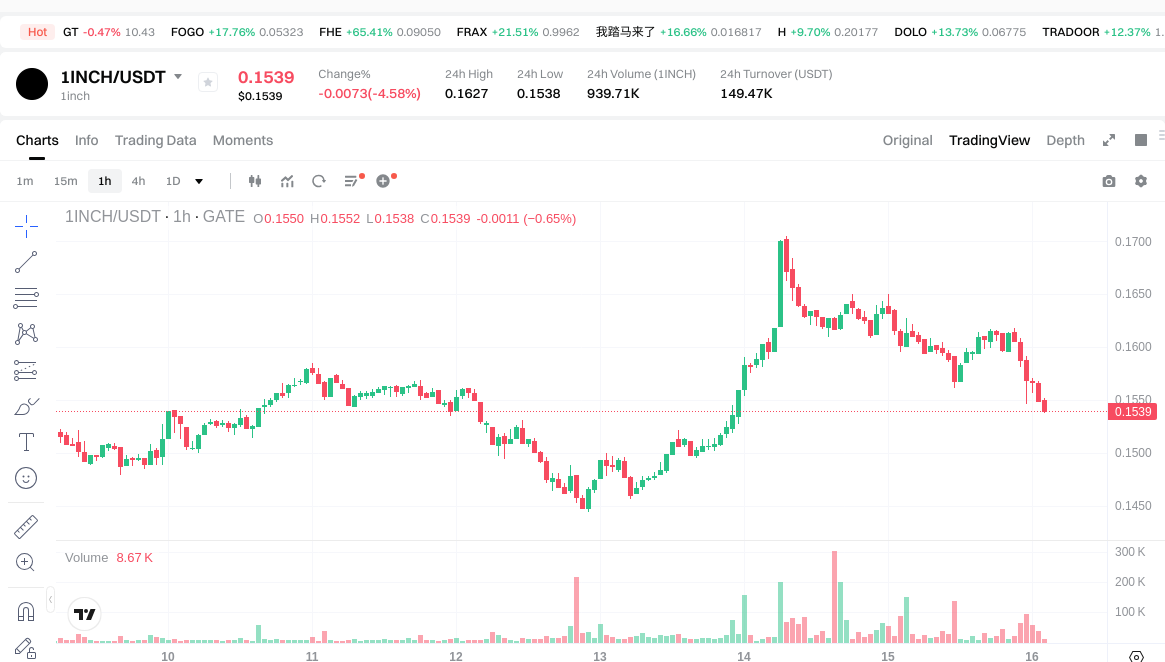
- 1INCH current price: $0.1552
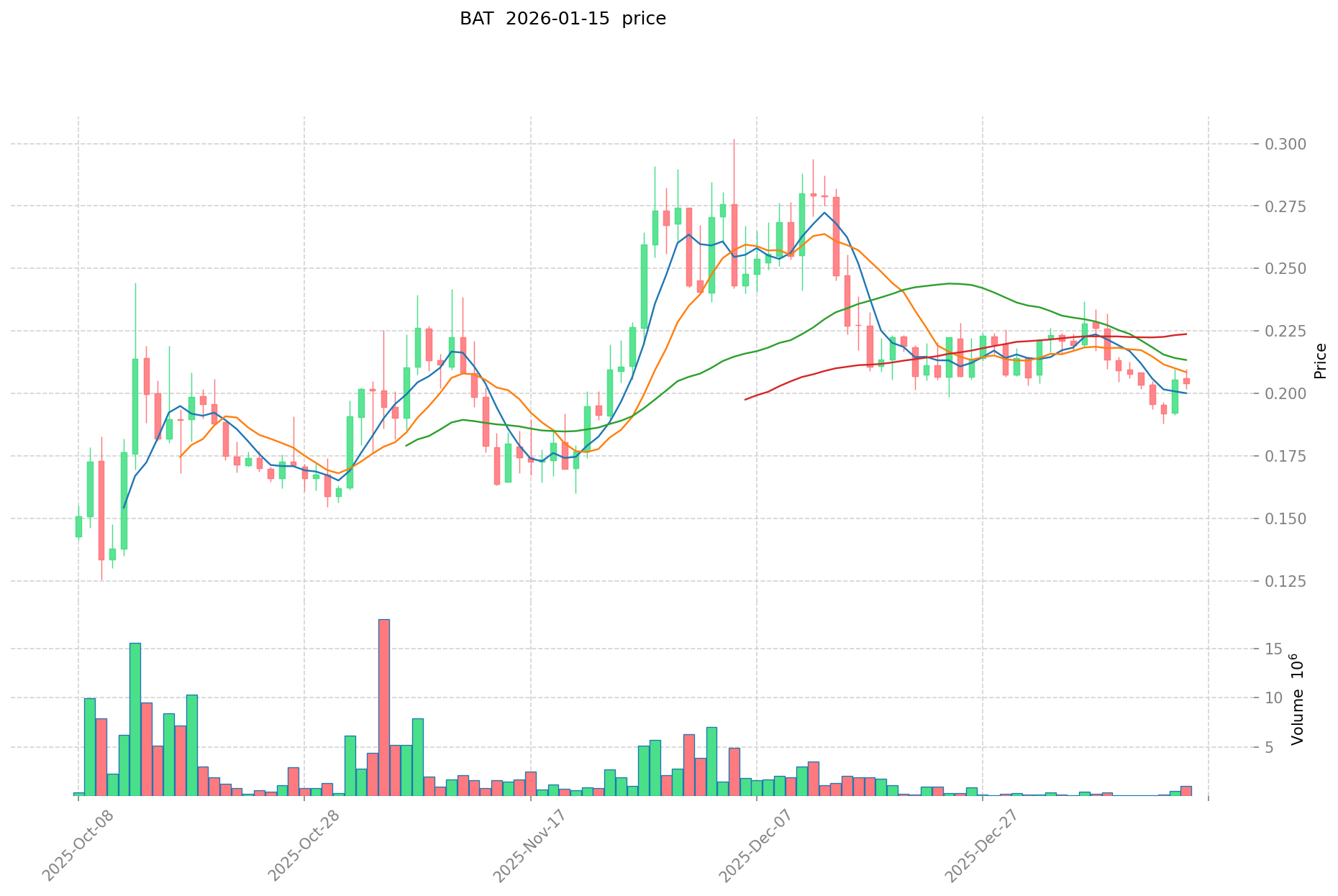
- BAT current price: $0.192
- 24-hour trading volume: $150,958.49 (1INCH) vs $84,169.13 (BAT)
- Market Sentiment Index (Fear & Greed Index): 61 (Greed)
Check real-time prices:
II. Core Factors Influencing 1INCH vs BAT Investment Value
Supply Mechanism Comparison (Tokenomics)
-
1INCH: The 1INCH token operates within a capped supply model designed to support the 1inch Network's decentralized exchange aggregation ecosystem. The tokenomics structure aims to incentivize liquidity providers and governance participants through staking mechanisms and network fee distributions.
-
BAT: Basic Attention Token follows a fixed supply framework integrated within the Brave browser ecosystem. The token circulation is driven by user engagement metrics and advertiser demand, creating a utility-based economic model that connects publishers, advertisers, and content consumers.
-
📌 Historical Pattern: Supply mechanisms directly correlate with price cycle dynamics. Tokens with programmatic supply controls and ecosystem-integrated utility tend to demonstrate stronger correlation between adoption metrics and valuation trends.
Institutional Adoption and Market Application
-
Institutional Holdings: Both tokens remain primarily retail-focused, with limited large-scale institutional accumulation compared to mainstream crypto assets. The DeFi aggregation utility of 1INCH and the digital advertising transformation potential of BAT represent distinct institutional value propositions.
-
Enterprise Integration: 1INCH serves as infrastructure for decentralized trading optimization, while BAT addresses digital advertising efficiency within the Brave ecosystem. Neither token has achieved significant penetration in cross-border payments or traditional settlement systems.
-
Regulatory Landscape: Both tokens operate within evolving regulatory frameworks. Utility token classifications provide certain operational advantages, though specific regulatory treatment varies by jurisdiction and continues to develop.
Technology Development and Ecosystem Construction
-
1INCH Technical Evolution: The platform continues enhancing its aggregation algorithms and expanding cross-chain functionality. Development focuses on optimizing trade execution efficiency and reducing transaction costs across multiple blockchain networks.
-
BAT Technical Progress: The token's development centers on expanding the Brave browser ecosystem, improving user reward mechanisms, and strengthening advertiser integration tools. Technical advancement emphasizes privacy preservation and attention-based reward distribution.
-
Ecosystem Comparison: 1INCH demonstrates stronger integration within DeFi infrastructure, serving traders and liquidity providers. BAT maintains focus on digital advertising transformation with limited expansion into NFT or smart contract applications beyond its core use case.
Macroeconomic Context and Market Cycles
-
Performance in Inflationary Environments: Neither token exhibits strong anti-inflation characteristics comparable to scarce-asset narratives. Both remain sensitive to broader crypto market sentiment and risk appetite cycles.
-
Monetary Policy Impact: Interest rate adjustments and dollar strength influence both tokens through liquidity conditions and capital flows into crypto markets. Utility tokens generally show higher sensitivity to risk-on/risk-off market dynamics.
-
Geopolitical Factors: Cross-border transaction demand and international regulatory developments create indirect impacts. The decentralized nature of both ecosystems provides certain resilience, though market access and adoption rates remain influenced by regional policy developments.
III. 2026-2031 Price Prediction: 1INCH vs BAT
Short-term Forecast (2026)
- 1INCH: Conservative $0.126-$0.154 | Optimistic $0.154-$0.206
- BAT: Conservative $0.109-$0.191 | Optimistic $0.191-$0.220
Mid-term Forecast (2028-2029)
- 1INCH may enter a consolidation phase with projected price range of $0.157-$0.265 in 2028, potentially expanding to $0.204-$0.276 by 2029
- BAT may experience gradual growth with estimated range of $0.159-$0.245 in 2028, advancing to $0.221-$0.316 in 2029
- Key drivers: institutional capital flows, ETF developments, ecosystem expansion
Long-term Forecast (2030-2031)
- 1INCH: Baseline scenario $0.237-$0.276 | Optimistic scenario $0.163-$0.390
- BAT: Baseline scenario $0.183-$0.366 | Optimistic scenario $0.270-$0.337
View detailed price predictions for 1INCH and BAT
Disclaimer: Price predictions are based on historical data analysis and market trends. Cryptocurrency markets are highly volatile and subject to various unpredictable factors. These forecasts should not be considered as investment advice. Past performance does not guarantee future results.
1INCH:
| Year |
Predicted High Price |
Predicted Average Price |
Predicted Low Price |
Price Change |
| 2026 |
0.206226 |
0.1539 |
0.126198 |
0 |
| 2027 |
0.25028757 |
0.180063 |
0.1620567 |
16 |
| 2028 |
0.26466560055 |
0.215175285 |
0.15707795805 |
38 |
| 2029 |
0.27590850919125 |
0.239920442775 |
0.20393237635875 |
54 |
| 2030 |
0.275968489301943 |
0.257914475983125 |
0.237281317904475 |
66 |
| 2031 |
0.3897345646581 |
0.266941482642534 |
0.162834304411945 |
71 |
BAT:
| Year |
Predicted High Price |
Predicted Average Price |
Predicted Low Price |
Price Change |
| 2026 |
0.219535 |
0.1909 |
0.108813 |
0 |
| 2027 |
0.256521875 |
0.2052175 |
0.121078325 |
6 |
| 2028 |
0.24472186875 |
0.2308696875 |
0.159300084375 |
20 |
| 2029 |
0.31626838490625 |
0.237795778125 |
0.22115007365625 |
23 |
| 2030 |
0.365682347600625 |
0.277032081515625 |
0.182841173800312 |
44 |
| 2031 |
0.337425075286031 |
0.321357214558125 |
0.269940060228825 |
67 |
IV. Investment Strategy Comparison: 1INCH vs BAT
Long-term vs Short-term Investment Strategies
-
1INCH: May appeal to investors focused on DeFi infrastructure development and decentralized exchange aggregation utility. The token's value proposition centers on protocol optimization and ecosystem expansion within the decentralized trading landscape.
-
BAT: May suit investors interested in digital advertising transformation and browser ecosystem development. The token's utility model connects with user engagement metrics and advertiser adoption within the Brave platform.
Risk Management and Asset Allocation
-
Conservative Investors: Consider diversified exposure with potential allocation frameworks such as 1INCH: 40% vs BAT: 60%, reflecting different risk-reward profiles and ecosystem maturity levels.
-
Aggressive Investors: May explore higher concentration strategies such as 1INCH: 60% vs BAT: 40%, emphasizing growth potential and ecosystem expansion dynamics.
-
Hedging Instruments: Stablecoin reserves, options strategies, and cross-asset portfolio construction can help manage volatility exposure and enhance risk-adjusted returns.
V. Potential Risk Comparison
Market Risks
-
1INCH: The token faces exposure to DeFi sector sentiment shifts, competitive pressure from emerging aggregation protocols, and dependency on trading volume trends across supported networks.
-
BAT: Market risks include browser adoption rate fluctuations, advertiser participation levels, and competition from alternative digital advertising models.
Technical Risks
-
1INCH: Scalability considerations include cross-chain integration complexity, smart contract security maintenance, and protocol upgrade coordination across multiple blockchain environments.
-
BAT: Technical considerations involve browser platform development continuity, reward distribution mechanism reliability, and ecosystem integration stability.
Regulatory Risks
- Global regulatory developments may impact both tokens differently based on their distinct use cases. DeFi protocols face evolving compliance frameworks around decentralized trading infrastructure, while digital advertising tokens encounter considerations related to user data, privacy regulations, and advertiser-publisher relationships. Jurisdictional variations create differentiated risk profiles for each asset.
VI. Conclusion: Which Is the Better Buy?
📌 Investment Value Summary:
-
1INCH Characteristics: The token demonstrates integration within DeFi trading infrastructure, serving as a functional component of decentralized exchange aggregation with ongoing protocol development.
-
BAT Characteristics: The token maintains a defined role within the Brave browser ecosystem, addressing digital advertising efficiency with an established user base and advertiser network.
✅ Investment Considerations:
-
New Investors: Consider starting with smaller position sizes, focusing on understanding each token's core utility and ecosystem dynamics before increasing exposure. Prioritize risk management and avoid concentration in single assets.
-
Experienced Investors: Evaluate both tokens within broader portfolio context, considering correlation with existing holdings, sector exposure balance, and alignment with investment thesis around DeFi infrastructure versus digital advertising transformation.
-
Institutional Investors: Assess liquidity profiles, custody solutions, regulatory classification, and integration potential within existing digital asset frameworks. Consider both tokens as tactical allocations rather than core holdings given current market positioning.
⚠️ Risk Disclosure: Cryptocurrency markets exhibit substantial volatility and unpredictability. This analysis does not constitute investment advice. Investors should conduct independent research and consider their risk tolerance before making investment decisions.
VII. FAQ
Q1: What is the fundamental difference between 1INCH and BAT in terms of utility?
1INCH serves as a functional token within decentralized exchange aggregation infrastructure, while BAT operates as a digital advertising utility token within the Brave browser ecosystem. 1INCH facilitates optimized trading execution across multiple DEX platforms through algorithmic aggregation, governance participation, and staking mechanisms. BAT addresses the advertising value chain by connecting advertisers, publishers, and users through attention-based reward distribution, fundamentally transforming how digital advertising transactions occur within a privacy-preserving browser environment.
Q2: Which token demonstrates stronger correlation with broader DeFi market trends?
1INCH exhibits stronger correlation with DeFi market dynamics. As a protocol token integrated within decentralized trading infrastructure, 1INCH's performance tracks DeFi sector sentiment, trading volume fluctuations, and liquidity conditions across supported networks. BAT maintains more independence from DeFi trends due to its focus on digital advertising transformation, though both tokens remain influenced by overall cryptocurrency market cycles and risk appetite shifts.
Q3: How do the supply mechanisms of 1INCH and BAT differ?
1INCH operates within a capped supply model designed to incentivize liquidity providers and governance participants through staking rewards and network fee distributions. BAT follows a fixed supply framework where token circulation is driven by user engagement metrics within the Brave ecosystem and advertiser demand patterns. The key distinction lies in their utility models: 1INCH's tokenomics support DeFi infrastructure participation, while BAT's economics facilitate attention-based advertising transactions.
Q4: What are the primary risk factors distinguishing 1INCH from BAT investments?
1INCH faces risks primarily related to DeFi sector volatility, competitive pressure from emerging aggregation protocols, smart contract security across multiple chains, and dependency on decentralized trading volume trends. BAT's risk profile centers on Brave browser adoption rates, advertiser participation levels, competition from alternative digital advertising models, and regulatory developments affecting user data privacy frameworks. Both tokens share exposure to broader cryptocurrency market sentiment and regulatory evolution, but through different sector-specific channels.
Q5: Which token offers better liquidity for institutional investors?
Based on current market data (2026-01-16), 1INCH demonstrates higher 24-hour trading volume ($150,958.49) compared to BAT ($84,169.13), suggesting marginally better short-term liquidity conditions. However, both tokens remain primarily retail-focused with limited large-scale institutional accumulation. Institutional investors should evaluate liquidity across multiple trading venues, assess custody solution availability, and consider order book depth during different market conditions rather than relying solely on aggregate volume metrics.
Q6: How do macroeconomic conditions affect 1INCH versus BAT differently?
Neither token exhibits strong anti-inflation characteristics, but they respond to macroeconomic conditions through different transmission channels. 1INCH sensitivity stems from its integration within DeFi trading infrastructure, where interest rate changes and liquidity conditions directly impact decentralized trading volumes and user participation. BAT's exposure relates to advertising budget cycles, discretionary spending patterns, and digital advertising market health. During risk-off environments, both tokens typically experience downward pressure, though 1INCH may show higher volatility due to its tighter coupling with speculative DeFi activity.
Q7: What technical developments could significantly impact the relative value proposition of these tokens?
For 1INCH, critical technical developments include successful cross-chain integration expansion, aggregation algorithm optimization improving execution efficiency, and enhanced gas fee management across Layer 2 solutions. For BAT, key technical catalysts involve Brave browser feature enhancements, expanded advertiser platform capabilities, improved user reward mechanisms, and potential integration of privacy-preserving advertising technologies. Each token's value proposition remains dependent on continued ecosystem development and adoption metrics specific to their respective use cases rather than generalized blockchain scalability improvements.
Q8: Should investors consider these tokens as complementary or competing investments?
1INCH and BAT function as complementary rather than competing investments due to their distinct utility models and sector exposures. 1INCH provides exposure to DeFi trading infrastructure and decentralized exchange aggregation, while BAT offers exposure to digital advertising transformation and browser ecosystem development. Portfolio construction may benefit from including both tokens to achieve sector diversification within cryptocurrency holdings, though allocation decisions should reflect individual risk tolerance, investment horizon, and conviction regarding each sector's growth trajectory rather than binary selection between the two assets.
* The information is not intended to be and does not constitute financial advice or any other recommendation of any sort offered or endorsed by Gate.