BARD, Lombard's governance token for Bitcoin liquid staking, offers investors a comprehensive price prediction analysis spanning 2026-2031 with forecasts ranging from $0.57 to $2.44. This article provides institutional-grade insights into BARD's market dynamics, currently trading at $0.77 with a $172.6M market cap across 32 exchanges including Gate.com. The analysis examines critical factors including token supply mechanisms, whale concentration risks, macroeconomic influences, and ecosystem development potential. Investors gain practical strategies for long-term holding and active trading, alongside detailed risk management frameworks addressing volatility, liquidity, regulatory, and technical challenges. Whether you're a beginner or institutional investor, this guide delivers actionable recommendations for BARD portfolio allocation, secure storage solutions via Gate Web3 Wallet, and strategic entry points aligned with your risk tolerance in the evolving Bitcoin DeFi landscape.
Introduction: BARD's Market Position and Investment Value
Lombard (BARD), as a decentralized finance initiative transforming Bitcoin's utility through liquid staked Bitcoin tokens, has established itself as an innovative DeFi protocol since its launch in 2025. As of 2026, BARD maintains a market capitalization of approximately $172.6 million, with a circulating supply of 225 million tokens, and the price is trading around $0.77. This asset, recognized as a "Bitcoin liquidity unlocking solution", is playing an increasingly critical role in enabling yield generation and DeFi participation for Bitcoin holders.
This article will comprehensively analyze BARD's price trajectory from 2026 to 2031, combining historical patterns, market supply-demand dynamics, ecosystem development, and macroeconomic conditions to provide investors with professional price forecasts and practical investment strategies.
I. BARD Price History Review and Market Status
BARD Historical Price Evolution Trajectory
- 2025: BARD launched on September 23, reaching an all-time high of $1.5345, followed by a sharp decline to an all-time low of $0.2373 on October 10, representing a 84.5% decrease within approximately two weeks
- Late 2025 to Early 2026: The token experienced significant volatility with price fluctuations, showing a one-year decline of 52.62% from its peak
BARD Current Market Status
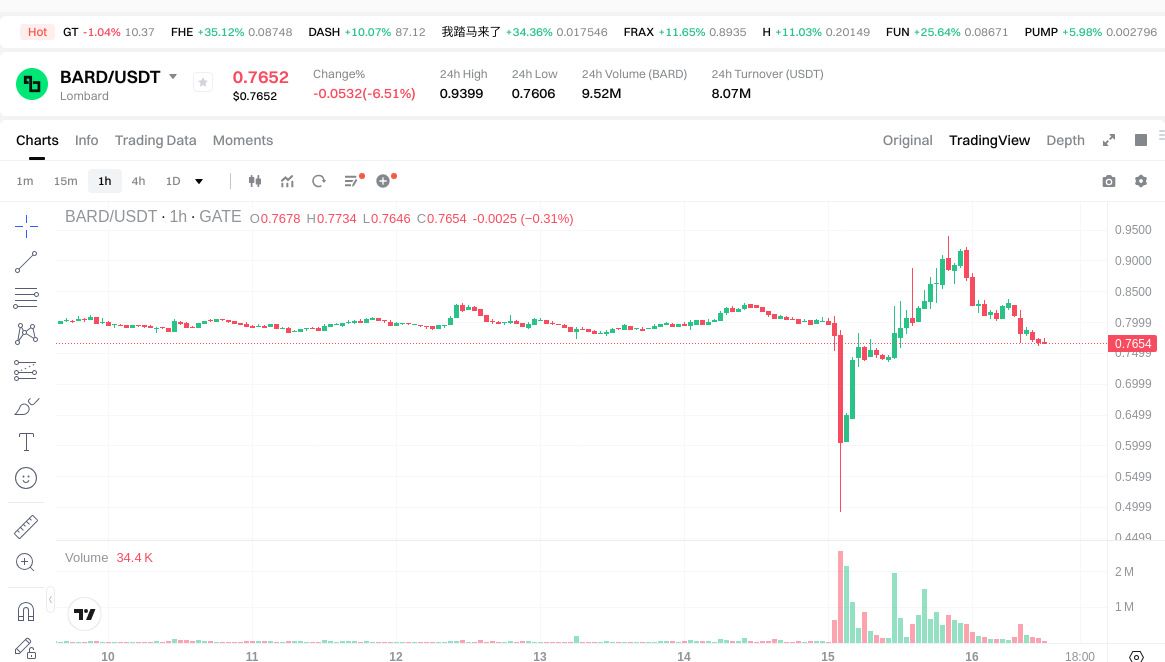
As of January 16, 2026, BARD is trading at $0.7671, showing mixed short-term performance across different timeframes. The token has declined 0.55% in the past hour and 4.96% over the last 24 hours, with the 24-hour trading range between $0.7606 and $0.9399.
Over the weekly period, BARD has decreased 3.96%, while the 30-day performance shows relative stability with only a 0.13% decline. The token's market capitalization stands at $172.60 million, ranking 263rd in the cryptocurrency market with a 0.022% market dominance. The 24-hour trading volume reached $8.17 million, indicating moderate market activity.
Lombard's BARD token has a circulating supply of 225 million tokens, representing 22.5% of the maximum supply of 1 billion tokens. The fully diluted valuation (FDV) is calculated at $767.10 million. The token has been listed on 32 exchanges and holds 35,847 holders, operating on the Ethereum network as an ERC-20 token.
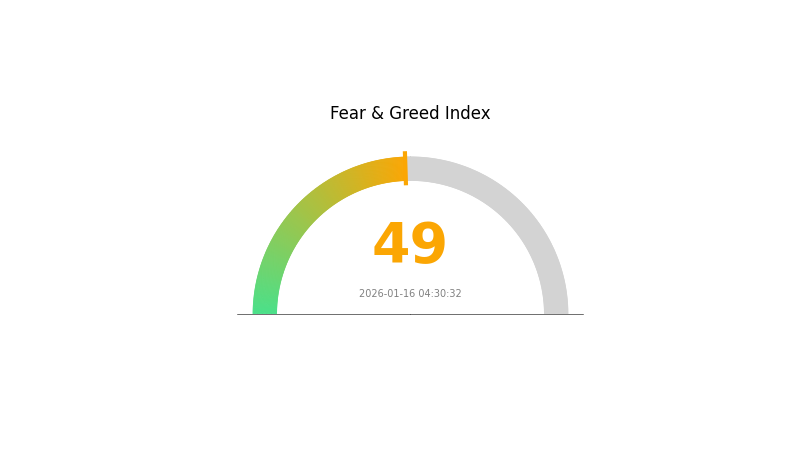
The Gate.com Crypto VIX Index currently stands at 49, indicating a neutral market sentiment environment for the broader cryptocurrency ecosystem.
Click to view the current BARD market price
BARD Market Sentiment Index
2026-01-16 Fear and Greed Index: 49 (Neutral)
Click to view current Fear & Greed Index
The cryptocurrency market is currently in a neutral sentiment state with the Fear and Greed Index standing at 49. This balanced reading suggests that market participants are exhibiting neither excessive fear nor unbridled greed. Investors should maintain a measured approach to portfolio decisions, as the market shows signs of stability without strong directional bias. Both long-term holders and traders may find this neutral environment suitable for strategic adjustments. Monitor upcoming market catalysts closely, as sentiment can shift rapidly in the dynamic crypto landscape. Consider diversifying positions and managing risk appropriately during this period of equilibrium.
BARD Holdings Distribution
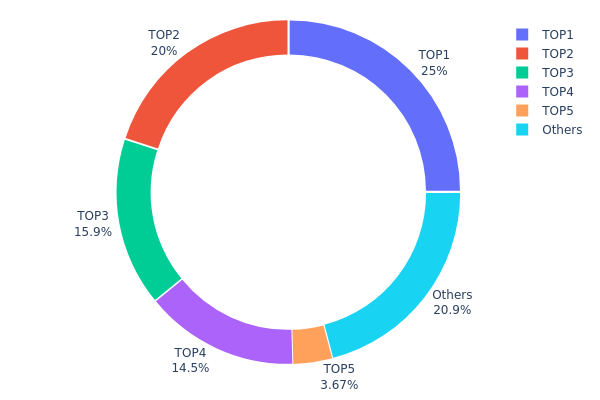
The holdings distribution chart illustrates the concentration of token ownership across different wallet addresses, serving as a critical metric for assessing the degree of decentralization and potential market manipulation risks within a cryptocurrency ecosystem. For BARD, the current distribution reveals a notably concentrated ownership structure that warrants careful examination from both structural and risk perspectives.
According to the latest on-chain data, the top five addresses collectively hold 784,964.30K BARD tokens, representing approximately 78.50% of the total supply. The largest holder controls 250,000.00K tokens (25.00%), followed by the second-largest with 200,000.00K tokens (20.00%), and the third with 159,075.77K tokens (15.90%). The fourth and fifth positions hold 145,188.53K (14.51%) and 36,700.00K (3.67%) respectively. This distribution pattern indicates a significant concentration risk, as more than three-quarters of the circulating supply resides within a limited number of addresses.
Such a concentrated holding structure presents several implications for BARD's market dynamics. The dominance of large holders creates elevated vulnerability to coordinated selling pressure, potentially triggering substantial price volatility should any major holder decide to liquidate positions. Furthermore, this concentration level raises concerns regarding governance centralization and the potential for price manipulation, as coordinated actions by top holders could disproportionately influence market sentiment and trading patterns. The relatively modest 20.92% held by "Others" suggests limited distribution among retail participants, which may constrain organic market development and price discovery mechanisms.
Click to view current BARD Holdings Distribution
| Top |
Address |
Holding Qty |
Holding (%) |
| 1 |
0x5f4b...28a34a |
250000.00K |
25.00% |
| 2 |
0x18b2...4c2201 |
200000.00K |
20.00% |
| 3 |
0xfcd7...ee5574 |
159075.77K |
15.90% |
| 4 |
0xc4ed...3989f1 |
145188.53K |
14.51% |
| 5 |
0x9b6e...32525b |
36700.00K |
3.67% |
| - |
Others |
209035.70K |
20.92% |
II. Core Factors Influencing BARD's Future Price
Supply Mechanism
- Fixed Maximum Supply: BARD operates under a capped token supply model with 1 billion tokens as the maximum issuance. As of current data, approximately 225 million BARD tokens are in circulation, representing roughly 22.5% of the total supply.
- Historical Pattern: Historical data shows that BARD experienced significant price volatility following its September 23, 2025 launch, reaching an all-time high of $1.5345 before declining sharply to $0.2373 by October 10, 2025—an 84.5% correction. This extreme volatility reflects early-stage market price discovery rather than supply-driven dynamics.
- Current Impact: The gradual release of remaining tokens may create potential selling pressure, though the pace and mechanism of future token unlocks have not been explicitly detailed in available materials. Investors should monitor token release schedules as they could influence medium-term price stability.
Institutional and Whale Dynamics
- Institutional Holdings: BARD has attracted attention from approximately 48,418 token holders across 32 global exchanges. The top holder controls 250 million tokens (25% of total supply), indicating significant concentration risk. This heavy concentration among top addresses suggests that large holder movements could substantially impact market liquidity and price action.
- Corporate Adoption: Available materials do not provide specific information regarding corporate adoption of BARD or integration into enterprise-level applications within the DeFi ecosystem.
- Regulatory Landscape: The broader cryptocurrency regulatory environment continues to evolve globally. While no jurisdiction-specific policies targeting BARD have been identified in the materials, general regulatory developments in major markets (United States, European Union, Asia-Pacific) could indirectly affect investor sentiment and market access for BARD and similar DeFi tokens.
Macroeconomic Environment
- Monetary Policy Impact: Central bank policies, particularly from the Federal Reserve, influence risk asset appetite including cryptocurrencies. Reports from late 2025 indicate market volatility surrounding Federal Reserve rate decisions, with Bitcoin retreating to the $90,000 range. Such macroeconomic headwinds typically correlate with increased volatility across the crypto sector, potentially affecting BARD's price trajectory.
- Inflation Hedge Characteristics: BARD's role in the Bitcoin DeFi ecosystem positions it within the broader narrative of Bitcoin as a potential inflation hedge. However, BARD itself has demonstrated extreme volatility with a year-to-date decline of 52.79%, suggesting its current price behavior is more influenced by project-specific factors and market speculation than macroeconomic inflation trends.
- Geopolitical Factors: Global economic and political uncertainties may influence investor interest in decentralized finance solutions. Heightened geopolitical tensions or economic instability could drive increased exploration of DeFi alternatives, though such effects remain indirect and difficult to quantify for BARD specifically.
Technology Development and Ecosystem Building
- Bitcoin Liquid Staking Infrastructure: BARD serves as the governance and utility token for Lombard, a protocol enabling liquid staking for Bitcoin within DeFi applications. This positions BARD within the emerging narrative of unlocking Bitcoin's utility beyond simple holding, potentially expanding its addressable market as Bitcoin DeFi adoption grows.
- ERC-20 Standard Deployment: BARD is deployed as an ERC-20 token on the Ethereum blockchain, benefiting from Ethereum's established infrastructure, liquidity, and interoperability with the broader DeFi ecosystem. This technical foundation supports integration with decentralized exchanges, lending protocols, and other DeFi applications.
- Ecosystem Applications: BARD's primary use case centers on facilitating Bitcoin participation in DeFi through Lombard's liquid staking mechanism. The protocol aims to address Bitcoin holders' yield generation needs while maintaining liquidity—a value proposition that could drive adoption if successfully executed. However, the project remains in early stages, and ecosystem maturity will be critical to long-term sustainability.
The interplay of these factors—supply dynamics, institutional positioning, macroeconomic conditions, and technological development—creates a complex landscape for BARD's price evolution. Market participants should recognize that early-stage DeFi tokens typically experience heightened volatility as projects establish product-market fit and navigate evolving market conditions.
III. 2026-2031 BARD Price Prediction
2026 Outlook
- Conservative forecast: $0.57458 - $0.7661
- Neutral forecast: $0.7661
- Optimistic forecast: $0.98827 (requires favorable market conditions and increased adoption)
2027-2029 Outlook
- Market stage expectation: BARD may enter a gradual growth phase as the crypto market potentially recovers from previous cycles, with increasing institutional interest and broader ecosystem development.
- Price range forecast:
- 2027: $0.5 - $1.20174 (approximately 14% year-over-year growth)
- 2028: $0.93552 - $1.25775 (approximately 35% cumulative growth)
- 2029: $0.76957 - $1.65399 (approximately 49% cumulative growth)
- Key catalysts: Market maturation, potential technological upgrades, expanding use cases, and favorable regulatory developments could drive price appreciation during this period.
2030-2031 Long-term Outlook
- Baseline scenario: $1.10703 - $1.4013 (assuming steady market growth and sustained project development)
- Optimistic scenario: $1.4013 - $2.05991 (assuming accelerated adoption and positive market sentiment)
- Transformational scenario: $2.05991 - $2.44016 (under exceptionally favorable conditions including widespread adoption, significant partnerships, and bullish crypto market trends)
- 2026-01-16: BARD price predictions suggest potential growth trajectory ranging from conservative estimates around $0.57 to optimistic projections approaching $0.99 by year-end 2026, with long-term forecasts indicating possible appreciation of up to 125% by 2031 compared to 2026 baseline levels.
| Year |
Predicted High Price |
Predicted Average Price |
Predicted Low Price |
Price Change |
| 2026 |
0.98827 |
0.7661 |
0.57458 |
0 |
| 2027 |
1.20174 |
0.87718 |
0.5 |
14 |
| 2028 |
1.25775 |
1.03946 |
0.93552 |
35 |
| 2029 |
1.65399 |
1.14861 |
0.76957 |
49 |
| 2030 |
2.05991 |
1.4013 |
1.10703 |
82 |
| 2031 |
2.44016 |
1.73061 |
1.22873 |
125 |
IV. BARD Professional Investment Strategy and Risk Management
BARD Investment Methodology
(1) Long-term Holding Strategy
- Target Investors: Believers in Bitcoin DeFi ecosystem expansion and liquid staking innovation
- Operational Recommendations:
- Consider accumulating positions during market corrections, particularly when BARD trades significantly below its recent range
- Monitor the development progress of Lombard's LBTC product and its adoption rate in the DeFi ecosystem
- Implement a diversified crypto portfolio where BARD represents a portion aligned with your risk tolerance
- Storage Solution: Utilize Gate Web3 Wallet for secure self-custody with convenient DeFi integration capabilities
(2) Active Trading Strategy
- Technical Analysis Tools:
- Volume Analysis: Monitor the 24-hour trading volume ($8.17M) relative to market cap to identify accumulation or distribution patterns
- Support and Resistance Levels: Track key price zones including the 24-hour low ($0.7606) and high ($0.9399) for short-term trading opportunities
- Swing Trading Considerations:
- BARD has shown notable volatility with a 24-hour range of approximately 23%, presenting potential swing trading opportunities
- Consider the recent 7-day decline of 3.96% when timing entry points, watching for reversal signals
- Set stop-loss orders to manage downside risk given the token's historical volatility
BARD Risk Management Framework
(1) Asset Allocation Principles
- Conservative Investors: 1-3% of crypto portfolio allocation
- Aggressive Investors: 5-8% of crypto portfolio allocation
- Professional Investors: Up to 10-15% with active management and hedging strategies
(2) Risk Hedging Solutions
- Correlation Hedging: Balance BARD exposure with Bitcoin holdings, as BARD's value proposition is tied to Bitcoin utility expansion
- Profit Taking Strategy: Consider taking partial profits during significant upward movements to lock in gains while maintaining exposure
- Diversification Approach: Spread investments across multiple DeFi protocols and liquid staking solutions to reduce protocol-specific risks
(3) Secure Storage Solutions
- Hot Wallet Recommendation: Gate Web3 Wallet for active trading and DeFi participation with user-friendly interface
- Cold Storage Option: For long-term holdings, consider hardware wallet solutions with proper backup procedures
- Security Precautions: Never share private keys or seed phrases, enable two-factor authentication, verify all transaction details before confirming, and be cautious of phishing attempts
V. BARD Potential Risks and Challenges
BARD Market Risks
- Price Volatility: BARD has experienced substantial fluctuations, with a 1-year decline of 52.62%, indicating significant market volatility that could result in losses
- Liquidity Concerns: With a market cap of $172.6M and circulating supply of only 22.5% of total supply, future token unlocks could create selling pressure
- Market Sentiment Dependency: As a DeFi project focused on Bitcoin utility, BARD's performance is closely tied to both Bitcoin market conditions and broader DeFi sector sentiment
BARD Regulatory Risks
- DeFi Regulatory Uncertainty: Evolving global regulations regarding decentralized finance platforms could impact Lombard's operations and BARD token utility
- Securities Classification Risk: Regulatory authorities may classify certain DeFi tokens as securities, potentially restricting trading or requiring compliance measures
- Cross-border Compliance: As a decentralized protocol, Lombard may face challenges navigating different regulatory frameworks across jurisdictions
BARD Technical Risks
- Smart Contract Vulnerabilities: As with any DeFi protocol, potential bugs or exploits in Lombard's smart contracts could compromise user funds and token value
- Protocol Dependency: BARD's value is closely tied to the success and security of the LBTC liquid staking mechanism, creating concentration risk
- Adoption Risk: The project's success depends on widespread adoption of LBTC in the DeFi ecosystem, which remains uncertain in a competitive landscape
- Integration Risks: Technical issues or delays in integrating LBTC with major DeFi protocols could hinder growth prospects
VI. Conclusion and Action Recommendations
BARD Investment Value Assessment
Lombard (BARD) presents an innovative approach to unlocking Bitcoin's utility in DeFi through liquid staking solutions. The project addresses a genuine market need by enabling Bitcoin holders to earn yields and participate in DeFi without selling their BTC holdings. With a market cap of $172.6M and listing on 32 exchanges including Gate.com, BARD has achieved notable market presence since its launch. However, investors should consider the substantial price volatility, with the token down 52.62% over the past year and trading well below its previous peak. The limited circulating supply of 22.5% also presents both opportunity and risk, as future token unlocks could impact price dynamics. Long-term value depends on successful LBTC adoption across DeFi protocols and the project's ability to differentiate itself in the competitive liquid staking landscape.
BARD Investment Recommendations
✅ Beginners: Start with small position sizes (1-2% of crypto portfolio) and focus on understanding the liquid staking concept before increasing exposure. Use Gate.com's spot trading to establish positions and store tokens in Gate Web3 Wallet for secure management.
✅ Experienced Investors: Consider strategic accumulation during market dips while monitoring project development milestones and LBTC integration progress. Implement risk management through position sizing and stop-loss orders, allocating 3-5% of crypto portfolio based on conviction.
✅ Institutional Investors: Conduct thorough due diligence on Lombard's protocol architecture, smart contract audits, and competitive positioning. Consider structured entry strategies with defined risk parameters and regular portfolio rebalancing, potentially allocating up to 5-10% with appropriate hedging mechanisms.
BARD Trading Participation Methods
- Spot Trading: Purchase BARD directly on Gate.com with competitive trading fees and deep liquidity, suitable for investors seeking direct token ownership.
- Dollar-Cost Averaging (DCA): Implement systematic investment plans to reduce timing risk and build positions gradually over time, particularly effective in volatile markets.
- Portfolio Integration: Incorporate BARD as part of a diversified DeFi portfolio alongside other liquid staking and Bitcoin-related protocols to balance risk and opportunity.
Cryptocurrency investments carry extremely high risks, and this article does not constitute investment advice. Investors should make prudent decisions based on their own risk tolerance and are advised to consult professional financial advisors. Never invest more than you can afford to lose.
FAQ
What is Google Bard and how does its pricing model work?
Google Bard is a generative AI tool designed for conversational interactions using advanced machine learning and natural language processing. It operates on a freemium model, offering free basic access while premium features require paid subscription. Specific pricing details remain undisclosed by Google.
Bard offers competitive pricing as a free AI tool, similar to ChatGPT's free tier. Premium features vary by platform. Bard's token economics provide value through efficient processing costs compared to other AI solutions.
What is the future outlook for Bard's pricing and market adoption?
Bard's pricing is expected to appreciate with increasing regulatory clarity and institutional adoption. Market momentum will strengthen as compliance frameworks solidify and real-world utility expands, driving sustained growth in trading volume and ecosystem participation.
Will Bard offer premium or enterprise pricing tiers in the future?
Yes, Bard will introduce premium and enterprise pricing tiers. Premium tier will require a paid subscription, offering advanced features and priority support for users seeking enhanced functionality.
How might Bard's price be affected by competition in the AI market?
Intense AI market competition may pressure Bard's price downward as competitors adopt aggressive pricing strategies. However, strong utility and adoption could support price appreciation despite competitive pressures in the evolving AI sector.
* The information is not intended to be and does not constitute financial advice or any other recommendation of any sort offered or endorsed by Gate.