This comprehensive guide analyzes Lombard (BARD), a Bitcoin liquid staking token positioned at $0.7804 with $175.59M market cap. The article examines BARD's historical price trajectory from launch through 2026, incorporating supply dynamics, institutional holdings, and macroeconomic factors. It projects price ranges through 2031, from conservative $0.46-$0.78 in 2026 to optimistic $1.28-$1.68 by 2031. The guide provides actionable investment strategies for beginners and professionals, emphasizing risk management through portfolio diversification and position sizing. Key considerations include concentrated whale holdings (45% supply), -51.61% yearly decline, and DeFi regulatory uncertainties. Readers gain clear entry strategies, secure custody recommendations via Gate Web3 Wallet, and technical analysis frameworks to navigate BARD's volatile market on Gate exchange effectively.
Introduction: BARD's Market Position and Investment Value
Lombard (BARD), positioned as a decentralized finance initiative transforming Bitcoin's utility through liquid staked Bitcoin tokens, has established a notable presence in the DeFi ecosystem since its launch in 2025. As of 2026, Lombard maintains a market capitalization of approximately $175.59 million, with a circulating supply of 225 million tokens, and the price hovering around $0.7804. This asset, recognized for its innovative approach to Bitcoin liquidity staking, is playing an increasingly significant role in bridging Bitcoin holders with DeFi yield opportunities.
This article will comprehensively analyze BARD's price trajectory from 2026 to 2031, combining historical patterns, market supply-demand dynamics, ecosystem development, and macroeconomic conditions to provide investors with professional price forecasts and practical investment strategies.
I. BARD Price History Review and Market Status
BARD Historical Price Evolution Trajectory
- 2025: Token launch and early trading phase, price experienced significant volatility with an all-time high of $1.5345 recorded on September 23, 2025
- 2025: Market correction period, price declined from the peak to reach an all-time low of $0.2373 on October 10, 2025
- 2025-2026: Recovery and stabilization phase, price gradually rebounded from the low point to current levels around $0.78
BARD Current Market Situation
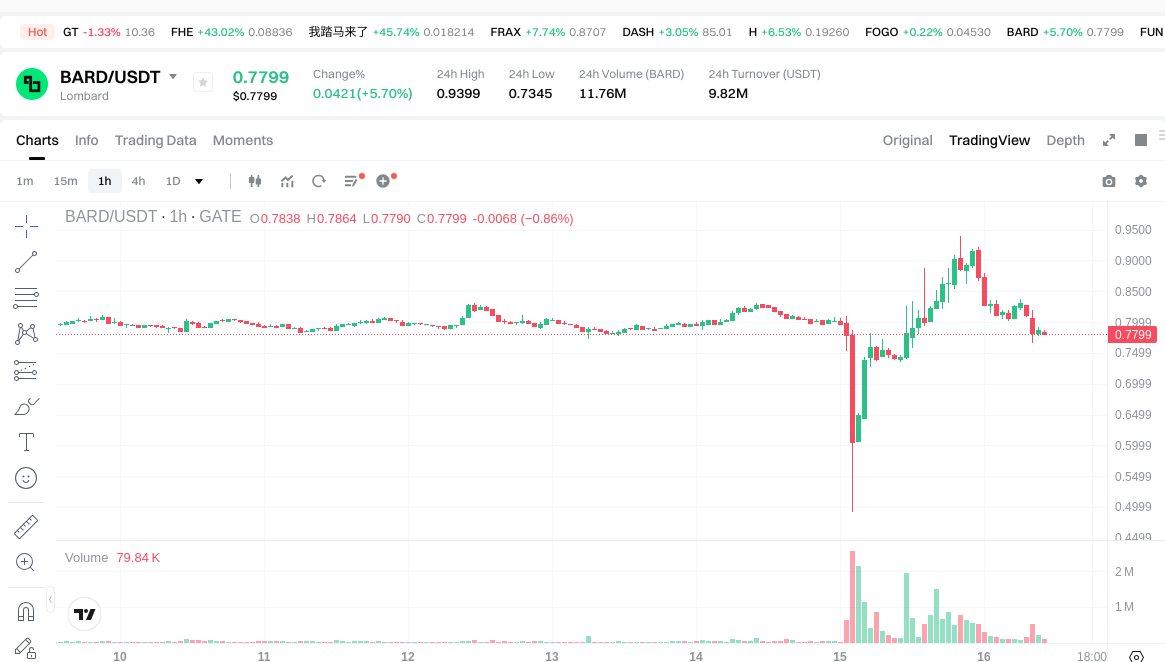
As of January 16, 2026, BARD is trading at $0.7804, representing a 24-hour increase of 5.67%. The token has demonstrated short-term bullish momentum with a 1-hour gain of 0.08%, though it experienced a slight 7-day decline of 1.69%. Over the past 30 days, BARD showed positive performance with a 2.42% increase.
The token's 24-hour trading range spans from $0.7345 to $0.9399, indicating notable intraday volatility. Current trading volume stands at approximately $9.82 million over the past 24 hours. BARD currently ranks #261 in market capitalization with a circulating market cap of $175.59 million.
With 225 million tokens in circulation out of a maximum supply of 1 billion, BARD maintains a circulation ratio of 22.5%. The fully diluted market cap stands at $780.4 million, and the token commands a 0.023% share of the total cryptocurrency market. The project has attracted 35,847 holders and is listed on 32 exchanges.
From its all-time high of $1.5345, BARD has declined by approximately 49.1%, while from its all-time low of $0.2373, it has gained approximately 228.9%. The year-over-year performance shows a decline of 51.61%, reflecting the broader market adjustments since the token's launch.
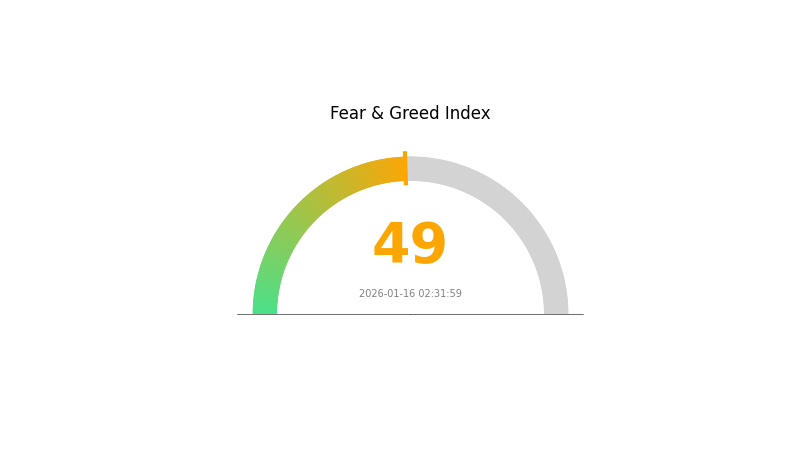
The crypto fear and greed index currently reads 49, indicating a neutral market sentiment environment for digital assets.
Click to view current BARD market price
BARD Market Sentiment Index
2026-01-16 Fear and Greed Index: 49(Neutral)
Click to view current Fear & Greed Index
The cryptocurrency market is currently in a neutral sentiment state with an index reading of 49. This balanced positioning suggests that market participants are neither excessively fearful nor overwhelmingly greedy. Investors should exercise measured caution and rational decision-making during this period. Market conditions remain relatively stable, making it an appropriate time for strategic positioning and careful portfolio management on Gate.com and other platforms.
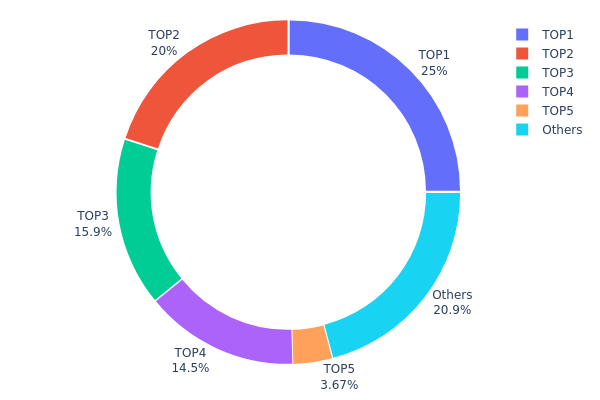
BARD Holding Distribution
According to the current on-chain data, BARD exhibits a highly centralized holding structure. The top holder controls 250,000K tokens (25.00% of total supply), while the second-largest address holds 200,000K tokens (20.00%). The top five addresses collectively control approximately 79.08% of the total circulating supply, with only 20.92% distributed among other addresses. This concentration pattern indicates that BARD's on-chain distribution remains heavily skewed toward a few major holders.
Such extreme concentration presents significant implications for market dynamics. The top two addresses alone control 45% of the supply, creating substantial selling pressure potential. If these major holders decide to liquidate positions, the market could experience severe price volatility due to insufficient liquidity absorption capacity. Additionally, this distribution structure increases the risk of price manipulation, as coordinated actions by these large holders could artificially influence market sentiment and trading prices.
From a decentralization perspective, BARD's current holding distribution reflects an immature market structure that contradicts the fundamental principles of cryptocurrency decentralization. The limited dispersion among retail investors and the dominance of whale addresses suggest that the project may still be in early development stages or that token distribution mechanisms require optimization. Investors should exercise heightened caution regarding liquidity risks and potential price manipulation when participating in BARD trading activities.
Click to view current BARD Holding Distribution
| Top |
Address |
Holding Qty |
Holding (%) |
| 1 |
0x5f4b...28a34a |
250000.00K |
25.00% |
| 2 |
0x18b2...4c2201 |
200000.00K |
20.00% |
| 3 |
0xfcd7...ee5574 |
159075.77K |
15.90% |
| 4 |
0xc4ed...3989f1 |
145188.53K |
14.51% |
| 5 |
0x9b6e...32525b |
36700.00K |
3.67% |
| - |
Others |
209035.70K |
20.92% |
II. Core Factors Influencing BARD's Future Price
Supply Mechanism
-
ERC-20 Token Standard: BARD operates as an ERC-20 token on the Ethereum blockchain with a circulating supply of 225 million tokens as of December 17, 2025. The token distribution mechanism follows standard ERC-20 protocols, allowing for transparent on-chain tracking.
-
Historical Patterns: Since its listing on September 23, 2025, BARD experienced notable volatility with its all-time high reaching $1.5345. However, concentrated holdings present a significant factor—top two addresses control approximately 45% of the supply, creating potential centralization risks that may amplify price movements during large transfers.
-
Current Impact: The high concentration of holdings among major addresses introduces market manipulation risks. Any substantial transfers from these large holders could trigger intensified price fluctuations, adding uncertainty to short-term price stability.
Institutional and Large Holder Dynamics
-
Institutional Holdings: Current data indicates approximately 48,418 token holders globally, with BARD listed on 32 exchanges worldwide. However, the concentration among top holders remains a critical concern, as the leading two addresses command 45% of total supply.
-
Adoption Patterns: BARD's integration within the DeFi liquid staking ecosystem positions it within the Bitcoin yield-generation sector. The token serves as participation rights in Lombard's Bitcoin liquid staking infrastructure, though specific enterprise adoption details remain limited in available materials.
-
Market Positioning: Trading volume has shown significant activity, with 24-hour volumes reaching approximately $16.68 million during recent volatility periods. This indicates active market participation despite the relatively early-stage nature of the project.
Macroeconomic Environment
-
Monetary Policy Influence: The broader cryptocurrency market has experienced fluctuations tied to Federal Reserve interest rate decisions. During recent periods, Bitcoin retreated to around $90,000 amid Fed policy expectations, though BARD demonstrated some resistance to these downward pressures, potentially benefiting from localized Bitcoin DeFi ecosystem recovery.
-
Market Volatility: The cryptocurrency sector's inherent 24/7 trading nature and high volatility create both opportunities and risks for BARD holders. The token's 26.35% volatility rate over certain 24-hour periods reflects this characteristic volatility.
-
Correlation Patterns: While specific correlation coefficients are not provided in available materials, BARD's price movements appear partially influenced by broader Bitcoin and DeFi market trends, though the token has occasionally moved independently of major cryptocurrency market directions.
Technical Development and Ecosystem Building
-
DeFi Integration: BARD functions within the decentralized finance liquid staking infrastructure, specifically addressing Bitcoin yield generation needs. This positioning places the token at the intersection of Bitcoin and DeFi, two significant sectors within the cryptocurrency landscape.
-
Technical Infrastructure: Operating on Ethereum's ERC-20 standard provides BARD with access to established infrastructure, wallets, and decentralized applications within the Ethereum ecosystem. This compatibility facilitates integration opportunities across the broader DeFi landscape.
-
Platform Development: The Lombard protocol focuses on Bitcoin liquid staking solutions, representing an attempt to bring yield-generating capabilities to Bitcoin holders. However, specific technical upgrade details or roadmap milestones are not extensively documented in available reference materials.
-
Community Engagement: With approximately 48,418 holders and listing across 32 exchanges, BARD has established initial market presence. Community discussions on social platforms indicate active trader engagement, with participants monitoring key support levels around $0.81 and resistance near $1.09.
III. 2026-2031 BARD Price Prediction
2026 Outlook
- Conservative Prediction: $0.46085 - $0.7811
- Neutral Prediction: Around $0.7811
- Optimistic Prediction: Up to $0.82797 (requires favorable market conditions and increased adoption)
2027-2029 Outlook
- Market Stage Expectation: BARD may enter a gradual growth phase as the broader crypto market matures and adoption patterns stabilize
- Price Range Predictions:
- 2027: $0.70799 - $0.96544
- 2028: $0.53099 - $1.31863
- 2029: $0.99163 - $1.48744
- Key Catalysts: Ecosystem development, potential partnerships, technological upgrades, and overall crypto market sentiment could drive price momentum during this period
2030-2031 Long-term Outlook
- Baseline Scenario: $1.06159 - $1.69596 (assuming steady ecosystem growth and maintained market interest)
- Optimistic Scenario: $1.28595 - $1.68968 (assuming strong adoption and favorable regulatory developments)
- Transformative Scenario: Potential to reach upper ranges if BARD achieves significant breakthroughs in use cases or secures major institutional adoption
- 2026-01-16: BARD price predictions indicate potential growth trajectory over the five-year period, with projected increases ranging from baseline stability to substantial appreciation
| Year |
Predicted High Price |
Predicted Average Price |
Predicted Low Price |
Price Change |
| 2026 |
0.82797 |
0.7811 |
0.46085 |
0 |
| 2027 |
0.96544 |
0.80453 |
0.70799 |
3 |
| 2028 |
1.31863 |
0.88499 |
0.53099 |
13 |
| 2029 |
1.48744 |
1.10181 |
0.99163 |
41 |
| 2030 |
1.69596 |
1.29462 |
1.06159 |
65 |
| 2031 |
1.68968 |
1.49529 |
1.28595 |
91 |
IV. BARD Professional Investment Strategies and Risk Management
BARD Investment Methodology
(1) Long-term Holding Strategy
- Suitable for: Investors seeking exposure to Bitcoin DeFi innovation with a multi-year horizon
- Operational Recommendations:
- Consider accumulating positions during market corrections when BARD trades below 30-day moving averages
- Monitor Lombard's LBTC adoption metrics and DeFi integration progress as fundamental indicators
- Implement a secure storage solution using Gate Web3 Wallet for enhanced asset protection
(2) Active Trading Strategy
- Technical Analysis Tools:
- Moving Averages: Track 7-day and 30-day MAs to identify trend reversals; current +2.42% monthly performance suggests consolidation phase
- Volume Analysis: Monitor daily trading volume (currently $9.8M) against market cap ($175.59M) to gauge liquidity conditions
- Swing Trading Essentials:
- Establish clear entry points near recent support levels around $0.73-$0.78 range
- Set stop-loss orders 8-12% below entry to manage downside exposure
BARD Risk Management Framework
(1) Asset Allocation Principles
- Conservative Investors: 1-3% portfolio allocation
- Aggressive Investors: 5-8% portfolio allocation
- Professional Investors: Up to 10-15% with active hedging strategies
(2) Risk Hedging Solutions
- Portfolio Diversification: Balance BARD exposure with established layer-1 assets and stablecoins
- Position Sizing: Limit single-trade exposure to 2-5% of crypto portfolio value
(3) Secure Storage Solutions
- Software Wallet Recommendation: Gate Web3 Wallet for convenient access and integrated trading features
- Multi-signature Solutions: Consider institutional-grade custody for holdings exceeding $50,000
- Security Considerations: Enable two-factor authentication, maintain offline backup of recovery phrases, and never share private keys
V. BARD Potential Risks and Challenges
BARD Market Risks
- High Volatility: BARD experienced -51.61% decline over the past year, reflecting significant price instability
- Liquidity Constraints: With 22.5% circulating supply, potential concentration risks exist among large holders
- Correlation Risks: Bitcoin-derivative tokens may exhibit heightened sensitivity to BTC price movements and DeFi market conditions
BARD Regulatory Risks
- DeFi Oversight Uncertainty: Evolving regulatory frameworks for liquid staking derivatives could impact operational models
- Cross-border Compliance: Multi-jurisdictional regulatory requirements may affect platform accessibility
- Tokenomics Transparency: Limited disclosure on vesting schedules and token distribution may concern institutional participants
BARD Technical Risks
- Smart Contract Vulnerabilities: DeFi protocols face inherent risks of code exploits despite audit processes
- Bridge Security: Cross-chain Bitcoin operations introduce additional attack vectors
- Scalability Concerns: Network congestion on Ethereum (ERC-20 standard) could affect transaction efficiency during high-demand periods
VI. Conclusion and Action Recommendations
BARD Investment Value Assessment
Lombard presents an innovative approach to unlocking Bitcoin liquidity through LBTC tokenization, addressing a significant market need in DeFi yield generation. The project's 22.5% circulating supply suggests controlled token distribution, though this also indicates substantial future unlock events. With 35,847 holders and listing on 32 exchanges including Gate.com, BARD demonstrates reasonable early adoption. However, the -51.61% yearly performance and current market cap of $175.59M reflect investor caution amid competitive liquid staking landscape. Long-term value depends on LBTC adoption rates and successful DeFi protocol integrations.
BARD Investment Recommendations
✅ Beginners: Start with minimal allocation (1-2%) to understand Bitcoin DeFi mechanics; use dollar-cost averaging to mitigate entry timing risks
✅ Experienced Investors: Consider 3-5% strategic allocation with active monitoring of protocol developments and quarterly rebalancing based on performance metrics
✅ Institutional Investors: Conduct thorough due diligence on smart contract audits and governance structures; consider 5-10% position with hedging strategies through derivatives or correlated asset pairs
BARD Trading Participation Methods
- Spot Trading: Access BARD/USDT pairs on Gate.com with competitive liquidity and trading fees
- Gradual Accumulation: Implement systematic investment plans to average entry prices over 3-6 month periods
- Yield Strategies: Explore staking or liquidity provision opportunities within Lombard ecosystem for enhanced returns
Cryptocurrency investments carry extremely high risks, and this article does not constitute investment advice. Investors should make cautious decisions based on their own risk tolerance and are advised to consult professional financial advisors. Never invest more than you can afford to lose.
FAQ
What is BARD? What are its uses and value propositions?
BARD is an AI-powered cryptocurrency token designed to enhance blockchain intelligence and automation. Its value proposition centers on providing advanced AI analytics, predictive insights, and smart contract optimization for the Web3 ecosystem, enabling users to make informed decisions in decentralized finance.
What are the main factors affecting BARD's price?
BARD's price is primarily influenced by supply and demand dynamics, market sentiment, and technical analysis. Key support and resistance levels significantly impact price movements. Trading volume and broader cryptocurrency market trends also play crucial roles in determining price direction.
How to conduct BARD price predictions? What analysis methods are available?
BARD price prediction relies on technical analysis and historical trend data. Key methods include technical indicators, trading volume analysis, and customizable growth rate projections. Current analysis suggests potential upward movement based on market momentum and on-chain metrics.
BARD's price remained stable following its launch. The most significant event was its upgrade to Gemini Pro in 2025, which enhanced its capabilities. No major price volatility occurred during this period.
What is the price prediction for BARD in 2024-2025?
Based on market analysis, BARD's 2024-2025 price predictions range from $0.85 to $1.85, with an average prediction of $1.30. For 2026, predictions suggest $1.05 to $2.22.
What are the main risks of investing in BARD?
Main risks include market volatility, price manipulation, global regulatory uncertainty, and technical risks from security issues or upgrade failures. These factors may impact investment returns.
BARD offers superior security features including multi-factor authentication and cold storage, combined with a user-friendly interface and competitive trading fees. It provides advanced trading tools and responsive customer support, delivering strong security infrastructure and efficient transaction execution.
BARD的流动性如何?在哪些交易所可以交易?
BARD has strong liquidity with trading volume exceeding $250 million in initial hours. The token is actively traded on major platforms and maintains robust on-chain liquidity, supporting healthy price discovery and efficient trading.
What is BARD's technical roadmap and future development plan?
BARD follows a four-phase roadmap starting with foundation building in 2024, progressing through development stages with continuous tech innovation and market expansion to enhance ecosystem utility and adoption.
How do professional analysts predict the BARD price?
Professional analysts predict BARD may rebound toward its initial $1.47 launch price in the coming days. Short-term price targets are expected to range between $0.9-$1.35. Medium-term forecasts suggest potential growth driven by increasing adoption and market sentiment.
* The information is not intended to be and does not constitute financial advice or any other recommendation of any sort offered or endorsed by Gate.