This comprehensive guide provides professional Bitcoin price analysis and market outlook for 2026-2031, combining historical patterns, supply dynamics, and macroeconomic factors. Bitcoin currently trades at $91,304 with a $1.82 trillion market cap and 56% dominance, presenting consolidation opportunities for long-term investors. The article forecasts price ranges from $52,952-$104,991 in 2026, escalating to $118,198-$171,781 by 2031, driven by institutional adoption, halving cycles, and regulatory clarity. Detailed investment strategies including dollar-cost averaging and technical analysis, combined with robust risk management frameworks, equip both beginners and experienced traders with actionable insights. Essential security recommendations via Gate Web3 Wallet and comprehensive risk assessments address market volatility, regulatory uncertainties, and technical challenges.
Introduction: BTC's Market Position and Investment Value
Bitcoin (BTC), as the pioneering decentralized digital currency, has established itself since its inception in 2009. As of 2026, Bitcoin has achieved a market capitalization of approximately $1.82 trillion, with a circulating supply of about 19.98 million coins, and the price maintaining around $91,304. This asset, often referred to as "digital gold," is playing an increasingly critical role in the digital asset ecosystem and as a store of value.
This article will comprehensively analyze Bitcoin's price trends from 2026 to 2031, combining historical patterns, market supply and demand dynamics, ecosystem development, and macroeconomic conditions to provide investors with professional price forecasts and practical investment strategies.
I. BTC Price History Review and Market Status
BTC Historical Price Evolution Trajectory
- 2013: Bitcoin experienced significant volatility during its early growth phase, with the price reaching a low point of $67.81 in July, marking an important milestone in its price discovery process.
- 2025: Bitcoin achieved a remarkable price level of $126,080 in October, representing a significant milestone in its market development and reflecting growing institutional adoption and market maturity.
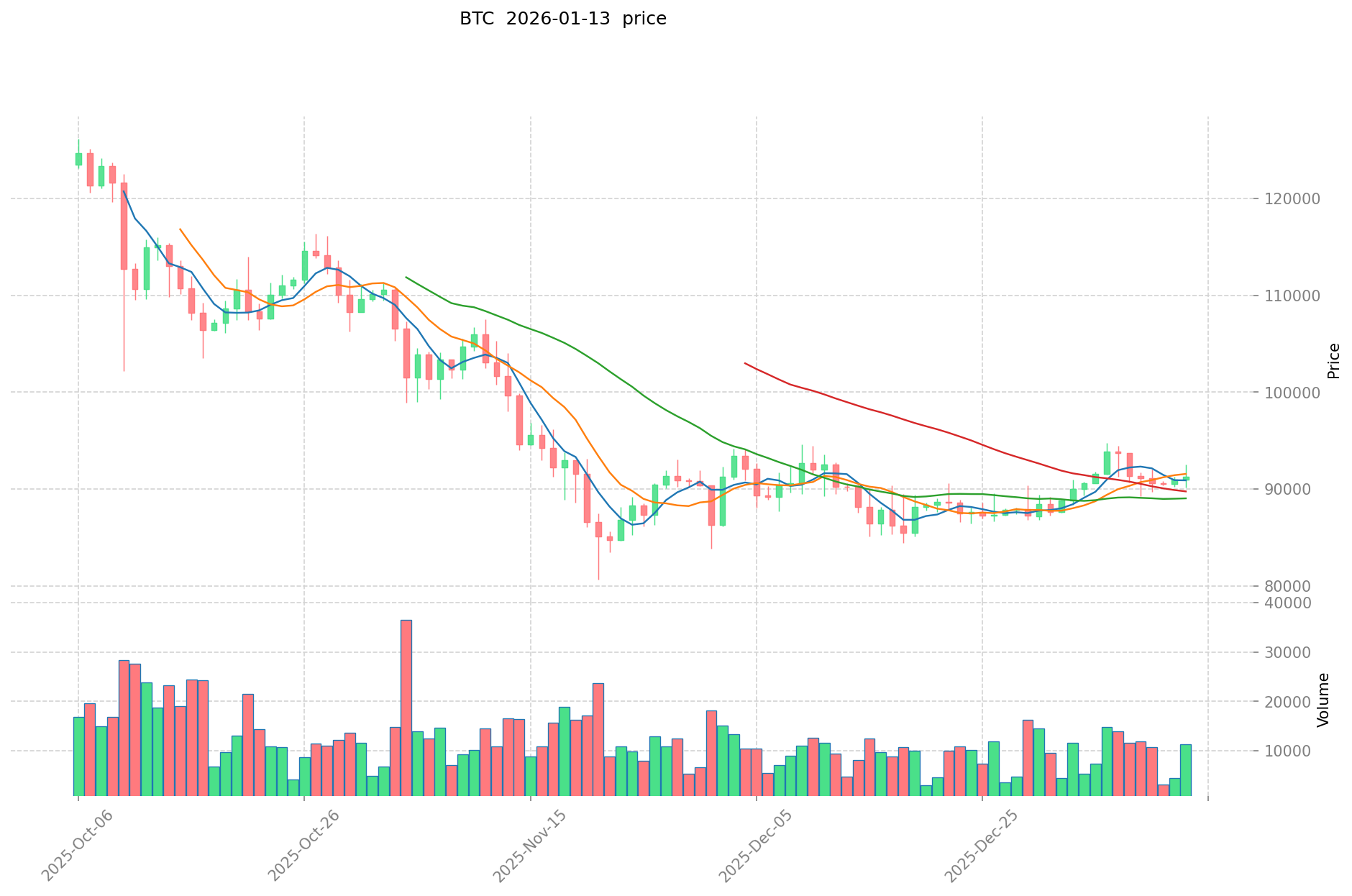
- 2026: As of January 13th, Bitcoin is trading at $91,304.3, showing a decline from recent peak levels with a 24-hour change of -0.53% and a 7-day change of -2.65%.
BTC Current Market Status
Bitcoin currently maintains its position as the leading cryptocurrency with a market capitalization of $1.82 trillion, representing a market dominance of 56.047%. The circulating supply stands at 19,975,140 BTC, which accounts for 95.12% of the maximum supply of 21 million coins.
In terms of recent price action, BTC has shown moderate volatility with the 24-hour trading range between $90,129.5 and $92,519.8. The current price of $91,304.3 reflects a slight decline across multiple timeframes, with a 1-hour change of -0.13%, 24-hour change of -0.53%, and a 7-day change of -2.65%. However, the 30-day performance shows a positive gain of 1.11%.
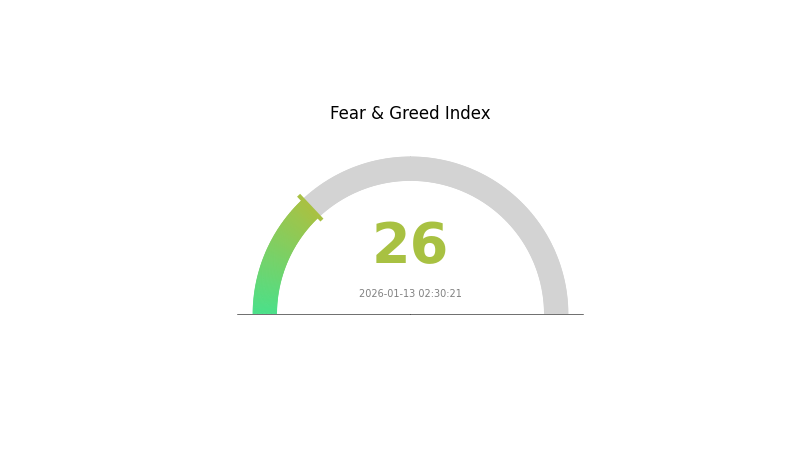
The 24-hour trading volume stands at approximately $994 million, indicating active market participation. The market sentiment index currently registers at 26, classified as "Fear," suggesting cautious positioning among market participants.
With over 56.6 million holders and availability across 84 exchanges, Bitcoin continues to demonstrate broad market accessibility and adoption. The market cap to fully diluted valuation ratio of 95.12% indicates that most of the eventual supply is already in circulation, providing relative clarity on the token economics.
Click to view current BTC market price
BTC Market Sentiment Indicator
2026-01-13 Fear and Greed Index: 26 (Fear)
Click to view current Fear & Greed Index
The cryptocurrency market is currently experiencing a fear sentiment with an index reading of 26. This indicates heightened market anxiety and risk aversion among investors. When the Fear and Greed Index falls into the fear zone, it typically suggests potential buying opportunities for long-term investors, as assets may be undervalued. However, traders should remain cautious and conduct thorough analysis before making investment decisions. Market conditions can shift rapidly, so staying informed through Gate.com's market data tools is essential for making well-informed trading choices.
BTC Holdings Distribution
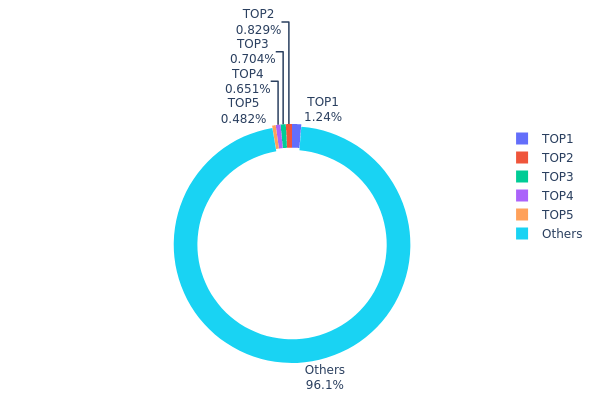
The BTC holdings distribution chart illustrates the concentration of Bitcoin across different wallet addresses, providing insights into the degree of decentralization within the network. According to the latest data as of January 13, 2026, the top five addresses collectively hold approximately 780.91K BTC, representing 3.9% of the total circulating supply. The largest single address holds 248.60K BTC (1.24%), followed by addresses holding 165.54K BTC (0.83%), 140.57K BTC (0.70%), 130.01K BTC (0.65%), and 96.19K BTC (0.48%). Meanwhile, the remaining addresses collectively account for 19,193.75K BTC, or 96.1% of the total supply.
From a concentration perspective, Bitcoin continues to demonstrate a relatively decentralized structure. The fact that over 96% of the supply is distributed across numerous smaller addresses suggests a healthy level of network participation and reduces the risk of market manipulation by a few dominant holders. While the top address holds over 248,000 BTC, this represents only a modest 1.24% of total supply, indicating that no single entity possesses overwhelming control over the market. This distribution pattern contrasts sharply with many altcoins, where top addresses often control significantly larger percentages of total supply.
The current holdings distribution has important implications for market dynamics and price stability. The relatively dispersed ownership structure suggests that Bitcoin's price movements are less susceptible to sudden large-scale liquidations by individual whales. However, it's worth noting that while the top five addresses hold less than 4% of supply, coordinated movements among major holders could still create notable market volatility. The predominance of smaller addresses holding the vast majority of BTC indicates strong retail and institutional participation across the ecosystem, which typically contributes to more organic price discovery and sustained market depth.
Click to view current BTC Holdings Distribution
| Top |
Address |
Holding Qty |
Holding (%) |
| 1 |
34xp4v...4Twseo |
248.60K |
1.24% |
| 2 |
3M219K...DjxRP6 |
165.54K |
0.83% |
| 3 |
bc1ql4...8859v2 |
140.57K |
0.70% |
| 4 |
bc1qgd...jwvw97 |
130.01K |
0.65% |
| 5 |
bc1qja...fc27a4 |
96.19K |
0.48% |
| - |
Others |
19193.75K |
96.1% |
II. Core Factors Influencing BTC's Future Price
Supply Mechanism
-
Halving Cycle: Bitcoin undergoes a halving event approximately every four years, reducing the block reward by 50%. The most recent halving occurred on April 20, 2024, lowering the reward from 6.25 BTC to 3.125 BTC per block. The next halving is anticipated around April 2028.
-
Historical Patterns: Past halving events have been followed by substantial price increases within 12 to 18 months, driven by the reduction in new supply entering the market. This supply shock, combined with steady or growing demand, has historically supported upward price momentum.
-
Current Impact: The 2024 halving reduced Bitcoin's annual inflation rate to approximately 0.83%, now lower than gold's inflation rate of 1-1.5%. As the supply shock effect diminishes with each successive halving, institutional adoption and regulatory clarity are becoming increasingly critical drivers of price appreciation.
Institutional and Major Holder Dynamics
-
Institutional Holdings: The approval of 11 spot Bitcoin ETFs by the U.S. Securities and Exchange Commission (SEC) in January 2024 marked a watershed moment. According to BitMEX Research, these ETFs attracted over $12 billion in net inflows during Q1 2024 alone. Institutional participation rates rose from approximately 20% in 2024 to an estimated 50% by 2025, reflecting Bitcoin's transition from speculative asset to mainstream portfolio allocation.
-
Corporate Adoption: Major financial institutions, including BlackRock and Fidelity, have expanded their Bitcoin-related services, offering asset management, custody, and trading solutions. Traditional finance giants are increasingly integrating Bitcoin into their product offerings, signaling broader acceptance.
-
National-Level Policies: Regulatory frameworks in major economies—particularly the United States, European Union, and key Asian markets such as Japan, South Korea, and Singapore—are evolving. The proposed Digital Asset Market Clarity Act in the U.S. represents a critical policy development that could unlock additional institutional capital flows and enhance market confidence.
Macroeconomic Environment
-
Monetary Policy Impact: Global liquidity conditions, particularly U.S. Federal Reserve interest rate policy, significantly influence Bitcoin's price trajectory. While the Fed implemented multiple rate cuts in 2025, consensus projections suggest only one to two additional cuts may occur in 2026. Should economic data remain robust or inflation rebound, the Fed may pause or delay further easing, potentially increasing the opportunity cost of holding non-yielding assets like Bitcoin.
-
Inflation Hedge Characteristics: Bitcoin's narrative as a store of value and inflation hedge continues to be tested. In high-inflation environments, if Bitcoin demonstrates effective value preservation, it may attract capital seeking asset protection. However, its performance relative to traditional inflation hedges remains subject to market validation.
-
Geopolitical Factors: International tensions and economic uncertainty can drive safe-haven demand for Bitcoin. Conversely, periods of global economic strength may reduce its appeal as a risk-off asset. The strengthening of the U.S. dollar (DXY rising above 105) typically exerts downward pressure on Bitcoin prices.
Technical Development and Ecosystem Building
-
Lightning Network Expansion: The Lightning Network, a Layer 2 scaling solution, continues to mature, enabling faster and lower-cost Bitcoin transactions. Broader adoption of this technology could expand Bitcoin's utility in payment applications and enhance its value proposition beyond store of value.
-
Network Security and Stability: The health of Bitcoin's network infrastructure remains fundamental. Continued development in network security, transaction processing capacity, and fee optimization supports long-term value retention and user confidence.
-
Ecosystem Applications: While Bitcoin's primary use case remains as a store of value and medium of exchange, emerging applications include integration with artificial intelligence agent economies and privacy-enhanced blockchain solutions. According to a16z projections, AI agents now outnumber human employees by a factor of 100, potentially requiring cryptographic identity verification (KYA) in which Bitcoin could serve as a foundational asset layer.
III. 2026-2031 BTC Price Prediction
2026 Outlook
- Conservative prediction: $52,951.74 - $91,296.10
- Neutral prediction: $91,296.10
- Optimistic prediction: $104,990.52 (requiring favorable market conditions and institutional adoption momentum)
2027-2029 Outlook
- Market stage expectation: Potential transition from consolidation phase to gradual upward momentum, with increased institutional participation and regulatory clarity potentially supporting price appreciation
- Price range prediction:
- 2027: $66,737.45 - $106,976.21, with an average around $98,143.31
- 2028: $67,689.44 - $134,353.28, with an average around $102,559.76
- 2029: $86,473.26 - $169,392.82, with an average around $118,456.52
- Key catalysts: Sustained institutional investment flows, potential regulatory frameworks providing market stability, technological infrastructure improvements, and broader mainstream adoption trends
2030-2031 Long-term Outlook
- Baseline scenario: $120,896.72 - $143,924.67 (assuming steady market maturation and moderate adoption growth)
- Optimistic scenario: $143,924.67 - $171,270.36 (assuming accelerated institutional integration and favorable macroeconomic conditions)
- Transformative scenario: Up to $171,781.29 (contingent on exceptional regulatory support, significant technological breakthroughs, and widespread global adoption)
- 2026-01-13: BTC trading within projected ranges as market participants assess evolving dynamics and position for potential growth trajectories through the decade
| Year |
Predicted High Price |
Predicted Average Price |
Predicted Low Price |
Price Change |
| 2026 |
104990.52 |
91296.1 |
52951.74 |
0 |
| 2027 |
106976.21 |
98143.31 |
66737.45 |
7 |
| 2028 |
134353.28 |
102559.76 |
67689.44 |
12 |
| 2029 |
169392.82 |
118456.52 |
86473.26 |
29 |
| 2030 |
171270.36 |
143924.67 |
120896.72 |
57 |
| 2031 |
171781.29 |
157597.51 |
118198.14 |
72 |
IV. BTC Professional Investment Strategies and Risk Management
BTC Investment Methodology
(I) Long-Term Holding Strategy
- Suitable for: Investors seeking exposure to digital assets with a long-term perspective and belief in Bitcoin's fundamental value proposition
- Operational recommendations:
- Consider dollar-cost averaging (DCA) to mitigate timing risk and reduce volatility impact
- Maintain discipline during market fluctuations and avoid emotional decision-making
- Utilize secure storage solutions such as Gate Web3 Wallet for convenient access combined with robust security features
(II) Active Trading Strategy
- Technical analysis tools:
- Moving averages: Use 50-day and 200-day moving averages to identify potential trend reversals and momentum shifts
- Relative Strength Index (RSI): Monitor overbought (above 70) and oversold (below 30) conditions to time entries and exits
- Swing trading considerations:
- Identify key support levels around $90,129.5 and resistance near $92,519.8 based on recent 24-hour range
- Set stop-loss orders to protect capital and maintain risk-reward ratios of at least 1:2
BTC Risk Management Framework
(I) Asset Allocation Principles
- Conservative investors: 5-10%
- Aggressive investors: 15-25%
- Professional investors: 30-40%
(II) Risk Hedging Solutions
- Portfolio diversification: Combine BTC with other digital assets and traditional investment vehicles to reduce concentration risk
- Position sizing: Limit individual trade exposure to 1-3% of total portfolio value to preserve capital during adverse movements
(III) Secure Storage Solutions
- Hot wallet recommendation: Gate Web3 Wallet provides user-friendly interface with multi-layer security protocols for active traders
- Cold storage solution: Consider hardware wallet solutions for long-term holdings exceeding $10,000 equivalent
- Security precautions: Enable two-factor authentication, regularly update security settings, never share private keys, and verify all transaction addresses before confirming transfers
V. BTC Potential Risks and Challenges
BTC Market Risks
- Price volatility: BTC has demonstrated significant price fluctuations with a 24-hour change of -0.53% and 7-day decline of -2.65%, reflecting ongoing market uncertainty
- Liquidity concerns: During periods of market stress, liquidity may diminish, potentially widening bid-ask spreads and impacting execution quality
- Macro correlation: BTC increasingly exhibits correlation with traditional risk assets, potentially reducing its diversification benefits during systemic downturns
BTC Regulatory Risks
- Evolving regulatory frameworks: Jurisdictions worldwide continue developing cryptocurrency regulations, which may impose operational restrictions or taxation changes
- Compliance requirements: Exchanges and service providers face increasing regulatory scrutiny, potentially affecting accessibility and transaction costs
- Geographical restrictions: Certain regions may implement trading limitations or outright bans, impacting market access for affected investors
BTC Technical Risks
- Network congestion: During periods of high transaction volume, network fees may increase substantially and confirmation times may extend
- Security vulnerabilities: While Bitcoin's core protocol has remained secure, exchange platforms and wallet providers may face hacking attempts
- Scalability limitations: The Bitcoin network processes approximately 7 transactions per second, which may constrain adoption for high-frequency payment applications
VI. Conclusion and Action Recommendations
BTC Investment Value Assessment
Bitcoin maintains its position as the leading cryptocurrency with a market dominance of 56.047% and a market capitalization of approximately $1.82 trillion. With 19,975,140 BTC in circulation representing 95.12% of maximum supply, the asset demonstrates scarcity characteristics. The current price of $91,304.3 reflects consolidation following recent market movements. While short-term volatility persists with a 7-day decline of -2.65%, the 30-day performance of +1.11% suggests stabilization. Long-term investors may view current levels as potential accumulation opportunities, though caution remains warranted given regulatory uncertainties and macroeconomic headwinds.
BTC Investment Recommendations
✅ Beginners: Start with small allocations (1-5% of investable assets), focus on education and understanding Bitcoin fundamentals, utilize reputable platforms like Gate.com for initial purchases, and prioritize security through Gate Web3 Wallet
✅ Experienced investors: Consider strategic accumulation during market corrections, implement technical analysis for timing optimization, diversify across multiple cryptocurrencies, and employ risk management tools including stop-losses
✅ Institutional investors: Evaluate Bitcoin as a portfolio diversification component, conduct thorough due diligence on custody solutions, assess regulatory compliance requirements, and consider derivative instruments for hedging strategies
BTC Trading Participation Methods
- Spot trading: Direct purchase and sale of BTC on Gate.com with immediate settlement, suitable for investors seeking straightforward ownership
- Futures contracts: Leverage Bitcoin price movements through standardized derivatives, appropriate for sophisticated traders with risk management expertise
- Systematic investment plans: Automated recurring purchases to accumulate positions gradually, ideal for long-term wealth building with reduced timing risk
Cryptocurrency investment carries extreme risk. This article does not constitute investment advice. Investors should make prudent decisions based on their risk tolerance and are advised to consult professional financial advisors. Never invest more than you can afford to lose.
FAQ
How high will Bitcoin price reach in 2024?
Bitcoin surged 150% in 2024, with market expectations for 2025 potentially doubling to $200,000 as industry experts remain optimistic about continued growth and new all-time highs.
What are the main factors affecting Bitcoin price?
Bitcoin price is influenced by market demand and supply, investor sentiment, macroeconomic factors like inflation and monetary policy, trading volume, major events, blockchain technology developments, market liquidity, Bitcoin halving cycles, and institutional investor participation.
How to predict Bitcoin's future price trend?
Bitcoin price prediction relies on analyzing historical trends, trading volume, market sentiment, and macroeconomic factors. Experts project BTC could reach $163,464 by 2026 and $660,471 by 2030, driven by scarcity and institutional adoption.
What is the price prediction for BTC from professional analysts?
Professional analysts forecast BTC could reach significantly higher levels during 2025-2026. Current market conditions support bullish projections. As of January 2026, BTC has achieved predicted price targets, reflecting strong market momentum and positive sentiment.
Can Bitcoin's historical price trends be used to predict future prices?
Yes, historical price trends provide valuable insights for Bitcoin price prediction. By analyzing past patterns, trading volume, and market cycles, analysts can identify trends and potential price movements. However, Bitcoin's volatility means predictions require careful analysis and multiple indicators for accuracy.
* The information is not intended to be and does not constitute financial advice or any other recommendation of any sort offered or endorsed by Gate.