This comprehensive guide delivers expert price forecasts and investment strategies for CoW Protocol (COW), a user-protective DeFi infrastructure token currently trading at $0.2401. The article analyzes COW's market position, historical price trajectory from 2024-2026, and projects potential price ranges through 2031, with conservative to optimistic scenarios detailed for each year. Key influencing factors including supply mechanisms, institutional dynamics, macroeconomic conditions, and ecosystem development are examined to support forecasting accuracy. The guide provides professional investment methodologies for different investor types, robust risk management frameworks with appropriate portfolio allocation percentages, and secure storage solutions via Gate Web3 Wallet. Critical risk assessments address liquidity concerns, regulatory uncertainties, and technical vulnerabilities. Suitable for DeFi enthusiasts and cryptocurrency investors seeking informed decision-making strategies in the decentralized exchan
Introduction: COW's Market Position and Investment Value
CoW Protocol (COW), positioning itself as a user-protective DeFi protocol suite, has established its presence in the decentralized finance landscape since its inception. As of January 2026, COW maintains a market capitalization of approximately $133 million with a circulating supply of around 553.93 million tokens, trading at $0.2401. This asset, recognized for its innovative approach to solving MEV-related challenges and enhancing transaction security, is playing an increasingly vital role in the DeFi trading infrastructure through its flagship products including CoW Swap and CoW AMM.
This article provides a comprehensive analysis of COW's price trajectory from 2026 to 2031, incorporating historical patterns, market supply-demand dynamics, ecosystem development, and macroeconomic conditions to deliver professional price forecasts and practical investment strategies for market participants.
I. COW Price History Review and Market Status
COW Historical Price Evolution Trajectory
- 2024: COW reached a notable price level of $1.2279 on December 25, representing a significant milestone in its trading history.
- 2025: The token experienced substantial volatility, with prices declining from previous highs to a lower level of $0.1323 recorded on October 10.
- 2026: As of January 17, COW is trading at $0.2401, showing signs of recovery with a 30-day increase of 29.06%.
COW Current Market Situation
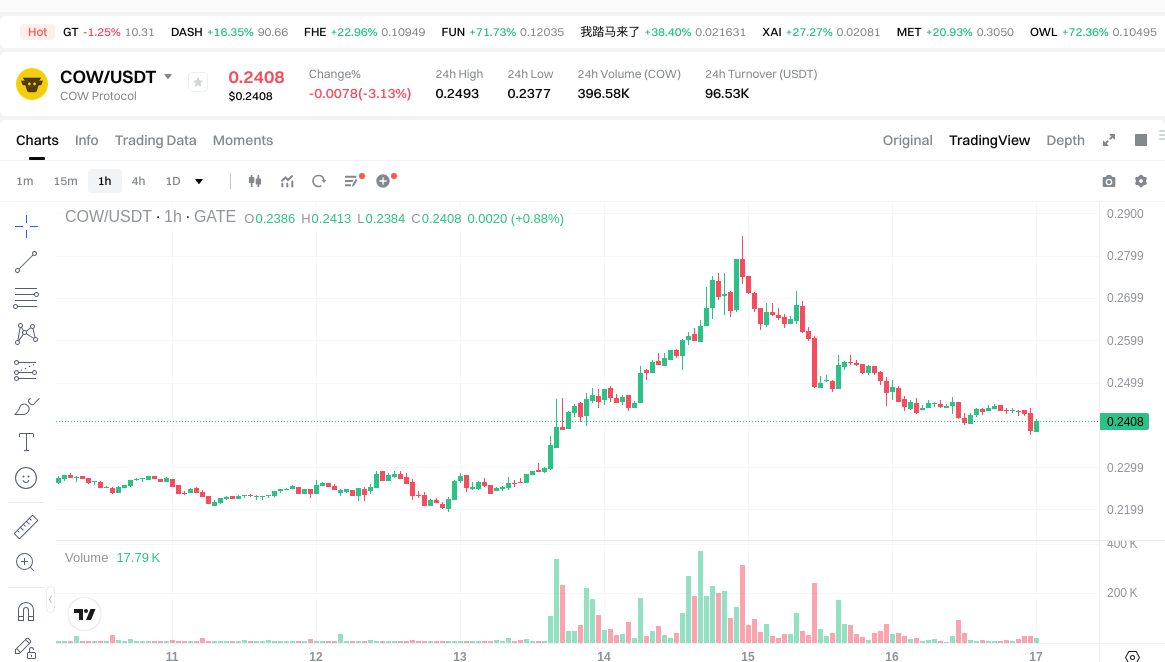
CoW Protocol (COW) is currently trading at $0.2401, with a 24-hour trading volume of $96,904.78. The token has experienced a slight decline of 3.25% over the past 24 hours, with intraday fluctuations between $0.2377 and $0.2494.
From a broader perspective, COW has demonstrated notable momentum, posting gains of 4.43% over the past week and a substantial 29.06% increase over the 30-day period. However, the token remains significantly below its previous peak, down 69.89% from its year-ago levels.
The circulating supply stands at 553.93 million COW tokens, representing 55.39% of the maximum supply of 1 billion tokens. The current market capitalization is approximately $133 million, with a fully diluted market cap of $240.1 million. The market cap to fully diluted valuation ratio of 55.39% indicates substantial token supply yet to enter circulation.
CoW Protocol maintains a market dominance of 0.0071% and ranks #309 in the cryptocurrency market. The token is listed on 24 exchanges and has a holder base of 6,977 addresses. The Gate.com Fear and Greed Index for COW registers at 49, indicating a neutral market sentiment.
Click to view current COW market price
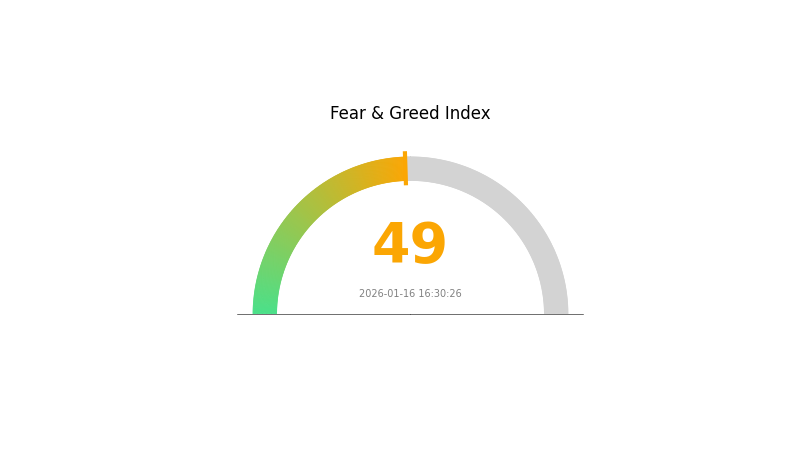
COW Market Sentiment Index
2026-01-16 Fear and Greed Index: 49 (Neutral)
Click to view current Fear & Greed Index
The cryptocurrency market is currently in a neutral sentiment state with a Fear and Greed Index reading of 49. This balanced positioning suggests that market participants are neither excessively fearful nor overly greedy, indicating a measured approach to trading and investment decisions. At this neutral level, investors may find opportunities to make rational assessments without extreme emotional pressure influencing their market behavior. Monitor this index closely as shifts in either direction could signal changing market dynamics and potential trading opportunities.
COW Holding Distribution
The holding distribution chart illustrates the concentration of token ownership across different wallet addresses, providing insights into the decentralization level and potential market manipulation risks. By analyzing the proportion of tokens held by top addresses versus the broader holder base, investors can assess the structural health of a project's token economy.
According to the current data, COW exhibits a highly concentrated holding pattern. The top address alone controls 360,015.51K tokens, representing 36.00% of the total supply. The second-largest holder possesses 155,087.25K tokens (15.50%), while addresses ranked third through fifth hold 3.87%, 3.81%, and 3.27% respectively. Combined, the top five addresses control approximately 62.45% of the total token supply, with the remaining 375,202.81K tokens (37.55%) distributed among other holders.
This concentration level presents significant implications for market dynamics. The dominance of the top two addresses, which collectively hold over 51% of the supply, creates potential price volatility concerns and heightened susceptibility to large-scale sell pressure. Such concentration could enable major holders to exert substantial influence over token price movements, potentially impacting smaller investors' positions. From a decentralization perspective, this distribution pattern suggests that COW's on-chain governance and market structure remain relatively centralized, which may affect long-term ecosystem stability and investor confidence in the token's resistance to manipulation.
Click to view current COW Holding Distribution

| Top |
Address |
Holding Qty |
Holding (%) |
| 1 |
0xca77...8fe662 |
360015.51K |
36.00% |
| 2 |
0xd057...688048 |
155087.25K |
15.50% |
| 3 |
0x849d...8d039d |
38761.89K |
3.87% |
| 4 |
0x5237...d478b0 |
38180.35K |
3.81% |
| 5 |
0xf977...41acec |
32752.19K |
3.27% |
| - |
Others |
375202.81K |
37.55% |
II. Core Factors Influencing COW's Future Price
Supply Mechanism
- Token Distribution and Circulation: COW operates within the DeFi ecosystem with a defined token supply structure. The token's circulation is managed through decentralized trading platforms and protocol-based mechanisms, which help regulate market availability.
- Historical Pattern: Historically, changes in token circulation and supply constraints have shown correlation with price movements in similar DeFi protocols. Limited supply releases during high demand periods have typically supported price stability.
- Current Impact: Current supply dynamics suggest gradual ecosystem expansion, with token distribution aligned with user adoption rates. This measured approach may provide structural support for price development.
Institutional and Major Holder Dynamics
- Institutional Holdings: Available data indicates community-driven ownership patterns typical of DeFi protocols, with holdings distributed across active participants in the ecosystem rather than concentrated in traditional institutional portfolios.
- Enterprise Adoption: The protocol serves as infrastructure for decentralized exchange services, with growing integration into broader DeFi platforms supporting its utility value.
- Regulatory Environment: The evolving regulatory landscape for DeFi projects continues to develop across jurisdictions, with compliance frameworks gradually taking shape that may influence operational parameters.
Macroeconomic Environment
- Monetary Policy Impact: Central bank policies regarding interest rates and liquidity conditions influence risk asset allocation, including cryptocurrency markets. Accommodative monetary stances have historically correlated with increased capital flows into digital assets.
- Inflation Hedge Characteristics: While cryptocurrencies demonstrate varying degrees of inflation sensitivity, DeFi tokens like COW show price behavior more closely tied to ecosystem utility and adoption rather than traditional inflation hedging patterns.
- Geopolitical Factors: International developments affecting cross-border financial flows and regulatory coordination can create volatility in cryptocurrency markets, though impact varies by specific project fundamentals.
Technology Development and Ecosystem Building
- Protocol Enhancement: Ongoing improvements to the underlying protocol architecture focus on user protection mechanisms and transaction efficiency, supporting the platform's core value proposition in the DeFi space.
- Ecosystem Applications: The protocol supports decentralized trading platforms and related DeFi services, with expanding use cases contributing to network effects and user base growth. Application development within the ecosystem provides fundamental drivers for long-term value creation.
III. 2026-2031 COW Price Forecast
2026 Outlook
- Conservative estimate: $0.21208 - $0.241
- Neutral estimate: Around $0.241
- Optimistic estimate: Up to $0.2651 (subject to favorable market conditions and increased adoption)
2027-2029 Mid-term Outlook
- Market phase expectation: Gradual recovery and growth phase, with increasing mainstream acceptance of decentralized trading protocols
- Price range forecast:
- 2027: $0.20497 - $0.34668
- 2028: $0.17092 - $0.4378
- 2029: $0.29138 - $0.42416
- Key catalysts: Enhanced protocol upgrades, expanding DeFi ecosystem integration, and growing institutional interest in decentralized exchange infrastructure
2030-2031 Long-term Outlook
- Base scenario: $0.32116 - $0.51148 (assuming steady DeFi sector growth and maintained market share)
- Optimistic scenario: $0.45399 - $0.52663 (contingent on widespread protocol adoption and favorable regulatory developments)
- Transformative scenario: Potential to exceed $0.52663 (requires breakthrough partnerships, significant technological advances, and exceptional market conditions)
- 2026-01-17: COW trading within the projected 2026 range as the token continues to establish its position in the decentralized exchange landscape
| Year |
Predicted High Price |
Predicted Average Price |
Predicted Low Price |
Price Change |
| 2026 |
0.2651 |
0.241 |
0.21208 |
0 |
| 2027 |
0.34668 |
0.25305 |
0.20497 |
5 |
| 2028 |
0.4378 |
0.29986 |
0.17092 |
24 |
| 2029 |
0.42416 |
0.36883 |
0.29138 |
53 |
| 2030 |
0.51148 |
0.3965 |
0.32116 |
65 |
| 2031 |
0.52663 |
0.45399 |
0.31325 |
89 |
IV. COW Professional Investment Strategy and Risk Management
COW Investment Methodology
(1) Long-term Holding Strategy
- Target Investors: DeFi enthusiasts seeking exposure to user-protective trading infrastructure, investors with moderate to high risk tolerance willing to participate in the DEX aggregation and MEV protection sector
- Operational Recommendations:
- Consider establishing positions during market corrections while monitoring the development progress of CoW DAO's product suite including CoW Swap and CoW AMM
- Evaluate the project's competitive positioning within the DEX aggregator landscape and track adoption metrics of MEV Blocker RPC
- Storage Solution: Utilize Gate Web3 Wallet for secure COW token storage, leveraging its multi-chain support and user-friendly interface for managing ERC-20 assets
(2) Active Trading Strategy
- Technical Analysis Tools:
- Volume Analysis: Monitor the 24-hour trading volume trends (current: $96,904.78) to identify potential breakout or breakdown patterns
- Support and Resistance Levels: Track key price levels including 24H range ($0.2377-$0.2494) and historical reference points
- Swing Trading Considerations:
- Observe short-term price volatility patterns, noting the -3.25% 24H change and +4.43% 7D performance
- Set appropriate stop-loss orders considering COW's price fluctuation characteristics within the current trading range
COW Risk Management Framework
(1) Asset Allocation Principles
- Conservative Investors: 1-3% portfolio allocation
- Moderate Investors: 3-7% portfolio allocation
- Aggressive Investors: 7-15% portfolio allocation
(2) Risk Hedging Approaches
- Diversification Strategy: Balance COW holdings with other DeFi infrastructure tokens and established cryptocurrencies to reduce concentration risk
- Position Sizing Method: Consider dollar-cost averaging (DCA) to mitigate timing risk, particularly given the token's 29.06% monthly gain and -69.89% yearly performance
(3) Secure Storage Solutions
- Hot Wallet Recommendation: Gate Web3 Wallet provides convenient access for active traders while maintaining security standards for ERC-20 token management
- Cold Storage Approach: For long-term holders, consider transferring significant COW holdings to hardware wallet solutions after accumulation
- Security Precautions: Never share private keys or seed phrases; verify contract addresses (0xdef1ca1fb7fbcdc777520aa7f396b4e015f497ab) before transactions; enable two-factor authentication on exchange accounts
V. COW Potential Risks and Challenges
COW Market Risks
- Liquidity Concerns: With a circulating supply of 553.93M COW (55.39% of max supply) and relatively modest 24H trading volume, sudden large sell orders could impact price stability
- High Volatility: The token has demonstrated significant price swings, trading from a historical low of $0.1323 (October 10, 2025) to historical high of $1.2279 (December 25, 2024), representing substantial volatility
- Market Capitalization Positioning: At rank #309 with 0.0071% market dominance, COW faces competitive pressure from established DEX protocols and aggregators
COW Regulatory Risks
- DeFi Protocol Scrutiny: Increasing regulatory attention on decentralized trading platforms and MEV-related services may impact operational flexibility
- Token Classification Uncertainty: Evolving regulatory frameworks regarding utility tokens and governance tokens could affect COW's trading status across different jurisdictions
- Compliance Requirements: Future regulatory mandates for DEX protocols may increase operational costs and affect the project's competitive positioning
COW Technical Risks
- Smart Contract Vulnerabilities: As an ERC-20 token deployed on Ethereum, COW is subject to potential smart contract exploits or protocol-level risks
- Dependency on Ethereum Network: Network congestion or high gas fees on Ethereum could impact user experience for CoW Swap and related services
- Competition from Alternative Solutions: Emerging MEV protection mechanisms and DEX aggregation technologies may challenge CoW Protocol's market position
VI. Conclusion and Action Recommendations
COW Investment Value Assessment
CoW Protocol presents an interesting proposition within the DeFi infrastructure space, focusing on user protection through features like MEV blocking and optimized swap execution. The project's 29.06% monthly gain suggests growing market interest, though the -69.89% yearly performance indicates substantial volatility and recovery potential from previous levels. With 6,977 holders and availability on 24 exchanges, COW maintains reasonable accessibility. However, investors should note the significant gap between current price ($0.2401) and all-time high ($1.2279), alongside the moderate circulating supply ratio (55.39%). The project's long-term value depends on continued development of its product suite and successful competition in the increasingly crowded DEX aggregator market.
COW Investment Recommendations
✅ Beginners: Start with minimal allocation (1-2% of crypto portfolio) to understand DeFi infrastructure tokens; use Gate.com for straightforward spot trading access; focus on learning about DEX mechanisms and MEV protection before increasing exposure
✅ Experienced Investors: Consider swing trading opportunities around key support/resistance levels while maintaining a core long-term position; monitor CoW DAO development updates and protocol adoption metrics; evaluate COW's positioning relative to competing DEX aggregators
✅ Institutional Investors: Conduct thorough due diligence on CoW Protocol's technology stack, competitive advantages, and tokenomics structure; assess liquidity depth for intended position sizes; consider phased accumulation strategies to minimize market impact
COW Trading Participation Methods
- Spot Trading on Gate.com: Direct purchase and sale of COW tokens with competitive fees and reliable liquidity access
- Dollar-Cost Averaging (DCA): Regular periodic purchases to smooth out price volatility and reduce timing risk
- Gate Web3 Wallet Integration: Self-custody option for users seeking direct control over their COW holdings while maintaining trading flexibility
Cryptocurrency investment carries extreme risk, and this article does not constitute investment advice. Investors should make prudent decisions based on their own risk tolerance and are advised to consult professional financial advisors. Never invest more than you can afford to lose.
FAQ
What is COW token and what are its practical application scenarios?
COW token is used for compensation rewards and community welfare activities. It aims to penetrate cross-border e-commerce, finance, and healthcare sectors, building a payment application platform for broader adoption.
What are the main factors affecting COW price?
COW price is influenced by user activity, exchange liquidity, ecosystem events like burns and upgrades, whale transfers, and social media sentiment.
How to conduct technical analysis and price prediction for COW?
Use technical analysis tools like moving averages and RSI to identify trends. Analyze trading volume and price patterns on charts. Monitor support and resistance levels. COW is expected to show growth potential based on market momentum and adoption trends in the DeFi ecosystem.
COW's historical price trends and current stage?
COW Protocol is in early growth stages. It has shown promising momentum with potential upside. Medium-term target around 0.65 USD if bullish trend continues. Currently positioned for potential appreciation in the coming months.
What are the risks to pay attention to when investing in COW tokens?
COW token investments face market volatility, regulatory uncertainty, liquidity risks, and smart contract vulnerabilities. Price fluctuations can be severe due to market sentiment. Additionally, the protocol may encounter technical issues, and regulatory changes could impact its value significantly.
What are the advantages and disadvantages of COW compared to mainstream cryptocurrencies?
COW offers superior MEV protection and efficient batch auction trading, providing better security than mainstream coins. However, it faces challenges with lower adoption rates and smaller network effects compared to established cryptocurrencies like Bitcoin and Ethereum.
* The information is not intended to be and does not constitute financial advice or any other recommendation of any sort offered or endorsed by Gate.