This comprehensive analysis examines Curve (CRV) DAO token's investment potential through expert market research and data-driven forecasting. CRV, trading at approximately $0.4358 with a $639.35M market cap, serves as governance infrastructure for Curve Finance—a leading decentralized stablecoin exchange protocol on Ethereum. The article evaluates historical price trends, institutional adoption patterns, and ecosystem dynamics to deliver detailed price predictions spanning 2026-2031, with 2026 projected at $0.4367 (neutral scenario) and potential long-term growth to $0.81517 by 2031. Key value drivers include veCRV locking mechanisms, institutional protocol adoption, and DeFi infrastructure demand. The guide provides actionable investment strategies from conservative to aggressive approaches, comprehensive risk management frameworks, and secure trading methodologies via Gate platform integration, supporting both beginner and institutional investors in navigating CRV's growth trajectory.
Introduction: CRV's Market Position and Investment Value
Curve (CRV), as a pioneering decentralized exchange protocol specializing in stablecoin trading on Ethereum, has established itself as a fundamental infrastructure component of the DeFi ecosystem since its launch in 2020. As of 2026, CRV maintains a market capitalization of approximately $639.35 million, with a circulating supply of around 1.47 billion tokens, and its price stabilizes at approximately $0.4358. This asset, recognized as a "core DeFi protocol token," is playing an increasingly vital role in decentralized finance and liquidity provision.
This article will comprehensively analyze CRV's price trends from 2026 to 2031, combining historical patterns, market supply-demand dynamics, ecosystem development, and macroeconomic factors to provide investors with professional price forecasts and practical investment strategies.
I. CRV Price History Review and Current Market Status
CRV Historical Price Evolution Trajectory
- August 2020: CRV launched on the market, reaching a price peak of $15.37, marking the token's initial surge following its debut
- August 2024: The token experienced significant market pressure, dropping to a historical low of $0.180354, reflecting broader challenges in the DeFi sector
- 2025-2026: The market entered a recovery phase, with CRV price showing signs of stabilization and gradual improvement
CRV Current Market Status
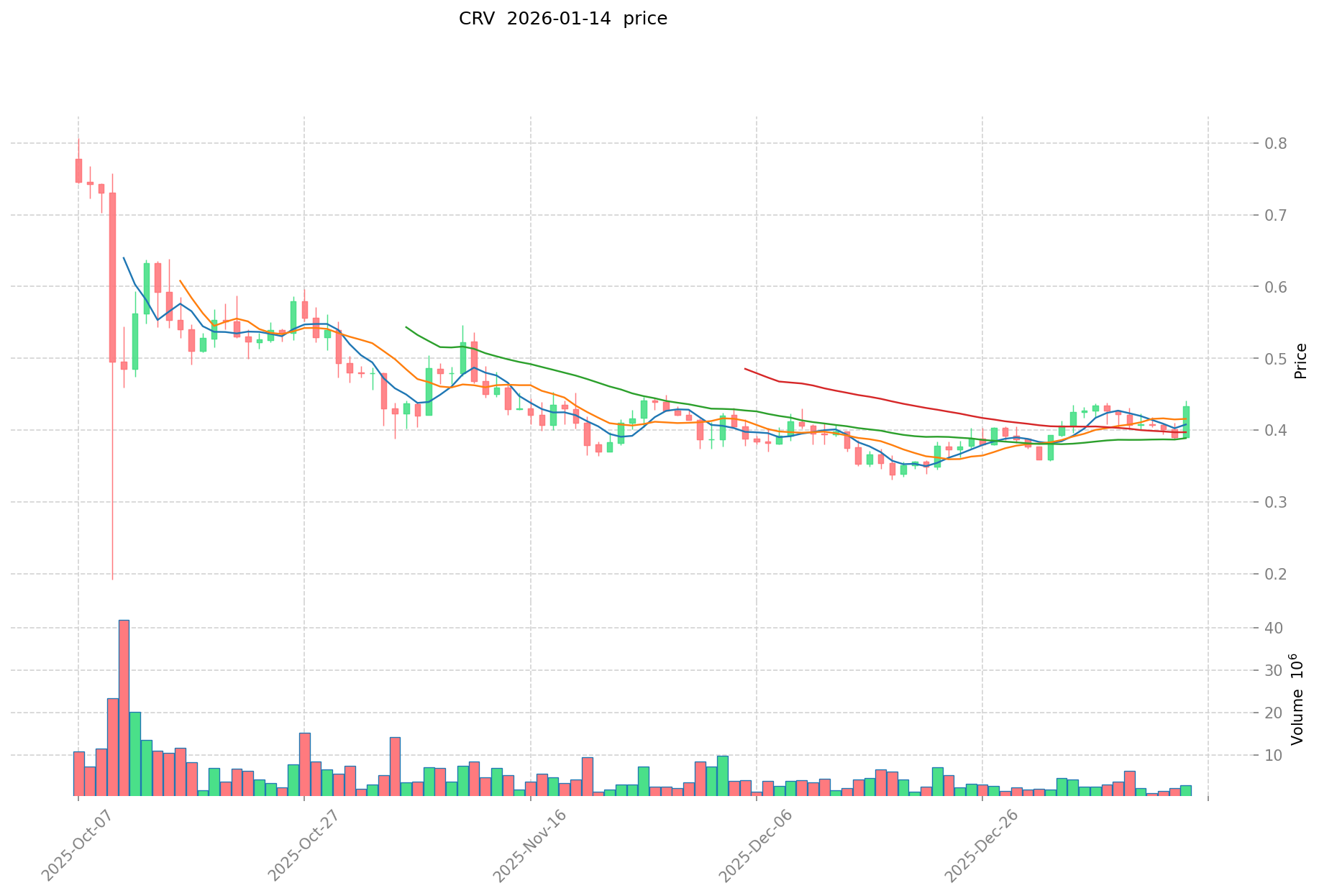
As of January 14, 2026, CRV is trading at $0.4358, demonstrating recent positive momentum with a 24-hour price increase of 6.24%. The token's weekly performance shows a gain of 4.08%, while the monthly trend indicates stronger recovery with a 13.99% increase. However, the annual perspective reveals a decline of 46.37%, highlighting the token's volatility over the longer term.
The current market capitalization stands at $639.35 million, with a circulating supply of 1.467 billion CRV tokens, representing approximately 48.41% of the total supply. The 24-hour trading volume of $1.63 million suggests moderate market activity. CRV maintains a market dominance of 0.030% within the broader cryptocurrency ecosystem.
The token's price range over the past 24 hours fluctuated between $0.4096 and $0.4413, indicating relatively stable trading conditions. With a fully diluted market cap of approximately $1.02 billion and a maximum supply of 3.03 billion tokens, CRV continues to serve as the governance token for the Curve protocol, which facilitates efficient stablecoin trading on the Ethereum network.
Click to view current CRV market price
Cryptocurrency Market Sentiment Indicator
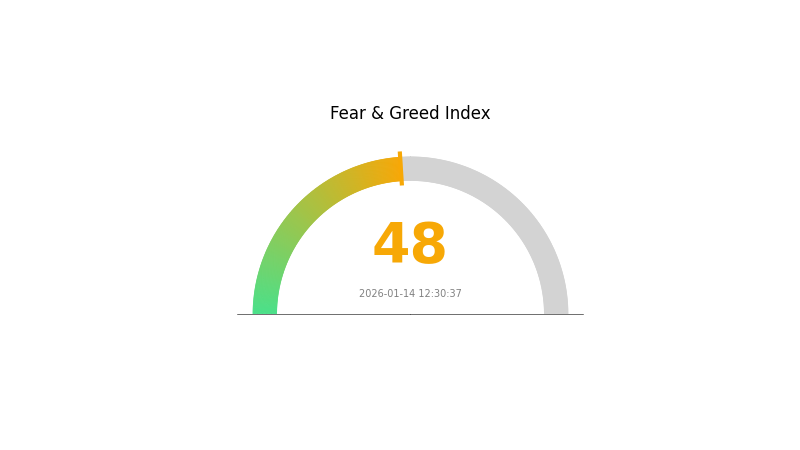
2026-01-14 Fear and Greed Index: 48 (Neutral)
Click to view current Fear & Greed Index
The cryptocurrency market is currently in a neutral sentiment state with an index reading of 48. This balanced reading suggests that neither excessive fear nor unbridled greed is dominating market participants' decision-making. Investors should maintain a measured approach, carefully evaluating opportunities while managing risk exposure. Market conditions remain relatively stable, making it an appropriate time for thoughtful portfolio assessment and strategic positioning aligned with your investment objectives.
CRV Holding Distribution
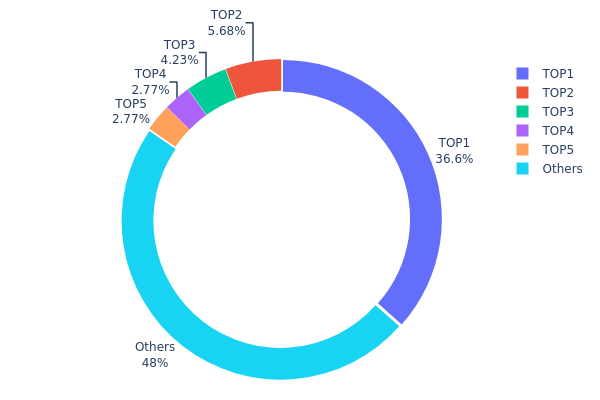
The holding distribution chart illustrates how CRV tokens are allocated across different wallet addresses, serving as a key indicator of token concentration and decentralization level within the ecosystem. This metric helps investors assess the distribution of market control power and potential risks associated with large holder movements.
Based on current data, CRV exhibits a moderate level of concentration with the top address holding 856.26M tokens, representing 36.56% of total supply. The top five addresses collectively control approximately 52% of the circulating supply, while the remaining 48.02% is distributed among other holders. This concentration pattern suggests that while the token maintains a degree of decentralization, a significant portion remains under the control of major stakeholders, likely including the protocol treasury, team allocations, and institutional investors.
From a market structure perspective, this distribution profile presents both stability and volatility potential. The substantial holding by top addresses could provide protocol stability and governance effectiveness, as major stakeholders typically have vested interests in long-term project success. However, this concentration also introduces price vulnerability, as large-scale movements from any top holder could trigger significant market fluctuations. The relatively dispersed "Others" category at 48.02% indicates a healthy retail and mid-tier holder base, which can provide liquidity cushioning and reduce single-point manipulation risks.
Click to view current CRV Holding Distribution
| Top |
Address |
Holding Qty |
Holding (%) |
| 1 |
0x5f3b...94e2a2 |
856263.35K |
36.56% |
| 2 |
0xf977...41acec |
132929.49K |
5.67% |
| 3 |
0x5a52...70efcb |
99000.00K |
4.22% |
| 4 |
0x300d...ab9d61 |
64910.64K |
2.77% |
| 5 |
0x7240...b0f0ad |
64786.99K |
2.76% |
| - |
Others |
1123681.49K |
48.02% |
II. Core Factors Influencing CRV's Future Price
Supply Mechanism
- veCRV Locking Mechanism: CRV holders can lock their tokens to obtain veCRV (vote-escrowed CRV), which grants governance rights and platform rewards. This mechanism requires long-term token locking to acquire governance power, significantly reducing circulating supply and potentially supporting higher token valuations.
- Historical Pattern: Large-scale and long-term locking has consistently compressed the project's circulating market cap, helping stabilize token prices and maintain attractive yields for liquidity providers.
- Current Impact: The continuous locking mechanism absorbs ongoing CRV unlock pressure by creating sustained demand through governance competition among platform participants, including liquidity providers and asset issuers.
Institutional and Major Holder Dynamics
- Institutional Holdings: Major DeFi protocols including Convex Finance, Yearn.finance, and Frax Finance hold substantial CRV positions. These protocols lock significant amounts of CRV to gain governance voting power, strengthening their influence within the Curve ecosystem.
- Enterprise Adoption: Leading DeFi projects such as Compound, Aave, and Yearn utilize Curve's liquidity pools for their yield-bearing tokens (cTokens, aTokens, yTokens), making Curve a critical infrastructure component for DeFi ticket trading markets.
- Ecosystem Integration: Curve's pools on Polygon, particularly the Aave stablecoin pool, demonstrate growing cross-chain adoption and multi-platform integration.
Macroeconomic Environment
- Market Correlation: CRV's performance tends to correlate with overall cryptocurrency market health, though it may show relative strength during periods of heightened DeFi activity.
- Liquidity Considerations: Trading volume and liquidity across platforms represent important factors affecting price stability, with higher liquidity generally supporting more stable valuations.
- Regulatory Landscape: Regulatory developments and policy changes in the cryptocurrency sector may influence market sentiment and token demand.
Technical Development and Ecosystem Building
- Curve V2 Innovation: The protocol introduced dynamic peg mechanisms for non-stablecoin asset pairs, utilizing an internal exponential moving average (EMA) oracle system. This advancement aims to provide 5-10 times higher liquidity efficiency compared to traditional constant product formulas.
- AMM Algorithm Optimization: Curve employs specialized automated market maker formulas that blend xy=k and x+y=k curves, optimizing for stable asset pairs with minimal slippage on substantial trades.
- Ecosystem Applications: The platform serves as infrastructure for major DeFi protocols, with prominent stablecoin pools including 3pool (USDT/USDC/DAI) and various yield-bearing asset pools. Factory pools enable community-driven experimentation with governance-weighted CRV incentive allocation through the Gauge Weight Voting system.
- Governance Framework: The DAO structure deeply integrates resource allocation with governance rights, creating high switching costs for core participants and enhancing long-term platform commitment.
III. 2026-2031 CRV Price Forecast
2026 Outlook
- Conservative forecast: $0.41487 - $0.4367
- Neutral forecast: Around $0.4367
- Optimistic forecast: Up to $0.45854 (requires sustained market momentum)
2027-2029 Outlook
- Market stage expectation: Transitional growth phase with gradual accumulation
- Price range forecast:
- 2027: $0.23724 - $0.59981
- 2028: $0.34565 - $0.61798
- 2029: $0.37105 - $0.62793
- Key catalysts: DeFi sector expansion, protocol adoption growth, and broader cryptocurrency market recovery
2030-2031 Long-term Outlook
- Baseline scenario: $0.51547 - $0.59939 (assuming steady DeFi market development)
- Optimistic scenario: $0.70728 - $0.81517 (contingent on significant protocol upgrades and increased institutional participation)
- Transformative scenario: Potential to reach $0.81517 (requires exceptional market conditions and widespread DeFi adoption)
- 2026-01-14: CRV price predictions indicate measured growth trajectory with potential upside depending on market conditions
| Year |
Predicted High Price |
Predicted Average Price |
Predicted Low Price |
Price Change |
| 2026 |
0.45854 |
0.4367 |
0.41487 |
0 |
| 2027 |
0.59981 |
0.44762 |
0.23724 |
2 |
| 2028 |
0.61798 |
0.52371 |
0.34565 |
20 |
| 2029 |
0.62793 |
0.57085 |
0.37105 |
30 |
| 2030 |
0.81517 |
0.59939 |
0.51547 |
37 |
| 2031 |
0.75679 |
0.70728 |
0.55168 |
62 |
IV. CRV Professional Investment Strategy and Risk Management
CRV Investment Methodology
(1) Long-term Holding Strategy
- Target Investors: Investors focused on DeFi ecosystem growth and stablecoin trading infrastructure
- Operation Recommendations:
- Consider accumulating positions during market corrections when CRV trades below key support levels
- Monitor Curve's protocol development, liquidity pool performance, and governance participation rates
- Implement a storage solution that supports secure long-term custody of ERC-20 tokens
(2) Active Trading Strategy
- Technical Analysis Tools:
- Moving Averages: Track 50-day and 200-day moving averages to identify trend reversals and momentum shifts
- Volume Analysis: Monitor the $1.63M daily trading volume relative to historical averages to gauge market participation
- Swing Trading Key Points:
- Consider the current 24-hour trading range between $0.4096 and $0.4413 for short-term entry and exit points
- Pay attention to broader DeFi market sentiment and stablecoin trading volume trends
CRV Risk Management Framework
(1) Asset Allocation Principles
- Conservative Investors: 2-5% of crypto portfolio allocation
- Aggressive Investors: 8-12% of crypto portfolio allocation
- Professional Investors: Up to 15% with active hedging strategies
(2) Risk Hedging Solutions
- Diversification Strategy: Balance CRV holdings with other DeFi protocol tokens and stablecoins
- Position Sizing: Implement dollar-cost averaging to mitigate timing risk given historical volatility
(3) Secure Storage Solutions
- Hot Wallet Option: Gate Web3 Wallet for active trading and frequent transactions
- Cold Storage Solution: Hardware wallets for long-term holdings exceeding $5,000
- Security Precautions: Never share private keys, enable two-factor authentication, and verify contract addresses (0xD533a949740bb3306d119CC777fa900bA034cd52) before transactions
V. CRV Potential Risks and Challenges
CRV Market Risks
- Volatility Risk: CRV has declined 46.37% over the past year, demonstrating significant price volatility
- Liquidity Risk: Market capitalization of approximately $639M represents moderate liquidity, but may face slippage during large transactions
- Competition Risk: Increasing competition from alternative stablecoin DEX platforms may impact Curve's market position
CRV Regulatory Risks
- DeFi Regulation Uncertainty: Evolving regulatory frameworks for decentralized exchanges may affect Curve's operations
- Stablecoin Oversight: Increased scrutiny of stablecoin trading platforms could impact trading volumes and user adoption
- Cross-border Compliance: Global regulatory divergence may create operational challenges for decentralized protocols
CRV Technical Risks
- Smart Contract Risk: Despite audits, vulnerabilities in Curve's protocol contracts could result in fund losses
- Integration Risk: Dependencies on external DeFi protocols like Compound may introduce systemic vulnerabilities
- Network Congestion: Ethereum network congestion may increase transaction costs and reduce trading efficiency
VI. Conclusion and Action Recommendations
CRV Investment Value Assessment
Curve represents an established DeFi infrastructure project with a proven track record in stablecoin liquidity provision. The protocol's market capitalization of $639M and presence on 58 exchanges demonstrate established market recognition. However, the significant year-over-year decline of 46.37% reflects broader DeFi sector challenges and competitive pressures. Long-term value depends on Curve's ability to maintain its position as a leading stablecoin DEX while expanding utility and governance participation. Short-term risks include continued market volatility and regulatory uncertainty affecting the broader DeFi ecosystem.
CRV Investment Recommendations
✅ Beginners: Start with small position sizes (1-3% of portfolio), focus on understanding Curve's role in DeFi before increasing exposure
✅ Experienced Investors: Consider strategic accumulation during market dips, actively monitor protocol metrics and governance developments
✅ Institutional Investors: Evaluate CRV as part of a diversified DeFi infrastructure allocation, implement comprehensive risk management protocols
CRV Trading Participation Methods
- Spot Trading: Purchase CRV directly on Gate.com and other major exchanges with ERC-20 token support
- Liquidity Provision: Participate in Curve's liquidity pools to earn trading fees and additional yields
- Governance Participation: Stake CRV tokens to participate in protocol governance and earn rewards
Cryptocurrency investment carries extremely high risks, and this article does not constitute investment advice. Investors should make prudent decisions based on their own risk tolerance and are advised to consult professional financial advisors. Never invest more than you can afford to lose.
FAQ
What is CRV token and what is its role in the DeFi ecosystem?
CRV is the governance token of Curve DAO, a decentralized stablecoin exchange platform. It incentivizes liquidity providers and maintains stability in DeFi by enabling efficient stablecoin trading and rewarding ecosystem contributors.
What are the main factors affecting CRV price?
CRV price is influenced by market demand, DeFi protocol adoption, liquidity pool volume, governance participation, overall crypto market sentiment, and Curve Finance ecosystem developments.
How to analyze CRV's technical aspects to predict price trends?
Analyze CRV using moving averages, RSI indicators, and trading volume trends. Monitor key support and resistance levels for potential trend reversals. Observe volume changes and trendline breakouts for short-term price direction signals.
What are the key differences between CRV and other DeFi governance tokens like AAVE and COMP?
CRV governs Curve Finance's liquidity pools and rewards liquidity providers, while AAVE governs Aave's lending protocol and COMP governs Compound's borrowing platform. Each token's value derives from its respective protocol's unique mechanism and utility.
What are the main risks to pay attention to when investing in CRV tokens?
CRV token investments carry risks including smart contract vulnerabilities, market volatility, past security incidents, regulatory uncertainty, and concentrated liquidity. Conduct thorough research before investing.
2024-2025年CRV的发展前景和价格预期如何?
CRV发展前景看好,预计价格将在$0.75以上波动,受200日均线支撑,有机会挑战$0.81。大户持续吸筹,多头信号显现,适合长期持有。
* The information is not intended to be and does not constitute financial advice or any other recommendation of any sort offered or endorsed by Gate.