This article examines the investment potential and price forecast for DIA in 2025-2030, analyzing historical trends, market dynamics, and macroeconomic factors. Readers will gain insights into DIA's market position, competition within the oracle landscape, and strategic investment approaches. The piece addresses core factors influencing future price movements and offers data-driven predictions with actionable strategies. Enabling informed decisions through technical analysis and risk management, it targets investors keen on decentralized data assets. Optimized for ease of scanning, the content leverages key terms such as "DIA," "price prediction," and "data oracle."
Introduction: Market Position and Investment Value of DIA
DIA (Decentralised Information Asset) is an open-source financial information platform that leverages cryptocurrency economic incentives to acquire and verify data. Since its launch in 2020, DIA has established itself as a decentralized oracle solution enabling market participants to provide, share, and utilize financial and digital asset data. As of December 2025, DIA has achieved a market capitalization of $45.14 million with a circulating supply of approximately 119.68 million tokens, trading at around $0.2674 per token. This governance-driven asset is playing an increasingly vital role in decentralized data verification and financial information infrastructure.
This article will conduct a comprehensive analysis of DIA's price trajectory through 2025-2030, integrating historical performance patterns, market supply-demand dynamics, ecosystem development, and macroeconomic factors to provide investors with professional price forecasts and actionable investment strategies. Our analysis will examine DIA's tokenomics, governance mechanisms, and competitive positioning within the oracle and data infrastructure landscape to deliver data-driven insights for informed investment decisions.
I. DIA Price History Review and Current Market Status
DIA Historical Price Evolution
-
May 2021: DIA reached its all-time high of $5.73, marking the peak of the initial bull market cycle for the decentralized information asset platform.
-
September 2023: DIA touched its all-time low of $0.208951, reflecting the extended bear market consolidation phase following the 2021-2022 market correction.
-
December 2025: DIA is currently trading at $0.2674, recovering modestly from its historical lows while remaining significantly below previous peaks.
DIA Current Market Status
Price Performance Metrics:
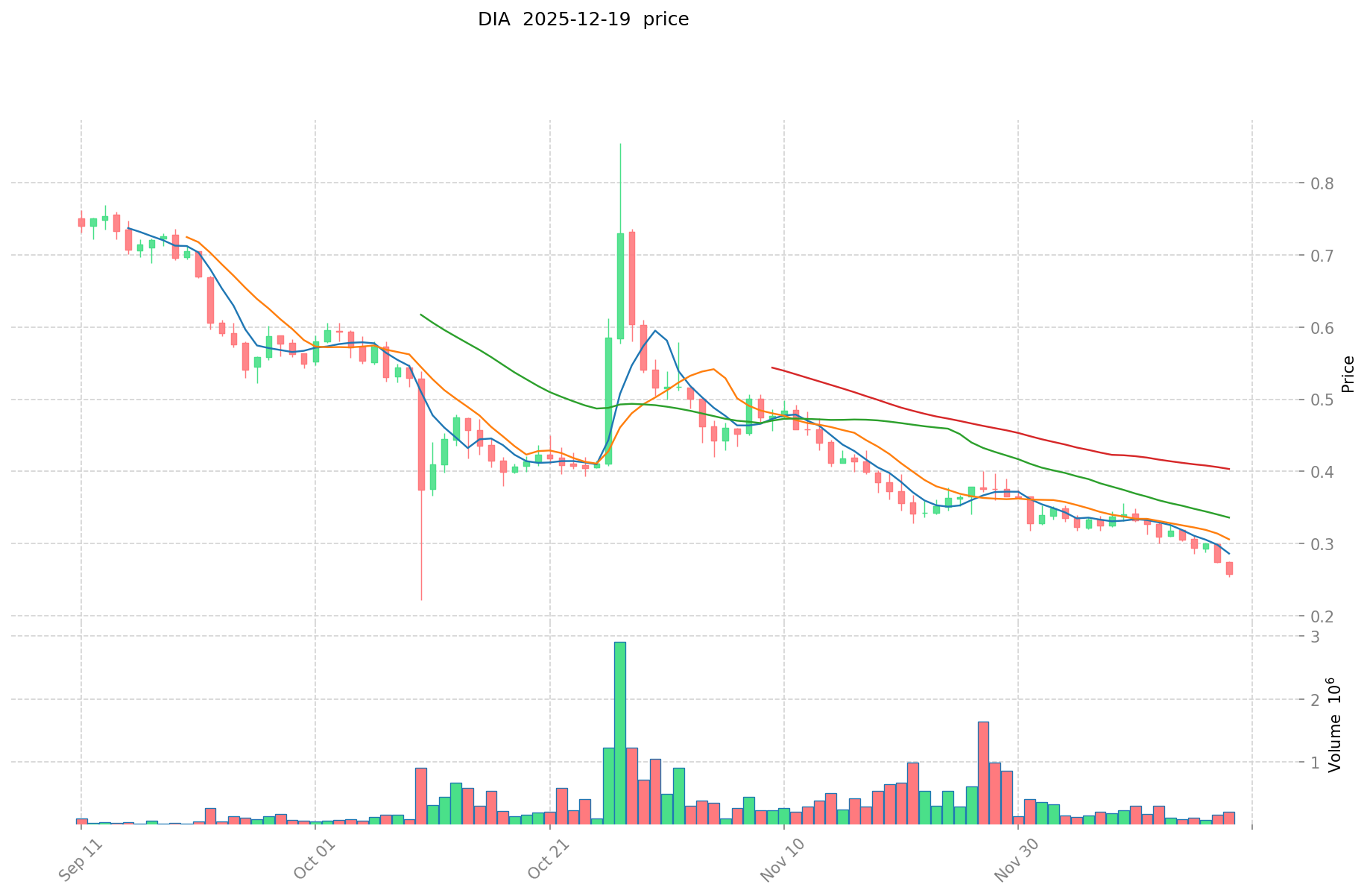
- Current Price: $0.2674 USD
- 24-Hour Change: -1.03% ($0.002783 decline)
- 7-Day Change: -17.8% ($0.057904 decline)
- 30-Day Change: -30.17% ($0.115530 decline)
- 1-Year Change: -61.35% ($0.424450 decline)
Market Capitalization and Supply:
- Fully Diluted Valuation: $45,141,732.11
- Market Capitalization: $32,001,390.21
- Circulating Supply: 119,676,104 DIA (59.84% of total supply)
- Total Supply: 168,817,248 DIA
- Maximum Supply: 200,000,000 DIA
- Market Share: 0.0014%
Trading Activity:
- 24-Hour Trading Volume: $65,311.63
- Market Ranking: #667
- 24-Hour High/Low: $0.2757 / $0.253
- Total Exchange Listings: 22
Token Holder Distribution:
- Total Token Holders: 24,732 addresses
View current DIA market price
DIA Market Sentiment Index
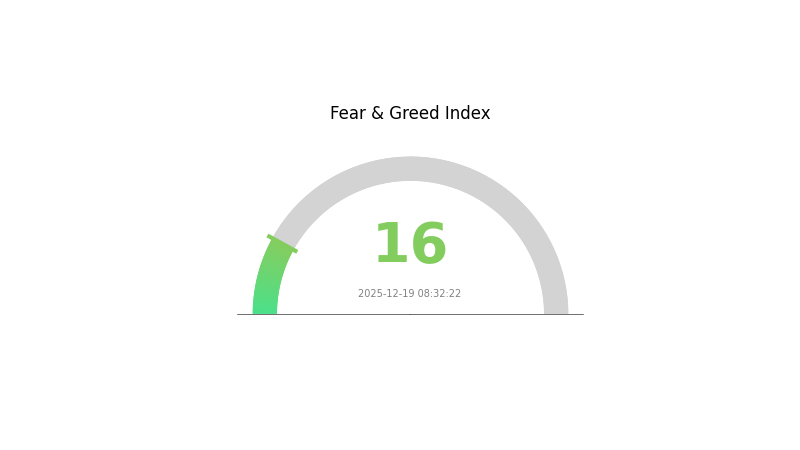
2025-12-19 Fear and Greed Index: 16 (Extreme Fear)
The cryptocurrency market is currently experiencing extreme fear sentiment. With the Fear and Greed Index at 16, market participants are showing significant caution and pessimism. This low reading typically indicates heightened risk aversion, potential capitulation selling, and substantial market uncertainty. During such periods, experienced investors often view extreme fear as potential buying opportunities, as markets may be overextending downside moves. However, extreme caution is advised, as further downside risk remains possible. Monitor key support levels and market developments closely for potential reversal signals.
Click to view the latest Fear & Greed Index
DIA Token Holdings Distribution
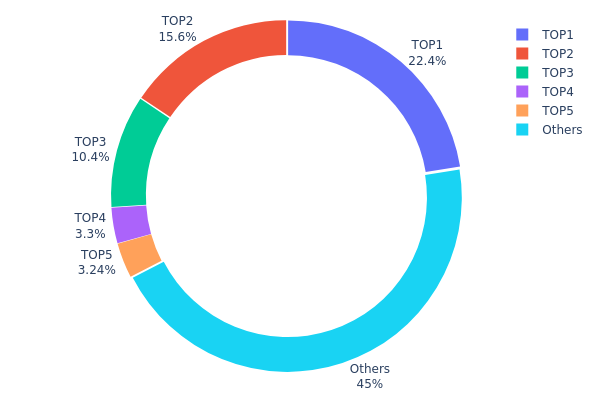
The address holdings distribution chart represents the concentration pattern of DIA tokens across blockchain addresses, revealing the degree of decentralization and potential concentration risks within the network. By analyzing the top token holders and their respective ownership percentages, investors and analysts can assess market structure stability, liquidity dynamics, and the potential for price volatility or market manipulation.
DIA's current holdings distribution demonstrates moderate concentration characteristics. The top three addresses collectively control approximately 48.46% of total token supply, with the largest holder (0x7170...9cbc85) commanding 22.41% and the second-largest address (0x0000...00dead) holding 15.63%. Notably, the dead address accounts for a significant portion, effectively removing these tokens from active circulation. The third major holder (0xf977...41acec) maintains 10.42% of the supply. This concentration pattern indicates that while a substantial portion of tokens remain distributed among smaller holders—represented by the "Others" category at 45.01%—the market still exhibits meaningful dependency on a limited number of major participants.
The current distribution structure presents both opportunities and risks for market dynamics. While the 45.01% allocation to dispersed holders suggests a reasonable degree of decentralization, the cumulative 54.99% concentration among top five addresses indicates that coordinated actions by major holders could meaningfully influence price movements and market sentiment. The presence of significant holdings in identified addresses warrants monitoring, as the market's resilience largely depends on these stakeholders' behavior patterns and their propensity for holding versus liquidating positions. Overall, DIA demonstrates a moderately decentralized structure with sufficient liquidity distribution, though token supply remains subject to concentrated stakeholder influence that could impact long-term market stability.
For detailed insights, visit DIA Token Holdings Distribution on Gate.com
| Top |
Address |
Holding Qty |
Holding (%) |
| 1 |
0x7170...9cbc85 |
44823.29K |
22.41% |
| 2 |
0x0000...00dead |
31267.41K |
15.63% |
| 3 |
0xf977...41acec |
20845.11K |
10.42% |
| 4 |
0x785a...df12c1 |
6593.79K |
3.29% |
| 5 |
0x3970...e4ace2 |
6489.15K |
3.24% |
| - |
Others |
89981.25K |
45.01% |
II. Core Factors Influencing DIA's Future Price
Industrial and Financial Sector Volatility
- Sector Sensitivity: DIA, as the SPDR Dow Jones Industrial Average ETF Trust, tracks 30 large-cap U.S. companies and is particularly exposed to industrial and financial sector performance.
- Supply Chain Disruptions: Global supply chain interruptions directly impact the underlying companies in the Dow Jones index, especially industrial sector components, which can create significant downward pressure on DIA's value.
- Economic Deterioration Effects: During periods of economic downturn or recession, companies within the index face greater operational challenges, leading to potential declines in DIA's price performance.
Market Competition and Data Quality
- High-Quality Data Demand: As DeFi ecosystems and blockchain applications grow, the demand for reliable, high-quality market data increases, which can indirectly support valuation metrics for traditional indices like the Dow Jones.
- Regulatory Compliance Impact: Regulatory changes affecting the financial and industrial sectors represented in the Dow index can significantly influence investor sentiment and pricing dynamics.
Macroeconomic Environment
- Investment Trends: Market sentiment and institutional investment flows toward large-cap U.S. equities directly influence DIA's price movements.
- Macroeconomic Factors: Broader economic conditions, including interest rates, inflation, and employment data, play a crucial role in determining DIA's performance alongside its component stocks.
Three、2025-2030 DIA Price Prediction
2025 Outlook
- Conservative Prediction: $0.1359 - $0.1800
- Neutral Prediction: $0.2000 - $0.2665
- Optimistic Prediction: $0.2500 - $0.2772 (Requires sustained demand for decentralized data infrastructure)
2026-2028 Medium-term Outlook
- Market Stage Expectation: Gradual recovery and consolidation phase with increasing institutional adoption of data oracle solutions
- Price Range Prediction:
- 2026: $0.1713 - $0.3262
- 2027: $0.1764 - $0.3409
- 2028: $0.2656 - $0.3359
- Key Catalysts: Expansion of DIA's data provider network, integration with emerging blockchain ecosystems, growth in DeFi and enterprise demand for reliable price feeds, and technological upgrades to the protocol
2029-2030 Long-term Outlook
- Base Case Scenario: $0.2853 - $0.4362 (Assumes moderate adoption growth and stable market conditions)
- Optimistic Scenario: $0.3200 - $0.4400 (Assumes accelerated enterprise adoption and expanded use cases across multiple blockchain networks)
- Transformative Scenario: $0.4000 - $0.4394 (Assumes DIA becomes a leading decentralized data provider with 42% cumulative growth by 2030, supported by widespread institutional integration and regulatory clarity)
By 2030, DIA price targets suggest potential growth trajectory with average price expectations around $0.3821, reflecting increasing market recognition of decentralized oracle solutions and data infrastructure importance.
| 年份 |
预测最高价 |
预测平均价格 |
预测最低价 |
涨跌幅 |
| 2025 |
0.27716 |
0.2665 |
0.13592 |
0 |
| 2026 |
0.3262 |
0.27183 |
0.17125 |
1 |
| 2027 |
0.34087 |
0.29901 |
0.17642 |
11 |
| 2028 |
0.33594 |
0.31994 |
0.26555 |
19 |
| 2029 |
0.43616 |
0.32794 |
0.28531 |
22 |
| 2030 |
0.43936 |
0.38205 |
0.24833 |
42 |
DIA Professional Investment Strategy and Risk Management Report
IV. DIA Professional Investment Strategy and Risk Management
DIA Investment Methodology
(1) Long-Term Holding Strategy
Target Investor Profile: Value-oriented investors who believe in DIA's long-term potential as a decentralized financial data platform and governance token.
Operational Recommendations:
- Dollar-Cost Averaging (DCA): Invest a fixed amount of capital at regular intervals (weekly, monthly) to reduce the impact of price volatility. Given DIA's 61.35% decline over the past year, this strategy helps accumulate tokens at varying price levels.
- Stake for Governance Participation: Hold DIA tokens to participate in protocol governance decisions and benefit from community reward distributions, leveraging the platform's planned 25 million DIA governance incentives.
- Storage Solution: Store tokens in a secure digital wallet with private key control. For large holdings, consider using hardware security solutions combined with secure backup procedures. Access DIA trading on Gate.com for reliable liquidity management.
(2) Active Trading Strategy
Technical Analysis Considerations:
- Price Action Analysis: Monitor DIA's 24-hour trading range ($0.253 - $0.2757) and historical support/resistance levels. The token's all-time low of $0.208951 (September 2, 2023) and all-time high of $5.73 (May 5, 2021) provide broader technical reference points.
- Volume Monitoring: Track the 24-hour trading volume of $65,311.63 to identify breakout opportunities and liquidity conditions across the 22 exchanges where DIA is listed.
Wave Trading Key Points:
- Volatility Exploitation: With a 7-day decline of 17.8% and 30-day decline of 30.17%, traders should identify oversold conditions and potential recovery bounces.
- Risk-Reward Ratio Management: Set clear entry and exit points based on technical signals, maintaining a minimum 1:2 risk-to-reward ratio for active positions.
DIA Risk Management Framework
(1) Asset Allocation Principles
- Conservative Investors: 1-3% portfolio allocation to DIA due to its speculative nature and long-term underperformance (-61.35% YoY).
- Aggressive Investors: 3-8% portfolio allocation, suitable for investors with higher risk tolerance who believe in the project's governance and data verification mechanisms.
- Professional Investors: 5-15% allocation as part of a diversified crypto portfolio, with sophisticated hedging strategies and position management protocols.
(2) Risk Hedging Solutions
- Inverse Position Hedging: For significant holdings, consider establishing small inverse positions to protect against further price declines during uncertain market conditions.
- Staged Exit Strategy: Rather than holding or liquidating entirely, implement a tiered exit plan where partial positions are closed at predetermined price levels or risk thresholds.
(3) Secure Storage Solutions
- Non-Custodial wallet: Use Gate.com's Web3 wallet for self-custody of DIA tokens, maintaining full control of private keys while enjoying seamless trading capabilities.
- Cold Storage Method: For long-term holdings exceeding a certain threshold, transfer tokens to an offline storage solution with comprehensive backup procedures and multi-signature verification options.
- Security Precautions: Enable two-factor authentication for all exchange accounts, use unique and complex passwords, regularly verify wallet addresses, never share private keys, and be cautious of phishing attempts targeting token holders.
V. DIA Potential Risks and Challenges
DIA Market Risk
- Severe Price Volatility: DIA has experienced an 61.35% decline over the past year and a 30.17% decline over 30 days. Such extreme volatility increases the risk of significant capital loss for investors with lower risk tolerance.
- Low Market Capitalization: With a fully diluted valuation of $45.14 million, DIA remains a relatively small-cap asset vulnerable to liquidity crises and price manipulation during market stress events.
- Limited Trading Liquidity: Despite being listed on 22 exchanges, the 24-hour trading volume of $65,311.63 relative to market cap suggests potential liquidity constraints for large orders.
DIA Regulatory Risk
- Uncertain Token Classification: As a governance and utility token combining voting rights, data verification staking, and API payment functions, DIA faces evolving regulatory interpretations across different jurisdictions.
- Compliance Uncertainty: Different regulatory frameworks (SEC in the US, FCA in the UK, ESMA in Europe) may impact DIA's ability to operate as a data oracle platform or affect token holder rights.
- Policy Changes: New regulations targeting decentralized data networks, oracle services, or token-based governance could fundamentally alter DIA's operational model and value proposition.
DIA Technical Risk
- Platform Dependency: DIA's value is inherently tied to adoption and usage of its decentralized data platform. Low adoption rates or migration to competitor solutions directly threaten token utility.
- Data Quality Challenges: As a platform reliant on decentralized data verification, integrity issues, validator collusion, or disputes over data accuracy could undermine platform credibility.
- Smart Contract Risk: Potential vulnerabilities in the platform's smart contracts managing data collection, verification, and governance could lead to fund loss or operational disruptions.
VI. Conclusion and Action Recommendations
DIA Investment Value Assessment
DIA operates within a challenging market environment characterized by sustained downward price pressure (-61.35% annually) and modest market capitalization ($45.14 million). The project presents a legitimate use case as a decentralized financial data platform with governance mechanisms, yet faces significant adoption hurdles, liquidity constraints, and regulatory uncertainties. While the 12.5% of tokens allocated for community incentives and open-source development indicate long-term commitment, the token's current valuation reflects skepticism about near-term growth prospects. Investors should view DIA primarily as a speculative position in the broader decentralized oracle and data infrastructure category rather than a core portfolio holding.
DIA Investment Recommendations
✅ Beginners: Limit DIA to experimental positions representing 1-2% of total crypto allocation. Use dollar-cost averaging through Gate.com over 3-6 months to develop familiarity with the project before increasing exposure. Prioritize education about governance mechanisms and data oracle functions.
✅ Experienced Investors: Consider 3-5% allocation as part of a diversified Web3 infrastructure portfolio. Implement technical analysis-based entry strategies during oversold conditions while maintaining strict stop-loss discipline. Actively participate in governance to influence platform development.
✅ Institutional Investors: Evaluate 5-10% positions within specialized crypto or Web3 infrastructure funds. Conduct comprehensive due diligence on tokenomics, development team, and competitive positioning. Establish relationships with the DIA team to monitor platform progress and adoption metrics.
DIA Trading Participation Methods
- Spot Trading on Gate.com: Access immediate liquidity for DIA token purchases and sales with competitive fees and real-time market data.
- Dollar-Cost Averaging Programs: Set up recurring investment orders on Gate.com to systematically accumulate DIA tokens regardless of price fluctuations.
- Gate.com Web3 Wallet Integration: Combine exchange trading with decentralized wallet management, enabling token transfers, governance participation, and yield opportunities while maintaining custody control.
Cryptocurrency investment carries extreme risk and is highly speculative. This report does not constitute investment advice. Investors must assess their personal risk tolerance and investment objectives before committing capital to DIA or any digital asset. Always consult with qualified financial advisors and never invest more than you can afford to lose. Past performance does not guarantee future results.
FAQ
Does dia crypto have a future?
Yes, DIA has strong potential for future growth. As a decentralized data oracle platform, it serves critical infrastructure needs in Web3. With continuous development, growing adoption, and increasing demand for reliable price feeds, DIA is well-positioned for long-term success in the cryptocurrency ecosystem.
What is the DIA price forecast?
DIA price is expected to range between $0.2214 and $0.2496 over the next 24 hours, with a forecast of $0.2621 tomorrow, representing a 3.21% potential gain.
Is now a good time to buy DIA?
Yes, DIA currently shows strong bullish momentum with positive market indicators. The token has demonstrated solid fundamentals and growing adoption in the ecosystem. Market conditions suggest a favorable entry point for investors seeking exposure to DIA.
What factors influence DIA token price movements?
DIA token price is influenced by market supply and demand, overall cryptocurrency market trends, trading volume, regulatory developments, and technological innovations within the ecosystem.
How does DIA compare to other oracle and data feed projects?
DIA distinguishes itself through its self-service oracle model, offering greater user autonomy compared to centralized alternatives. It emphasizes simplicity and accessibility, enabling users to create custom oracles without complex intermediaries, setting it apart from traditional oracle frameworks in the market.
* The information is not intended to be and does not constitute financial advice or any other recommendation of any sort offered or endorsed by Gate.