This comprehensive analysis examines Fetch.ai (FET) token's market dynamics and price trajectory from 2026 to 2031. Currently trading at $0.2933 with a $678 million market cap, FET integrates AI and blockchain technology through its Autonomous Economic Agents ecosystem. The article reviews historical price patterns, supply mechanisms, and institutional developments within the Artificial Superintelligence Alliance, then projects FET reaching $0.36-$1.02 by 2031 under various scenarios. Key sections detail technical analysis tools, risk management frameworks, and investment strategies across conservative, active, and institutional approaches. Comprehensive risk assessment covers price volatility, regulatory uncertainty, and competitive pressures, with secure storage recommendations via Gate Web3 Wallet. Essential reading for investors evaluating AI-blockchain convergence opportunities through FET token.
Introduction: FET's Market Position and Investment Value
Artificial Superintelligence Alliance (FET), as a pioneer integrating machine learning, artificial intelligence, and decentralized ledger technology to build the economic internet, has been developing its autonomous agent ecosystem since its launch in 2019. As of 2026, FET has achieved a market capitalization of approximately $678 million, with a circulating supply of around 2.31 billion tokens and a current price hovering around $0.29. This asset, positioned at the intersection of AI and blockchain technology, is playing an increasingly significant role in enabling autonomous economic transactions and intelligent digital agents across various market sectors.
This article will comprehensively analyze FET's price trends from 2026 to 2031, combining historical patterns, market supply and demand dynamics, ecosystem development, and macroeconomic conditions to provide investors with professional price forecasts and practical investment strategies.
I. FET Price History Review and Market Status
FET Historical Price Evolution Trajectory
- 2020: During the early development phase, FET reached its historical low price of $0.00827 on March 13, experiencing significant market volatility during the crypto market downturn.
- 2024: The token achieved notable growth momentum, with prices climbing substantially throughout the year, reaching an all-time high of $3.47 on March 29.
- 2025-2026: Following the peak in early 2024, FET experienced a correction phase, with prices declining from historical highs to current levels around $0.29.
FET Current Market Status
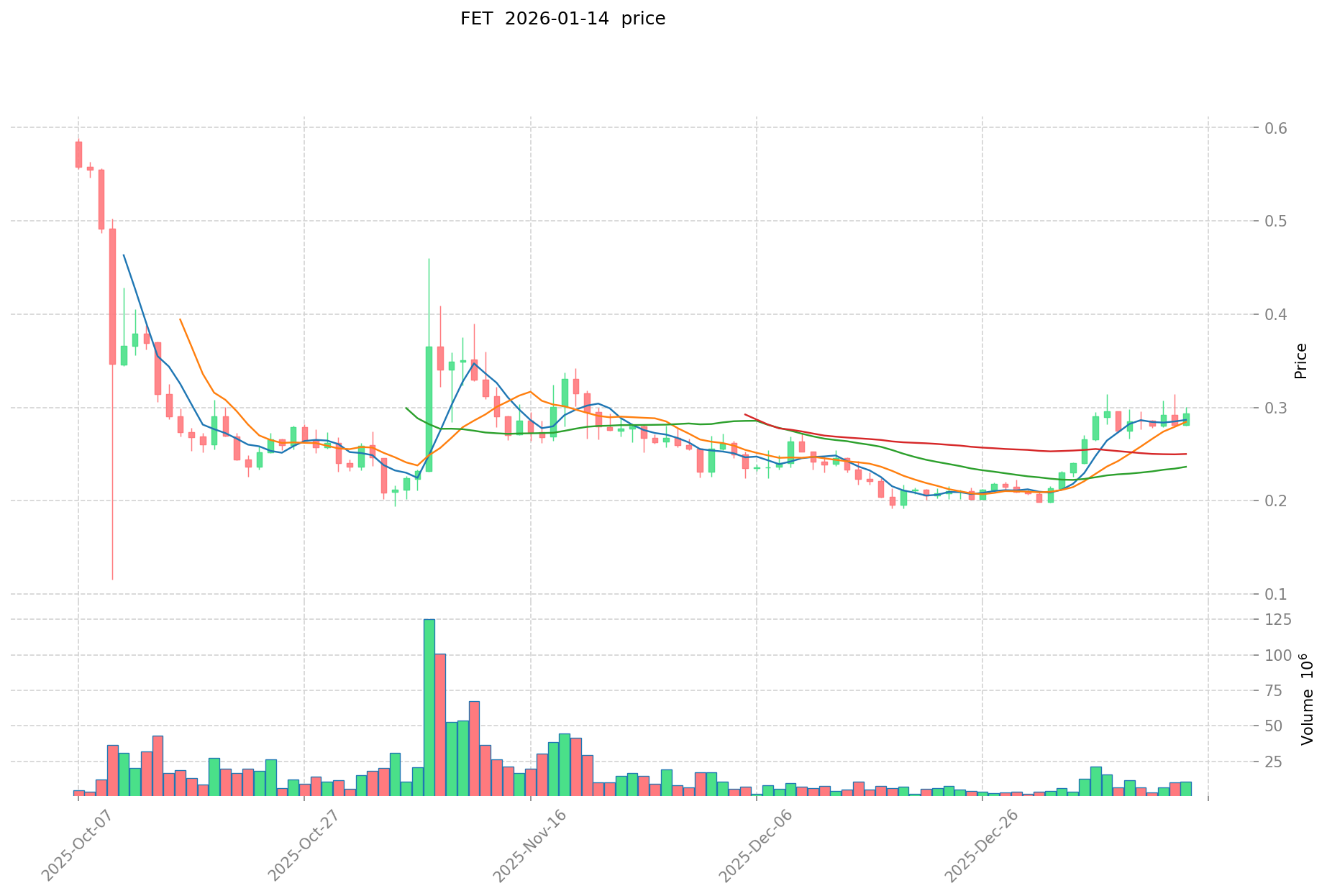
As of January 14, 2026, FET is trading at $0.2933, with a 24-hour trading volume of approximately $4.58 million. The token has shown positive short-term momentum, registering a 2.54% increase over the past 24 hours and a 1.38% gain over the past week. The 30-day performance demonstrates stronger recovery signals with a 22.62% price appreciation.
The token currently holds a market ranking of #114 with a circulating market capitalization of approximately $678 million. With 2.31 billion tokens in circulation out of a total supply of 2.71 billion, FET maintains a circulating ratio of 85.02%. The fully diluted market capitalization stands at approximately $796 million, representing a market cap to FDV ratio of 85.02%.
Recent price action shows FET trading within a 24-hour range between $0.2808 and $0.3002. The one-hour timeframe indicates a modest 0.27% uptick, suggesting continued near-term interest. However, the one-year perspective reveals a significant correction of 76.38% from previous highs, reflecting broader market adjustments and consolidation patterns.
The token is listed on 51 exchanges and has attracted a holder base of 159,225 addresses. Market sentiment indicators show a neutral reading with a VIX score of 48, suggesting balanced trading conditions without extreme fear or greed in the current market environment.
Click to view current FET market price
FET Market Sentiment Index
2026-01-14 Fear and Greed Index: 48 (Neutral)
Click to view current Fear & Greed Index
The cryptocurrency market is currently in a neutral sentiment state, with the Fear and Greed Index at 48. This balanced reading suggests that market participants are neither excessively fearful nor greedy, indicating a relatively stable trading environment. Investors should remain cautious and conduct thorough analysis before making investment decisions. Such neutral conditions often present both opportunities and risks, requiring careful market observation and risk management strategies to navigate effectively.

FET Holding Distribution
The holding distribution chart reflects the concentration of token ownership across different wallet addresses in the FET ecosystem. It provides critical insights into whether the token supply is controlled by a few large holders or distributed more evenly among participants. This metric serves as a key indicator of decentralization and potential market manipulation risks.
Based on the current data, FET exhibits a moderate to high concentration pattern. The top holder controls 290,000K tokens (10.68%), followed by the second-largest address with 277,549.57K tokens (10.22%), and the third with 213,734.57K tokens (7.87%). Collectively, the top five addresses hold approximately 36.63% of the total supply, while the remaining 63.37% is distributed among other addresses. This concentration level suggests that while major holders possess significant influence, the majority of tokens remain in broader circulation, indicating a relatively balanced distribution compared to many emerging projects.
The current holding structure presents both stability and risk factors. On one hand, the substantial holdings by top addresses could provide liquidity anchors and reduce excessive volatility during market fluctuations. On the other hand, concentrated ownership creates potential vulnerability to coordinated selling pressure or price manipulation if these large holders choose to execute significant transactions simultaneously. The 63.37% held by "Others" suggests a reasonable degree of decentralization, which typically contributes to healthier price discovery mechanisms and reduces single-point failure risks in the token's market structure.
Click to view current FET Holding Distribution

| Top |
Address |
Holding Qty |
Holding (%) |
| 1 |
0xf977...41acec |
290000.00K |
10.68% |
| 2 |
0xf58d...b645dc |
277549.57K |
10.22% |
| 3 |
0x9478...b626cc |
213734.57K |
7.87% |
| 4 |
0xfcf1...2a6fb1 |
107372.79K |
3.95% |
| 5 |
0x5e0c...794a5f |
106403.40K |
3.91% |
| - |
Others |
1719324.22K |
63.37% |
II. Core Factors Influencing FET's Future Price
Supply Mechanism
- Fixed Supply Model: Fetch.ai operates with a fixed token supply structure, with a maximum supply of 2,719,493,897 FET tokens. The circulating supply as of January 2026 stands at approximately 2,312,273,764 FET.
- Historical Impact: The fixed supply mechanism has historically supported price appreciation during periods of increased demand. Between November 2023 and January 2024, FET experienced significant growth from $0.36 to $0.67, reflecting how limited supply can amplify positive market sentiment.
- Current Influence: With supply remaining constant, FET's price trajectory will primarily depend on utility expansion and adoption rates. The fixed supply structure may continue to exert upward pressure on prices if AI application demand increases.
Institutional and Major Holder Dynamics
- Institutional Involvement: The formation of the Artificial Superintelligence Alliance (ASI) in March 2024, initially involving Fetch.ai, SingularityNET, and Ocean Protocol, represented a significant institutional development with a combined market capitalization exceeding $7.6 billion at launch.
- Partnership Developments: Fetch.ai has expanded its influence across decentralized finance (DeFi), healthcare, and transportation sectors through its Autonomous Economic Agents (AEA) framework, facilitating data transactions and machine-based economic activities.
- Market Dynamics: The Alliance experienced significant challenges in October 2025 when Ocean Protocol withdrew following governance disputes, which contributed to substantial market volatility and price decline.
Macroeconomic Environment
- Market Sentiment Impact: Global economic conditions and market sentiment fluctuations significantly affect FET's performance. The token has demonstrated sensitivity to broader cryptocurrency market trends and risk appetite.
- Volatility Characteristics: Cryptocurrency markets remain highly unpredictable, and FET is subject to rapid price movements regardless of fundamental strength. External factors including regulatory developments and macroeconomic events continue to influence trading patterns.
- Economic Uncertainty: As with other digital assets, FET's price may experience heightened volatility during periods of economic instability or shifts in monetary policy expectations.
Technology Development and Ecosystem Building
- Decentralized Machine Learning Platform: Fetch.ai is developing a decentralized machine learning infrastructure that enables data sharing and exchange through Autonomous Economic Agents (AEAs), allowing users to bypass centralized aggregators.
- AI and Blockchain Integration: The platform combines artificial intelligence capabilities with blockchain technology to facilitate smart contract automation and optimization for decentralized applications.
- Ecosystem Applications: FET tokens serve multiple functions within the network, including payment for data request fees, governance voting on proposals, and earning staking rewards. The token's utility extends across various sectors where autonomous agents can optimize operations, from DeFi trading services to healthcare system enhancements.
III. 2026-2031 FET Price Predictions
2026 Outlook
- Conservative Prediction: $0.17598 - $0.2933
- Neutral Prediction: $0.2933
- Optimistic Prediction: $0.36663 (requires favorable market conditions and increased adoption)
2027-2029 Outlook
- Market Stage Expectation: Gradual growth phase with increasing institutional interest and AI sector expansion
- Price Range Predictions:
- 2027: $0.20788 - $0.47845
- 2028: $0.25061 - $0.60226
- 2029: $0.34723 - $0.74479
- Key Catalysts: AI technology advancement, ecosystem development, and broader market recovery
2030-2031 Long-term Outlook
- Base Scenario: $0.34945 - $0.84865 (assuming steady market development and technology adoption)
- Optimistic Scenario: $0.62401 - $1.0235 (with accelerated AI integration and strong institutional support)
- Transformative Scenario: Above $1.02 (under conditions of widespread AI agent adoption and significant protocol upgrades)
- 2026-01-14: FET shows potential for substantial growth trajectory over the five-year period
| Year |
Predicted High Price |
Predicted Average Price |
Predicted Low Price |
Price Change |
| 2026 |
0.36663 |
0.2933 |
0.17598 |
0 |
| 2027 |
0.47845 |
0.32996 |
0.20788 |
12 |
| 2028 |
0.60226 |
0.4042 |
0.25061 |
37 |
| 2029 |
0.74479 |
0.50323 |
0.34723 |
71 |
| 2030 |
0.84865 |
0.62401 |
0.34945 |
112 |
| 2031 |
1.0235 |
0.73633 |
0.71424 |
151 |
IV. FET Professional Investment Strategies and Risk Management
FET Investment Methodology
(1) Long-term Holding Strategy
- Suitable for: Investors who believe in AI and blockchain technology convergence with a multi-year investment horizon
- Operational Recommendations:
- Consider accumulating positions during market corrections when FET trades below key technical support levels
- Diversify entry points through dollar-cost averaging to mitigate timing risk
- Storage Solution: Use Gate Web3 Wallet for secure non-custodial storage with multi-signature protection
(2) Active Trading Strategy
- Technical Analysis Tools:
- Moving Averages: Monitor 50-day and 200-day moving averages to identify trend directions and potential crossover signals
- RSI (Relative Strength Index): Track overbought conditions above 70 and oversold conditions below 30 for potential reversal opportunities
- Swing Trading Key Points:
- Focus on the 24-hour volatility range, considering FET's recent price movement between $0.2808 and $0.3002
- Set stop-loss orders approximately 5-8% below entry points to limit downside exposure
FET Risk Management Framework
(1) Asset Allocation Principles
- Conservative Investors: 2-3% of cryptocurrency portfolio allocation
- Aggressive Investors: 5-8% of cryptocurrency portfolio allocation
- Professional Investors: Up to 10-12% with active hedging strategies
(2) Risk Hedging Solutions
- Diversification Approach: Balance FET holdings with other AI-focused tokens and established cryptocurrencies to reduce sector-specific risk
- Position Sizing Strategy: Limit individual trade size to 1-2% of total portfolio value to prevent significant losses from single positions
(3) Secure Storage Solutions
- Hot Wallet Recommendation: Gate Web3 Wallet for convenient trading access with enhanced security features
- Cold Storage Option: Hardware wallet solutions for long-term holdings exceeding investment timeframes of 6 months
- Security Precautions: Enable two-factor authentication, regularly update wallet software, never share private keys, and verify contract addresses (0xaea46A60368A7bD060eec7DF8CBa43b7EF41Ad85 for ETH)
V. FET Potential Risks and Challenges
FET Market Risks
- Price Volatility: FET has experienced significant price fluctuations, with 1-year performance showing a decline of approximately 76.38%, highlighting substantial market volatility
- Liquidity Concerns: While FET shows reasonable trading volume of approximately $4.58 million in 24 hours, sudden market movements could impact execution prices
- Market Sentiment Dependence: AI-related tokens are subject to hype cycles, and investor sentiment shifts could rapidly affect FET's market valuation
FET Regulatory Risks
- Cryptocurrency Regulation Evolution: Changing regulatory frameworks across jurisdictions may impact FET's accessibility and trading conditions
- AI Technology Oversight: Increasing scrutiny on AI applications could introduce compliance requirements affecting the Artificial Superintelligence Alliance ecosystem
- Token Classification Uncertainty: Potential reclassification of utility tokens by regulatory authorities could affect FET's trading status on exchanges
FET Technical Risks
- Network Dependency: FET operates on ETH infrastructure, creating exposure to Ethereum network congestion and gas fee fluctuations
- Smart Contract Vulnerabilities: Despite security measures, smart contract bugs or exploits could impact token functionality and user funds
- Competition Pressure: The AI and blockchain integration space is rapidly evolving with numerous competing projects, potentially affecting FET's market position
VI. Conclusion and Action Recommendations
FET Investment Value Assessment
Artificial Superintelligence Alliance (FET) represents an innovative approach to combining AI, machine learning, and blockchain technology to create an "Economic Internet." With a market capitalization around $678 million and trading at $0.2933, FET sits within the top 120 cryptocurrencies by ranking. The project's focus on autonomous economic agents and multi-agent systems addresses real-world efficiency challenges across markets. However, the significant 76.38% decline over the past year reflects broader market challenges and highlights the volatility inherent in AI-focused cryptocurrency projects. The circulating supply represents approximately 85% of maximum supply, suggesting limited inflation pressure. Long-term value depends on successful ecosystem development and adoption of the autonomous agent framework, while short-term risks include market volatility, regulatory uncertainty, and competitive pressures in the AI-blockchain sector.
FET Investment Recommendations
✅ Beginners: Start with minimal allocation (1-2% of crypto portfolio) and focus on understanding the project fundamentals before increasing position size; use Gate Web3 Wallet for straightforward storage
✅ Experienced Investors: Consider strategic accumulation during market dips with dollar-cost averaging approach; maintain 3-5% portfolio allocation with active monitoring of technical indicators and project developments
✅ Institutional Investors: Conduct thorough due diligence on the Artificial Superintelligence Alliance roadmap and partnerships; consider hedged positions with defined risk parameters and allocation between 5-10% depending on risk appetite
FET Trading Participation Methods
- Spot Trading: Direct purchase and holding of FET tokens through Gate.com with flexible entry and exit options
- Gradual Accumulation: Implement systematic investment plans to build positions over time, reducing timing risk exposure
- Portfolio Balancing: Regularly rebalance FET allocation relative to other crypto assets to maintain target risk profile
Cryptocurrency investment carries extremely high risk, and this article does not constitute investment advice. Investors should make prudent decisions based on their own risk tolerance and are advised to consult professional financial advisors. Never invest more than you can afford to lose.
FAQ
What is FET (Fetch.ai)? What are its main application scenarios?
FET is an AI-powered blockchain project creating autonomous agents that interact without human intervention. Key applications include logistics, finance, smart cities, and DeFi ecosystems for decentralized problem-solving.
FET's all-time low was $0.0532, while its all-time high reached $24.2898. Currently trading at $1.7147, FET demonstrates significant volatility and substantial recovery potential from historical lows.
What is the 2024 FET price prediction? What are analysts' target prices?
2024 FET price predictions range between $2.25 to $2.40, with analysts targeting $2.40. These forecasts are based on Fibonacci levels and market trend analysis.
What are the main factors affecting FET price?
FET price is primarily influenced by market demand, supply volume, market sentiment, and overall crypto market trends. Key drivers include trading volume, technological developments, network adoption, and major news announcements.
FET powers Fetch.ai's autonomous agent ecosystem with strong platform integration and governance participation through staking. AGI focuses on broader AI infrastructure, while RENDER specializes in GPU computing. FET's advantage lies in its specific autonomous agent use case; disadvantage is narrower application scope compared to competitors.
What is the current technical and fundamental status of FET?
FET demonstrates strong technical and fundamental positioning in early 2026, showing sustained upward momentum with robust support levels. The project benefits from growing AI integration and blockchain adoption, indicating bullish prospects ahead.
What are the main risks of investing in FET?
Main risks include market price volatility, competition in AI and blockchain sectors, regulatory uncertainty in crypto markets, and technology adoption challenges.
FET在未来3-5年的发展前景如何?
FET is positioned for strong growth, driven by AI advancements and expanding decentralized AI network adoption. With increased demand for intelligent automation and smart contracts, FET's value is expected to rise significantly as the platform captures more enterprise and developer interest in the AI revolution.
* The information is not intended to be and does not constitute financial advice or any other recommendation of any sort offered or endorsed by Gate.