This article provides an expert analysis on the GST price prediction for 2025, focusing on historical performance, market dynamics, and macroeconomic factors. It offers practical investment strategies for individuals interested in the move-to-earn and GameFi sectors. Key insights include GST’s market position, its price history, significant drop since its peak, and future price trends. The article also highlights risks and challenges, making it valuable for investors seeking a comprehensive understanding of GST’s potential and its impact on the Web3 lifestyle application space. Readers will appreciate the strategic recommendations and market sentiment analysis for informed decision-making.
Introduction: GST's Market Position and Investment Value
Green Satoshi Token (GST), as the game token of the STEPN move-to-earn ecosystem, has established itself as a key utility asset within the Web3 lifestyle application space since its launch. As of December 2025, GST maintains a market capitalization of approximately $1.29 million with a circulating supply of 1.147 billion tokens, currently trading around $0.00112. This token, integral to the STEPN platform's dual-token system, plays an essential role in enabling users to upgrade and mint NFT sneakers while participating in the move-to-earn mechanism.
This article will conduct a comprehensive analysis of GST's price trajectory throughout 2025 and beyond, integrating historical performance patterns, market supply-demand dynamics, ecosystem development, and macroeconomic factors to deliver professional price forecasting and practical investment strategies for investors seeking exposure to the move-to-earn and GameFi sectors.
Green Satoshi Token (GST) Market Analysis Report
I. GST Price History Review and Current Market Status
GST Historical Price Evolution Trajectory
-
April 2022: GST reached its all-time high of $8.51 on April 29, 2022, reflecting peak market enthusiasm during the early phase of the STEPN ecosystem.
-
2022-2025: Significant price depreciation occurred over the following years, with GST experiencing substantial downward pressure as market conditions evolved.
-
December 2025: GST hit a new all-time low of $0.00195663 on December 26, 2025, representing a decline of approximately 99.98% from its historical peak.
GST Current Market Positioning
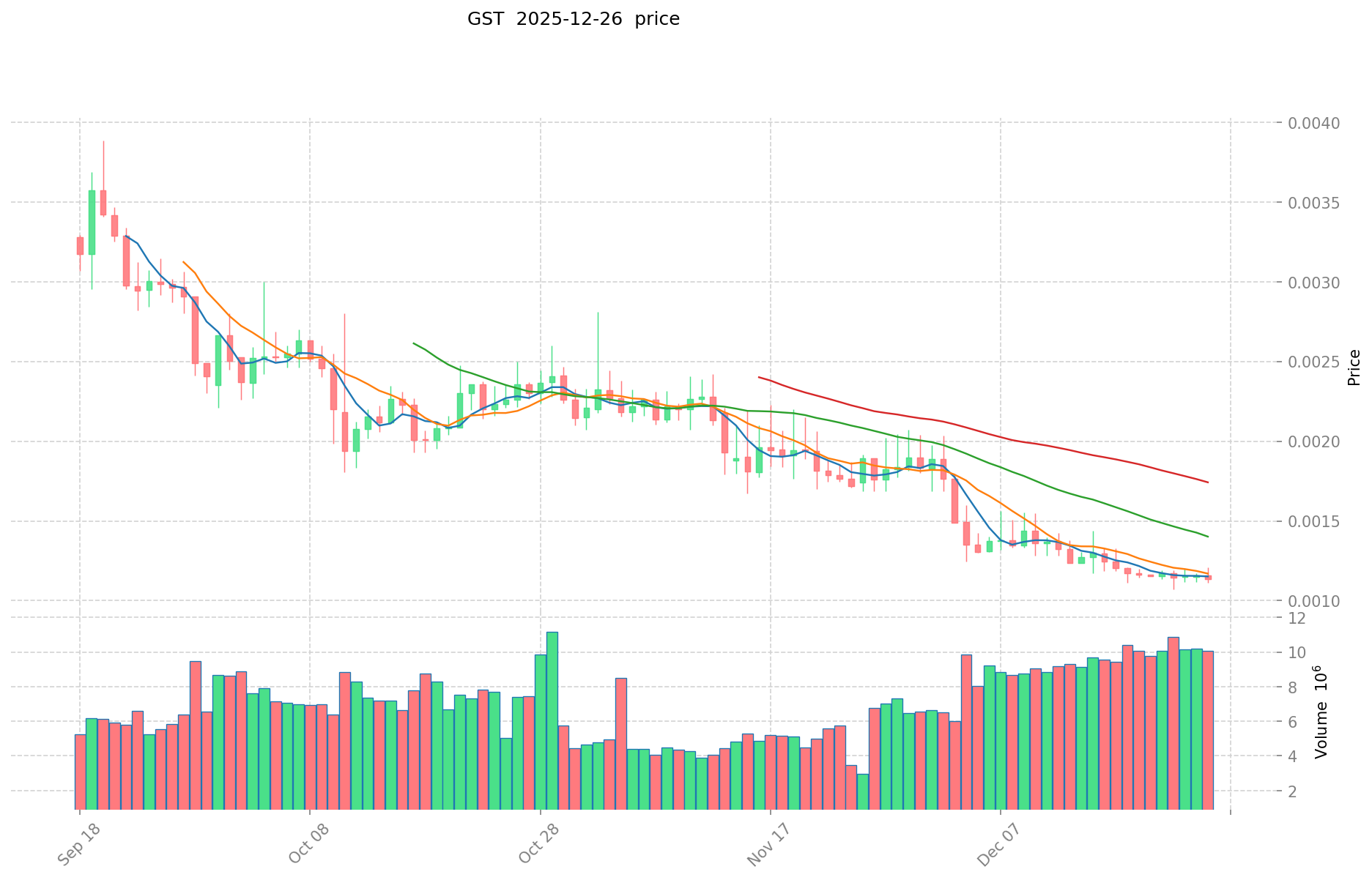
As of December 26, 2025, GST is trading at $0.00112, reflecting a market capitalization of approximately $1.29 million with a fully diluted valuation of $1.30 million. The token maintains a circulating supply of 1,147,161,857 GST out of a maximum supply of 1,157,161,858 GST, representing a circulation ratio of 99.14%.
Recent Performance Metrics:
- 24-hour price change: -3.7%
- 7-day price change: -4.53%
- 30-day price change: -36.33%
- 1-year price change: -75.67%
- 1-hour price change: -0.088%
The 24-hour trading volume stands at $11,520.79, with GST ranking #2,442 by market capitalization. The token currently holds a market dominance of 0.000040% in the overall cryptocurrency market.
Current market sentiment indicators suggest "Extreme Fear", reflecting the broader market conditions as of the reporting date.
Click to view current GST market price
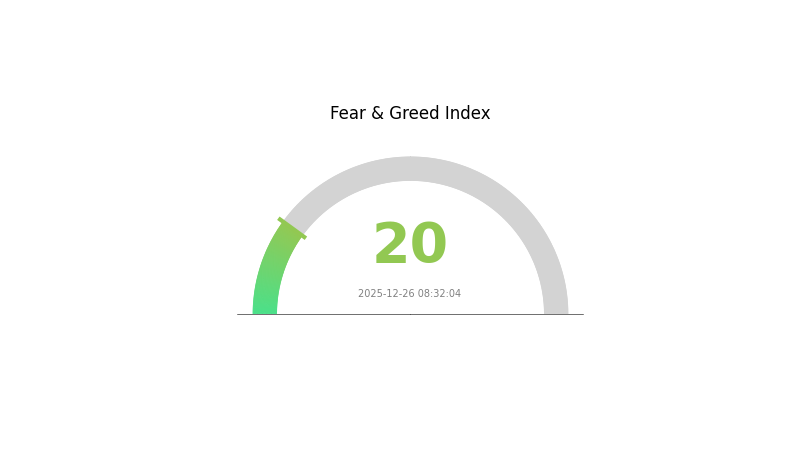
GST Market Sentiment Indicator
2025-12-26 Fear and Greed Index: 20 (Extreme Fear)
Click to view current Fear & Greed Index
The crypto market is currently experiencing extreme fear, with the Fear and Greed Index at 20. This sentiment reflects significant market pessimism and risk aversion among investors. During periods of extreme fear, asset prices are typically depressed, presenting potential opportunities for contrarian investors with a long-term perspective. However, elevated risk remains, and investors should exercise caution. Monitor market developments closely and consider your risk tolerance before making investment decisions. On Gate.com, you can track real-time market sentiment indicators to make more informed trading choices.
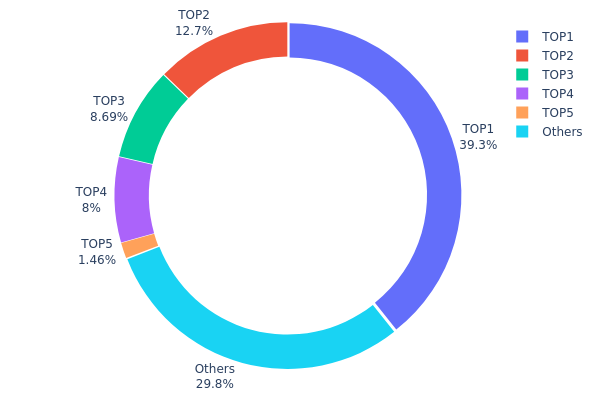
GST Holdings Distribution
The address holdings distribution chart illustrates the concentration of GST tokens across different wallet addresses, serving as a critical metric for evaluating token decentralization and market structure health. This visualization reveals how token supply is distributed among top holders, which directly impacts potential market manipulation risks, price volatility, and overall ecosystem stability.
GST demonstrates moderate to significant concentration characteristics based on current holdings data. The top four addresses collectively hold approximately 68.73% of total token supply, with the largest holder commanding 39.33% of all GST tokens. This concentration level indicates a relatively centralized distribution pattern. The top address alone exceeding one-third of total supply represents a substantial concentration risk, while the second and third-largest holders each maintain meaningful influence with 12.72% and 8.68% respectively. Notably, the remaining 29.81% of tokens are dispersed among numerous other addresses, suggesting that while major concentration exists at the top tier, a significant portion of supply remains distributed across smaller holders.
The current address distribution structure presents both opportunities and challenges for market dynamics. The pronounced concentration among top addresses creates potential liquidity risks and raises concerns about coordinated price movements or market manipulation. However, the presence of nearly 30% of supply outside the top five holders suggests some degree of decentralization at the grassroots level. For market participants and institutional investors, this distribution pattern warrants careful consideration regarding long-term sustainability and governance resilience. The on-chain structure reflects a stage of development typical of projects where early investors or project teams maintain substantial holdings, though achieving greater token distribution across addresses would enhance network decentralization and reduce systemic risks associated with whale activity.
Click to view current GST Holdings Distribution
| Top |
Address |
Holding Qty |
Holding (%) |
| 1 |
0x5566...415432 |
83870.57K |
39.33% |
| 2 |
0x7760...0eb0d2 |
27119.65K |
12.72% |
| 3 |
0x0d07...b492fe |
18523.12K |
8.68% |
| 4 |
0xba5a...d8f6a9 |
17062.28K |
8.00% |
| 5 |
0x08b6...73054c |
3118.88K |
1.46% |
| - |
Others |
63502.72K |
29.81% |
II. Core Factors Affecting Future GST Price Trends
Macroeconomic Environment
-
Global Trade Tariffs and Protectionism: Global trade tariff escalation and geopolitical tensions continue to exert downward pressure on GST pricing strategies. Trade protectionism measures, particularly high tariffs imposed by major economies, directly impact cross-border pricing models and cost structures.
-
Currency Fluctuations: International currency volatility significantly influences GST pricing in cross-border transactions. Exchange rate movements affect the competitiveness of goods in overseas markets and impact the calculation basis for indirect taxes.
-
Inflation and Price Dynamics: Inflationary pressures and changes in general price levels influence GST taxation bases. As inflation fluctuates, the actual tax burden on transactions may increase or decrease depending on how GST is structured in different jurisdictions.
-
Geopolitical Risk Factors: International political tensions, trade disputes, and regulatory uncertainties create volatility in GST application. Geopolitical instability can lead to sudden policy changes affecting tax compliance requirements and pricing strategies.
Regulatory and Compliance Environment
-
Regulatory Changes and Compliance Costs: Modifications to tax regulations and increased compliance requirements directly impact GST pricing strategies. Enterprises must restructure cost models to incorporate cross-border logistics costs into the GST tax base to avoid loss of price competitiveness.
-
International Tax Policy Coordination: Global efforts to harmonize indirect tax standards, including VAT and GST guidelines established by the OECD, influence how GST is applied across jurisdictions. These international frameworks shape pricing mechanisms and compliance obligations for multinational operations.
-
Local Tax Obligations: Different countries and regions impose varying GST registration and compliance requirements. For example, offshore companies may need to register as indirect tax taxpayers and fulfill tax obligations when meeting specific conditions, impacting pricing structures in e-commerce and cross-border trade scenarios.
Three, 2025-2030 GST Price Forecast
2025 Outlook
- Conservative Prediction: $0.00068 - $0.00112
- Neutral Prediction: $0.00112 (average expectation)
- Optimistic Prediction: $0.00157 (requires sustained market momentum and positive ecosystem developments)
2026-2027 Mid-term Outlook
- Market Stage Expectation: Gradual recovery and consolidation phase with increasing adoption momentum
- Price Range Predictions:
- 2026: $0.00114 - $0.00152 (20% upside potential)
- 2027: $0.0009 - $0.00182 (27% upside potential)
- Key Catalysts: Platform expansion initiatives, increased utility adoption, ecosystem partnership announcements, and growing institutional interest in the GST token ecosystem
2028-2030 Long-term Outlook
- Base Case: $0.00112 - $0.00224 (assuming steady ecosystem growth and moderate market expansion by 2028)
- Optimistic Case: $0.00156 - $0.00269 (assuming accelerated adoption, successful protocol upgrades, and broader market recovery by 2030)
- Transformative Case: $0.00269+ (extreme favorable conditions including mainstream adoption, major strategic partnerships, and significant market capitalization expansion)
- 2025-12-26: GST at $0.00112 (consolidation phase with neutral market sentiment)
| 年份 |
预测最高价 |
预测平均价格 |
预测最低价 |
涨跌幅 |
| 2025 |
0.00157 |
0.00112 |
0.00068 |
0 |
| 2026 |
0.00152 |
0.00134 |
0.00114 |
20 |
| 2027 |
0.00182 |
0.00143 |
0.0009 |
27 |
| 2028 |
0.00224 |
0.00162 |
0.00112 |
45 |
| 2029 |
0.00211 |
0.00193 |
0.00168 |
72 |
| 2030 |
0.00269 |
0.00202 |
0.00156 |
80 |
Green Satoshi Token (GST) Professional Investment Analysis Report
I. Executive Summary
Green Satoshi Token (GST) is the utility token of STEPN, a Web3 lifestyle application that combines Social-Fi and Game-Fi elements. As of December 26, 2025, GST is trading at $0.00112, with a market capitalization of approximately $1.29 million and a 24-hour trading volume of $11,520.79. The token has experienced significant depreciation, declining 75.67% over the past year from its all-time high of $8.51 reached on April 29, 2022.
II. GST Market Overview
Current Market Status
| Metric |
Value |
| Current Price |
$0.00112 |
| Market Capitalization |
$1,284,821.28 |
| Fully Diluted Valuation |
$1,296,021.28 |
| 24-Hour Trading Volume |
$11,520.79 |
| Circulating Supply |
1,147,161,857 GST |
| Total Supply |
1,157,161,857 GST |
| 24-Hour Price Change |
-3.7% |
| 7-Day Price Change |
-4.53% |
| 30-Day Price Change |
-36.33% |
| 1-Year Price Change |
-75.67% |
| Market Ranking |
2442 |
GST has experienced substantial value erosion since its peak. The token reached its all-time high of $8.51 on April 29, 2022, but declined to a low of $0.00195663 on December 26, 2025, representing a depreciation of over 99.9%. The token demonstrates ongoing downward pressure with recent short-term declines across 1-hour, 24-hour, 7-day, and 30-day periods.
III. GST Project Fundamentals
Project Overview
STEPN is a move-to-earn sports application that incentivizes outdoor physical activity through cryptocurrency rewards. Users equipped with NFT sneakers can walk, jog, or run outdoors to earn GST tokens, which serve as the primary in-game utility token.
Token System Architecture
STEPN operates a dual-token economic model:
Game Token - GST (Green Satoshi Token)
- Primary utility token earned through outdoor movement
- Used for upgrading and minting new NFT sneakers
- Enables in-app transactions and currency conversion
- Stored in the built-in application wallet
Governance Token - GMT (Green Metaverse Token)
- Secondary token for protocol governance
- Provides voting rights on platform decisions
Mobile Application
STEPN is available on iOS App Store and Google Play Store (availability limited to select regions).
NFT Sneaker System
- Each sneaker possesses distinct types, quality levels, attributes, and gem slots
- Users can upgrade and customize sneakers through token burning
- Sneakers serve as the primary asset required to earn rewards
Move-to-Earn Mechanism
Users equipped with NFT sneakers can earn GST tokens through outdoor movement. The platform implements multi-layer anti-cheating mechanisms to prevent fraudulent activity.
Rental System
Non-NFT owners can rent sneakers for free and earn rewards, with income shared between renters and sneaker owners, reducing entry barriers for new users.
In-App NFT Marketplace
Users can trade NFT sneakers directly within the application.
In-App Exchange Function
Users can convert earned GST into other cryptocurrency forms through the built-in swap functionality.
Decentralized In-App Wallet
Users maintain a built-in wallet for depositing, storing, and transferring cryptocurrencies to fund their accounts.
Network Deployment
GST is deployed on the Binance Smart Chain (BSC) network:
- Contract Address: 0x4a2c860cEC6471b9F5F5a336eB4F38bb21683c98
- Network: BSC (Binance Smart Chain)
IV. GST Professional Investment Strategy and Risk Management
GST Investment Methodology
(1) Long-Term Holding Strategy
Target Investors: Investors believing in STEPN's long-term Web3 lifestyle application potential and willing to tolerate significant volatility over extended periods.
Operational Recommendations:
- Conduct thorough due diligence on STEPN's user adoption metrics, active user growth, and engagement statistics
- Assess the sustainability of the move-to-earn economic model and token emission schedules
- Monitor platform feature releases, market expansion into new regions, and partnership announcements
- Implement dollar-cost averaging (DCA) approach to mitigate timing risk during market downturns
- Establish a 2-5 year holding horizon aligned with project development milestones
Storage Solution:
- Utilize Gate Web3 Wallet for enhanced security and direct trading access on Gate.com
- Maintain backup recovery phrases in secure, offline locations
- Consider cold storage options for long-term holdings exceeding 12 months
- Never store significant holdings on exchange accounts
(2) Active Trading Strategy
Technical Analysis Tools:
- Moving Average Convergence Divergence (MACD): Identify trend reversals and momentum shifts to time entry and exit points
- Relative Strength Index (RSI): Detect overbought (>70) and oversold (<30) conditions for mean-reversion trading opportunities
- Support and Resistance Levels: Monitor key price levels at $0.001113 (24-hour low) and $0.001208 (24-hour high) for breakout confirmation
Swing Trading Key Points:
- Execute trades during high-volume periods to ensure adequate liquidity
- Implement strict stop-loss orders at 5-7% below entry prices to limit downside exposure
- Target profit-taking at technical resistance levels or 8-12% gains above entry points
- Monitor STEPN ecosystem announcements for news-driven volatility opportunities
GST Risk Management Framework
(1) Asset Allocation Principles
Conservative Investors: 0-1% of total portfolio allocation
- GST presents significant concentration risk due to extreme historical volatility and ongoing price depreciation
- Only allocate capital explicitly designated for high-risk cryptocurrency exposure
- Prioritize capital preservation through diversified holdings
Active Investors: 1-3% of total portfolio allocation
- Allocate based on individual risk tolerance and diversification strategy
- Maintain positions sized to allow continued participation during market stress
- Rebalance quarterly to maintain target allocation percentages
Professional Investors: 3-5% of total portfolio allocation
- Implement sophisticated hedging strategies and options-based risk management
- Utilize position sizing based on volatility-adjusted calculations
- Monitor correlation with broader cryptocurrency and equity markets
(2) Risk Hedging Strategies
Diversification Across Use Cases: Allocate portions to both GST utility token plays and broader Web3 lifestyle application sector exposure through other projects showing stronger fundamentals and user retention.
Volatility-Based Position Sizing: Reduce position size by 30-50% during periods of elevated market volatility (VIX >25 equivalent) to protect against tail-risk events.
(3) Secure Storage Solutions
Custodial Wallet Approach: Gate Web3 Wallet provides convenient access to GST with built-in trading capabilities and secure key management. Gate.com's institutional-grade security infrastructure protects against unauthorized access.
Self-Custody Alternative: For holdings exceeding $10,000 equivalent, consider hardware wallet solutions with offline storage capabilities and multi-signature configurations.
Security Risk Notices:
- Never share private keys or recovery phrases with any third parties
- Enable two-factor authentication on all exchange and wallet accounts
- Maintain updated software and operating systems to prevent malware infections
- Verify wallet addresses through multiple confirmation methods before executing transfers
- Implement regular security audits of connected devices and access protocols
V. GST Potential Risks and Challenges
GST Market Risks
Extreme Price Volatility: GST exhibits exceptional price instability with 75.67% depreciation over 12 months and 36.33% decline over 30 days. This volatility creates substantial liquidation risk for leveraged positions and psychological pressure on retail investors, potentially triggering panic selling during downturns.
Low Trading Liquidity: With only $11,520.79 in 24-hour trading volume against a $1.29 million market capitalization, GST demonstrates insufficient liquidity for institutional trading. Large position entries or exits could significantly impact prices, creating slippage risks for significant orders.
User Adoption Sustainability: The move-to-earn model's long-term viability depends on continuous user growth and sustained engagement. Declining active users, reduced earning incentives, or competitive pressure from emerging platforms could substantially diminish token demand and value.
GST Regulatory Risks
Cryptocurrency Classification Uncertainty: Ambiguous regulatory treatment of move-to-earn tokens across different jurisdictions could impose restrictions on token distribution, trading, or utility functions, potentially affecting token value and platform operations.
Regional Service Restrictions: STEPN's limited availability across select countries indicates regulatory compliance challenges. Expanded geographical restrictions or complete service cessations in major markets could severely impact the user base and token economics.
Gaming and Gambling Regulations: Potential regulatory classification as gambling or gaming activities subject to licensing requirements could impose operational constraints on the platform and restrict user participation in certain jurisdictions.
GST Technical Risks
Smart Contract Vulnerabilities: Bugs, exploits, or vulnerabilities in GST's smart contract code could enable unauthorized token minting, fund theft, or protocol failures resulting in substantial token value destruction.
Blockchain Network Dependency: GST's operation on Binance Smart Chain creates dependency on BSC's security, uptime, and governance. Network congestion, security compromises, or protocol changes could negatively affect GST's functionality and value.
Token Economics Imbalance: The move-to-earn model's inherent design creates continuous inflationary pressure through token rewards. Insufficient token burning mechanisms or inadequate utility demand could lead to excessive inflation, chronic price depreciation, and economic model collapse.
VI. Conclusion and Action Recommendations
GST Investment Value Assessment
Green Satoshi Token currently presents a high-risk speculative opportunity rather than a stable investment vehicle. The project demonstrates innovative applications of blockchain technology in incentivizing physical activity; however, significant challenges threaten long-term viability. The 99.9% depreciation from all-time highs, minimal trading liquidity, and ongoing downward price pressure reflect market skepticism regarding the move-to-earn model's sustainability. The token's utility depends critically on STEPN's ability to maintain active user engagement, expand geographical availability, and develop sustainable token economics that balance rewards with long-term value preservation. Prospective investors should approach GST exclusively with capital explicitly designated for high-risk speculative positions within diversified portfolios.
GST Investment Recommendations
✅ Beginners: Avoid direct GST purchases until gaining foundational cryptocurrency trading experience. If interested in the move-to-earn concept, consider allocating less than 0.5% of total cryptocurrency holdings after developing technical analysis competencies and risk management discipline.
✅ Experienced Investors: Implement positions sized at 1-2% of total portfolio only after conducting comprehensive ecosystem research. Utilize technical analysis indicators to identify favorable entry points during oversold conditions. Establish strict stop-loss orders and profit-taking targets. Monitor quarterly earnings metrics and user growth statistics.
✅ Institutional Investors: Consider GST as a satellite position within broader Web3 lifestyle sector allocations. Implement volatility-adjusted position sizing and hedging strategies. Utilize over-the-counter trading venues on Gate.com for large orders to minimize slippage impact. Conduct quarterly thematic research on competitive landscape and regulatory developments.
GST Trading Participation Methods
Option 1 - Direct Exchange Trading: Execute GST purchases and sales directly on Gate.com, which provides institutional-quality security infrastructure, competitive fee structures, and deep liquidity for GST trading pairs.
Option 2 - Decentralized Trading: Access GST through decentralized protocols, though this method typically involves higher transaction costs and greater technical complexity.
Option 3 - Portfolio Integration: Include GST within diversified cryptocurrency allocations through automated portfolio rebalancing strategies and periodic tactical adjustments based on technical indicators.
Cryptocurrency investments carry extreme risk potential, including complete capital loss. This report does not constitute investment advice. Investors must conduct independent due diligence and consult professional financial advisors aligned with their specific circumstances and objectives. Never invest capital you cannot afford to lose completely. All cryptocurrency investments require careful risk assessment and disciplined portfolio management.
FAQ
Is GST a good investment?
GST shows promising potential as a green-focused token with increasing adoption. Strong community support and sustainable initiatives drive long-term value. Market dynamics suggest positive growth trajectory ahead.
How high can GST crypto go?
GST crypto can potentially reach $2.87 based on recent market analysis and predictions. The exact future price depends on market conditions, adoption rates, and overall crypto market sentiment. Current projections suggest this represents a significant upside from present levels.
How high can GST go?
GST is projected to reach $0.0513 in 2025 based on market analysis and current trends. Long-term potential depends on adoption rates, utility expansion, and overall market conditions in the Web3 ecosystem.
What is the price of GST?
The current GST price is $0.0021 USD. The token has experienced a 0.09% price change over the past 24 hours. Real-time price movements vary based on market demand and trading activity across the network.
What is GST and what is its use case?
GST is a governance and utility token designed to facilitate decentralized transactions and platform governance. Its use case includes enabling token holders to participate in protocol decisions, access platform services, and earn rewards through staking mechanisms within the web3 ecosystem.
What are the risks of investing in GST?
GST investment risks include market volatility from price fluctuations, liquidity risk during low trading volume periods, and regulatory uncertainty in evolving crypto markets. Smart contract risks and platform security issues may also impact your investment.
What factors influence GST price movements?
GST price movements are driven by market demand, trading volume, token utility, regulatory changes, macroeconomic conditions, and overall sentiment in the cryptocurrency market.
* The information is not intended to be and does not constitute financial advice or any other recommendation of any sort offered or endorsed by Gate.