This article provides an in-depth analysis of Housecoin (HOUSE), a meme token linked to real estate market dynamics. It covers its historical price trends, current market conditions, and the factors influencing its projected price through 2030. Investors can gain insights into potential investment strategies, risk assessments, and how macroeconomic factors and the evolving real estate landscape affect HOUSE's value. The article is tailored for seasoned crypto investors seeking emerging opportunities on Gate.com. Key topics include HOUSE's market sentiment, holdings distribution, and investment recommendations with risk management strategies.
Introduction: HOUSE's Market Position and Investment Value
Housecoin (HOUSE) is a meme token themed on hedging the real estate market, where 1 HOUSE token is designed to represent the value of 1 house. Since its launch, the project has gained traction within the cryptocurrency community as a unique digital asset tied to real estate market dynamics. As of December 2025, HOUSE maintains a market capitalization of approximately $1,961,566.40, with a circulating supply of 998,760,897 tokens at a current price of $0.001964. This innovative meme asset is gaining recognition for its distinctive approach to bridging cryptocurrency and real estate market hedging.
This article will comprehensively analyze HOUSE's price trends through 2030, incorporating historical price patterns, market supply and demand dynamics, ecosystem development, and macroeconomic factors to provide investors with professional price forecasts and practical investment strategies. Whether you are a seasoned crypto investor or exploring emerging opportunities on platforms like Gate.com, this analysis aims to deliver actionable insights for navigating HOUSE's market potential.
I. HOUSE Price History Review and Market Status
HOUSE Historical Price Trajectory
Based on available data, Housecoin (HOUSE) has experienced significant volatility since its launch:
- May 1, 2025: All-time high (ATH) reached at $0.33, marking the peak of market enthusiasm for this meme token themed on hedging the real estate market.
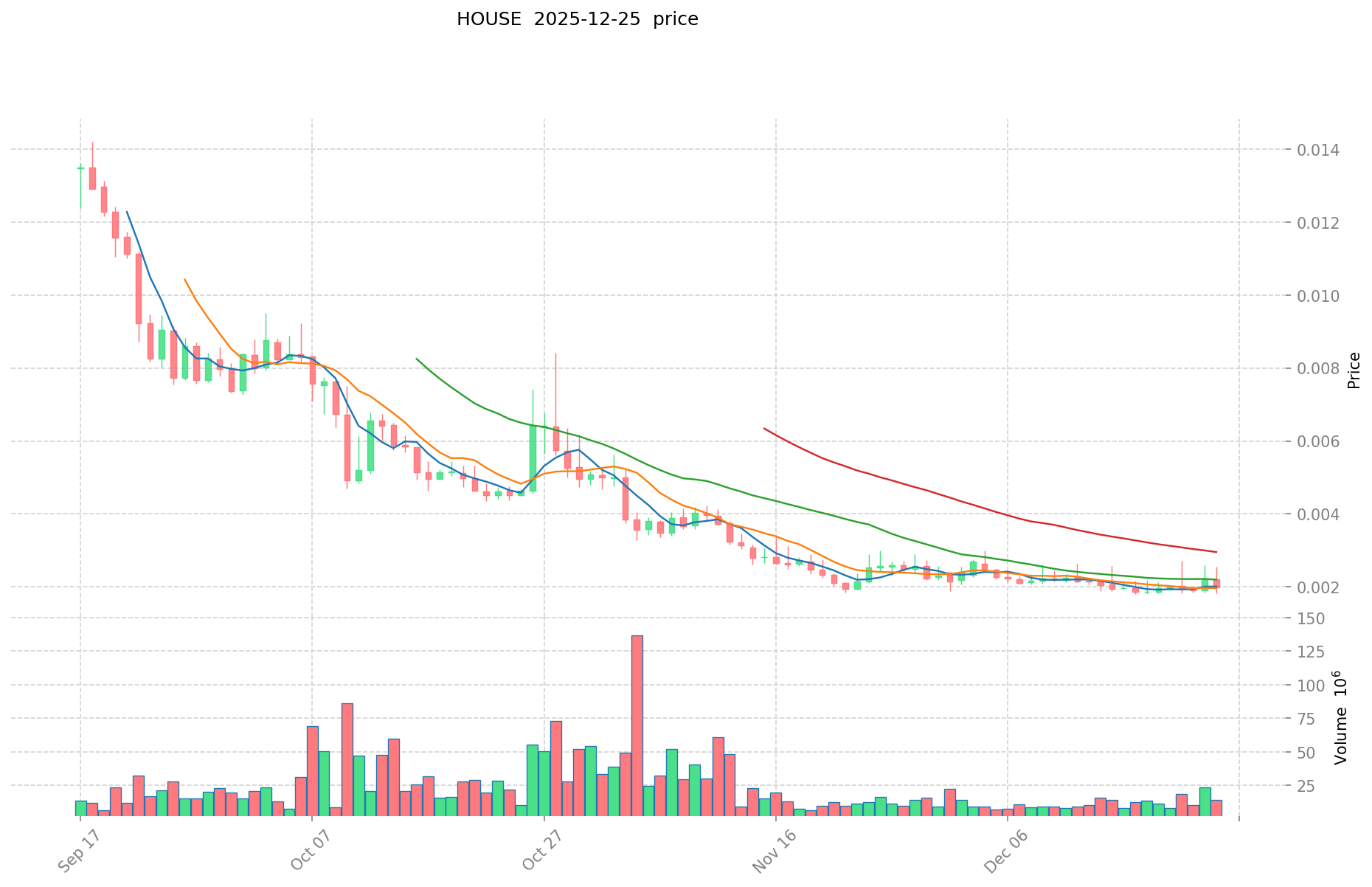
- December 18, 2025: All-time low (ATL) recorded at $0.0018, representing a substantial decline from historical peaks.
HOUSE Current Market Conditions
As of December 25, 2025, Housecoin is trading at $0.001964, reflecting the volatile nature of meme tokens within the cryptocurrency market. The token has exhibited concerning short-term performance, with a 24-hour decline of -12.29% and a 1-hour drop of -1.83%. However, the 7-day performance shows a positive adjustment of +6.56%, suggesting some recovery attempts despite broader market pressures.
The 24-hour trading volume stands at approximately $23,927.40, indicating relatively modest liquidity for the asset. With a fully diluted market capitalization of $1,961,566.40 and a circulating supply of 998,760,897 tokens (representing 100% of total supply), HOUSE maintains a market dominance of 0.000061%, positioning it at rank 2,145 in the overall cryptocurrency market.
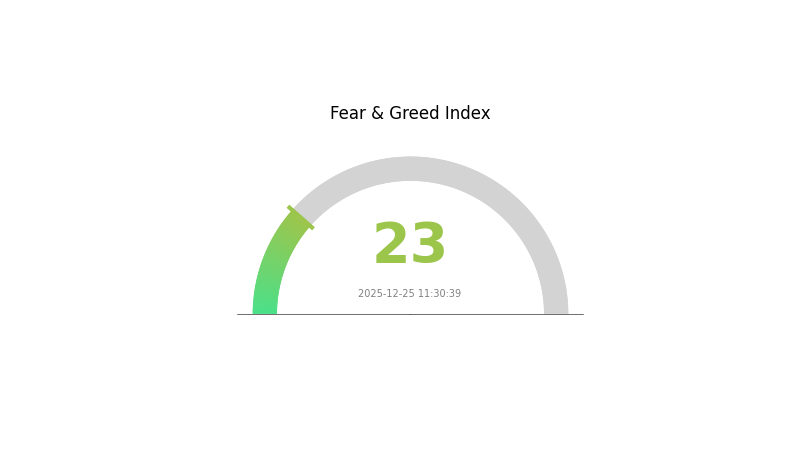
The token currently has 22,401 token holders, and operates on the Solana blockchain network. Market sentiment indicators suggest an "Extreme Fear" environment with a VIX reading of 23, reflecting heightened market anxiety.
Click to view current HOUSE market price
HOUSE Market Sentiment Index
2025-12-25 Fear and Greed Index: 23 (Extreme Fear)
Click to view current Fear & Greed Index
The cryptocurrency market is currently experiencing extreme fear, with the Fear and Greed Index dropping to 23. This indicates significant market pessimism and heightened risk aversion among investors. During periods of extreme fear, assets are often oversold, creating potential contrarian opportunities for long-term investors. However, caution remains essential as market volatility typically increases in such conditions. Monitor key support levels closely and consider risk management strategies. On Gate.com, you can track real-time market sentiment to make more informed trading decisions.
HOUSE Holdings Distribution
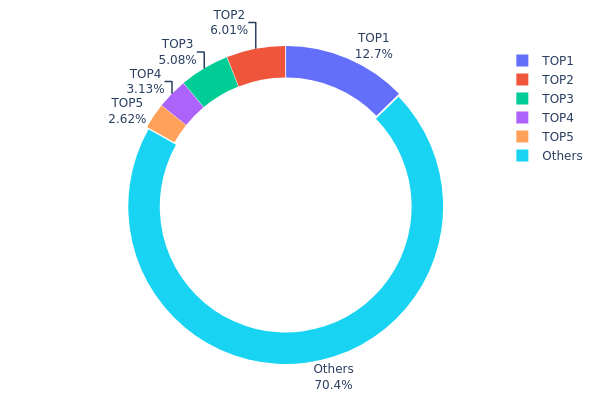
The address holdings distribution map illustrates the concentration of token ownership across the blockchain network by tracking the top token holders and their respective portfolio percentages. This metric serves as a critical indicator of decentralization levels, market structure integrity, and potential vulnerability to coordinated selling or price manipulation by large stakeholders.
Analysis of HOUSE's current holdings distribution reveals moderate concentration characteristics. The top five addresses collectively control approximately 29.53% of total token supply, with the largest holder (Gj5t6K...f96HNH) commanding 12.72% of all HOUSE tokens. While this concentration level is not severe, it does warrant attention as a single entity could theoretically influence market dynamics through strategic accumulation or liquidation activities. The remaining 70.47% of tokens distributed among other addresses indicates a relatively dispersed ownership structure compared to highly centralized projects.
The current address distribution presents both structural stability and moderate concentration risks. The substantial holdings by top addresses suggest potential for coordinated movements that could impact price volatility during market cycles; however, the significant proportion held by dispersed addresses provides a counterbalancing effect that mitigates extreme centralization concerns. From a chain-on-structure perspective, HOUSE demonstrates reasonable decentralization metrics, with no single address commanding an excessive majority that would trigger critical governance or price stability concerns. This distribution pattern suggests a moderately mature token ecosystem capable of sustaining organic market dynamics while maintaining sufficient liquidity depth.
For current real-time data on HOUSE holdings distribution, visit Gate.com Crypto Holdings Analytics
| Top |
Address |
Holding Qty |
Holding (%) |
| 1 |
Gj5t6K...f96HNH |
127113.63K |
12.72% |
| 2 |
AGVhmr...gHAk8N |
60000.00K |
6.00% |
| 3 |
u6PJ8D...ynXq2w |
50776.68K |
5.08% |
| 4 |
ASTyfS...g7iaJZ |
31236.44K |
3.12% |
| 5 |
8bEfPK...Howub5 |
26135.40K |
2.61% |
| - |
Others |
703342.03K |
70.47% |
II. Core Factors Affecting HOUSE Future Price
Supply Mechanism
-
Inventory Dynamics: Market inventory levels directly impact price trends. When available housing supply decreases significantly, property owners adopt aggressive pricing strategies. For example, when housing inventory drops from 31.2 million units to 25.4 million units over six months, representing an 18% reduction, market supply contraction causes price increases. Conversely, new housing inventory that remains below market demand—particularly in mid-sized unit formats—continues to support elevated pricing.
-
Historical Patterns: New housing inventory has shown cyclical patterns. From 2012 to 2016, new housing inventory grew from 2.4 million to 7.3 million units, then stabilized. After 2020, inventory began declining again to below 5 million units, demonstrating how supply cycles directly correlate with price movements.
-
Current Impact: With supply remaining constrained relative to demand, new housing demonstrates continued supply shortage conditions. This supply-demand imbalance is expected to persist, maintaining upward price pressure in the medium term.
Supply and Demand Relationship
-
Transaction Volume: Housing transaction volumes indicate market strength. In 2021, transaction volumes reached 26.8 million units across major metropolitan areas, representing an 8-year high and 6% growth year-over-year. This surge reflects market recovery from previous downturns and validates sustained demand growth.
-
Demand Surge: Market recovery has generated substantial demand increases, particularly as markets transition from contraction phases to expansion phases. Inflation hedging psychology has further amplified purchasing demand, supporting price appreciation.
-
Future Outlook: Household formation trends suggest continued positive demand dynamics. Even as population growth slows in certain regions, household fragmentation—including increases in single-person households and changes in family structures—has generated net household formation exceeding 100,000 annually over the past 11 years, surpassing population decline rates.
Macroeconomic Environment
-
Inflation Hedge Motivation: Housing functions as an inflation protection asset. In inflationary environments, buyers increasingly view property acquisition as a hedge against currency depreciation, driving demand and supporting price levels.
-
Interest Rate Environment: Mortgage interest rates significantly influence purchasing power. When central banks maintain accommodative monetary policies with lower rates, borrowing costs decrease, expanding the buyer pool and supporting higher valuations. Conversely, rate increases constrain affordability and dampen demand.
-
Economic Growth Correlation: Housing price movements correlate strongly with regional economic development. In rapidly developing urban centers, GDP growth drives income increases, enhancing purchasing power and supporting sustained price appreciation.
Construction Cost Dynamics
-
Input Cost Escalation: Housing cost structures encompassing land acquisition, construction materials, and labor expenses face persistent upward pressure. Land scarcity, global carbon neutrality commitments, and construction workforce shortages combine to push costs higher, supporting gradual to accelerated price appreciation.
-
Construction Standards Evolution: New construction specifications have upgraded substantially. Regulatory requirements for noise reduction (17-decibel improvement to 58 decibels), enhanced earthquake resistance standards, universal accessibility design, and optimized solar exposure considerations all increase construction costs. These quality upgrades generate incremental value and support price differentiation between new premium construction and older housing stock.
III. 2025-2030 HOUSE Price Forecast
2025 Outlook
- Conservative Forecast: $0.00182 - $0.00204
- Base Case Forecast: $0.00204
- Optimistic Forecast: $0.00222 (requires sustained ecosystem growth and increased institutional adoption)
2026-2028 Medium-term Outlook
- Market Phase Expectation: Gradual accumulation and recovery phase with increasing adoption momentum
- Price Range Predictions:
- 2026: $0.00141 - $0.00232
- 2027: $0.0012 - $0.0027
- 2028: $0.00199 - $0.0032
- Key Catalysts: Expansion of use cases within the HOUSE ecosystem, growth in user base, strategic partnerships, and improved market sentiment following regulatory clarity
2029-2030 Long-term Outlook
- Base Scenario: $0.00261 - $0.00312 (assumes steady adoption and organic ecosystem development)
- Optimistic Scenario: $0.00283 - $0.00381 (contingent on mainstream institutional investment and significant DeFi integration)
- Transformative Scenario: Up to $0.00381+ (assumes breakthrough developments, major protocol upgrades, and broader cryptocurrency market expansion)
- December 25, 2030: HOUSE projected at $0.00297 average (base case scenario with 51% potential appreciation from current levels)
| 年份 |
预测最高价 |
预测平均价格 |
预测最低价 |
涨跌幅 |
| 2025 |
0.00222 |
0.00204 |
0.00182 |
3 |
| 2026 |
0.00232 |
0.00213 |
0.00141 |
8 |
| 2027 |
0.0027 |
0.00223 |
0.0012 |
13 |
| 2028 |
0.0032 |
0.00246 |
0.00199 |
25 |
| 2029 |
0.00312 |
0.00283 |
0.00261 |
44 |
| 2030 |
0.00381 |
0.00297 |
0.00256 |
51 |
Housecoin (HOUSE) Investment Strategy and Risk Management Report
IV. HOUSE Professional Investment Strategy and Risk Management
HOUSE Investment Methodology
(1) Long-term Holding Strategy
- Suitable for: Retail investors with high risk tolerance and belief in meme coin ecosystems
- Operational Recommendations:
- Establish a core position at support levels and maintain for extended periods to benefit from potential ecosystem growth
- Dollar-cost averaging (DCA) approach by investing fixed amounts at regular intervals to reduce timing risk
- Secure storage through Gate.com account with strong authentication or hardware storage solutions for peace of mind
(2) Active Trading Strategy
- Technical Analysis Tools:
- Support and Resistance Levels: Monitor key price levels on daily and weekly charts to identify optimal entry and exit points
- Volume Analysis: Track trading volume changes to confirm trend reversals and identify potential breakout opportunities
- Wave Trading Key Points:
- Execute short-term trades during identified volatility cycles, particularly around support levels of $0.0018 and resistance near $0.002261
- Implement strict stop-loss orders at 5-10% below entry points to manage downside risk in volatile market conditions
HOUSE Risk Management Framework
(1) Asset Allocation Principles
- Conservative Investors: 0.5-1% of total portfolio
- Active Investors: 2-5% of total portfolio
- Professional Investors: 5-10% of total portfolio
(2) Risk Hedging Solutions
- Portfolio Diversification: Balance HOUSE holdings with established cryptocurrencies and traditional assets to reduce concentration risk
- Position Sizing: Never allocate more than 2% of total capital to any single meme coin to protect against catastrophic losses
(3) Secure Storage Solution
- Exchange Account Method: Gate.com provides a secure platform for active traders with two-factor authentication and insurance protections
- Self-Custody Approach: For long-term holders, transfer HOUSE tokens to personal Solana wallets with strong private key management
- Security Precautions: Enable all available security features, use unique passwords, regularly audit wallet activity, and never share private keys or seed phrases
V. HOUSE Potential Risks and Challenges
HOUSE Market Risk
- Extreme Volatility: The token has experienced a -12.29% decline in 24 hours and -20.23% over 30 days, reflecting the speculative nature of meme coins with potential for significant capital loss
- Liquidity Constraints: With only $23,927.40 in 24-hour trading volume and a market cap of approximately $1.96 million, limited trading volume may result in slippage and difficulty executing large orders
- Price Manipulation Risk: Meme coins with small market caps are vulnerable to pump-and-dump schemes and coordinated trading activities that can devastate retail investors
HOUSE Regulatory Risk
- Legal Classification Uncertainty: Regulatory frameworks for meme coins remain unclear across jurisdictions, potentially resulting in trading restrictions or delisting
- Compliance Exposure: Future regulatory crackdowns on unregistered securities or gambling-like tokens could impact HOUSE's trading status and value
- Geographic Restrictions: Certain jurisdictions may restrict access to HOUSE trading, limiting liquidity and investment opportunities
HOUSE Technical Risk
- Smart Contract Vulnerability: As a Solana-based token, HOUSE depends on the integrity of its smart contracts; any code vulnerabilities could result in total loss of funds
- Network Dependency: Reliance on Solana blockchain means HOUSE is subject to network congestion, outages, or security breaches that could impact accessibility
- Liquidity Provider Risk: The token may suffer from inadequate liquidity pools, making it difficult to exit positions at favorable prices
VI. Conclusion and Action Recommendations
HOUSE Investment Value Assessment
Housecoin is a meme coin themed on hedging real estate markets with a current market capitalization of $1.96 million and 998.76 million circulating tokens. While the concept of "1 token = 1 house" provides novelty appeal, the project faces significant challenges including extreme volatility, minimal trading volume, and the speculative nature of meme coins. The token's -12.29% 24-hour decline and -20.23% monthly decline reflect market skepticism and liquidity constraints. Investors should approach HOUSE with extreme caution, recognizing that meme coins typically lack fundamental value drivers and business models.
HOUSE Investment Recommendations
✅ Beginners: Only allocate a small portion (0.5% or less) of total portfolio as a high-risk, speculative position. Ensure the capital invested can be completely lost without affecting financial stability. Use Gate.com for secure trading with proper account security measures.
✅ Experienced Investors: Consider tactical entry positions during identified support levels with strict risk management protocols. Implement disciplined stop-loss orders and take-profit targets. Monitor community sentiment and technical indicators closely for exit signals.
✅ Institutional Investors: Exercise extreme caution given the limited market depth and regulatory uncertainty. If considering exposure, maintain a minimal allocation (less than 1% of fund) and only through thoroughly vetted channels.
HOUSE Trading Participation Methods
- Gate.com Spot Trading: Direct trading of HOUSE token with real-time price discovery and secure fund management
- Limit Orders: Set predetermined buy/sell prices to automate trading execution at optimal price levels without constant monitoring
- Portfolio Tracking: Use Gate.com's portfolio tools to monitor HOUSE performance, track gains/losses, and rebalance positions according to investment strategy
Cryptocurrency investment carries extreme risk. This report does not constitute investment advice. Investors should make decisions based on their individual risk tolerance and consider consulting professional financial advisors. Never invest more capital than you can afford to lose completely. Meme coins are highly speculative and suitable only for experienced traders with high risk tolerance.
FAQ
Are home prices going down in SC?
Home prices in South Carolina are not declining. The median home price is $335,000 with a 2.8% year-over-year increase. While more homes have price reductions (61.3%), overall prices remain stable and rising. It's a balanced buyer's market.
Are houses dropping in price in Indiana?
Yes, houses are dropping in price in Indiana. Nearly half of homes have reduced their prices, and the market is moving faster than the national median, with listings selling 21 days quicker.
Are house prices dropping in CT?
Yes, Connecticut home prices are experiencing slight drops in 2025. However, CT remains a challenging market for homebuyers despite the price reductions reported by Zillow.
Are Michigan home prices dropping?
No, Michigan home prices are not dropping. They remain stable and 80% above pre-COVID levels, with no signs of a crash expected in the near future.
* The information is not intended to be and does not constitute financial advice or any other recommendation of any sort offered or endorsed by Gate.