This comprehensive IOTA price analysis evaluates the Tangle-based cryptocurrency's investment potential through 2031, currently trading at $0.10 with a $435 million market cap. The article combines historical performance review, market sentiment analysis, and institutional adoption trends to provide professional price forecasts ranging from $0.095 to $0.264 across different scenarios. Covering core factors including fixed supply mechanics, enterprise partnerships with Bosch and Volkswagen, and technological upgrades like DPoS implementation, this guide delivers actionable investment strategies for beginners through institutional investors. Readers will discover risk management frameworks, trading methodologies on Gate, and detailed assessments of regulatory and technical challenges. Perfect for crypto investors seeking data-driven IoT sector exposure and long-term growth opportunities in the machine economy landscape.
Introduction: IOTA's Market Position and Investment Value
IOTA, a pioneering digital cryptocurrency focused on machine-to-machine (M2M) transactions, has been reshaping the Internet of Things (IoT) landscape since its launch in 2017. As of 2026, IOTA maintains a market capitalization of approximately $435 million, with a circulating supply of around 4.24 billion tokens and a current price hovering near $0.10. This asset, often recognized as a "Tangle-based cryptocurrency that transcends traditional blockchain technology," is playing an increasingly vital role in enabling feeless microtransactions within the growing machine economy.
This article will comprehensively analyze IOTA's price trajectory from 2026 through 2031, combining insights from historical patterns, market supply-demand dynamics, ecosystem developments, and macroeconomic conditions to provide investors with professional price forecasts and practical investment strategies.
I. IOTA Price History Review and Market Status
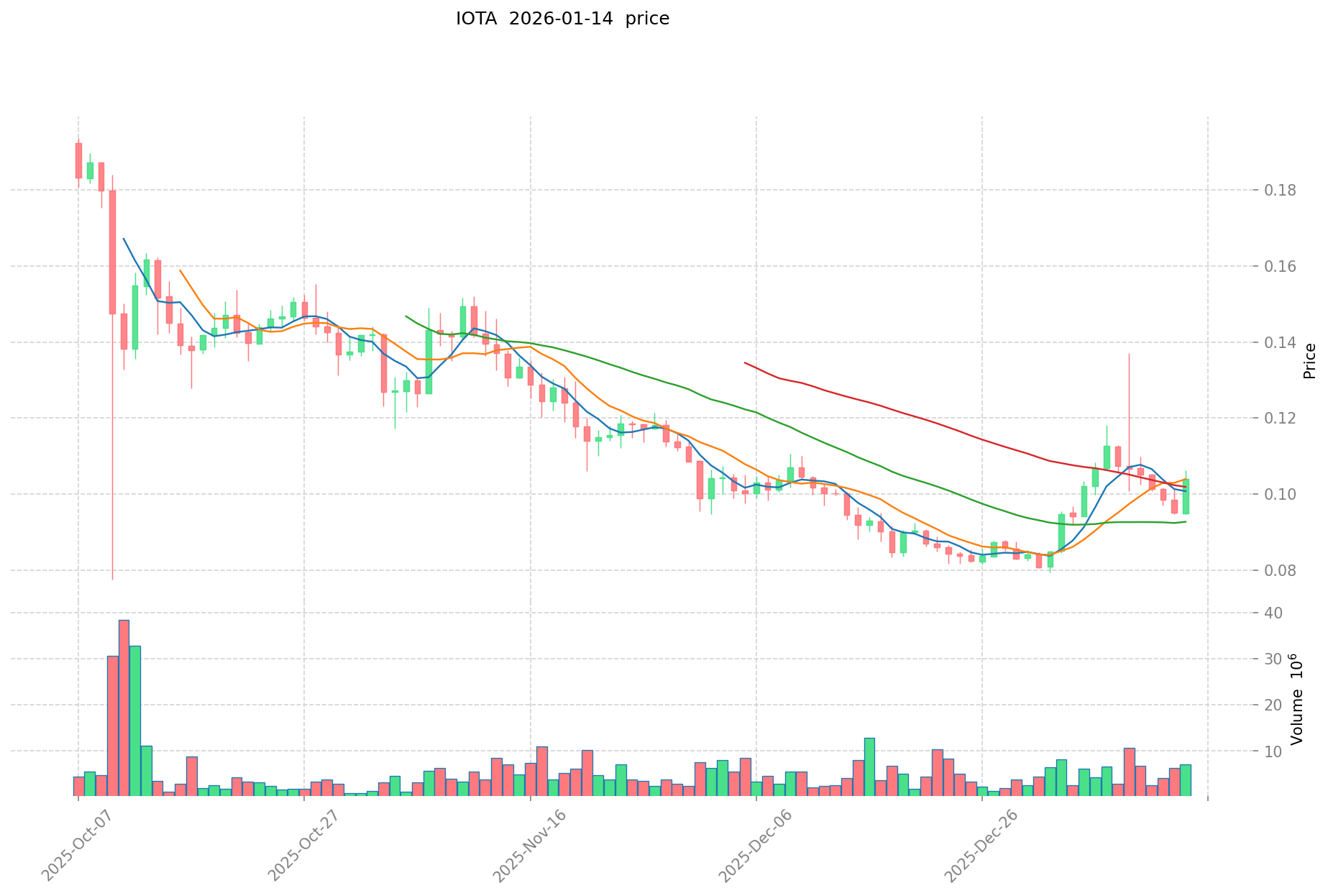
IOTA Historical Price Evolution Trajectory
- 2017: IOTA launched and reached an all-time high of $5.25 on December 19, 2017, during the cryptocurrency market boom
- 2018-2020: Price experienced significant corrections following the broader crypto market downturn
- 2021-2025: Price fluctuated within a range as the project continued development
- 2026: On January 1, 2026, IOTA touched an all-time low of $0.079428
IOTA Current Market Status
As of January 15, 2026, IOTA is trading at $0.10266, showing a modest increase of 0.62% over the past 24 hours. The token has demonstrated mixed performance across different timeframes, with a 1-hour decline of 0.13% and a 7-day decrease of 4.63%. However, the 30-day performance shows positive momentum with a gain of 12.98%.
The current trading range spans from a 24-hour low of $0.10088 to a high of $0.10761. IOTA's market capitalization stands at approximately $435.08 million, with a 24-hour trading volume of $806,040.50. The circulating supply is 4.24 billion IOTA tokens, representing about 92.13% of the total supply of 4.79 billion tokens.
With a market dominance of 0.014% and ranking at position 144 among cryptocurrencies, IOTA maintains an active presence across 30 exchanges. The token holder count stands at 42,669, indicating sustained community engagement. The fully diluted market cap of $492.23 million suggests relatively limited dilution risk given the high circulation ratio.
Click to view current IOTA market price
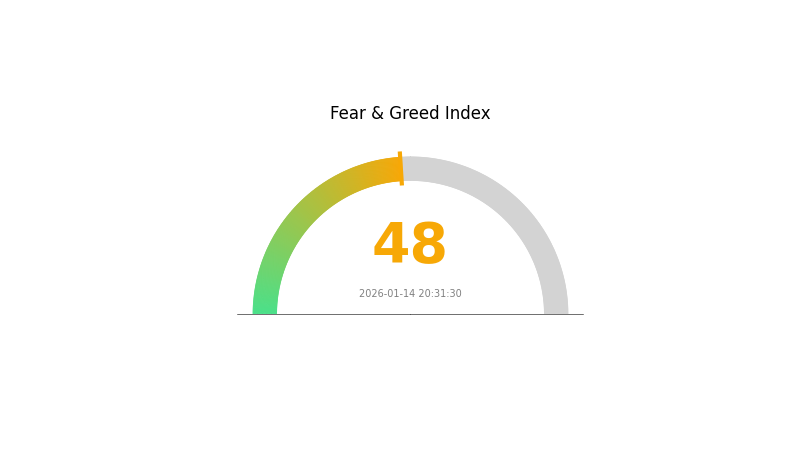
IOTA Market Sentiment Index
2026-01-14 Fear and Greed Index: 48 (Neutral)
Click to view the current Fear & Greed Index
The cryptocurrency market is currently experiencing a neutral sentiment, with the Fear and Greed Index standing at 48. This balanced reading indicates that market participants are neither predominantly fearful nor excessively greedy at this moment. IOTA investors should monitor this metric closely as it reflects overall market psychology and can signal potential shifts in trading momentum. A neutral stance suggests a stabilizing market environment, making it an opportune time for careful analysis before making investment decisions on Gate.com.
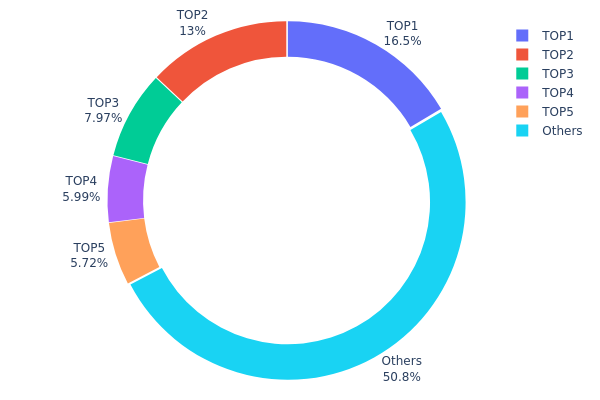
IOTA 持仓分布
The holdings distribution chart illustrates the allocation of IOTA tokens across different wallet addresses, providing insights into the degree of decentralization within the network. By analyzing the concentration of tokens among top holders versus the broader community, this metric reveals the potential influence of large holders (often referred to as "whales") on market dynamics.
Current data shows that the top five addresses collectively hold approximately 50.2% of the total IOTA supply, indicating a moderate to high concentration level. The largest single address controls 16.53% of total tokens, followed by the second-largest at 13.00%. While these figures suggest significant concentration among major holders, the remaining 50.8% distributed among other addresses demonstrates a reasonably balanced ecosystem. This distribution pattern reflects a semi-centralized structure where large institutional holders or early investors maintain substantial positions, yet sufficient token dispersion exists to support organic market activity.
The current concentration level carries mixed implications for market stability. On one hand, the presence of large holders could contribute to price volatility if these entities decide to liquidate significant portions of their holdings. Conversely, the relatively balanced distribution among the top five addresses—none exceeding 17% individually—reduces the risk of single-entity market manipulation. The 50.8% held by smaller addresses provides liquidity cushion and suggests active community participation, which is essential for maintaining a healthy trading environment and supporting IOTA's network utility.
Click to view current IOTA Holdings Distribution
| Top |
Address |
Holding Qty |
Holding (%) |
| 1 |
0x8894...e2d4e3 |
49948.66K |
16.53% |
| 2 |
0x0c50...38f70e |
39266.63K |
13.00% |
| 3 |
0x77fb...94df0e |
24073.53K |
7.97% |
| 4 |
0x4368...26f042 |
18090.95K |
5.99% |
| 5 |
0x8bee...3b65ed |
17263.65K |
5.71% |
| - |
Others |
153362.65K |
50.8% |
II. Core Factors Influencing IOTA's Future Price
Supply Mechanism
- Fixed Supply Model: IOTA maintains a fixed maximum supply of 2,779,530,283 MIOTA tokens with no additional issuance planned. This scarcity-driven model ensures long-term value stability and predictability.
- Historical Patterns: The absence of mining mechanisms and fixed supply structure has historically contributed to IOTA's environmental efficiency while preventing inflationary pressures that affect other cryptocurrencies.
- Current Impact: Foundation token unlocks remain a significant factor affecting short-term price movements, as these releases can influence circulating supply and market liquidity.
Institutional and Major Stakeholder Dynamics
- Institutional Holdings: IOTA has established strategic partnerships with global technology leaders including Bosch, Volkswagen, and Fujitsu, demonstrating institutional confidence in its infrastructure.
- Enterprise Adoption: The project's focus on Internet of Things (IoT) applications has attracted enterprise interest across automotive, smart city, and supply chain sectors, with implementations supporting device-to-device micropayments and data verification.
- Regional Initiatives: IOTA has formed collaborations with government-level entities, including partnerships in the United Arab Emirates region, though specific policy frameworks remain under development.
Macroeconomic Environment
- Overall Crypto Market Conditions: IOTA's price performance remains closely tied to broader cryptocurrency market sentiment and Bitcoin's directional movements, with altcoin market recoveries often triggering corresponding IOTA price increases.
- Investor Sentiment: Market confidence fluctuates based on technological progress announcements, partnership developments, and general risk appetite in digital asset markets.
- Market Competition: IOTA faces competition from other IoT and DeFi-focused blockchain projects including Helium, VeChain, and Cardano, which influences its market positioning and valuation.
Technological Development and Ecosystem Building
- Rebased Mainnet Upgrade: The introduction of Delegated Proof of Stake (DPoS) mechanism transitions the network from coordinator-dependent validation to community-governed validator selection, enhancing true decentralization.
- IOTA Notarization Toolkit: Built upon the Rebased upgrade, this toolkit significantly reduces transaction fees while enabling efficient, tamper-proof data storage capabilities for enterprise applications requiring transparent and verifiable trust mechanisms.
- Tangle Technology: IOTA's proprietary Directed Acyclic Graph (DAG) structure enables feeless transactions and supports processing over 50,000 transactions per second, differentiating it from traditional blockchain architectures and supporting scalable IoT deployment.
III. 2026-2031 IOTA Price Prediction
2026 Outlook
- Conservative Prediction: $0.095 - $0.102
- Neutral Prediction: $0.102 - $0.110
- Optimistic Prediction: $0.110 - $0.139 (contingent on favorable market conditions and adoption acceleration)
2027-2029 Outlook
- Market Stage Expectation: Transition from early adoption phase to broader market recognition, with potential ecosystem expansion driving gradual price appreciation
- Price Range Predictions:
- 2027: $0.104 - $0.177
- 2028: $0.136 - $0.214
- 2029: $0.142 - $0.225
- Key Catalysts: Technology maturation, increased institutional interest, and potential real-world implementation of IoT solutions leveraging IOTA's infrastructure
2030-2031 Long-term Outlook
- Baseline Scenario: $0.106 - $0.203 (assuming steady ecosystem development and moderate market growth)
- Optimistic Scenario: $0.165 - $0.226 (contingent on significant adoption milestones and favorable regulatory environment)
- Transformative Scenario: $0.215 - $0.264 (requiring breakthrough partnerships and mass adoption of IoT payment solutions)
- 2026-01-15: IOTA trading within early-stage consolidation range as market participants assess long-term growth potential
| Year |
Predicted High Price |
Predicted Average Price |
Predicted Low Price |
Price Change |
| 2026 |
0.13898 |
0.10219 |
0.09504 |
0 |
| 2027 |
0.17726 |
0.12058 |
0.1037 |
17 |
| 2028 |
0.21445 |
0.14892 |
0.13552 |
45 |
| 2029 |
0.22529 |
0.18168 |
0.14171 |
76 |
| 2030 |
0.22587 |
0.20349 |
0.10581 |
98 |
| 2031 |
0.26405 |
0.21468 |
0.1653 |
109 |
IV. IOTA Professional Investment Strategies and Risk Management
IOTA Investment Methodology
(1) Long-term Holding Strategy
- Target Audience: Investors focused on IoT ecosystem growth and believers in machine-to-machine economy
- Operational Recommendations:
- Accumulate positions during market corrections when IOTA trades below $0.10
- Hold through technology upgrade cycles and ecosystem expansion phases
- Store assets in Gate Web3 Wallet for secure long-term custody
(2) Active Trading Strategy
- Technical Analysis Tools:
- Moving Average Convergence Divergence (MACD): Monitor crossovers to identify momentum shifts in IOTA's price movements
- Relative Strength Index (RSI): Track overbought levels above 70 and oversold conditions below 30 for entry/exit signals
- Swing Trading Considerations:
- Focus on volatility patterns within the $0.10-$0.11 range based on recent 24-hour fluctuations
- Set stop-loss orders 5-8% below entry points to manage downside exposure
IOTA Risk Management Framework
(1) Asset Allocation Principles
- Conservative Investors: 1-3% of crypto portfolio
- Aggressive Investors: 5-10% of crypto portfolio
- Professional Investors: Up to 15% with active hedging strategies
(2) Risk Hedging Solutions
- Diversification Approach: Balance IOTA holdings with established layer-1 protocols to reduce IoT-specific concentration risk
- Position Sizing Strategy: Scale investments gradually rather than deploying full capital at single price points
(3) Secure Storage Solutions
- Hot Wallet Recommendation: Gate Web3 Wallet for active trading and daily transactions
- Cold Storage Option: Hardware wallet solutions for holdings exceeding $10,000 equivalent
- Security Precautions: Enable two-factor authentication, regularly update wallet software, and never share private keys or seed phrases
V. IOTA Potential Risks and Challenges
IOTA Market Risks
- Price Volatility: IOTA has experienced a 67.61% decline over the past year, reflecting significant downside potential
- Liquidity Concerns: With 24-hour trading volume around $806,000, sudden large orders may experience considerable slippage
- Market Cap Position: Ranking at #144 indicates limited institutional attention compared to top-tier assets
IOTA Regulatory Risks
- IoT Compliance Uncertainty: Evolving regulations around machine-to-machine payment systems may impact IOTA's core use case
- Securities Classification: Regulatory bodies may scrutinize IOTA's token economics and distribution model
- Cross-border Transaction Rules: IoT micropayment networks could face jurisdictional challenges as regulations develop
IOTA Technical Risks
- Tangle Architecture Maturity: As a non-blockchain protocol, IOTA's Tangle technology faces ongoing validation requirements
- Network Scaling Challenges: Achieving mass adoption for IoT micropayments requires continued technical development
- Competition Risk: Emerging IoT-focused protocols may offer alternative solutions to IOTA's value proposition
VI. Conclusion and Action Recommendations
IOTA Investment Value Assessment
IOTA presents a speculative opportunity for investors interested in the intersection of cryptocurrency and Internet of Things infrastructure. The project's focus on feeless machine-to-machine transactions addresses a genuine market need, particularly as IoT device proliferation continues globally. However, the significant year-over-year price decline of 67.61% and relatively modest market capitalization of approximately $435 million reflect substantial execution risk and market skepticism. Long-term value depends on successful ecosystem adoption and technical milestone achievement, while short-term volatility remains considerable given the token's performance history and market position.
IOTA Investment Recommendations
✅ Beginners: Limit exposure to 1-2% of total crypto portfolio; prioritize learning about Tangle technology before increasing position size
✅ Experienced Investors: Consider 3-5% allocation as a speculative IoT play; monitor development milestones and partnership announcements for rebalancing opportunities
✅ Institutional Investors: Evaluate IOTA within a thematic IoT investment basket; conduct thorough due diligence on technology scalability and regulatory landscape
IOTA Trading Participation Methods
- Spot Trading: Purchase IOTA directly on Gate.com with USDT or other major trading pairs for straightforward exposure
- Dollar-Cost Averaging: Implement regular monthly purchases to mitigate timing risk given IOTA's price volatility
- Risk-Defined Trading: Utilize limit orders and stop-loss mechanisms to maintain disciplined entry and exit points
Cryptocurrency investment carries extreme risk, and this article does not constitute investment advice. Investors should make cautious decisions based on their own risk tolerance and are advised to consult professional financial advisors. Never invest more than you can afford to lose.
FAQ
What is IOTA? What are its main uses and technical features?
IOTA is a distributed ledger technology designed for IoT devices, using Tangle architecture based on DAG to enable zero-fee transactions and high scalability for machine-to-machine data transmission.
What is the IOTA price prediction for 2024-2025?
Based on market analysis, IOTA's price prediction for 2024-2025 ranges between 0.6771 to 1.2958 USD. These projections consider IOTA's market performance and development potential in the blockchain ecosystem.
What are the main factors affecting IOTA price?
IOTA price is primarily influenced by market sentiment, technology upgrades, breaking through key resistance levels, trading volume, investor confidence, and macroeconomic conditions.
What are the advantages and disadvantages of IOTA compared to Bitcoin and Ethereum?
IOTA offers high throughput and low transaction fees with scalability advantages. However, it has lower market adoption and liquidity compared to Bitcoin and Ethereum, which benefit from established ecosystems and longer market presence.
How to conduct technical analysis and price prediction for IOTA?
Analyze IOTA using technical tools like moving averages, trend lines, and trading volume patterns. Monitor chart formations and support/resistance levels. Combine with fundamental analysis of project development and market sentiment to forecast price movements.
What are the main risks of investing in IOTA?
IOTA's main risks include network centralization tendencies, security vulnerabilities in its transaction confirmation mechanism, and potential long-term stability concerns. These factors could impact project development and investor returns.
* The information is not intended to be and does not constitute financial advice or any other recommendation of any sort offered or endorsed by Gate.