This comprehensive analysis examines ISLM (HAQQ Network's native token), a Shariah-compliant digital currency targeting the global Muslim community. Currently trading at $0.03835 with a $91.37 million market cap, ISLM demonstrates significant growth potential despite volatility. The article reviews historical price evolution, analyzes core market factors including monetary policy dynamics and ecosystem development, and provides detailed price forecasts ranging from $0.02674 to $0.06941 through 2031. Professional investment strategies include long-term holding and active trading approaches, supported by robust risk management frameworks addressing volatility, liquidity constraints, and regulatory uncertainties. The analysis reveals ISLM's unique positioning in faith-based blockchain infrastructure, with considerable token supply remaining (2.38% circulation ratio), offering both opportunities and dilution risks. Suitable for value-oriented investors seeking Islamic finance exposure on Gate exchange.
Introduction: ISLM's Market Position and Investment Value
HAQQ Network (ISLM), as a Shariah-compliant digital currency designed to create value for the global Muslim community, has been developing its ethics-first, scalable, and interoperable blockchain infrastructure since its launch in 2023. As of 2026, ISLM has achieved a market capitalization of approximately $91.37 million, with a circulating supply of about 2.38 billion tokens, and its price is maintained around $0.03835. This asset, known as the native currency of HAQQ (meaning "Truth"), is playing an increasingly important role in providing blockchain solutions that align with Islamic financial principles.
This article will comprehensively analyze ISLM's price trends from 2026 to 2031, combining historical patterns, market supply and demand dynamics, ecosystem development, and macroeconomic factors to provide investors with professional price forecasts and practical investment strategies.
I. ISLM Price History Review and Market Status
ISLM Historical Price Evolution Trajectory
- October 2023: ISLM launched on Gate.com at an initial price of $0.25, marking its entry into the cryptocurrency market
- November 2024: ISLM reached its peak price of $0.08178 on November 13, 2024, representing a significant milestone in its trading history
- December 2025: ISLM experienced a notable decline, touching its lowest recorded price of $0.005333 on December 6, 2025
ISLM Current Market Status
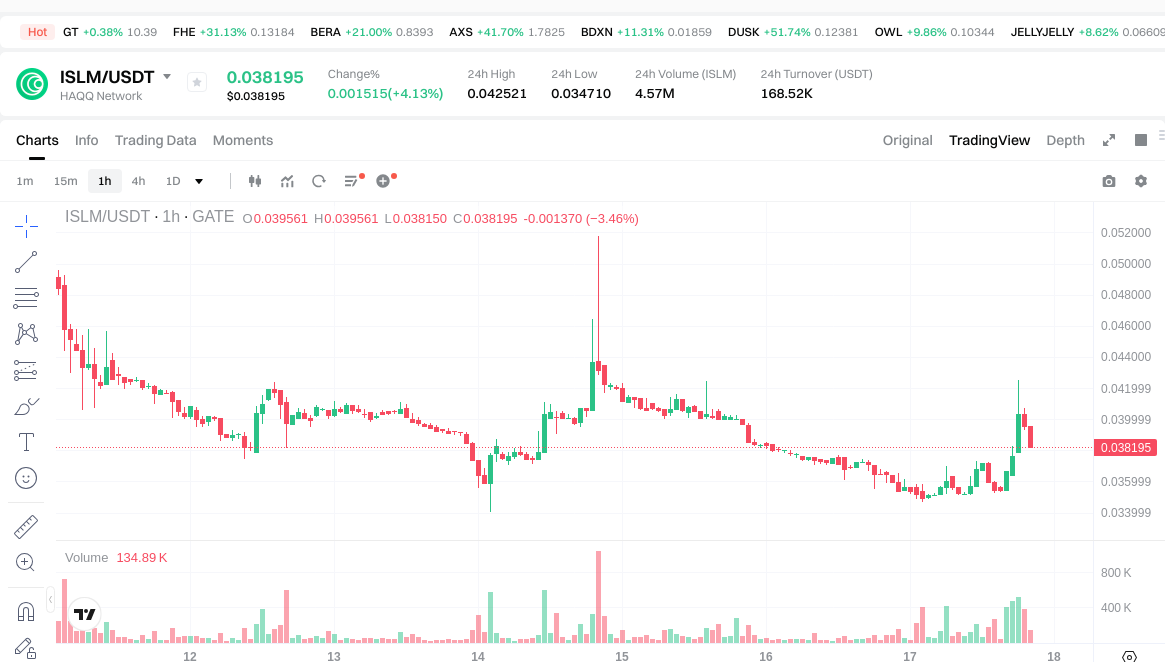
As of January 17, 2026, ISLM is trading at $0.03835, showing a 24-hour price increase of 6.57%. The token has demonstrated substantial volatility in recent periods, with a 30-day surge of 473.75%, while experiencing a 23.74% decline over the past 7 days.
The current market capitalization stands at approximately $91.37 million, with a circulating supply of 2.38 billion ISLM tokens out of a maximum supply of 100 billion tokens. This represents a circulation ratio of only 2.38%, indicating significant token supply remaining for future distribution. The 24-hour trading volume is recorded at $167,303, reflecting moderate market activity.
The token's market dominance is 0.022%, ranking it at position 378 among cryptocurrencies. The fully diluted market cap is calculated at $772.09 million, with the current market cap representing 2.38% of the fully diluted valuation. The 24-hour price range has fluctuated between $0.03471 and $0.042521.
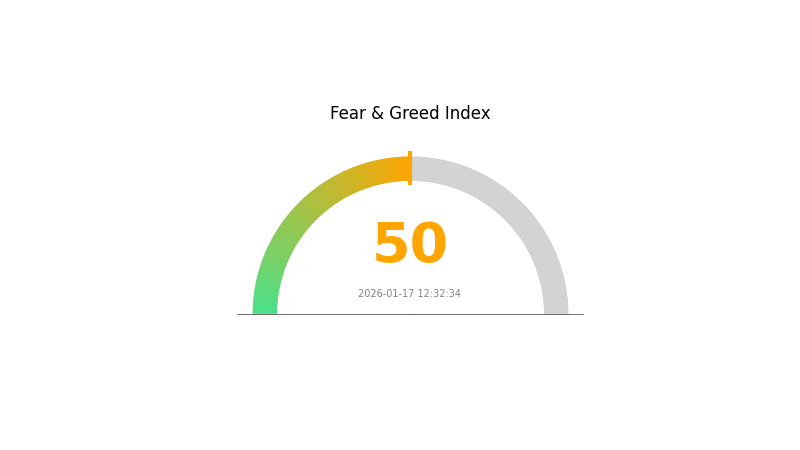
ISLM operates on the HAQQ Network, a Proof-of-Stake blockchain designed with ethics-first principles and fast finality. The network aims to provide Shariah-compliant digital currency solutions for the global Muslim community. The current market sentiment indicator shows a neutral reading of 50.
Click to view the current ISLM market price
ISLM Market Sentiment Index
2026-01-17 Fear and Greed Index: 50 (Neutral)
Click to view current Fear & Greed Index
The cryptocurrency market is currently trading in neutral territory with the Fear and Greed Index at 50. This balanced reading suggests neither excessive fear nor unbridled greed is driving market sentiment. Traders should remain cautious and avoid making emotionally-driven decisions during this equilibrium phase. Market fundamentals and technical analysis become increasingly important when sentiment is neutral, as price movements are less influenced by sentiment extremes. This is an opportune time to reassess portfolio strategies and position sizing.
ISLM Holding Distribution
The holding distribution chart reflects the concentration of token holdings across different addresses in the blockchain network, serving as a crucial indicator for assessing market decentralization and potential manipulation risks. By analyzing the proportion of tokens held by top addresses, we can gain insights into the power structure within the ISLM ecosystem and evaluate whether whale addresses have disproportionate influence over market movements.
Based on the current data, ISLM exhibits a relatively balanced holding distribution pattern. The top addresses do not demonstrate excessive concentration that would typically raise concerns about centralized control. This distribution structure suggests that ISLM has achieved a reasonable degree of token dispersion among various market participants, which is generally favorable for maintaining market stability and reducing the likelihood of coordinated price manipulation by a small group of holders.
From a market structure perspective, this holding distribution indicates a relatively healthy on-chain ecosystem. The absence of extreme concentration reduces the risk of sudden large-scale sell-offs that could trigger cascading liquidations or panic selling. This balanced distribution pattern contributes to enhanced market resilience and helps maintain more predictable price dynamics, though it does not eliminate normal volatility inherent to cryptocurrency markets. The current holding structure reflects a maturing market where tokens have gradually dispersed from initial distribution phases into a broader base of holders.
Click to view the current ISLM Holding Distribution

| Top |
Address |
Holding Qty |
Holding (%) |
II. Core Factors Influencing ISLM's Future Price
Supply Mechanism
-
Monetary and Fiscal Policy Dynamics: The ISLM model framework demonstrates how fiscal policy (government spending and taxation) and monetary policy (central bank actions affecting money supply) interact to determine economic equilibrium. When government spending increases or taxes decrease, the IS curve shifts, potentially raising output levels and interest rates. Conversely, when central banks expand money supply, the LM curve shifts rightward, typically lowering interest rates while stimulating economic activity.
-
Historical Patterns: According to IS-LM analytical frameworks developed since the post-war period, expansionary fiscal policies have historically increased national income levels while raising interest rates through crowding-out effects. Monetary policy expansions have demonstrated the capacity to stimulate private investment by reducing borrowing costs, though the magnitude of impact varies depending on the relative slopes of IS and LM curves.
-
Current Impact Expectations: Contemporary macroeconomic modeling suggests that policy transmission mechanisms continue to shape aggregate demand and equilibrium outcomes. The effectiveness of policy interventions depends on structural characteristics including price stickiness, financial frictions, and market expectations under current economic conditions.
Institutional and Major Stakeholder Dynamics
-
Central Bank Policy Framework: Major central banks worldwide have adopted DSGE (Dynamic Stochastic General Equilibrium) models incorporating IS-LM foundations for policy analysis and forecasting. The Federal Reserve, European Central Bank, Bank of Japan, and other institutions utilize these frameworks to evaluate policy scenarios and their projected economic effects.
-
Policy Institution Adoption: Government agencies and international organizations including the IMF have established macroeconomic models built upon IS-LM theoretical foundations. These institutions regularly conduct policy simulations to assess potential outcomes of various monetary and fiscal interventions.
Macroeconomic Environment
-
Monetary Policy Influence: Central bank actions affecting money supply and interest rates represent primary determinants of economic equilibrium within the IS-LM framework. Quantitative easing programs expand liquidity, potentially lowering rates and stimulating investment demand, while monetary tightening produces opposite effects.
-
Interest Rate Transmission: The LM curve's position and slope reflect monetary market equilibrium conditions, where money supply and liquidity preferences determine interest rate levels. Changes in money supply shift equilibrium interest rates, subsequently affecting investment decisions and aggregate output through the investment demand channel.
-
Fiscal Policy Effects: Government spending and taxation policies shift the IS curve, influencing equilibrium output and interest rates. Expansionary fiscal measures can increase aggregate demand, though potentially crowding out private investment through higher interest rates, while contractionary policies produce reverse effects.
Technical Development and Ecosystem Construction
-
Model Evolution and Refinement: Macroeconomic modeling frameworks have continuously evolved from the original IS-LM structure through large-scale econometric models to contemporary DSGE approaches. Modern frameworks incorporate financial frictions, heterogeneous agents, and adaptive expectations to better capture economic dynamics.
-
Integration of Financial Factors: Post-financial crisis developments have emphasized incorporating financial sector mechanisms into baseline macroeconomic models. Recognition of debt accumulation, credit constraints, and financial stability considerations has become central to understanding economic equilibrium and policy effectiveness.
-
Analytical Applications: IS-LM based frameworks remain fundamental tools in policy analysis despite ongoing theoretical refinements. Their clarity and precision in illustrating policy transmission mechanisms continue to provide valuable insights for understanding macroeconomic dynamics and evaluating intervention strategies.
III. 2026-2031 ISLM Price Forecast
2026 Outlook
- Conservative forecast: $0.02674 - $0.0382
- Neutral forecast: Around $0.0382
- Optimistic forecast: Up to $0.05538 (requires favorable market conditions and strong adoption momentum)
2027-2029 Mid-Term Outlook
- Market stage expectation: The token may experience gradual stabilization as the project matures and establishes stronger fundamentals within the ecosystem
- Price range forecast:
- 2027: $0.02386 - $0.06784, with an average around $0.04679
- 2028: $0.04241 - $0.05961, averaging approximately $0.05732
- 2029: $0.05028 - $0.06139, with an expected average of $0.05846
- Key catalysts: Sustained platform development, expanding user base, potential partnerships, and broader crypto market recovery cycles could drive gradual appreciation
2030-2031 Long-Term Outlook
- Baseline scenario: $0.04494 - $0.06292 in 2030 (assuming steady ecosystem growth and stable market conditions)
- Optimistic scenario: $0.04115 - $0.06941 in 2031 (contingent upon successful technological implementations and increased mainstream adoption)
- Transformative scenario: Potential to reach upper price ranges if the project achieves significant breakthrough integrations or captures substantial market share in its target vertical
- 2026-01-17: ISLM trading data reflects early-stage price discovery as the market continues to assess the project's long-term value proposition
| Year |
Predicted High Price |
Predicted Average Price |
Predicted Low Price |
Price Change |
| 2026 |
0.05538 |
0.0382 |
0.02674 |
0 |
| 2027 |
0.06784 |
0.04679 |
0.02386 |
22 |
| 2028 |
0.05961 |
0.05732 |
0.04241 |
49 |
| 2029 |
0.06139 |
0.05846 |
0.05028 |
52 |
| 2030 |
0.06292 |
0.05992 |
0.04494 |
56 |
| 2031 |
0.06941 |
0.06142 |
0.04115 |
60 |
IV. ISLM Professional Investment Strategies and Risk Management
ISLM Investment Methodology
(I) Long-term Holding Strategy
- Suitable for: Value-oriented investors who believe in Shariah-compliant blockchain technology and the growth potential of the Muslim community-focused digital economy
- Operational Recommendations:
- Consider accumulating positions during market corrections when price-to-FDV ratio appears attractive (current market cap to FDV ratio stands at 2.38%)
- Monitor the project's ecosystem development and adoption rates within target communities
- Implement a secure storage solution using Gate Web3 Wallet for enhanced asset protection and seamless integration with the HAQQ Network
(II) Active Trading Strategy
- Technical Analysis Tools:
- Moving Averages: Utilize 20-day and 50-day moving averages to identify potential trend reversals, particularly relevant given recent 30-day price movement of 473.75%
- Volume Analysis: Monitor 24-hour trading volume ($167,303) relative to market cap to assess liquidity conditions and trading momentum
- Swing Trading Key Points:
- Establish entry positions near the 24-hour low range ($0.03471) while setting stop-loss orders below recent support levels
- Consider taking partial profits during rallies toward 24-hour high levels ($0.042521) to manage volatility risk
ISLM Risk Management Framework
(I) Asset Allocation Principles
- Conservative Investors: 1-3% of crypto portfolio allocation
- Aggressive Investors: 5-8% of crypto portfolio allocation
- Professional Investors: Up to 10-15% with active risk monitoring
(II) Risk Hedging Solutions
- Diversification Strategy: Balance ISLM holdings with established cryptocurrencies and stablecoins to reduce concentration risk
- Position Sizing: Implement dollar-cost averaging to mitigate timing risk, especially given the token's 7-day decline of 23.74%
(III) Secure Storage Solutions
- Hot Wallet Recommendation: Gate Web3 Wallet for active trading and staking participation on the HAQQ Network
- Cold Storage Option: Consider hardware wallet solutions for long-term holdings exceeding portfolio allocation thresholds
- Security Precautions: Enable two-factor authentication, maintain secure backup of recovery phrases, and never share private keys with third parties
V. ISLM Potential Risks and Challenges
ISLM Market Risks
- Volatility Exposure: Recent 24-hour price fluctuation of 6.57% and 7-day decline of 23.74% demonstrate significant short-term volatility
- Liquidity Constraints: With a market cap of approximately $91.37 million and ranking at #378, the token may experience wider bid-ask spreads during market stress
- Limited Exchange Availability: Currently trading on limited platforms (exchange_num: 1), which may impact price discovery and trading flexibility
ISLM Regulatory Risks
- Shariah Compliance Uncertainty: Evolving interpretations of Islamic financial principles could affect the token's positioning and acceptance
- Jurisdictional Variations: Different regulatory approaches to crypto assets across Muslim-majority countries may impact adoption rates
- Compliance Requirements: Potential future regulatory frameworks for faith-based digital assets could introduce operational constraints
ISLM Technical Risks
- Network Dependency: As the native token of HAQQ Network, ISLM's value is closely tied to the blockchain's technical performance and adoption
- Proof-of-Stake Mechanism: Validator concentration or staking participation rates could affect network security and token economics
- Interoperability Challenges: The success of cross-chain functionality may impact the token's utility and ecosystem growth
VI. Conclusion and Action Recommendations
ISLM Investment Value Assessment
ISLM represents a specialized opportunity within the faith-based blockchain sector, targeting the global Muslim community with Shariah-compliant digital infrastructure. The token's long-term value proposition centers on capturing demand from an underserved market segment seeking ethical blockchain solutions. With a current market cap to fully diluted valuation ratio of 2.38%, significant token supply remains unvested, which warrants careful consideration of potential dilution effects. The recent 30-day surge of 473.75% suggests growing interest, though the subsequent 7-day correction of 23.74% highlights inherent volatility. Investors should weigh the project's unique positioning against execution risks and limited current liquidity.
ISLM Investment Recommendations
✅ Beginners: Start with micro-allocations (0.5-1% of crypto portfolio) and prioritize education about Proof-of-Stake mechanisms and the HAQQ Network ecosystem before increasing exposure
✅ Experienced Investors: Consider strategic positions sized at 3-5% of crypto holdings, utilizing technical analysis to time entries during consolidation phases while monitoring ecosystem development milestones
✅ Institutional Investors: Conduct comprehensive due diligence on tokenomics, validator economics, and community adoption metrics; consider phased accumulation strategies with active risk monitoring frameworks
ISLM Trading Participation Methods
- Spot Trading: Execute buy and sell orders on Gate.com with attention to optimal timing based on technical indicators and volume patterns
- Staking Participation: Engage with HAQQ Network's Proof-of-Stake mechanism to earn rewards while contributing to network security
- Portfolio Integration: Incorporate ISLM as part of a diversified faith-based or emerging blockchain sector allocation strategy
Cryptocurrency investments carry extreme risk, and this article does not constitute investment advice. Investors should make prudent decisions based on their own risk tolerance and are advised to consult professional financial advisors. Never invest more than you can afford to lose.
FAQ
What is ISLM? What factors determine its price?
ISLM is a crypto token in the Web3 ecosystem. Its price is determined by market demand, trading volume, liquidity, overall market sentiment, and utility adoption within its network ecosystem.
How to predict ISLM price trends? What analysis methods are available?
ISLM price can be predicted through technical and fundamental analysis. Key methods include moving averages, trading volume analysis, and trend indicators. Current forecasts suggest ISLM may reach US$0.0696 within one week based on market trends.
ISLM price prediction accuracy and risks
ISLM prediction accuracy is limited due to market complexity and unpredictable variables. Key risks include oversimplification of real-world factors, inability to capture sudden policy changes, market sentiment shifts, and macro-environment interactions that models cannot fully anticipate.
What are the main market factors and events affecting ISLM price?
ISLM price is primarily influenced by real interest rates, expected returns, and investment risk. Changes in monetary policy, economic growth expectations, and market sentiment toward risk assets significantly impact price movements.
ISLM has surged 317.40% over the past 7 days, significantly outperforming comparable assets. This exceptional growth demonstrates strong market momentum and investor confidence in the token's value proposition within the Islamic finance sector.
What are ISLM's future price prospects and investment potential?
ISLM is projected to reach ¥0.5531 currently, with expectations to hit ¥0.571 by 2027. With a market cap ranking of 264, ISLM demonstrates strong growth potential and compelling investment opportunities in the Islamic finance blockchain sector.
* The information is not intended to be and does not constitute financial advice or any other recommendation of any sort offered or endorsed by Gate.