This comprehensive analysis examines Jupiter (JUP), Solana's leading DeFi infrastructure token, providing investors with detailed price forecasts and strategic guidance through 2031. The article reviews JUP's market trajectory from its $2.2 peak in 2024 to current levels around $0.229, analyzing key factors including tokenomics reform (30% supply reduction), ecosystem development, and macroeconomic conditions. With price predictions ranging from $0.2214 conservatively to $0.6278 optimistically by 2031, the guide addresses both fundamentals and technical indicators. It delivers practical investment strategies for different investor profiles—from conservative long-term holding through dollar-cost averaging to active trading approaches—while emphasizing risk management, secure storage solutions on Gate Web3 Wallet, and regulatory considerations. Ideal for cryptocurrency investors seeking data-driven insights into DeFi token valuation and portfolio positioning.
Introduction: JUP's Market Position and Investment Value
Jupiter (JUP), as the leading DeFi dApp on Solana and the ecosystem's primary liquidity infrastructure, has established a commanding presence since its launch in 2024. The platform drives over 80% of Solana's total retail liquidity movement and integrates seamlessly with the majority of protocols within the network. As of 2026, JUP has achieved a market capitalization of approximately $730 million, with a circulating supply of around 3.19 billion tokens and a trading price hovering near $0.229. This asset, recognized for its central role in Solana's decentralized exchange landscape, is playing an increasingly critical function in facilitating efficient token swaps and liquidity aggregation across the ecosystem.
This article will comprehensively analyze JUP's price trajectory from 2026 to 2031, combining historical patterns, market supply-demand dynamics, ecosystem development milestones, and macroeconomic environmental factors to provide investors with professional price forecasting and practical investment strategies.
I. JUP Price History Review and Market Status
JUP Historical Price Evolution Trajectory
- 2024: Jupiter launched on January 31, 2024, reaching its historical peak price of $2.2 on the same day, marking a significant milestone as the leading DeFi dApp on Solana
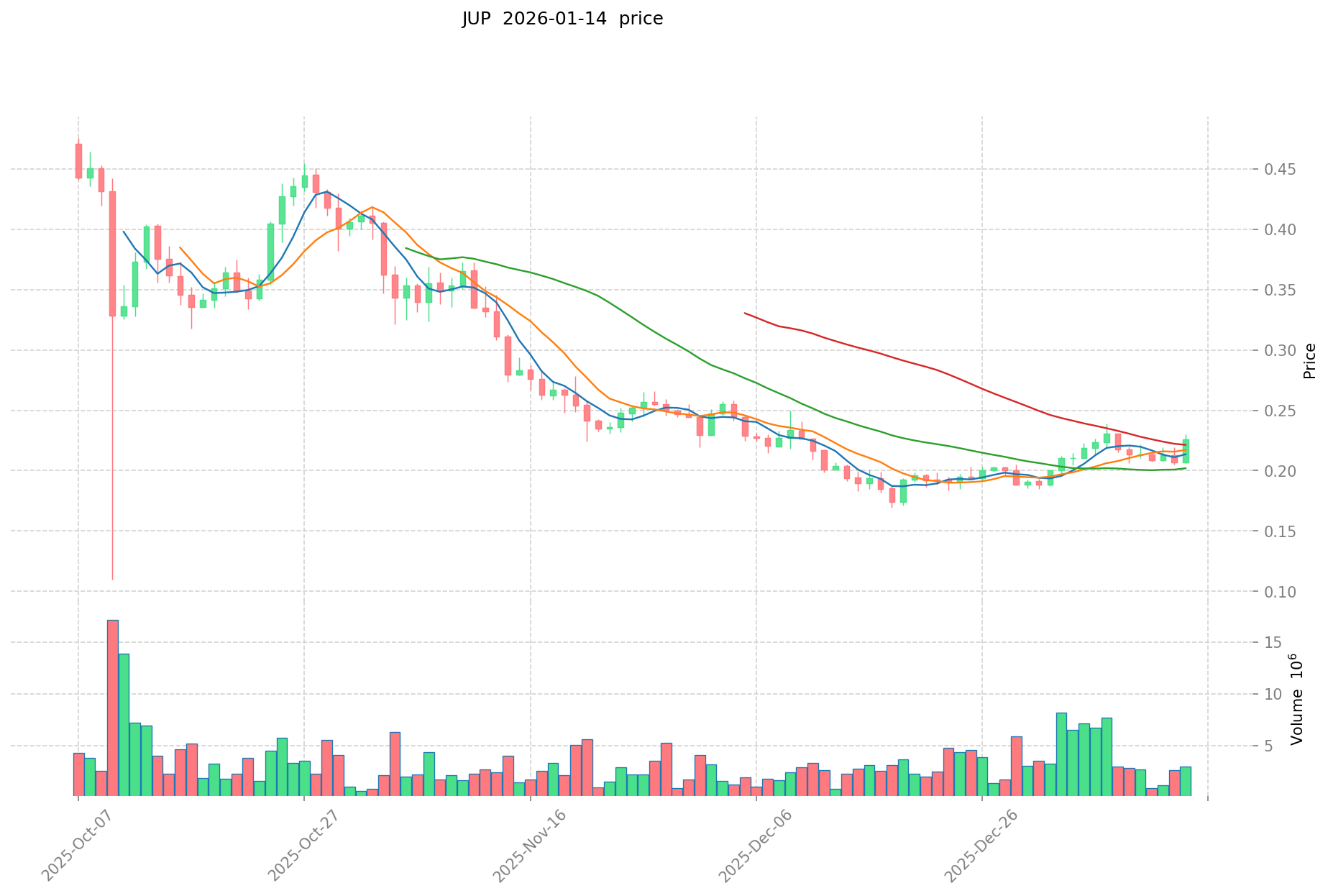
- 2025: The token experienced substantial market corrections throughout the year, with price declining to its lowest point of $0.1097 on October 10, 2025
- 2026: As of January 14, 2026, JUP is trading at $0.22891, showing signs of recovery with an 8.23% increase over the past 24 hours and a 16.04% gain over the past 30 days
JUP Current Market Situation
As of January 14, 2026, Jupiter (JUP) is trading at $0.22891, with a 24-hour trading volume of $807,171.21. The token demonstrates notable short-term momentum, with price increasing by 0.99% over the past hour and 8.23% over the past 24 hours. Within the 24-hour period, JUP has fluctuated between a low of $0.21043 and a high of $0.22994.
The market capitalization stands at approximately $730.32 million, with a circulating supply of 3.19 billion tokens, representing 31.9% of the total supply of 6.86 billion tokens. The fully diluted market cap is calculated at $1.57 billion, based on a maximum supply of 10 billion tokens. Jupiter currently ranks 106th in the cryptocurrency market with a market dominance of 0.046%.
The project serves as Solana's primary liquidity infrastructure, reportedly driving more than 80% of retail liquidity movement within the network. The token is listed on 46 exchanges and has 852,684 holders. The current market sentiment index indicates a neutral status at 48. Over the past 30 days, JUP has experienced a 16.04% price increase, though the yearly performance shows a decline of 70.33% from previous levels.
Click to view current JUP market price
JUP Market Sentiment Indicator
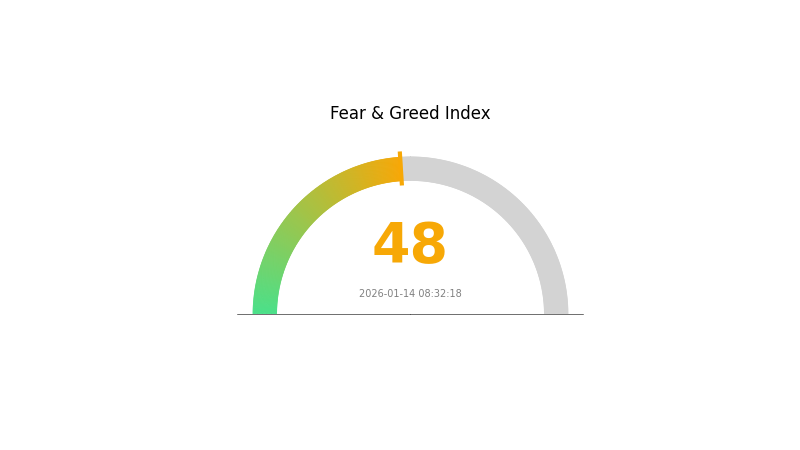
2026-01-14 Fear and Greed Index: 48 (Neutral)
Click to view current Fear & Greed Index
The cryptocurrency market is currently operating in a neutral sentiment zone, with the Fear and Greed Index reading 48. This balanced state suggests investors are neither excessively fearful nor overly greedy, indicating a stabilized market environment. Traders should maintain a measured approach, avoiding emotional decision-making while remaining vigilant to market shifts. Monitor key support and resistance levels closely, as this neutral territory often precedes significant directional moves.
JUP Holding Distribution
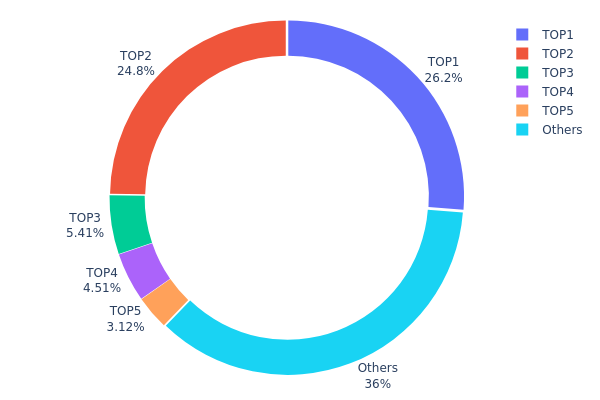
The holding distribution chart reflects the concentration of token supply across different wallet addresses, serving as a crucial indicator of market structure and decentralization level. For JUP, the current data reveals a notably concentrated holding pattern that warrants careful examination.
According to the latest on-chain data, the top two addresses collectively control approximately 50.97% of the total JUP supply, with the largest holder possessing 1.799 million tokens (26.21%) and the second-largest holding 1.7 million tokens (24.76%). The top five addresses account for 63.99% of total holdings, while the remaining 36% is distributed among other addresses. This distribution pattern indicates a relatively high concentration level, which is common among newer tokens but may pose certain structural risks. Such concentrated holdings could potentially amplify price volatility, as large holders possess significant influence over market dynamics through their trading activities.
From a market structure perspective, this concentration level presents both opportunities and challenges. While major holders may have vested interests in the project's long-term success, their dominant positions could enable coordinated market movements or create liquidity imbalances during periods of high trading activity. The 36% distribution among smaller holders suggests some degree of retail participation, yet the overall structure leans toward centralization compared to more mature digital assets. This configuration requires market participants to remain vigilant regarding potential sudden supply changes and assess their risk tolerance accordingly when engaging with JUP.
Click to view current JUP Holding Distribution
| Top |
Address |
Holding Qty |
Holding (%) |
| 1 |
61aq58...s5xHXV |
1799366.67K |
26.21% |
| 2 |
EXJHiM...7yHm6T |
1700000.00K |
24.76% |
| 3 |
FVhQ3Q...iKfekf |
371492.92K |
5.41% |
| 4 |
Any5gL...37T7iz |
309433.23K |
4.50% |
| 5 |
BmEyv8...CSF1j2 |
214495.33K |
3.12% |
| - |
Others |
2469194.80K |
36% |
II. Core Factors Influencing JUP's Future Price
Supply Mechanism
- Token Supply Reduction: Jupiter founder Meow proposed a significant tokenomics reform, reducing the total supply by 30%. The proposal includes a 30% reduction in vested JUP received by the team and a 30% reduction in annual Jupuary airdrops. This proposal has been approved through Jupiter DAO voting and will be implemented in the future.
- Buyback Program Adjustments: Jupiter co-founder SIONG disclosed that the project spent over $70 million on JUP buybacks in the previous year, but the price showed limited response. The community is now discussing alternative approaches, including using funds for staking rewards and protocol asset incentives for long-term holders, rather than continuing buyback programs.
- Current Impact: The 30% supply reduction may create deflationary pressure, potentially supporting price stability. However, the effectiveness of buyback programs remains under debate, with community members suggesting that providing holding incentives through staking mechanisms (with potential APY around 25%) may be more beneficial than direct buybacks.
Market Dynamics and Ecosystem Health
- Trading Volume Leadership: Jupiter maintains a leading position in Solana's perpetual trading market, demonstrating strong user adoption and platform competitiveness.
- Ecosystem Development: As a core project in the Solana ecosystem, Jupiter focuses on providing optimal trading experiences and efficient capital utilization. The platform integrates multiple decentralized exchanges and liquidity sources, including Serum, Raydium, and Orca, ensuring users can conduct efficient trading on a unified platform.
- Community Governance: The Jupiter DAO plays an active role in major decisions, including the recent approval of supply reduction proposals, demonstrating a mature governance structure.
Macroeconomic Environment
- Global Economic Conditions: Factors such as inflation rates and monetary policies influence investor behavior and indirectly affect cryptocurrency prices, including JUP.
- Market Sentiment: The broader cryptocurrency market dynamics significantly impact JUP's price movements, as the token operates within the mid-cap altcoin segment.
Technical Development and Ecosystem Building
- Perpetual Trading Integration: Jupiter launched perpetual trading functionality, transitioning from a pure aggregator to include contract trading capabilities. Unlike traditional order book models, Jupiter's Perp utilizes the Jupiter LP (JLP) pool mechanism, offering zero price impact, zero slippage, and deep liquidity.
- Smart Routing System: Jupiter's core technology includes an intelligent path system that analyzes different trading routes to select optimal paths, achieving the lowest trading costs and best prices for users.
- API Services: Jupiter provides open APIs allowing other applications and platforms to integrate its aggregator services, expanding the ecosystem's influence and reach.
- LFG Launchpad: The platform supports new blockchain projects through Jupiter DAO and community backing, providing comprehensive project introductions and protection against market manipulation.
- Giant Unified Markets Initiative (GUMI): Jupiter announced an ambitious plan to bring all assets, including cryptocurrencies, RWA, stocks, and forex, into Solana and establish indexing on Jupiter. This vision requires three key components: more assets, more liquidity, and more seamless operations. The GUM Alliance, including support from the Solana Foundation and market makers like Wintermute and DWF Labs, has been established to advance this vision.
III. 2026-2031 JUP Price Prediction
2026 Outlook
- Conservative Prediction: $0.2214 - $0.2283
- Neutral Prediction: $0.2283 - $0.2625
- Optimistic Prediction: $0.2625 (requires favorable market conditions and increased adoption)
2027-2029 Outlook
- Market Stage Expectation: During this period, JUP may experience gradual growth as the broader cryptocurrency market matures and DeFi protocols gain wider acceptance. The token could see increased trading activity on platforms like Gate.com as institutional participation grows.
- Price Range Predictions:
- 2027: $0.2233 - $0.3484
- 2028: $0.2464 - $0.3741
- 2029: $0.2114 - $0.4697
- Key Catalysts: Platform upgrades, expanding user base, potential partnerships within the Solana ecosystem, and overall cryptocurrency market sentiment may drive price appreciation during these years.
2030-2031 Long-term Outlook
- Baseline Scenario: $0.2255 - $0.5073 (assuming steady ecosystem development and moderate market growth)
- Optimistic Scenario: $0.4049 - $0.6278 (contingent upon significant protocol improvements and broader DeFi adoption)
- Transformative Scenario: Potential to reach upper ranges of $0.6278 (requires exceptional market conditions, major technological breakthroughs, and substantial increase in total value locked)
- 2026-01-14: JUP trading within the predicted baseline range with market participants monitoring ecosystem developments closely
| Year |
Predicted High Price |
Predicted Average Price |
Predicted Low Price |
Price Change |
| 2026 |
0.2625 |
0.22826 |
0.22141 |
0 |
| 2027 |
0.34844 |
0.24538 |
0.2233 |
7 |
| 2028 |
0.37411 |
0.29691 |
0.24643 |
29 |
| 2029 |
0.46971 |
0.33551 |
0.21137 |
46 |
| 2030 |
0.50729 |
0.40261 |
0.22546 |
75 |
| 2031 |
0.62783 |
0.45495 |
0.4049 |
98 |
IV. JUP Professional Investment Strategy and Risk Management
JUP Investment Methodology
(I) Long-term Holding Strategy
- Suitable for: Investors who believe in the long-term development of the Solana ecosystem and DeFi infrastructure
- Operational Recommendations:
- Consider dollar-cost averaging (DCA) during market volatility to reduce timing risk
- Monitor Jupiter's protocol integration expansion and liquidity metrics as indicators of ecosystem growth
- Storage Solution: Utilize Gate Web3 Wallet for secure long-term storage with enhanced security features
(II) Active Trading Strategy
- Technical Analysis Tools:
- Moving Averages: Track 50-day and 200-day moving averages to identify trend reversals and potential entry/exit points
- Relative Strength Index (RSI): Monitor overbought (above 70) and oversold (below 30) conditions to optimize timing
- Swing Trading Key Points:
- Pay attention to Jupiter's daily trading volume changes, as significant volume increases may signal trend shifts
- Consider correlation with Solana ecosystem developments and broader DeFi market movements
JUP Risk Management Framework
(I) Asset Allocation Principles
- Conservative Investors: 2-5% of crypto portfolio allocation
- Aggressive Investors: 8-12% of crypto portfolio allocation
- Professional Investors: 15-20% of crypto portfolio allocation with active hedging strategies
(II) Risk Hedging Solutions
- Diversification Strategy: Combine JUP holdings with other blue-chip cryptocurrencies to reduce single-asset exposure
- Position Sizing: Implement stop-loss orders at 10-15% below entry price to limit downside risk
(III) Secure Storage Solutions
- Hot Wallet Recommendation: Gate Web3 Wallet offers convenient access for active trading with multi-layer security protocols
- Cold Storage Solution: For large holdings, consider hardware wallet solutions with offline private key management
- Security Precautions: Never share private keys or seed phrases, enable two-factor authentication, and regularly verify wallet addresses before transactions
V. JUP Potential Risks and Challenges
JUP Market Risks
- Price Volatility: As demonstrated by the -70.33% year-over-year change, JUP exhibits significant price fluctuations typical of DeFi tokens
- Liquidity Concentration: Despite processing over 80% of Solana retail liquidity, market depth may vary during high volatility periods
- Competition Risk: Other DEX aggregators and liquidity protocols on competing chains may capture market share
JUP Regulatory Risks
- DeFi Protocol Oversight: Increasing regulatory scrutiny on decentralized finance platforms may impact operational frameworks
- Token Classification Uncertainty: Evolving regulatory definitions of utility tokens versus securities could affect market accessibility
- Cross-border Compliance: Multi-jurisdictional regulatory requirements may create operational complexity
JUP Technical Risks
- Smart Contract Vulnerabilities: Despite audits, potential undiscovered bugs could affect protocol security
- Network Dependency: JUP's performance is closely tied to Solana network stability and congestion levels
- Integration Complexity: Dependencies on multiple protocols within the Solana ecosystem create potential points of failure
VI. Conclusion and Action Recommendations
JUP Investment Value Assessment
Jupiter represents a critical infrastructure component within the Solana DeFi ecosystem, serving as the primary liquidity aggregation layer. With over 850,000 holders and integration across the majority of Solana protocols, JUP demonstrates strong network effects. However, the significant year-over-year price decline and circulating supply of only 31.9% of total supply present both risks and potential opportunities. Long-term value depends on continued Solana ecosystem growth and Jupiter's ability to maintain its dominant liquidity position.
JUP Investment Recommendations
✅ Beginners: Start with small position sizing (1-3% of portfolio) and focus on learning Jupiter's role in the Solana ecosystem before increasing exposure
✅ Experienced Investors: Consider swing trading opportunities around key Solana ecosystem developments while maintaining core long-term positions
✅ Institutional Investors: Evaluate JUP as part of broader DeFi infrastructure exposure with appropriate hedging through diversified protocol positions
JUP Trading Participation Methods
- Spot Trading: Purchase JUP directly on Gate.com with various trading pairs for immediate exposure
- Dollar-Cost Averaging: Establish regular purchase schedules to mitigate timing risk and reduce volatility impact
- Liquidity Provision: Consider participating in Jupiter's liquidity pools to earn additional yields while holding tokens
Cryptocurrency investment carries extremely high risks, and this article does not constitute investment advice. Investors should make prudent decisions based on their own risk tolerance and are advised to consult professional financial advisors. Never invest more than you can afford to lose.
FAQ
What is JUP token? What are the functions and purposes of Jupiter protocol?
JUP token enables governance in Jupiter protocol, allowing holders to influence protocol development through decentralized voting. Jupiter serves as a key liquidity aggregator and routing protocol in Solana ecosystem.
How to conduct JUP price prediction? What are the main factors affecting JUP price?
JUP price prediction relies on historical data trends and market sentiment analysis. Key factors include market demand, ecosystem development, trading volume, overall crypto market performance, and network adoption growth.
JUP experienced significant pullback, down 89.57% from its all-time high. Market sentiment remains optimistic with strong fundamentals. Technical analysis shows potential recovery opportunities. Price projected to reach $0.2549 by 2027 based on growth models.
What are the risks of investing in JUP? How accurate is cryptocurrency price prediction?
JUP faces market volatility and regulatory risks typical of emerging cryptocurrencies. Price predictions rely on technical analysis and market trends, with moderate accuracy. Jupiter's growing ecosystem and trading volume support bullish long-term potential despite short-term fluctuations.
What are JUP's advantages compared to other DEX tokens such as RAY and ORCA?
JUP excels with its liquidity aggregator, limit orders, and DCA investment features, delivering superior user experience and trading efficiency compared to RAY and ORCA.
What are the future development prospects of JUP? How is the team and ecosystem construction?
Jupiter Protocol demonstrates strong potential with an active developer team expanding its DEX aggregation capabilities. The ecosystem is growing steadily with increasing liquidity and trading volume, positioning JUP as a key infrastructure player in Solana's DeFi landscape.
* The information is not intended to be and does not constitute financial advice or any other recommendation of any sort offered or endorsed by Gate.