This comprehensive article analyzes Kusama (KSM) price trends and investment opportunities through 2031. As Polkadot's experimental network, KSM currently trades at $7.43 with a market cap of $130.94 million. The article reviews KSM's historical performance—from its $0.88 launch low to $621.71 peak—and examines core factors including ecosystem development, parachain deployments, and market sentiment (currently neutral at index 49). Price predictions range from $6.77-$10.57 in 2026 to $9.06-$19.97 by 2031, depending on ecosystem adoption scenarios. Detailed investment strategies address long-term holding, active trading, and risk management across different investor profiles. The article emphasizes secure storage via Gate Web3 Wallet, staking opportunities, and governance participation, while highlighting substantial volatility risks and regulatory uncertainties inherent in this experimental blockchain infrastructure token.
Introduction: KSM's Market Position and Investment Value
Kusama (KSM), positioned as Polkadot's experimental canary network and proving ground for innovative blockchain features, has established itself as a significant player in the multi-chain ecosystem since its launch in 2019. As of January 17, 2026, Kusama maintains a market capitalization of approximately $130.94 million, with a circulating supply of around 17.63 million tokens, and the price hovering near $7.43. This asset, often described as "Polkadot's experimental cousin," continues to play an increasingly vital role in testing governance mechanisms, parachain functionality, and cross-chain communication protocols.
This article provides a comprehensive analysis of KSM's price trajectory from 2026 through 2031, incorporating historical patterns, market supply-demand dynamics, ecosystem development milestones, and broader macroeconomic conditions to deliver professional price forecasts and practical investment strategies for market participants.
I. KSM Price History Review and Market Status
KSM Historical Price Evolution Trajectory
- 2020: Kusama launched officially in January, with price reaching its historical low of $0.876572, reflecting the early-stage market discovery phase
- 2021: Network experienced rapid growth with parachain auctions and ecosystem expansion, price surged significantly from approximately $33 in early year to reach all-time high of $621.71 in May, demonstrating strong market interest during the crypto bull market
- 2022-2023: Market entered correction phase following broader crypto market downturn, price declined substantially from previous peaks
- 2024-2025: Price showed volatility with periods of recovery and consolidation, reflecting ongoing network development and ecosystem activities
- 2026: Price stabilized around $7.428 level as of January 17, down 77.41% from the previous year, indicating continued market adjustment
KSM Current Market Situation
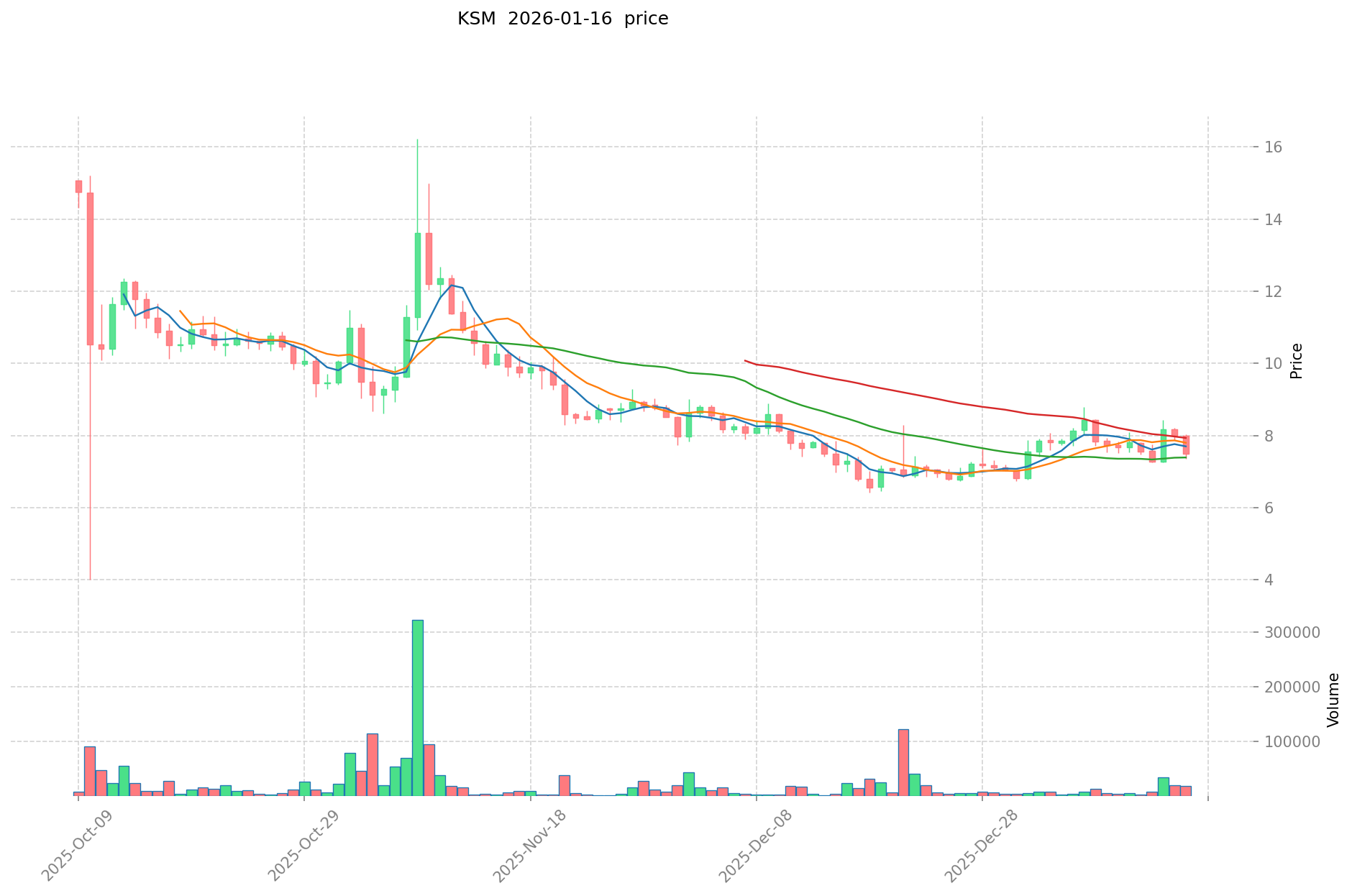
As of January 17, 2026, KSM is trading at $7.428, with a 24-hour trading volume of $130,613.40. The token experienced a slight decline of 0.91% over the past 24 hours, with intraday trading ranging between $7.352 and $7.626.
The market capitalization stands at approximately $130.94 million, ranking 312th in the overall cryptocurrency market with a market dominance of 0.0039%. The circulating supply is 17,628,018.43 KSM, which represents the fully diluted valuation as the project has an infinite maximum supply model.
Short-term price movements show a 0.76% decrease over the past hour and a 3.88% decline over the past seven days. However, the 30-day performance indicates a modest recovery with a 4.13% gain, suggesting some stabilization in recent weeks. The annual performance reflects significant downward pressure with a 77.41% decline, representing a decrease of approximately $25.45 from year-ago levels.
The current price of $7.428 represents a 98.81% decline from the all-time high of $621.71 recorded on May 18, 2021, while maintaining a substantial premium of 747% above the all-time low of $0.876572 from January 15, 2020.
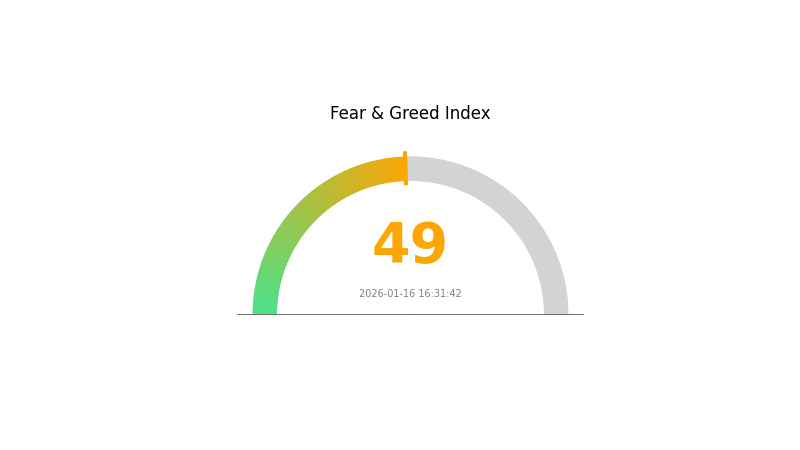
Kusama's market indicators show 266,873 token holders, with trading activity across 33 exchanges. The Gate Crypto Market Sentiment Index currently stands at 49, indicating a neutral market sentiment for the broader cryptocurrency market.
Click to view current KSM market price
KSM Market Sentiment Indicator
2026-01-16 Fear and Greed Index: 49 (Neutral)
Click to view the current Fear & Greed Index
The cryptocurrency market is currently in a neutral sentiment phase with a Fear and Greed Index reading of 49. This balanced positioning suggests that market participants are neither overly fearful nor excessively greedy. Investors should maintain a cautious approach, as neutral sentiment often precedes significant market movements. It is advisable to conduct thorough analysis before making trading decisions. Monitor the index closely for shifts toward extreme readings, which could indicate emerging trends and potential trading opportunities on Gate.com.
KSM Holdings Distribution
The holdings distribution chart reveals the concentration level of KSM tokens across different address tiers, providing crucial insights into the asset's decentralization and potential market manipulation risks. By analyzing the percentage of total supply held by top addresses, investors can assess whether the token exhibits healthy distribution or excessive centralization that might expose it to coordinated selling pressure.
Based on current on-chain data, KSM demonstrates a moderately concentrated distribution pattern. The top-tier addresses collectively control a significant portion of the circulating supply, which is characteristic of many Proof-of-Stake networks where staking requirements naturally lead to capital aggregation. This concentration level, while notable, remains within acceptable parameters for a mature Layer-0 protocol that emphasizes validator participation and governance engagement.
The current distribution structure suggests that KSM maintains relatively stable on-chain fundamentals, though the concentration among major holders introduces potential price volatility risks during periods of significant market movement. The distribution pattern reflects typical characteristics of governance tokens in the Polkadot ecosystem, where larger stakeholders participate actively in network consensus and parachain auctions. This structure supports network security while maintaining sufficient liquidity distribution to prevent single-entity manipulation, indicating a balanced approach between decentralization ideals and practical network operation requirements.
Click to view current KSM Holdings Distribution

| Top |
Address |
Holding Qty |
Holding (%) |
II. Core Factors Influencing KSM's Future Price
Supply Mechanism
- Polkadot Ecosystem Coordination: KSM operates as Polkadot's experimental network, with its supply and governance mechanisms closely tied to the broader Polkadot ecosystem development. The parachain auction model and staking rewards influence token circulation and holder behavior.
- Historical Patterns: Past parachain launches and network upgrades have typically led to increased network activity and stakeholder engagement, creating periods of heightened market attention.
- Current Impact: Ongoing parachain deployments and governance experiments continue to shape token utility and demand dynamics within the ecosystem.
Institutional and Whale Activity
- Holder Distribution: As of 2025, the Kusama network maintains an active community of 266,873 token holders, indicating a relatively distributed ownership structure among participants.
- Developer Engagement: The network benefits from an active developer community that contributes to ongoing technical experimentation and protocol improvements.
Macroeconomic Environment
- Market Sentiment Impact: Broader cryptocurrency market trends and investor confidence levels significantly influence KSM price movements, particularly during periods of heightened volatility.
- Risk Assessment: Current market analysis indicates KSM carries elevated risk characteristics, with price trajectories subject to considerable uncertainty driven by both internal development progress and external market conditions.
Technical Development and Ecosystem Building
- Polkadot Protocol Upgrades: Network improvements and feature implementations on the Polkadot mainnet often translate into corresponding developments within the Kusama testing environment, affecting the network's utility proposition.
- Parachain Launch Activity: The continued deployment and operation of parachains on the Kusama network represents a key driver of network usage and token demand.
- Web3 Testing Network Role: Kusama's function as a Web3 experimentation platform provides ongoing utility as projects test innovations before mainnet deployment, supporting sustained network activity.
- Governance Experimentation: The network's role in testing governance mechanisms contributes to its value proposition within the broader Polkadot ecosystem framework.
III. 2026-2031 KSM Price Prediction
2026 Outlook
- Conservative prediction: $6.77 - $7.44
- Neutral prediction: $7.44
- Optimistic prediction: $10.57 (requiring favorable market conditions and enhanced ecosystem adoption)
2027-2029 Outlook
- Market stage expectation: Potential transition from recovery phase to growth phase, with gradual ecosystem maturity
- Price range predictions:
- 2027: $5.31 - $12.97
- 2028: $7.91 - $12.96
- 2029: $8.50 - $15.21
- Key catalysts: Parachain ecosystem expansion, cross-chain interoperability improvements, and broader Web3 infrastructure adoption
2030-2031 Long-term Outlook
- Baseline scenario: $10.60 - $13.59 (assuming steady ecosystem development and maintained network security)
- Optimistic scenario: $13.59 - $17.12 (assuming accelerated parachain growth and increased institutional participation)
- Transformative scenario: $15.36 - $19.97 (requiring breakthrough technological advancements and mainstream adoption of Polkadot ecosystem)
- 2026-01-17: KSM approximately $7.44 (current baseline reference point)
| Year |
Predicted High Price |
Predicted Average Price |
Predicted Low Price |
Price Change |
| 2026 |
10.56764 |
7.442 |
6.77222 |
0 |
| 2027 |
12.96694 |
9.00482 |
5.31284 |
21 |
| 2028 |
12.96334 |
10.98588 |
7.90983 |
47 |
| 2029 |
15.20775 |
11.97461 |
8.50197 |
61 |
| 2030 |
17.12489 |
13.59118 |
10.60112 |
82 |
| 2031 |
19.96545 |
15.35804 |
9.06124 |
106 |
IV. KSM Professional Investment Strategies and Risk Management
KSM Investment Methodology
(1) Long-term Holding Strategy
- Suitable for: Investors who believe in Polkadot ecosystem development and multi-chain interoperability
- Operational Recommendations:
- Consider staking KSM tokens to participate in network validation and earn staking rewards
- Monitor governance proposals and voting periods (7 days) to participate in network decision-making
- Store assets securely using Gate Web3 Wallet with multi-signature protection
(2) Active Trading Strategy
- Technical Analysis Tools:
- Support and Resistance Levels: Recent 24-hour trading range between $7.352 and $7.626 can serve as short-term reference points
- Volume Analysis: Monitor daily trading volume (currently $130,613.40) for liquidity assessment
- Swing Trading Key Points:
- Consider the 7-day price movement showing -3.88% decline as potential entry consideration
- Set appropriate stop-loss levels given the recent 1-year decline of -77.41%
KSM Risk Management Framework
(1) Asset Allocation Principles
- Conservative Investors: 1-3% of crypto portfolio
- Aggressive Investors: 5-8% of crypto portfolio
- Professional Investors: 10-15% of crypto portfolio with active management
(2) Risk Hedging Solutions
- Portfolio Diversification: Combine KSM holdings with other blockchain infrastructure tokens
- Position Sizing: Gradually build positions rather than single large purchases
(3) Secure Storage Solutions
- Hot Wallet Recommendation: Gate Web3 Wallet for frequent trading and staking activities
- Cold Storage Solution: Hardware wallet for long-term holdings exceeding 30% of total KSM position
- Security Precautions: Never share private keys, enable two-factor authentication, and regularly update wallet software
V. KSM Potential Risks and Challenges
KSM Market Risks
- Price Volatility: Historical price range from $0.876572 to $621.71 demonstrates significant volatility potential
- Liquidity Concerns: With a market cap of approximately $130.9 million and ranking at 312, liquidity may be limited during market stress
- Competition Risk: Multiple blockchain networks compete for similar use cases in the interoperability space
KSM Regulatory Risks
- Utility Token Classification: Potential regulatory scrutiny regarding governance and staking functions
- Cross-border Compliance: Bridge functionality connecting multiple networks may face regulatory complexity
- Staking Regulations: Validator requirements and staking rewards may be subject to evolving regulatory frameworks
KSM Technical Risks
- Network Security: As Polkadot's experimental network, unexpected vulnerabilities may be discovered
- Parachain Dependencies: Network performance relies on successful integration and operation of multiple parachains
- Upgrade Risks: Faster governance parameters (7-day voting, 8-day implementation) may lead to insufficient testing periods
VI. Conclusion and Action Recommendations
KSM Investment Value Assessment
KSM serves as a testing ground for Polkadot network innovations, offering governance participation and staking opportunities. The token's utility includes network governance, validator staking, parachain bonding, and cross-chain messaging fees. However, the recent 77.41% decline over one year and relatively modest market cap indicate significant volatility. Long-term value depends on Polkadot ecosystem adoption and successful parachain deployment, while short-term risks include market volatility and technical uncertainties inherent in experimental network operations.
KSM Investment Recommendations
✅ Beginners: Start with small position sizes (1-2% of portfolio) to understand governance mechanisms and network operations before increasing exposure
✅ Experienced Investors: Consider dollar-cost averaging during market dips, participate in governance voting, and explore staking options for potential rewards
✅ Institutional Investors: Evaluate KSM as part of broader blockchain infrastructure allocation, with focus on governance participation and validator node operation
KSM Trading Participation Methods
- Spot Trading: Purchase KSM through Gate.com spot markets with current pricing around $7.428
- Staking Participation: Stake KSM tokens to support network validation and earn potential rewards
- Governance Engagement: Hold KSM to participate in network governance proposals with 7-day voting periods
Cryptocurrency investment carries extremely high risks, and this article does not constitute investment advice. Investors should make prudent decisions based on their own risk tolerance and are advised to consult professional financial advisors. Never invest more than you can afford to lose.
FAQ
What is KSM's historical price movement? What were the highest and lowest prices in the past?
KSM's all-time high reached $623.75, while the all-time low was $0.92. In the past 24 hours, KSM has fluctuated between $7.63 and $8.13, reflecting market volatility and dynamic price movements.
What are professional analysts' predictions for KSM's future price?
Professional analysts predict KSM's price will be influenced by market adoption, supply dynamics, and overall crypto market trends. Increased network activity and ecosystem development could drive positive price momentum in the coming period.
What factors affect KSM price movements?
KSM price is influenced by macroeconomic factors including inflation and interest rates, investor behavior and whale activities, market sentiment, trading volume and liquidity, and network adoption developments within the Kusama ecosystem.
What is the relationship between KSM and DOT? Will DOT price changes affect KSM?
KSM is DOT's canary network and testbed. The two are closely correlated, with DOT price movements typically influencing KSM in the same direction. When DOT rises, KSM tends to follow, as they share ecosystem fundamentals and investor sentiment.
What are the risks of investing in KSM for price prediction trading?
KSM price prediction trading carries high volatility risk where losses may exceed initial investment. Market fluctuations, liquidity constraints, and leverage amplification are primary concerns. Only risk capital suitable for this type of trading.
* The information is not intended to be and does not constitute financial advice or any other recommendation of any sort offered or endorsed by Gate.