This comprehensive analysis examines Litecoin's price trajectory from 2026 to 2031, combining historical patterns, market dynamics, and technical developments. As of January 2026, LTC trades at $75.84 with a market cap of $5.82 billion, maintaining significant institutional interest with pending spot ETF approvals. The article addresses key factors influencing LTC's future performance, including the 2027 halving event, MWEB integration achievements, and the upcoming LitecoinVM Layer-2 launch. Professional price forecasts range from conservative scenarios at $53.80 to optimistic projections exceeding $141.83 by 2031. Investors gain practical strategies for long-term holding and active trading, along with comprehensive risk management frameworks applicable across conservative to aggressive portfolios, all grounded in current market data from Gate exchange platforms.
Introduction: LTC's Market Position and Investment Value
Litecoin (LTC), as the first cryptocurrency based on the Scrypt algorithm, has achieved significant milestones since its inception in 2011. As of 2026, Litecoin's market capitalization has reached approximately $5.82 billion, with a circulating supply of around 76.73 million coins, and its price is maintained at approximately $75.84. This asset, often referred to as the "silver to Bitcoin's gold," is playing an increasingly vital role in fast payment solutions and peer-to-peer transaction networks.
This article will comprehensively analyze LTC's price trends from 2026 to 2031, combining historical patterns, market supply and demand dynamics, ecosystem development, and macroeconomic conditions to provide investors with professional price forecasts and practical investment strategies.
I. LTC Price History Review and Current Market Status
LTC Historical Price Evolution Trajectory
- 2015: Early market development phase, price reached its historical low point, recording $1.15
- 2021: During the crypto market bull cycle in May, price experienced significant growth, reaching $410.26
- 2022-2025: Market adjustment period, price underwent volatility and correction from previous highs
LTC Current Market Dynamics
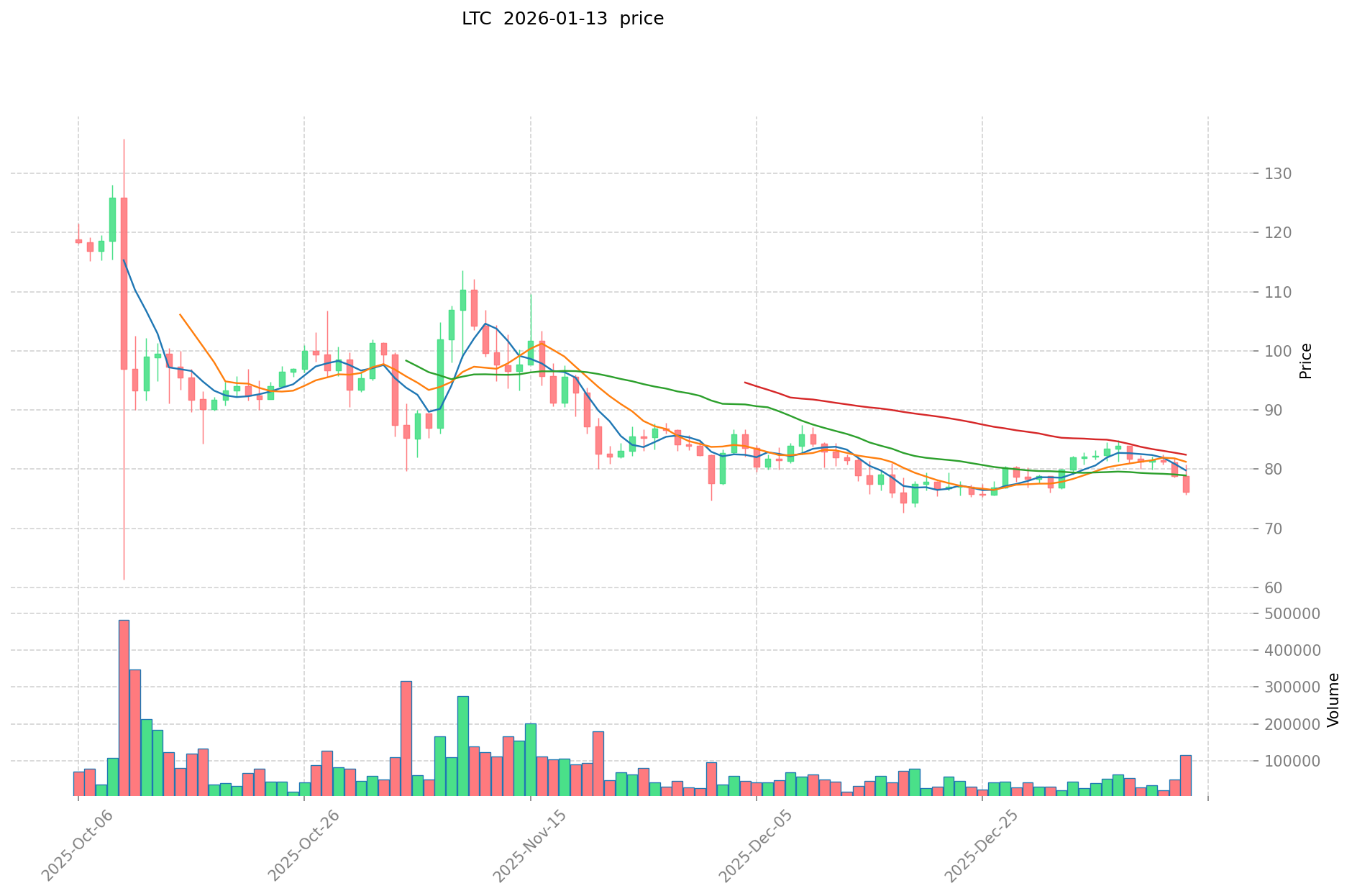
As of January 13, 2026, Litecoin is trading at $75.84, showing a decrease of 2.71% over the past 24 hours with a trading volume of $8.83 million. The token has experienced notable price movements across different timeframes, with a 0.58% decline in the past hour, an 8.69% decrease over the past week, and a 6.22% drop over the past 30 days. Over the one-year period, LTC has declined by 25.71%.
The 24-hour trading range shows price fluctuation between $75.62 and $77.98. Litecoin currently holds a market capitalization of approximately $5.82 billion, ranking 26th in the cryptocurrency market with a 0.17% market dominance. The circulating supply stands at 76.73 million LTC, representing 91.35% of the maximum supply of 84 million tokens. The market cap to fully diluted valuation ratio is 91.35%, indicating a relatively high proportion of tokens already in circulation.
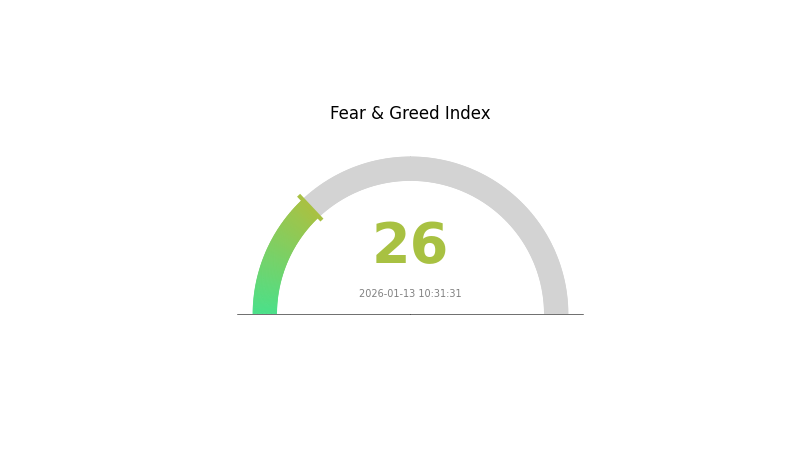
With over 8.87 million holders and listings on 77 exchanges, Litecoin maintains substantial market presence and accessibility. The current market sentiment index registers at 26, reflecting a fear sentiment in the broader crypto market environment.
Click to view current LTC market price
LTC Market Sentiment Indicator
2026-01-13 Fear and Greed Index: 26 (Fear)
Click to view the current Fear & Greed Index
The LTC market is currently showing significant fear sentiment with an index reading of 26. This low reading indicates that market participants are experiencing considerable anxiety and pessimism regarding price movements. When the Fear and Greed Index is in the fear zone, it often presents potential buying opportunities for long-term investors, as assets may be undervalued due to emotional selling pressure. However, traders should remain cautious and conduct thorough analysis before making investment decisions. Monitor market conditions closely on Gate.com for the latest sentiment data and trading opportunities.
LTC Holding Distribution
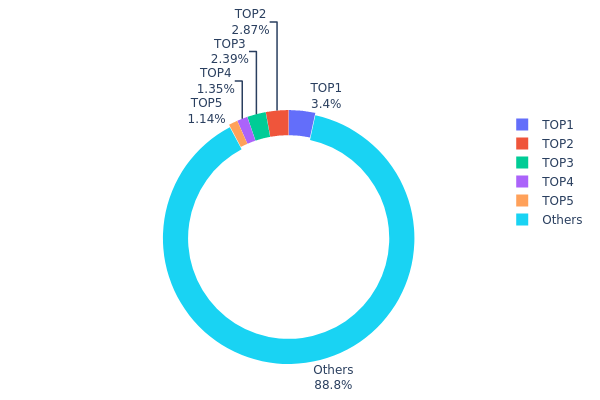
The holding distribution chart reflects the concentration of LTC supply across different addresses on the blockchain network. This metric serves as a crucial indicator for assessing decentralization levels and potential market manipulation risks. By analyzing the proportion of total supply held by top addresses versus smaller holders, investors can gauge whether the asset's distribution aligns with a healthy, decentralized ecosystem or exhibits concerning concentration patterns.
Based on the current data, LTC demonstrates a relatively moderate concentration profile. The top 5 addresses collectively hold approximately 11.13% of the total supply, with the largest single address controlling 3.40% (2.61M LTC). While the leading address holds a notable position, this concentration level remains within acceptable parameters compared to many altcoins that often see top holders controlling 10-20% individually. The remaining 88.87% of supply is distributed among other addresses, suggesting a reasonably broad holder base. This distribution pattern indicates that LTC maintains stronger decentralization characteristics than many smaller-cap cryptocurrencies, though it still exhibits some degree of whale influence.
The current holding distribution presents a balanced risk-reward scenario for market participants. The moderate concentration among top addresses means that while large holders possess the theoretical capacity to influence short-term price movements, the risk of coordinated manipulation remains limited due to the substantial portion held by dispersed smaller addresses. This structure typically contributes to reduced volatility compared to highly concentrated assets, as no single entity can dominate market dynamics. The on-chain structure reflected by this distribution suggests a mature asset with established long-term holders, supporting fundamental stability while maintaining sufficient liquidity for active trading. This equilibrium between concentrated and distributed holdings represents a characteristic feature of established Layer-1 blockchain assets that have undergone multiple market cycles.
Click to view current LTC Holding Distribution
| Top |
Address |
Holding Qty |
Holding (%) |
| 1 |
MQd1fJ...qDbPQS |
2611.45K |
3.40% |
| 2 |
ltc1qr...h5pp4t |
2205.01K |
2.87% |
| 3 |
ltc1ql...ldnr70 |
1832.09K |
2.38% |
| 4 |
MLj1bg...nXXV3E |
1033.08K |
1.34% |
| 5 |
MS56eJ...pTzZ5V |
878.22K |
1.14% |
| - |
Others |
68169.35K |
88.87% |
II. Core Factors Influencing LTC's Future Price
Supply Mechanism
- Halving Events: Litecoin undergoes a halving approximately every four years, reducing block rewards by 50%. The next halving is scheduled for July 2027, when rewards will decrease from 6.25 LTC to 3.125 LTC.
- Historical Pattern: Previous halvings in 2019 and 2023 have historically preceded price increases, with LTC rising to around $140 in 2019 ahead of the halving event.
- Current Impact: While the 2027 halving remains distant, market participants may begin pricing in reduced supply dynamics as the event approaches, potentially creating upward price pressure in 2026.
Institutional and Whale Dynamics
- Institutional Holdings: Multiple institutions including Grayscale, Canary Capital, and CoinShares have submitted applications for Litecoin spot ETFs, with approval probability estimated between 68% and 90% in early 2026.
- Corporate Adoption: Companies such as MEI Pharma and Luxxfolio have invested over $100 million into Litecoin treasury holdings, utilizing MWEB technology for confidential settlements.
- Regulatory Developments: The potential ETF approval represents a significant institutional catalyst that could bring billions in capital inflows, similar to the impact observed with Bitcoin ETF approvals in 2024.
Macroeconomic Environment
- Monetary Policy Impact: LTC's price trajectory remains sensitive to broader cryptocurrency market cycles and Bitcoin's performance, with BTC dominance currently at 58.67% limiting altcoin upside potential.
- Bitcoin Correlation: As a long-established cryptocurrency often trading in tandem with Bitcoin, Litecoin's price movements are significantly influenced by BTC trends and overall market sentiment.
- Market Conditions: Current market outlook shows mixed sentiment, with technical analysts identifying key support at $82 and resistance zones that could determine near-term direction.
Technical Development and Ecosystem Building
- LitecoinVM Launch (Q1 2026): A zero-knowledge proof Layer-2 solution built on BitcoinOS and Polygon CDK, enabling Ethereum Virtual Machine (EVM) compatibility and smart contract functionality without altering Litecoin's base protocol.
- MWEB Integration: Over 90% of Litecoin miners and nodes now support MWEB block validation, enhancing transaction privacy and efficiency while maintaining Litecoin's speed and low-cost advantages.
- Ecosystem Expansion: The LitecoinVM testnet aims to unlock decentralized finance (DeFi), tokenized assets, and cross-chain interoperability, potentially attracting Ethereum developers and increasing on-chain activity beyond simple payment use cases.
III. 2026-2031 LTC Price Forecast
2026 Outlook
- Conservative prediction: $53.80-$75.78
- Neutral prediction: $75.78
- Optimistic prediction: $101.55 (requires sustained market momentum and favorable regulatory environment)
2027-2029 Mid-term Outlook
- Market stage expectation: The market may experience gradual recovery and moderate growth, with price fluctuations influenced by broader cryptocurrency market cycles and technological developments
- Price range forecast:
- 2027: $60.29-$93.10
- 2028: $48.17-$95.42
- 2029: $68.93-$108.06
- Key catalysts: Network upgrades, institutional adoption trends, macroeconomic conditions, and overall cryptocurrency market sentiment could serve as primary drivers for price movements
2030-2031 Long-term Outlook
- Baseline scenario: $61.37-$112.68 (assuming steady market development and moderate adoption growth)
- Optimistic scenario: $100.60-$141.83 (contingent on significant technological breakthroughs and widespread mainstream acceptance)
- Transformative scenario: Potential to exceed $141.83 (requires exceptional market conditions, major partnerships, and breakthrough integration into financial systems)
- 2026-01-13: LTC trading analysis suggests a projected average price around $75.78 for the year ahead
| Year |
Predicted High Price |
Predicted Average Price |
Predicted Low Price |
Price Change |
| 2026 |
101.55 |
75.78 |
53.8038 |
0 |
| 2027 |
93.09573 |
88.6626 |
60.29057 |
16 |
| 2028 |
95.42312 |
90.87917 |
48.16596 |
19 |
| 2029 |
108.06 |
93.15114 |
68.93185 |
22 |
| 2030 |
112.68 |
100.6 |
61.36797 |
32 |
| 2031 |
141.83 |
106.64 |
56.5189 |
40 |
IV. LTC Professional Investment Strategies and Risk Management
LTC Investment Methodology
(I) Long-term Holding Strategy
- Target Investors: Investors seeking exposure to established cryptocurrencies with lower volatility compared to newer assets
- Operational Recommendations:
- Consider accumulating positions during market downturns, as LTC has demonstrated recovery patterns from its all-time low of $1.15 in January 2015
- Monitor the circulating supply ratio of 91.35%, with maximum supply capped at 84 million LTC, providing supply predictability
- Utilize secure storage solutions such as Gate Web3 Wallet for long-term holdings
(II) Active Trading Strategy
- Technical Analysis Tools:
- Price Range Analysis: Monitor the 24-hour trading range ($75.62-$77.98) to identify support and resistance levels
- Volume Analysis: Track the 24-hour trading volume of $8,826,143.37 to gauge market liquidity and trading activity
- Swing Trading Considerations:
- Be aware of recent price trends showing a 2.71% decline over 24 hours and 8.69% decline over 7 days
- Note the 2.5-minute block confirmation time, which facilitates faster transaction settlements compared to some alternatives
LTC Risk Management Framework
(I) Asset Allocation Principles
- Conservative Investors: 5-10% of crypto portfolio allocation
- Aggressive Investors: 15-25% of crypto portfolio allocation
- Professional Investors: Consider dynamic allocation based on market conditions and technical indicators
(II) Risk Hedging Solutions
- Portfolio Diversification: Balance LTC holdings with other digital assets to reduce concentration risk
- Position Sizing: Avoid overexposure given the 25.71% decline over the past year
(III) Secure Storage Solutions
- Hot Wallet Recommendation: Gate Web3 Wallet for active trading and convenient access
- Cold Storage Solution: Consider hardware wallet solutions for long-term holdings exceeding short-term trading needs
- Security Precautions: Enable two-factor authentication, never share private keys, and verify all transaction addresses before confirming transfers
V. LTC Potential Risks and Challenges
LTC Market Risks
- Price Volatility: Recent performance shows declines across multiple timeframes, with 8.69% drop over 7 days and 25.71% decline over one year
- Market Capitalization Position: Currently ranked #26 with 0.17% market dominance, indicating significant competition from other cryptocurrencies
- Distance from Historical High: Trading at $75.84, approximately 81.5% below the all-time high of $410.26 reached in May 2021
LTC Regulatory Risks
- Compliance Evolution: Cryptocurrency regulations continue to evolve globally, potentially affecting trading availability and operational frameworks
- Exchange Listing Risk: While listed on 77 exchanges, regulatory changes may impact accessibility on certain platforms
- Jurisdictional Variations: Different countries maintain varying stances on cryptocurrency trading and holdings
LTC Technical Risks
- Network Competition: Faces competition from newer blockchain protocols with enhanced features and capabilities
- Adoption Challenges: Must maintain relevance and utility in an increasingly competitive cryptocurrency landscape
- Technology Evolution: Requires ongoing development to address scalability and functionality demands
VI. Conclusion and Action Recommendations
LTC Investment Value Assessment
Litecoin represents an established cryptocurrency with a mature infrastructure, having been operational since November 2011. With over 8.87 million holders and listing on 77 exchanges, it demonstrates significant market presence. However, recent price performance indicates headwinds, with declines across multiple timeframes. The fixed maximum supply of 84 million LTC provides supply predictability, while the 2.5-minute block confirmation time offers practical transaction efficiency. Investors should weigh these long-term structural advantages against current market challenges and price trends.
LTC Investment Recommendations
✅ Beginners: Start with minimal allocation (2-5% of crypto portfolio), focus on understanding market dynamics before increasing exposure, and prioritize secure storage practices
✅ Experienced Investors: Consider strategic accumulation during price weakness if long-term thesis remains intact, maintain disciplined position sizing, and implement stop-loss mechanisms
✅ Institutional Investors: Evaluate LTC as part of a diversified digital asset strategy, conduct thorough due diligence on liquidity requirements, and consider regulatory implications across operating jurisdictions
LTC Trading Participation Methods
- Spot Trading: Direct purchase and sale of LTC through Gate.com and other cryptocurrency exchanges
- Dollar-Cost Averaging: Regular periodic purchases to reduce timing risk and average entry prices
- Portfolio Rebalancing: Periodic adjustments to maintain target allocation percentages within broader investment strategy
Cryptocurrency investment carries extremely high risks. This article does not constitute investment advice. Investors should make prudent decisions based on their own risk tolerance and are advised to consult professional financial advisors. Never invest more than you can afford to lose.
FAQ
How high will Litecoin (LTC) price go in the future?
Litecoin (LTC) is projected to reach approximately ¥2,868.95 by 2027, with potential for continued growth. Based on its market cap ranking at 22, LTC shows strong growth momentum.
How to predict LTC price trends?
Analyze on-chain metrics, trading volume, market sentiment, and halving cycles. Technical analysis using support/resistance levels and moving averages helps identify trends. Monitor macroeconomic factors and cryptocurrency adoption rates. Experts predict LTC may reach $254 by 2027 and $304 by 2030.
What are the main factors affecting Litecoin price?
Litecoin price is mainly influenced by Bitcoin's market performance, market demand and adoption rates, regulatory policies, transaction volume, and its fixed supply of 84 million coins. Network innovations and community sentiment also impact price trends.
What is the price relationship between LTC and Bitcoin (BTC)?
LTC and BTC prices are influenced by market dynamics without fixed ratios. Historically, LTC was theorized as one-quarter of BTC's price, but actual market movements show significant variations. Both assets respond to overall crypto market sentiment and individual blockchain developments differently.
What is the Litecoin price prediction for 2024/2025?
Litecoin is expected to experience significant volatility during 2024/2025, with prices potentially fluctuating around $100. Long-term trends suggest stable fundamentals, though precise predictions remain challenging due to market dynamics.
What are the common analysis methods for Litecoin price prediction?
Common LTC price prediction methods include technical analysis using trend lines and indicators, fundamental analysis of market data, and predictive models. Technical analysis examines price patterns and trading volume. Market aggregation platforms provide consolidated forecasts based on multiple analytical approaches.
* The information is not intended to be and does not constitute financial advice or any other recommendation of any sort offered or endorsed by Gate.