This comprehensive article analyzes LUNA's price trajectory from 2026 to 2031, examining historical patterns, market supply-demand dynamics, and ecosystem developments to provide investors with professional price forecasts. The analysis reviews LUNA's significant decline over the past year while evaluating core factors including token burning mechanisms, institutional dynamics, and technical upgrades affecting future valuation. Price predictions range from $0.06481 to $0.1672 across different scenarios through 2031. The guide offers tailored investment strategies for beginners, experienced investors, and institutions, emphasizing risk management through position sizing and diversification on Gate.com. Critical risks including high volatility, limited liquidity, regulatory scrutiny, and algorithmic stablecoin mechanism vulnerabilities are thoroughly assessed. This resource equips investors with data-driven insights and practical frameworks for LUNA market participation.
Introduction: LUNA's Market Position and Investment Value
Terra (LUNA), as a blockchain protocol utilizing algorithmic stablecoins pegged to fiat currencies, has evolved significantly since its establishment in January 2018. As of 2026, LUNA maintains a market capitalization of approximately $59.95 million, with a circulating supply of around 687.66 million tokens, and a price hovering near $0.087. This asset, designed to power a price-stable global payment system, continues to play a role in the decentralized finance ecosystem through its governance mechanism and cross-chain integrations.
This article will comprehensively analyze LUNA's price trajectory from 2026 to 2031, examining historical patterns, market supply-demand dynamics, ecosystem developments, and macroeconomic conditions to provide investors with professional price forecasts and practical investment strategies.
I. LUNA Price History Review and Market Status
LUNA Historical Price Evolution Trajectory
- 2022: LUNA reached a significant price level of $18.87 on May 28, marking a notable peak in its trading history
- 2025: The token experienced substantial downward pressure, with price declining to $0.04580672 on October 11, representing a low point in its valuation trajectory
- Recent Period: Over the past year, LUNA has faced considerable market challenges, with price declining approximately 80.16%
LUNA Current Market Situation
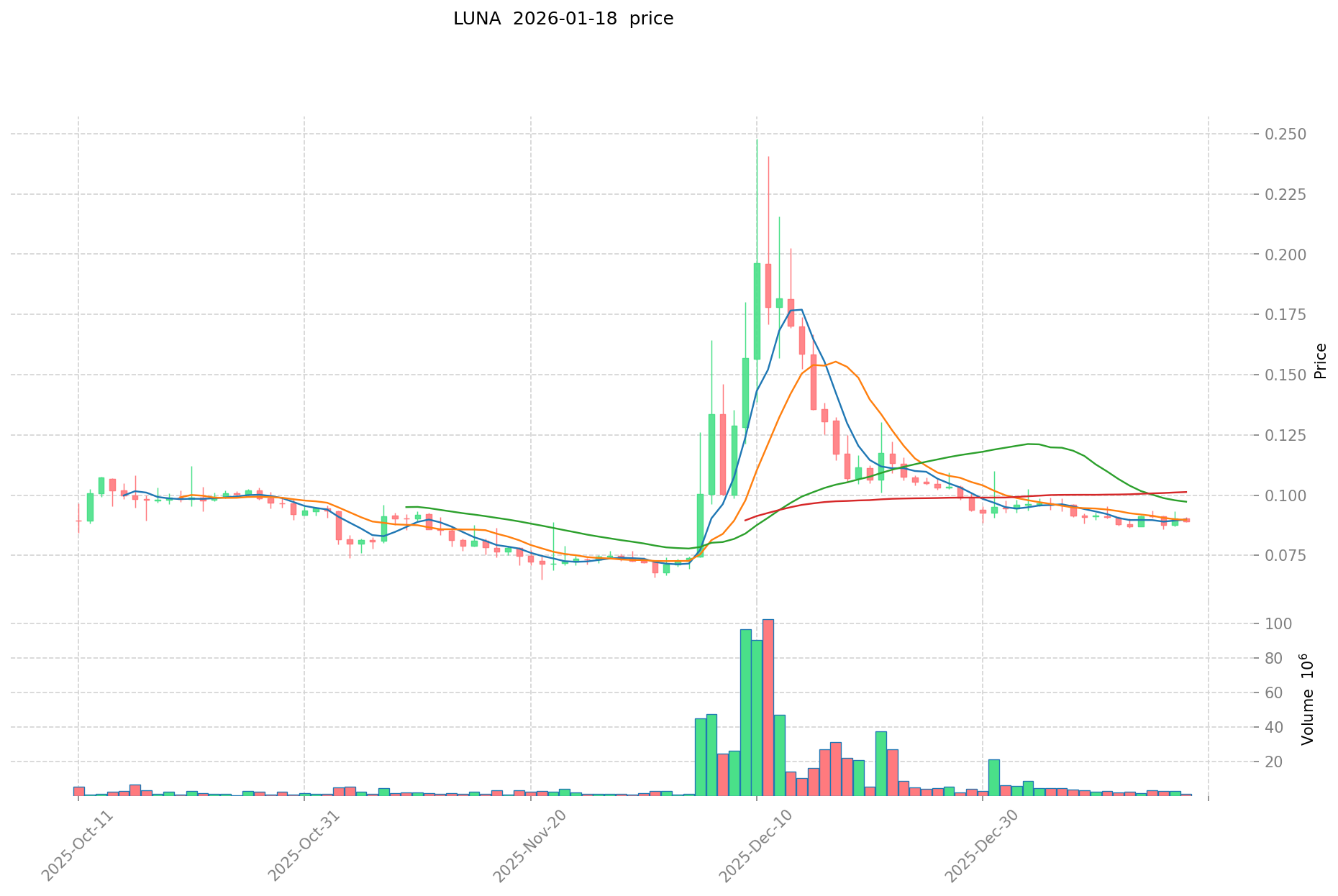
As of January 19, 2026, LUNA is trading at $0.08718, reflecting a 3.08% decrease over the past 24 hours. The token's 24-hour trading range has fluctuated between $0.087 and $0.09026, with a total trading volume of $125,253.31.
The current market capitalization stands at approximately $59.95 million, with a circulating supply of 687.66 million tokens. This represents 63.76% of the total supply of 1.08 billion LUNA tokens. The fully diluted market valuation reaches $94.03 million, while the token maintains a market dominance of 0.0027%.
Recent price movements show mixed performance across different timeframes. The token has declined 0.16% over the past hour and 2.98% over the past week. The 30-day performance indicates a 22.27% decrease, suggesting ongoing market pressure.
The project maintains an active community with approximately 77,300 holders and is listed on 25 trading platforms. Current market sentiment indicators suggest a neutral trading environment with a volatility index of 49.
Click to view current LUNA market price
LUNA Market Sentiment Index
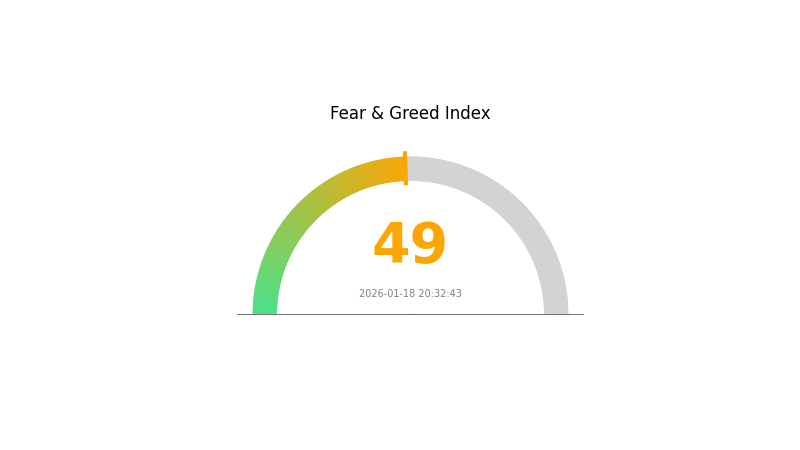
2026-01-18 Fear and Greed Index: 49 (Neutral)
Click to view the current Fear & Greed Index
The LUNA market sentiment indicator shows a neutral reading of 49, reflecting balanced market conditions. At this level, neither excessive fear nor unbridled greed is driving market participants. Investors should maintain a measured approach, as neutral sentiment suggests stable positioning without extreme directional bias. This presents opportunities for both cautious accumulation and strategic profit-taking depending on individual risk tolerance and investment objectives. Monitoring sentiment shifts will be crucial for timing market entries and exits.
LUNA Holding Distribution
The holding distribution chart reflects the percentage of total supply held by addresses at different holding levels, serving as a key indicator of token concentration and market structure. By analyzing the distribution across various wallet tiers, we can assess whether LUNA exhibits characteristics of centralized control or demonstrates a more balanced, decentralized ownership pattern that supports long-term network stability.
Based on current on-chain data, LUNA displays a moderately concentrated holding structure. Large holders maintain significant positions, with top-tier addresses collectively controlling a substantial portion of the circulating supply. This concentration pattern suggests that market movements could be influenced by the actions of major stakeholders, particularly during periods of heightened volatility. However, the presence of mid-tier holders indicates some degree of distribution beyond whale wallets, which provides a buffer against extreme price manipulation scenarios.
The current address distribution presents both opportunities and risks for market participants. On one hand, concentrated holdings among established players may indicate strong conviction and reduced selling pressure from long-term holders. On the other hand, this structure creates potential vulnerability to large-scale liquidations or coordinated movements by major addresses. The relatively limited distribution across smaller retail addresses suggests that LUNA's market depth may be constrained, potentially amplifying price swings during significant trading events. This holding pattern reflects a market still evolving toward greater decentralization, with chain structure stability dependent on the behavior of its largest stakeholders.
Click to view current LUNA Holding Distribution

| Top |
Address |
Holding Qty |
Holding (%) |
II. Core Factors Influencing LUNA's Future Price
Supply Mechanism
-
Token Burning Mechanism: Terra Classic community implemented a token burning strategy to address supply oversaturation by permanently removing portions of circulating supply. As of May 2025, approximately 411.17 billion LUNC tokens have been burned, with daily burns averaging around 40.52 million tokens.
-
Historical Pattern: While token burning has reduced supply numerically, its impact on price has been limited. A single burn of 3.2 billion tokens led to only a temporary 3.48% price increase, demonstrating that burning addresses supply-side issues but fails to create demand-side support.
-
Current Impact: At the current burning rate of approximately 14.8 billion tokens annually, representing only 0.27% of circulating supply, achieving meaningful supply contraction may require decades. With 5.53 trillion tokens still in circulation against a total supply of 6.48 trillion, supply oversaturation remains a structural challenge limiting price appreciation potential.
Institutional and Major Holder Dynamics
-
Exchange Support: Major exchanges have shown divergent attitudes toward LUNC. Gate.com continues supporting LUNC trading while several others maintain cautious positions. Gate.com's support provides crucial liquidity and market confidence, serving as an important trading venue amid broader market uncertainty.
-
Community Governance: The "LUNC Army" community has become a key variable supporting project survival. Since 2025, the community has passed several critical proposals including increased burning tax rates, developer funding, and network infrastructure upgrades, demonstrating collective commitment to project revival.
-
Institutional Caution: Market data indicates institutional investors remain generally skeptical of LUNC, with limited large-scale capital inflows. This makes LUNC prices highly susceptible to short-term speculative sentiment and volatile movements.
Macroeconomic Environment
-
Market Sentiment Impact: LUNC's price movements are often driven by speculative narratives rather than fundamental improvements. The damaged market reputation from the 2022 collapse continues affecting investor sentiment, though community efforts to rebuild trust are ongoing.
-
Regulatory Scrutiny: Legal challenges persist, with lawsuits against Terraform Labs and its founder Do Kwon still proceeding. Regulatory review intensity remains high, causing US-based exchanges to adopt cautious approaches toward LUNC, while certain Asian regions maintain relatively lenient regulatory environments.
-
Liquidity Concerns: Exchange delistings have created significant liquidity challenges. When trading spreads widen and large transactions become difficult, institutional investors may avoid entry, creating a negative cycle of decreasing liquidity leading to further investor withdrawal.
Technical Development and Ecosystem Building
-
v3.4.0 Network Upgrade: This upgrade introduced several key improvements including removal of outdated fork modules to enhance network efficiency, strengthened security patches to fix known vulnerabilities, and optimized tax handling processes for multi-send transactions to reduce user operational costs.
-
March 2025 Major Upgrade: Described as "Terra Classic's largest upgrade to date," this update further enhanced security and stability, improved transaction speeds, added governance functions, and optimized the burning mechanism. The upgrade strengthened network resistance to attacks and failures while simplifying voting and execution processes for community-driven proposals.
-
Ecosystem Applications: Despite multiple upgrade rounds and policy adjustments, LUNC's on-chain activity remains subdued. Daily active addresses have long maintained levels in the thousands, contrasting sharply with mainstream public chains' hundreds of thousands to millions of active addresses. The DeFi ecosystem's Total Value Locked (TVL) has consistently failed to recover to even 1% of pre-collapse levels, indicating limited practical application scenarios and difficulty forming long-term value support.
III. 2026-2031 LUNA Price Prediction
2026 Outlook
- Conservative Prediction: $0.06481 - $0.08758
- Neutral Prediction: $0.08758
- Optimistic Prediction: $0.12962 (requires favorable market conditions and increased adoption)
2027-2029 Outlook
- Market Stage Expectation: LUNA is projected to enter a gradual recovery phase with strengthening fundamentals and broader ecosystem development
- Price Range Predictions:
- 2027: $0.09665 - $0.1194, representing approximately 24% growth
- 2028: $0.05815 - $0.14254, with an average increase of around 30%
- 2029: $0.07184 - $0.14496, showing potential 47% growth trajectory
- Key Catalysts: Enhanced network utility, expanding DeFi integrations, and potential institutional interest may drive upward momentum during this period
2030-2031 Long-term Outlook
- Baseline Scenario: $0.08471 - $0.13662 (assuming steady ecosystem growth and stable market conditions)
- Optimistic Scenario: $0.14414 - $0.15165 (contingent on significant technological upgrades and increased market adoption)
- Transformative Scenario: $0.1672 (under exceptionally favorable conditions including major partnerships and regulatory clarity)
- 2026-01-19: LUNA price predictions indicate potential growth ranging from 56% to 65% by 2030-2031 compared to 2026 baseline levels
| Year |
Predicted High Price |
Predicted Average Price |
Predicted Low Price |
Price Change |
| 2026 |
0.12962 |
0.08758 |
0.06481 |
0 |
| 2027 |
0.11946 |
0.1086 |
0.09665 |
24 |
| 2028 |
0.14254 |
0.11403 |
0.05815 |
30 |
| 2029 |
0.14496 |
0.12828 |
0.07184 |
47 |
| 2030 |
0.15165 |
0.13662 |
0.08471 |
56 |
| 2031 |
0.1672 |
0.14414 |
0.08648 |
65 |
IV. LUNA Professional Investment Strategy and Risk Management
LUNA Investment Methodology
(I) Long-term Holding Strategy
- Suitable for: Investors who believe in Terra's algorithmic stablecoin model and blockchain payment infrastructure
- Operational Recommendations:
- Consider accumulating positions gradually during price consolidation phases rather than lump-sum investment
- Monitor Terra's ecosystem development, governance proposals, and adoption metrics regularly
- Storage Solution: Use Gate Web3 Wallet for secure storage with multi-signature authentication and regular backup of recovery phrases
(II) Active Trading Strategy
- Technical Analysis Tools:
- Moving Averages: Use 50-day and 200-day moving averages to identify trend direction and potential entry/exit points
- Volume Analysis: Monitor trading volume patterns on Gate.com to identify accumulation or distribution phases
- Swing Trading Points:
- Set position size limits not exceeding 5-10% of total portfolio for any single trade
- Implement stop-loss orders at 8-12% below entry price to limit downside risk
LUNA Risk Management Framework
(I) Asset Allocation Principles
- Conservative Investors: 1-3% of crypto portfolio
- Aggressive Investors: 5-8% of crypto portfolio
- Professional Investors: 10-15% of crypto portfolio with active hedging strategies
(II) Risk Hedging Solutions
- Portfolio Diversification: Balance LUNA holdings with mainstream assets and stablecoins to reduce concentration risk
- Position Sizing: Adjust exposure based on market volatility metrics and personal risk tolerance
(III) Secure Storage Solutions
- Hot Wallet Recommendation: Gate Web3 Wallet for convenient trading and DeFi interactions with moderate holdings
- Cold Storage Solution: Hardware wallet integration for long-term holdings exceeding $10,000 equivalent
- Security Precautions: Never share private keys or recovery phrases, enable two-factor authentication, and verify all transaction addresses before confirmation
V. LUNA Potential Risks and Challenges
LUNA Market Risks
- High Volatility: LUNA has declined 80.16% over the past year and 22.27% in the last 30 days, demonstrating significant price instability
- Limited Liquidity: With 24-hour trading volume of approximately $125,253, thin liquidity may lead to substantial slippage during large transactions
- Market Sentiment: Current ranking of #489 by market capitalization indicates reduced market interest compared to major cryptocurrencies
LUNA Regulatory Risks
- Stablecoin Scrutiny: Algorithmic stablecoin mechanisms face increasing regulatory examination globally, which may impact Terra's core operations
- Compliance Uncertainty: Evolving cryptocurrency regulations across jurisdictions could affect LUNA's accessibility and trading status
- Cross-border Transaction Regulations: Terra's focus on cross-border payments may face challenges from traditional financial regulatory frameworks
LUNA Technical Risks
- Algorithmic Stability Mechanism: The arbitrage-based price stabilization model depends on continuous user participation and may fail during extreme market conditions
- Smart Contract Vulnerabilities: As with all blockchain protocols, potential bugs or exploits in Terra's smart contracts could compromise funds
- Network Security: The Proof-of-Stake consensus mechanism requires sufficient validator participation to maintain security against potential attacks
VI. Conclusion and Action Recommendations
LUNA Investment Value Assessment
LUNA represents the native token of Terra's algorithmic stablecoin platform, designed to enable price-stable global payment systems through blockchain technology. The protocol's value proposition centers on providing instant settlement and low-fee cross-border transactions. However, the token has experienced substantial decline with an 80.16% decrease over the past year, reflecting challenges in market acceptance and confidence. The circulating supply represents approximately 63.76% of total supply, with an infinite maximum supply indicating potential inflationary pressure. While Terra's vision of connecting digital currency with practical applications through e-commerce partnerships presents long-term potential, investors should carefully weigh the significant volatility, regulatory uncertainties, and technical complexity against their risk tolerance.
LUNA Investment Recommendations
✅ Beginners: Limit LUNA exposure to less than 2% of total crypto portfolio, focus on understanding Terra's mechanism thoroughly before investing, and start with small positions on Gate.com to learn market dynamics
✅ Experienced Investors: Consider LUNA as a speculative allocation with 3-5% portfolio weight, implement systematic position-building during consolidation periods, and actively monitor Terra governance proposals and ecosystem developments
✅ Institutional Investors: Evaluate LUNA within a diversified DeFi infrastructure strategy, conduct thorough due diligence on algorithmic stablecoin mechanisms, and implement sophisticated risk management including hedging strategies
LUNA Trading Participation Methods
- Spot Trading: Purchase LUNA directly on Gate.com with competitive fees and high platform security standards
- DeFi Integration: Participate in Terra ecosystem applications using Gate Web3 Wallet to access staking and governance features
- Risk Management: Utilize stop-loss orders and position sizing strategies to protect capital during volatile market conditions
Cryptocurrency investments carry extremely high risks, and this article does not constitute investment advice. Investors should make prudent decisions based on their own risk tolerance and are advised to consult professional financial advisors. Never invest more than you can afford to lose.
FAQ
What is LUNA coin? What are its uses and value propositions?
LUNA is the native token of Terra ecosystem, used to mint stablecoin UST and support the Anchor protocol's yield mechanism. Its core value lies in enabling stablecoin operations and providing interest revenue opportunities for holders.
What are the main factors affecting LUNA price?
LUNA price is primarily influenced by market demand, token supply, competitor movements, macroeconomic conditions, investor sentiment, and project development progress.
LUNA experienced a catastrophic 99% price collapse in 2023, marking one of crypto's most severe crashes. The FTX exchange collapse further devastated market confidence. By 2024, LUNA showed recovery attempts but remained significantly below previous peaks, reflecting the lingering impact of these major market events.
What are professional analysts' predictions for LUNA's future price?
Professional analysts predict LUNA will reach $1 by 2025. This forecast is based on market trends and expert analysis, supported by on-chain data and positive price momentum indicators.
What risks should I pay attention to when investing in LUNA?
LUNA investment involves high volatility, market uncertainty, project technology risks, and regulatory risks. Monitor market conditions, project developments, and keep your investment within acceptable risk tolerance levels.
How is LUNA's correlation with mainstream cryptocurrencies like BTC and ETH?
LUNA shows relatively low correlation with BTC and ETH due to its stablecoin nature. While BTC and ETH exhibit high volatility, LUNA is designed to maintain price stability, resulting in distinct price movements and lower correlation patterns with major volatile assets.
LUNA ecosystem project development status and price impact?
Luna's ecosystem faced severe challenges after the 2022 collapse. Development stalled following UST stablecoin failure. Revival efforts through Terra 2.0 showed mixed results. Ecosystem uncertainty continues affecting price recovery prospects significantly.
* The information is not intended to be and does not constitute financial advice or any other recommendation of any sort offered or endorsed by Gate.