The article delves into the price trajectory and investment potential of Obol (OBOL) by 2025 and beyond, highlighting its role in decentralizing Ethereum's staking infrastructure. It offers an analysis of OBOL's market performance, explores technological advancements, and discusses key factors influencing future prices. Targeting investors interested in emergent infrastructure plays, it proposes strategies for both long-term holding and active trading. Key sections include a historical price review, market dynamics, and potential risks, with insights grounded in quantitative analysis. This resource serves as a concise guide for investors seeking strategic entry points in a speculative but promising technology.
Introduction: OBOL's Market Position and Investment Value
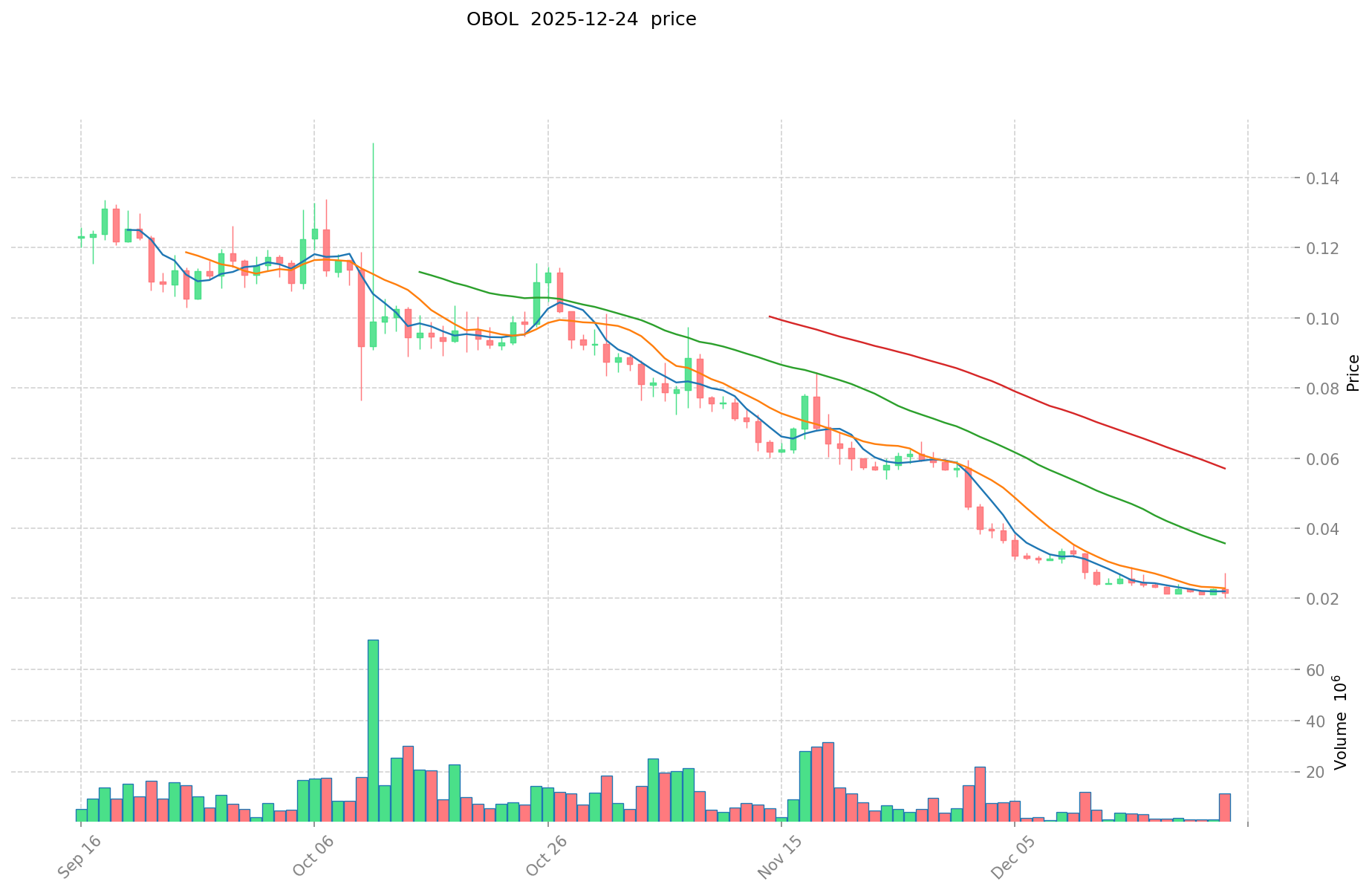
Obol (OBOL) serves as a foundational infrastructure token for decentralizing and democratizing digital systems across Web3, with a primary focus on Ethereum-based validator infrastructure. As a core component of the Obol Collective ecosystem, it powers the world's largest decentralized operator network. As of December 24, 2025, OBOL maintains a market capitalization of $3,036,124 with a circulating supply of 138,320,000 tokens, currently trading at approximately $0.02195. This innovative infrastructure asset is playing an increasingly critical role in securing over $1 billion in mainnet value through its Distributed Validator technology and modular Obol Stack framework.
This article will comprehensively analyze OBOL's price trajectory through 2030, integrating historical price patterns, market supply-demand dynamics, ecosystem development milestones, and macroeconomic factors to provide investors with professional price forecasts and actionable investment strategies grounded in quantitative analysis and protocol fundamentals.
OBOL Price Analysis Report
I. OBOL Price History Review and Market Status
OBOL Historical Price Evolution
- May 7, 2025: OBOL reached its all-time high (ATH) of $0.4211, marking a significant peak in the token's trading history.
- December 24, 2025: OBOL hit its all-time low (ATL) of $0.01973, representing a dramatic 95.31% decline from the ATH over a seven-month period.
OBOL Current Market Dynamics
As of December 24, 2025, OBOL is trading at $0.02195, reflecting a 24-hour decline of -5.32%. The token exhibits the following market characteristics:
Price Performance Across Multiple Timeframes:
- 1-hour change: +0.19%
- 24-hour change: -5.32%
- 7-day change: -9.24%
- 30-day change: -61.46%
- 1-year change: -94.90%
Market Capitalization Metrics:
- Current market cap: $3,036,124
- Fully diluted valuation (FDV): $10,975,000
- 24-hour trading volume: $385,686.59
- Market dominance: 0.00034%
Supply Information:
- Circulating supply: 138,320,000 OBOL
- Total supply: 500,000,000 OBOL
- Circulating supply ratio: 19.25% of total supply
- Token holders: 5,958
Trading Range (24-hour):
- High: $0.02722
- Low: $0.01973
Market Sentiment:
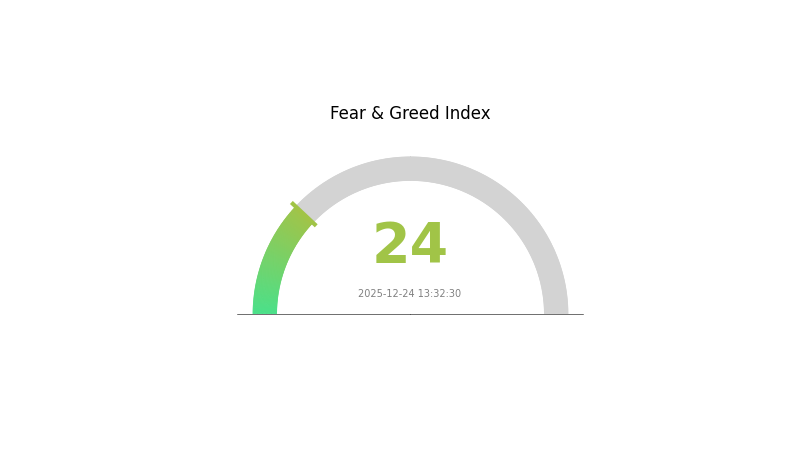
The current market environment is characterized by "Extreme Fear" (VIX: 24), indicating heightened market anxiety and risk aversion among investors.
Click to view current OBOL market price
OBOL Market Sentiment Indicator
2025-12-24 Fear and Greed Index: 24 (Extreme Fear)
Click to view current Fear & Greed Index
The crypto market is currently experiencing extreme fear, with the Fear and Greed Index standing at 24. This represents a significant risk-off sentiment among investors, indicating widespread pessimism and cautious market positioning. During such periods of extreme fear, opportunities often emerge for long-term investors. However, traders should remain vigilant and implement proper risk management strategies. Monitor market developments closely on Gate.com to identify potential entry points while protecting your portfolio from further downside risks.
OBOL Holdings Distribution
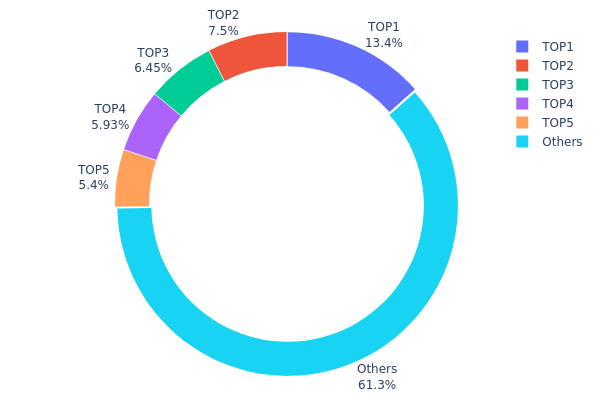
The address holdings distribution map illustrates the concentration of OBOL tokens across the top wallet addresses on the blockchain. This metric reveals the degree of token centralization, with each address's proportional share indicating potential influence over token supply and market dynamics.
OBOL's current holdings distribution exhibits moderate concentration characteristics. The top five addresses collectively hold approximately 38.7% of the total token supply, with the largest holder commanding 13.43% and the remaining addresses accounting for 61.3%. While the top holder's position is significant, the gradual decline in holdings across the top five addresses suggests a relatively distributed ownership structure compared to heavily centralized tokens. The concentration ratio indicates that OBOL maintains a balanced decentralization profile, with no single entity possessing overwhelming dominance.
This distribution pattern presents a generally favorable market structure. The presence of substantial token concentration among the top five addresses could theoretically facilitate coordinated price movements if these holders act in concert; however, the majority stake held by "Others" (61.3%) provides a significant counterbalance and market resilience against potential manipulation attempts. The diversified ownership across multiple addresses reduces systemic risk and suggests healthy token circulation mechanisms. Overall, OBOL's holdings distribution reflects a reasonably decentralized on-chain structure that supports market stability while preserving adequate liquidity dynamics.
Click to view the current OBOL Holdings Distribution
| Top |
Address |
Holding Qty |
Holding (%) |
| 1 |
0xaefd...fef5fb |
67186.76K |
13.43% |
| 2 |
0x42d2...c1fa72 |
37507.19K |
7.50% |
| 3 |
0x872a...6eb205 |
32255.03K |
6.45% |
| 4 |
0xdc8a...e4c374 |
29637.31K |
5.92% |
| 5 |
0x1986...f5d227 |
27001.73K |
5.40% |
| - |
Others |
306411.98K |
61.3% |
II. Core Factors Influencing OBOL's Future Price
Technology Development and Ecosystem Construction
-
Distributed Validator Technology (DVT) Implementation: DVT represents the core innovation that will fundamentally transform Ethereum's staking ecosystem. This technology enables more efficient staking performance and improved Liquid Staking Derivative (LSD) efficiency, fostering a more decentralized environment. Obol Network serves as the staking infrastructure coordination layer utilizing DVT, positioning itself as a foundational protocol for distributed validator deployment.
-
Mainnet Expansion Strategy: Obol Network is currently in the Alpha Launch phase of its roadmap, working with a group of launch partners who have already deployed initial decentralized validators on mainnet. Beyond Ethereum, Obol plans to explore scaling solutions on Ethereum L2s and Cosmos, demonstrating belief that DVT can make significant contributions to other Proof-of-Stake ecosystems, with Cosmos at the forefront.
-
Ecosystem Integration and Partnerships: Obol has successfully demonstrated DVT configuration capabilities through pilot projects with major liquid staking platforms including Stakewise, Rocket Pool, and Lido. These integrations showcase how DVT technology can be seamlessly integrated into existing liquid staking models, expanding Obol's utility across the staking infrastructure landscape.
Institutional and Major Holder Dynamics
-
Institutional Investment: Obol Network has attracted substantial investment from Pantera Capital and Archetype, which co-led the Series A funding round, raising $12.5 million. This institutional backing demonstrates confidence in the project's long-term potential and technological viability.
-
Risk Mitigation and Safety Focus: The protocol attracts diverse stakeholders who benefit from DVT's capabilities. Liquid staking pools can reduce risk by distributing stakes across multiple operators. Individual stakers can protect against internet outages or power disruptions, thereby reducing slashing risks. Institutional staking products also find value in DVT through reduced operational and hardware costs, appealing particularly to risk-averse validators prioritizing security.
Three, 2025-2030 OBOL Price Forecast
2025 Outlook
- Conservative Forecast: $0.01899 - $0.02134
- Neutral Forecast: $0.02134
- Optimistic Forecast: $0.02689 (requires sustained market sentiment and positive ecosystem developments)
2026-2027 Medium-term Outlook
- Market Stage Expectation: Transition phase with gradual recovery and consolidation, characterized by increasing institutional adoption and protocol maturation
- Price Range Prediction:
- 2026: $0.01977 - $0.03135
- 2027: $0.01969 - $0.03189
- Key Catalysts: Enhanced protocol functionality, expanding validator participation, network utility improvements, and broader cryptocurrency market recovery
2028-2030 Long-term Outlook
- Base Case: $0.02015 - $0.03752 (assuming steady adoption of staking infrastructure and gradual market expansion)
- Optimistic Case: $0.03279 - $0.03819 (assuming accelerated institutional adoption and significant ecosystem growth)
- Transformational Case: $0.03819+ (contingent on OBOL becoming integral to Ethereum staking infrastructure and achieving mainstream recognition among institutional players)
- 2030-12-31: OBOL reaching $0.03752 as average price stabilizes at $0.03474 (market maturation phase with 58% potential gains from current levels)
| 年份 |
预测最高价 |
预测平均价格 |
预测最低价 |
涨跌幅 |
| 2025 |
0.02689 |
0.02134 |
0.01899 |
-2 |
| 2026 |
0.03135 |
0.02411 |
0.01977 |
9 |
| 2027 |
0.03189 |
0.02773 |
0.01969 |
26 |
| 2028 |
0.03279 |
0.02981 |
0.01759 |
35 |
| 2029 |
0.03819 |
0.0313 |
0.02035 |
42 |
| 2030 |
0.03752 |
0.03474 |
0.02015 |
58 |
OBOL Investment Strategy and Risk Management Report
IV. OBOL Professional Investment Strategy and Risk Management
OBOL Investment Methodology
(1) Long-term Holding Strategy
- Target Investors: Infrastructure believers and Ethereum ecosystem participants who prioritize stability and protocol-level value creation
- Operational Recommendations:
- Accumulate during market downturns when OBOL trades significantly below all-time high prices, leveraging dollar-cost averaging to reduce entry risk
- Hold through complete validator cycles to capture compounding rewards from the Obol Distributed Validator ecosystem
- Maintain a 2-3 year investment horizon to benefit from potential adoption growth across L1s, L2s, DePIN, and AVS infrastructure expansion
(2) Active Trading Strategy
- Technical Analysis Tools:
- Support and Resistance Levels: Monitor key price points at $0.4211 (all-time high) and $0.01973 (current all-time low) to identify potential breakout or breakdown scenarios
- Moving Averages: Track 50-day and 200-day moving averages to confirm medium-term trend direction and identify optimal entry/exit windows
- Wave Trading Key Points:
- Execute counter-trend trades during the 7-day consolidation phases when volatility contracts, targeting 5-10% gains per wave
- Apply risk/reward ratios of 1:2 minimum per trade, with strict stop-losses set 3-5% below entry positions
OBOL Risk Management Framework
(1) Asset Allocation Principles
- Conservative Investors: 1-3% portfolio allocation to OBOL and emerging infrastructure tokens
- Active Investors: 3-7% portfolio allocation with periodic rebalancing
- Professional Investors: 5-15% allocation with hedging strategies and derivatives overlay
(2) Risk Mitigation Strategies
- Portfolio Diversification: Balance OBOL holdings with established Layer 1 assets and stablecoins to reduce concentrated exposure to emerging infrastructure protocols
- Position Sizing: Never allocate more than 5% of total portfolio to any single emerging token; scale entries gradually over 4-8 weeks
(3) Secure Storage Solutions
- Hardware Security: For holdings exceeding $10,000 USD equivalent, utilize cold storage solutions with multi-signature protocols
- Exchange Storage: For active trading positions, utilize Gate.com's institutional-grade security infrastructure with withdrawal whitelisting enabled
- Security Best Practices: Enable two-factor authentication (2FA) on all exchange accounts, maintain separate withdrawal addresses, and regularly audit wallet activities
V. OBOL Potential Risks and Challenges
Market Risk Factors
- Extreme Volatility: OBOL has declined 94.90% year-over-year, indicating severe price instability and potential for further drawdowns in unfavorable market conditions
- Low Trading Liquidity: With 24-hour volume of $385,686 and market capitalization of only $3.04 million, OBOL exhibits limited liquidity that could result in significant slippage during large trades
- Validator Network Concentration: Despite claims of 800+ operators, the decentralized validator ecosystem may face concentration risks if key operators control disproportionate validator shares
Regulatory Risk Factors
- Staking Protocol Classification: Regulatory authorities may reclassify distributed validator protocols as unregistered securities or investment products, triggering compliance obligations
- Ethereum Protocol Changes: Future Ethereum upgrades or modifications to consensus mechanisms could fundamentally alter the validator economics underlying OBOL's value proposition
- International Compliance: Operating across multiple jurisdictions exposes OBOL to fragmented regulatory frameworks that could restrict token utility or operator participation
Technical Risk Factors
- Distributed System Complexity: Managing 800+ operators requires sophisticated consensus mechanisms; any critical vulnerability could compromise $1B+ in secured assets
- Smart Contract Vulnerabilities: As an ERC-20 token deployed on Ethereum, undetected bugs in the Obol Stack framework could enable token theft or validator slashing events
- Protocol Adoption Risk: The success of OBOL depends on mainstream adoption of distributed validators; continued preference for traditional staking infrastructure could limit growth
VI. Conclusion and Action Recommendations
OBOL Investment Value Assessment
OBOL presents a speculative infrastructure play targeting the emerging decentralized validator and modular blockchain ecosystem. The protocol's positioning across L1s, L2s, DePIN, and AVS markets offers genuine long-term utility potential, with 800+ active operators demonstrating early traction. However, the 94.90% year-over-year decline, low market liquidity, and unproven mass-market adoption create substantial near-term risks. Current valuations near all-time lows may represent accumulation opportunities for conviction investors with high risk tolerance, but significant downside remains possible before stabilization occurs.
OBOL Investment Recommendations
✅ Beginners: Start with micro-positions (0.5-1% of trading capital) exclusively on Gate.com with stop-losses set at -20% below entry; prioritize learning about distributed validator mechanics before scaling
✅ Experienced Investors: Implement 3-5% portfolio allocations with staged accumulation during 10-15% price dips; combine with Ethereum staking positions for correlated infrastructure exposure
✅ Institutional Investors: Conduct deep protocol due diligence with validator operator interviews; consider 5-10% allocations only after validating operator network quality and technical security audits
OBOL Trading Participation Methods
- Direct Token Trading: Purchase OBOL directly on Gate.com via spot markets using ETH or stablecoin pairs; verify ERC-20 contract address (0x0b010000b7624eb9b3dfbc279673c76e9d29d5f7) before transactions
- Validator Participation: Contribute capital to Obol Distributed Validator pools to earn native staking rewards while supporting the decentralized operator ecosystem
- Dollar-Cost Averaging: Execute 4-8 weekly purchases of equal OBOL amounts to systematically reduce timing risk during prolonged market downturns
Cryptocurrency investments carry extreme risk. This report does not constitute investment advice. Investors must make decisions based on individual risk tolerance and should consult professional financial advisors. Never invest capital you cannot afford to lose completely.
FAQ
How much is OBOL token worth?
OBOL token worth is determined by real-time market conditions and trading activity. As of December 2025, OBOL maintains a market capitalization of approximately $2.8K, with its value fluctuating based on market demand and supply dynamics in the crypto market.
How much is an OBOL worth today?
OBOL is currently trading at $0.02152 as of December 24, 2025, with a 24-hour trading volume of $2.41M. The token has gained 1.32% in the last 24 hours and is down 20.45% from its 7-day peak.
What is OBOL token and what is its use case?
OBOL is the governance token for Obol Collective, enabling community voting and management of the decentralized operator network in Web3 infrastructure. It facilitates protocol decisions and network participation.
What factors affect OBOL price prediction?
OBOL price is primarily driven by supply and demand dynamics, protocol updates, and network activity. Market sentiment, trading volume, and broader cryptocurrency trends also significantly influence price movements.
Is OBOL a good investment in 2025?
Yes, OBOL shows strong potential as a 2025 investment. With increasing adoption in distributed validator networks and growing institutional interest, OBOL demonstrates solid fundamentals. Market analysts project continued growth trajectory, making it an attractive opportunity for long-term crypto investors.
* The information is not intended to be and does not constitute financial advice or any other recommendation of any sort offered or endorsed by Gate.