This article provides an expert analysis of the OBT price prediction for 2025, examining Orbiter Finance's position as a ZK-technology protocol in the multi-chain era. Key insights include historical price patterns, current market dynamics, ecosystem development, and macroeconomic factors influencing OBT's potential growth. Intended for investors and enthusiasts interested in cross-chain interoperability solutions, it offers forecast scenarios, investment strategies, and risk assessments to inform trading decisions. Emphasizing practical insights, the piece serves as a guide through OBT's complexities and growth opportunities.
Introduction: Market Position and Investment Value of OBT
Orbiter Finance (OBT) is a ZK-technology-based interoperability protocol designed to enhance blockchain interaction security, enable seamless cross-chain operability, and reduce liquidity fragmentation through innovative solutions such as universal cross-chain protocols and Omni Account Abstraction. As of December 22, 2025, OBT has achieved a market capitalization of approximately $10.48 million with a circulating supply of 5 billion tokens, currently trading at $0.002096. This asset, positioned as a multi-chain Web3 infrastructure solution, is increasingly playing a critical role in redefining the user experience in the multi-chain era.
This article will provide a comprehensive analysis of OBT's price trends through 2030, integrating historical patterns, market supply-demand dynamics, ecosystem development, and macroeconomic factors to deliver professional price forecasts and practical investment strategies for investors seeking exposure to cross-chain interoperability solutions.
I. OBT Price History Review and Market Status
OBT Historical Price Evolution Trajectory
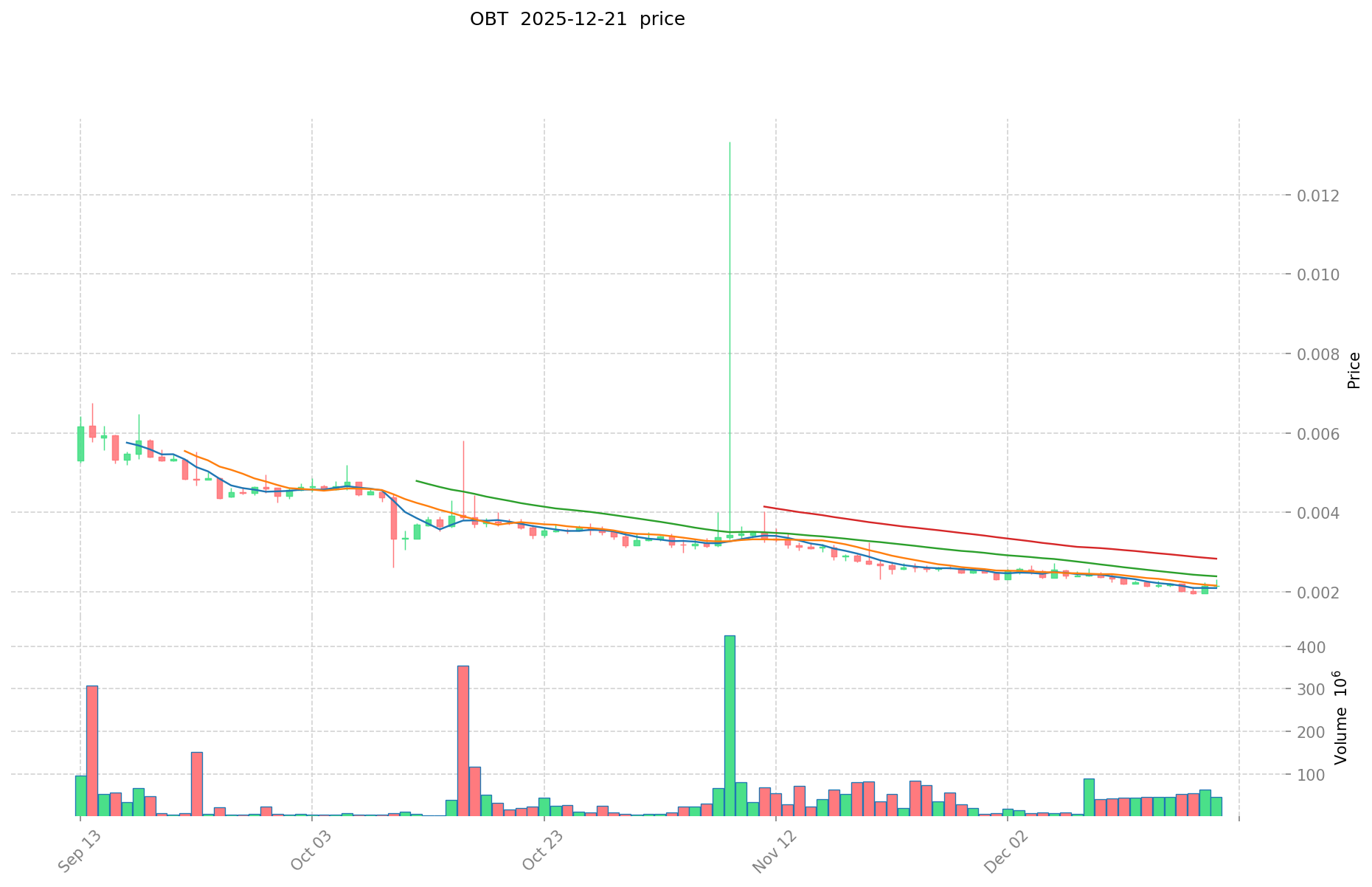
- March 2025: OBT reached its all-time high of $0.0335 on March 14, 2025, marking the peak of the token's price performance during its early trading period.
- December 2025: OBT experienced significant depreciation, reaching its all-time low of $0.001936 on December 18, 2025, representing an 85.79% decline from its annual peak.
OBT Current Market Dynamics
As of December 22, 2025, OBT is trading at $0.002096 with a 24-hour trading volume of $100,089.12. The token has experienced a 2.1% price decline over the past 24 hours, moving between a daily low of $0.002085 and a daily high of $0.002213. Over the 7-day period, OBT has declined 4.16%, while the 30-day performance shows a steeper contraction of 19.68%.
The fully diluted market capitalization stands at $20,960,000, with a circulating supply of 5 billion OBT tokens out of a total supply of 10 billion tokens. The token maintains a market dominance of 0.0065%, ranking 1,144th by market capitalization. With 77,193 token holders and presence on 10 cryptocurrency exchanges, OBT maintains moderate liquidity and distribution across the market ecosystem.
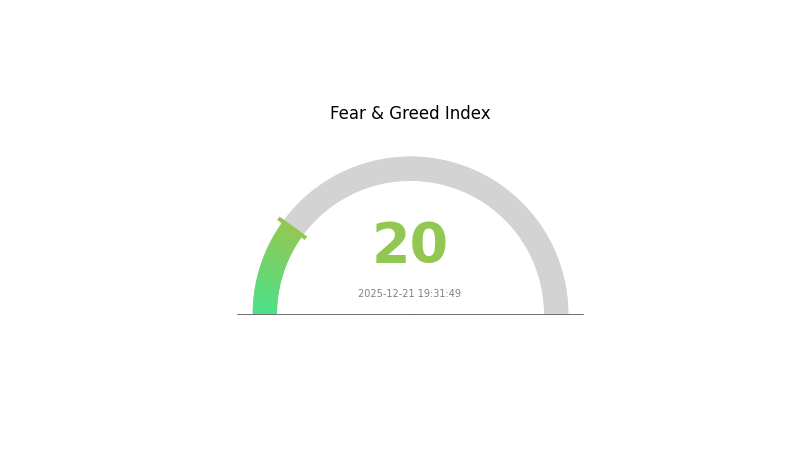
The current market sentiment reflects extreme fear, with a VIX reading of 20 as of December 21, 2025, indicating heightened volatility and risk aversion in the broader cryptocurrency market environment.
Click to view current OBT market price
OBT Market Sentiment Indicator
2025-12-21 Fear and Greed Index: 20 (Extreme Fear)
Click to view current Fear & Greed Index
The cryptocurrency market is experiencing extreme fear, with the Fear and Greed Index dropping to 20. This indicates severe market pessimism and heightened investor anxiety. During such periods, market volatility typically increases, and risk-averse traders often reduce their positions. However, contrarian investors view extreme fear as potential buying opportunities, as markets historically tend to recover from such lows. Traders should exercise caution, conduct thorough research, and avoid making impulsive decisions driven by emotions. On Gate.com, you can track real-time market sentiment indicators to make more informed trading decisions.
OBT Holding Distribution
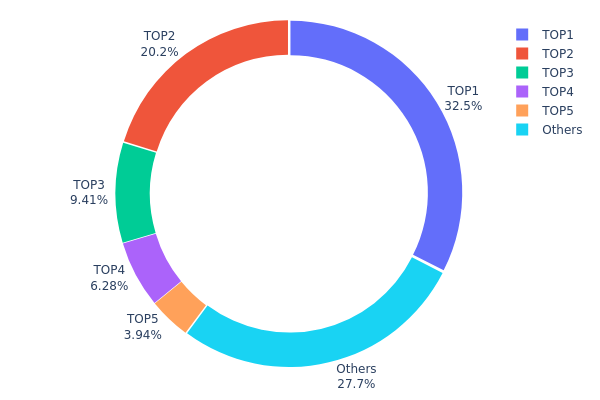
The address holding distribution chart illustrates the concentration of OBT tokens across the blockchain network by displaying the percentage of total supply held by individual addresses. This metric serves as a critical indicator for assessing token decentralization, market structure stability, and potential systemic risks associated with whale concentration.
The current distribution of OBT exhibits pronounced concentration characteristics. The top five addresses collectively control approximately 72.29% of the circulating supply, with the leading address alone commanding 32.47% of holdings. The top two addresses account for 52.69% of total tokens, indicating substantial wealth concentration at the apex of the distribution hierarchy. This level of concentration suggests that a limited number of stakeholders possess significant influence over the token's market dynamics and potential governance outcomes.
The remaining supply distribution demonstrates moderate fragmentation, with the "Others" category representing 27.71% of holdings distributed across numerous addresses. While this dispersed segment provides some degree of decentralization, it is insufficient to counterbalance the dominant position of the top holders. The concentration pattern observed in OBT's distribution raises considerations regarding price volatility risk, as large holders possess considerable capacity to influence market conditions through their trading activities. Furthermore, the structural imbalance between concentrated and dispersed holdings suggests that market movements may be disproportionately influenced by decisions made by a small cohort of major stakeholders.
View the current OBT Holding Distribution
| Top |
Address |
Holding Qty |
Holding (%) |
| 1 |
0x40b8...8bef9a |
791432.30K |
32.47% |
| 2 |
0xd823...b01dfb |
492868.63K |
20.22% |
| 3 |
0xc882...84f071 |
229301.67K |
9.40% |
| 4 |
0x1443...96847c |
153014.72K |
6.27% |
| 5 |
0x13df...7e4679 |
95986.07K |
3.93% |
| - |
Others |
674774.07K |
27.71% |
II. Core Factors Affecting OBT's Future Price
Supply Mechanism
-
Halving Mechanism: OBT undergoes a halving event every four years, which reduces the rate of new token supply entering the market. This deflationary mechanism is designed to create scarcity and potentially support long-term price appreciation.
-
Token Scarcity: The total supply of OBT is capped at 10 billion tokens, establishing a fixed maximum supply that contributes to the token's scarcity value proposition.
Institutional and Whale Dynamics
- Institutional Investment Trends: OBT's investment potential is influenced by growing institutional participation and investment interest in the cross-chain protocol space.
Macroeconomic Environment
-
Market Volatility: The blockchain market exhibits high volatility, which directly impacts OBT's price fluctuations. During periods of market instability, users may reduce cross-chain transactions, affecting demand for the token and investment decisions.
-
Regulatory Changes: Shifts in regulatory frameworks across different jurisdictions can significantly influence OBT's price trajectory and market adoption.
-
Overall Market Sentiment: Broader cryptocurrency market sentiment and investor confidence play crucial roles in determining OBT's price movements.
Technology Development and Ecosystem Building
-
Cross-Chain Protocol Enhancement: Advancements in Orbiter Finance's cross-chain bridge technology improve interoperability and expand the use cases for OBT within the broader blockchain ecosystem.
-
Ecosystem Application Expansion: Growth in related DApps and ecosystem projects built on or integrated with Orbiter Finance has the potential to enhance the utility and demand for OBT tokens.
III. 2025-2030 OBT Price Forecast
2025 Outlook
- Conservative Forecast: $0.0014 - $0.0020
- Neutral Forecast: $0.0020 - $0.0026
- Optimistic Forecast: $0.0026 (contingent on positive market sentiment and increased adoption)
2026-2028 Medium-term Outlook
- Market Stage Expectations: The market is anticipated to enter a consolidation and gradual recovery phase, with incremental growth driven by ecosystem development and increased utility adoption.
- Price Range Forecasts:
- 2026: $0.00157 - $0.00241 (11% potential upside)
- 2027: $0.00224 - $0.00347 (13% potential upside)
- 2028: $0.00167 - $0.00316 (39% potential upside)
- Key Catalysts: Protocol upgrades, partnership announcements, increased institutional interest, and broader market recovery cycles.
2029-2030 Long-term Outlook
- Base Case: $0.00292 - $0.00353 (45% potential upside by 2029), with progression toward $0.00224 - $0.00414 (56% potential upside by 2030) under sustained market conditions.
- Optimistic Case: $0.00414 (60% cumulative growth by 2030) assuming strong ecosystem adoption, successful product launches, and favorable macroeconomic conditions.
- Transformational Case: Higher price trajectories achievable under extreme favorable conditions including mainstream institutional adoption, significant regulatory clarity, and breakthrough technological developments.
Note: Price forecasts reflect technical analysis and market data available through December 22, 2025. Investors are advised to conduct independent research and exercise caution when trading OBT on platforms such as Gate.com.
| 年份 |
预测最高价 |
预测平均价格 |
预测最低价 |
涨跌幅 |
| 2025 |
0.0026 |
0.00209 |
0.0014 |
0 |
| 2026 |
0.00241 |
0.00234 |
0.00157 |
11 |
| 2027 |
0.00347 |
0.00238 |
0.00224 |
13 |
| 2028 |
0.00316 |
0.00293 |
0.00167 |
39 |
| 2029 |
0.00353 |
0.00304 |
0.00292 |
45 |
| 2030 |
0.00414 |
0.00329 |
0.00224 |
56 |
Orbiter Finance (OBT) Professional Investment Strategy and Risk Management Report
IV. OBT Professional Investment Strategy and Risk Management
OBT Investment Methodology
(1) Long-term Holding Strategy
-
Target Investors: Long-term believers in cross-chain infrastructure, developers interested in ZK-based interoperability protocols, and investors with high risk tolerance for emerging Web3 solutions.
-
Operational Recommendations:
- Establish positions during market consolidation phases when volatility stabilizes, focusing on dollar-cost averaging over 3-6 month periods to mitigate timing risk.
- Maintain a disciplined rebalancing schedule quarterly to adjust exposure based on project development milestones and ecosystem adoption metrics.
- Store OBT tokens securely in institutional-grade custody solutions with multi-signature verification protocols to ensure long-term asset safety.
(2) Active Trading Strategy
OBT Risk Management Framework
(1) Asset Allocation Principles
- Conservative Investors: 1-3% of total crypto portfolio allocation, with maximum allocation limited to funds that can withstand complete loss without affecting financial stability.
- Active Investors: 3-8% of total crypto portfolio allocation, allowing for tactical position adjustments based on technical indicators and project development announcements.
- Professional Investors: 5-15% of total crypto portfolio allocation, with sophisticated hedging strategies and correlation analysis against broader market movements.
(2) Risk Hedging Solutions
- Volatility Insurance Strategies: Implement put options on correlated assets or maintain stablecoin reserves to execute countercyclical purchases during severe drawdown periods, protecting portfolio value during market stress.
- Diversification Across Protocol Layers: Balance OBT exposure with positions in complementary interoperability solutions and layer-2 protocols to reduce concentration risk from single-protocol failure scenarios.
(3) Secure Storage Solutions
- Non-Custodial wallet Management: Self-custody through secure wallet implementations with hardware-level security ensures complete asset control; maintain offline backup copies of private keys in geographically distributed, physically secured locations.
- Exchange-Based Storage for Active Trading: Utilize Gate.com's institutional-grade security infrastructure for active trading positions, leveraging their multi-layer cold storage and insurance protection mechanisms.
- Security Considerations: Enable two-factor authentication on all exchange and wallet platforms, implement withdrawal whitelisting to prevent unauthorized transfers, regularly audit transaction histories for unauthorized activity, and never share private keys or seed phrases with any third parties.
V. OBT Potential Risks and Challenges
OBT Market Risk
-
Liquidity Risk: With 24-hour trading volume of approximately $100,089 against a market capitalization of $10.48 million, the token exhibits relatively constrained liquidity that may result in significant slippage during large-volume transactions and higher price volatility during market stress periods.
-
Price Volatility: Historical data reveals extreme price volatility, including a -85.79% decline over 12 months from $0.02 at launch, coupled with significant 30-day (-19.68%) and 7-day (-4.16%) drawdowns, indicating high susceptibility to both market-wide corrections and project-specific negative developments.
-
Market Adoption Risk: As an early-stage infrastructure protocol, Orbiter Finance faces execution risk in achieving meaningful ecosystem adoption; failure to establish compelling use cases for cross-chain transactions could result in continued token devaluation and limited liquidity growth.
OBT Regulatory Risk
-
Cross-Border Regulation Uncertainty: Multi-chain protocols operating across multiple blockchain ecosystems face ambiguous regulatory treatment across jurisdictions, creating potential compliance challenges that could restrict operational scope or require significant protocol modifications.
-
Classification Ambiguity: Regulatory uncertainty regarding whether infrastructure tokens constitute securities, utilities, or commodities varies significantly across major markets, potentially creating unexpected compliance burdens or trading restrictions for users in specific jurisdictions.
OBT Technology Risk
-
ZK Protocol Complexity: Zero-knowledge technology implementations carry inherent risks of mathematical vulnerabilities or implementation flaws that could compromise security guarantees; protocol audits should be reviewed carefully before significant capital deployment.
-
Smart Contract Risk: As a protocol relying on complex smart contract interactions, Orbiter Finance faces potential vulnerabilities in cross-chain communication bridges or the Account Abstraction layer that could lead to fund loss or protocol disruption.
-
Cross-Chain Bridge Risk: Multi-chain protocols inherently depend on bridge security across different blockchain ecosystems; vulnerabilities in any component bridge could create systemic risks affecting the entire protocol's security posture.
VI. Conclusion and Action Recommendations
OBT Investment Value Assessment
Orbiter Finance represents an early-stage infrastructure play focused on solving cross-chain interoperability through ZK technology and Omni Account Abstraction. The project addresses genuine pain points in multi-chain Web3 experiences, particularly around liquidity fragmentation and seamless asset transfers. However, the token exhibits significant execution risk, extreme price volatility (-85.79% annually), and the early-stage nature of the protocol. Current valuation reflects substantial downward pressure, creating speculative opportunities for risk-tolerant investors while presenting considerable challenges for conservative capital preservation strategies. Long-term value creation depends critically on ecosystem adoption, successful protocol security audit completion, and establishment of meaningful cross-chain transaction volume.
OBT Investment Recommendations
✅ Newcomers: Begin with minimal position sizes (0.5-1% of crypto allocation) exclusively with funds you can afford to lose completely. Use this position primarily as an educational vehicle to understand cross-chain infrastructure mechanics rather than as primary return generation strategy. Consider increasing exposure only after demonstrating comfort with protocol architecture and monitoring project development milestones over 6+ months.
✅ Experienced Investors: Implement tactical wave-trading strategies during high-volatility periods, establishing scaled entry positions near identified support levels ($0.001936 represents recent absolute low). Maintain maximum allocation between 3-8% of total crypto portfolio, with disciplined rebalancing quarterly based on technical indicators and protocol development progress. Use technical analysis tools systematically to identify favorable risk-reward entry opportunities while maintaining strict stop-loss discipline.
✅ Institutional Investors: Evaluate OBT as a small-allocation thesis within broader cross-chain infrastructure exposure strategies, focusing on portfolio diversification rather than concentration bets. Conduct comprehensive due diligence on protocol security audits, team credibility, and ecosystem partnership development before commitment. Consider establishing positions through Gate.com's institutional services with appropriate custody and compliance frameworks tailored to your regulatory environment.
OBT Trading Participation Methods
-
Direct Exchange Trading on Gate.com: Execute spot trading through Gate.com's professional trading interface, leveraging real-time price data, advanced charting tools, and institutional-grade liquidity pools; Gate.com provides access to OBT with multiple trading pairs including stablecoin routes for streamlined transactions.
-
Dollar-Cost Averaging (DCA) Programs: Implement automated regular purchase schedules over extended timeframes to reduce timing risk and average entry prices, particularly effective for long-term conviction positions designed to weather short-term volatility.
-
Limit Order Strategies: Place limit orders at predetermined price levels identified through technical analysis to execute trades at optimal risk-reward ratios without requiring constant market monitoring, enabling disciplined position accumulation during consolidation phases.
Cryptocurrency investments carry extreme risk. This report does not constitute investment advice. Investors should make decisions carefully according to their individual risk tolerance and should consult professional financial advisors. Never invest more than you can afford to lose completely.
FAQ
Is OBT crypto a good investment?
OBT crypto shows strong growth potential based on technical analysis. With increasing market adoption and positive momentum, it presents attractive opportunities for investors seeking exposure to emerging digital assets.
What is OBT token and what is its use case?
OBT is Oobit's native token on Ethereum blockchain. It powers ecosystem transactions and governance, enabling holders to participate in platform decision-making and ecosystem activities.
What is the current price of OBT and what are the price predictions for 2025?
OBT's current price fluctuates daily in the market. Based on 2025 predictions, OBT is expected to range between $0.001446 and $0.03698, depending on market conditions and adoption trends.
What are the risks and advantages of investing in OBT?
OBT offers growth potential and dividend returns as key advantages. Risks include market volatility and potential capital loss. Success depends on thorough market research and timing.
How does OBT compare to other similar cryptocurrency projects?
OBT currently underperforms relative to similar Ethereum ecosystem projects, which have gained 12.70% recently. As of 2025-12-21, OBT is down -1.00%, indicating it trails comparable projects in market performance and momentum.
* The information is not intended to be and does not constitute financial advice or any other recommendation of any sort offered or endorsed by Gate.