Explore the 2025 outlook for PSTAKE with expert analysis on market trends, price forecasts, and investment strategies. pSTAKE Finance offers liquidity solutions for staked assets, addressing investor needs for yield optimization and capital efficiency across blockchain ecosystems. The article delves into historical price movements, current market sentiment, and potential growth drivers, equipping investors with actionable insights. Whether you are a beginner or an experienced trader, this report highlights key opportunities and risks, guiding strategic decision-making. Stay informed on market dynamics with Gate's comprehensive platform data.
Introduction: Market Position and Investment Value of PSTAKE
pSTAKE Finance (PSTAKE) is a liquid staking protocol for proof-of-stake (PoS) assets that unlocks the true potential of staked PoS assets such as ATOM. Since its launch, pSTAKE has enabled staking asset holders to earn rewards while maintaining asset liquidity. As of December 2025, PSTAKE has achieved a market capitalization of $1,364,500, with a circulating supply of 500 million tokens and a price trading around $0.002729. This innovative protocol utilizes custom bridges to facilitate Cosmos ecosystem growth while enhancing liquidity and composability for Ethereum ecosystem assets.
This comprehensive analysis will examine PSTAKE's price trajectory and market dynamics, integrating historical patterns, market supply and demand dynamics, ecosystem development, and macroeconomic factors to provide investors with professional price forecasts and actionable investment strategies for the coming years.
pSTAKE Finance (PSTAKE) Market Analysis Report
I. PSTAKE Price History Review and Current Market Status
PSTAKE Historical Price Evolution Trajectory
- 2022: Project launch and early market expansion, reached all-time high of $1.21 on March 7, 2022
- 2022-2025: Extended bear market period, experiencing significant depreciation as market conditions deteriorated
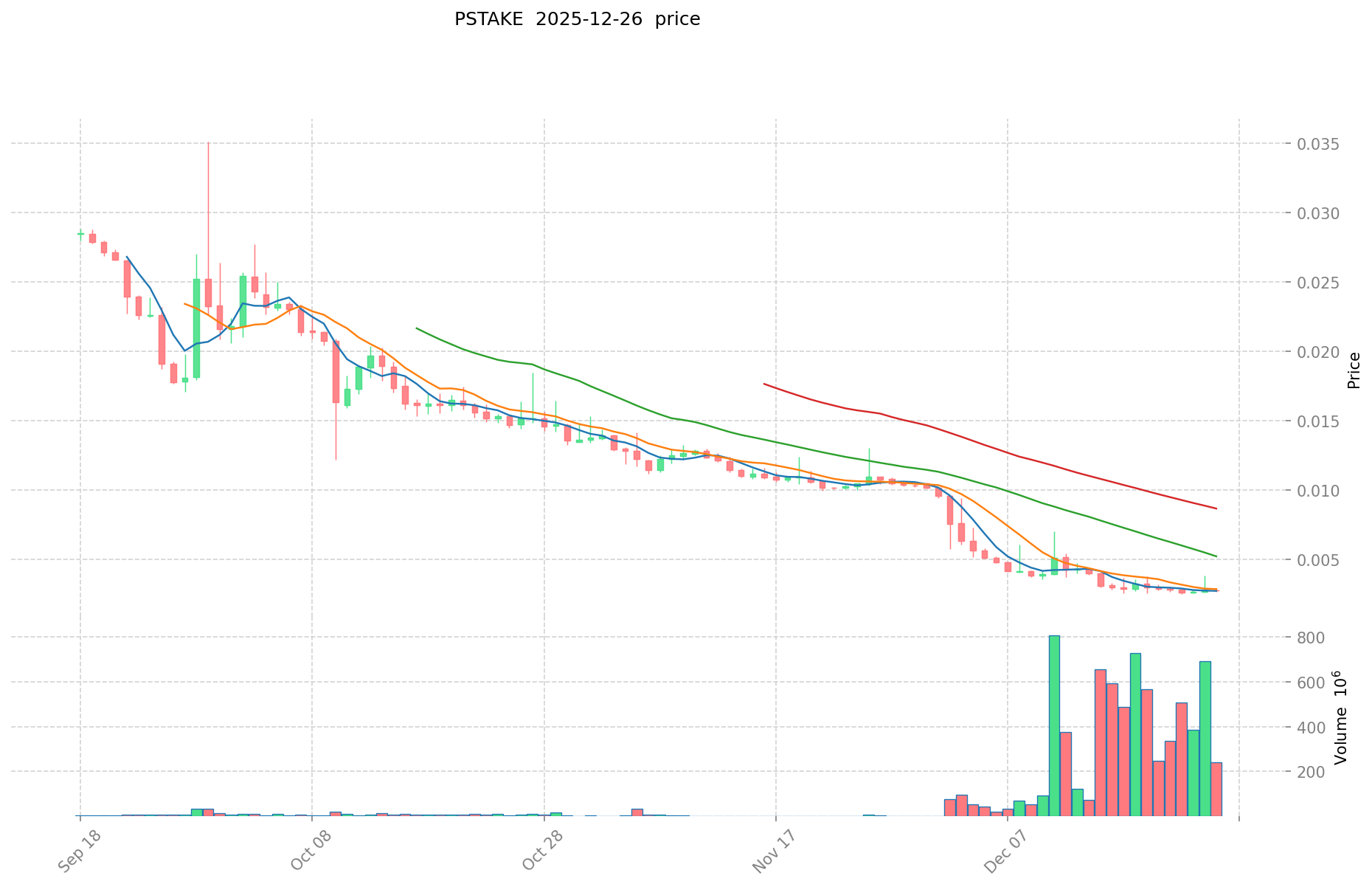
- 2025: Continued downtrend, price declined from historical highs to current levels, with the token reaching its all-time low of $0.00252015 on December 22, 2025
PSTAKE Current Market Landscape
As of December 26, 2025, PSTAKE is trading at $0.002729, reflecting a market capitalization of approximately $1,364,500. The token exhibits significant negative price momentum across multiple timeframes:
- 1-hour change: -0.66%
- 24-hour change: -2.25%
- 7-day change: -17.2%
- 30-day change: -74.25%
- 1-year change: -95.15%
The 24-hour trading volume stands at $591,996.79, with the token trading between a low of $0.00263 and a high of $0.002927 during this period. With a fully diluted valuation matching its market cap, PSTAKE maintains a circulating supply of 500,000,000 tokens out of a total supply of 500,000,000 tokens, representing 100% circulation. The token is currently listed on 6 exchanges with approximately 14,131 token holders. Market sentiment remains at "Extreme Fear" levels (VIX: 20).
Click to view current PSTAKE market price
PSTAKE Market Sentiment Indicator
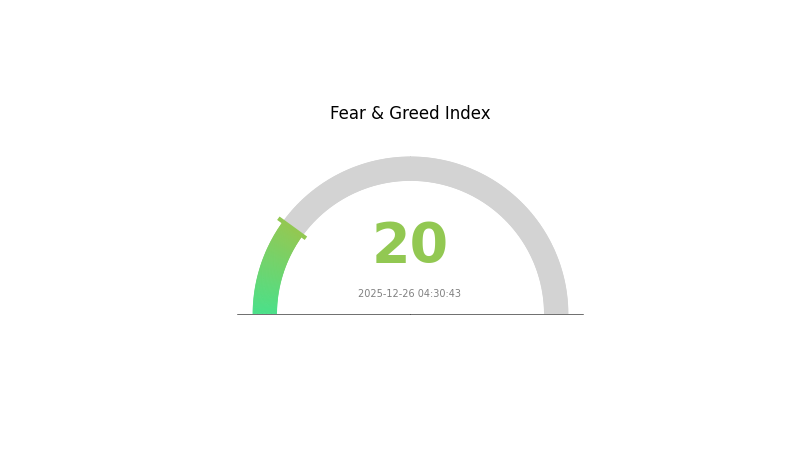
2025-12-26 Fear & Greed Index: 20 (Extreme Fear)
Click to view current Fear & Greed Index
The cryptocurrency market is currently experiencing extreme fear, with the Fear & Greed Index at 20. This indicates significant market pessimism and heightened selling pressure. Investors are displaying risk-averse behavior, presenting potential buying opportunities for those with long-term investment horizons. During periods of extreme fear, contrarian investors often accumulate assets at lower valuations. However, exercise caution and conduct thorough research before making investment decisions. Monitor market developments closely on Gate.com to stay informed about price movements and sentiment shifts.
PSTAKE Holdings Distribution
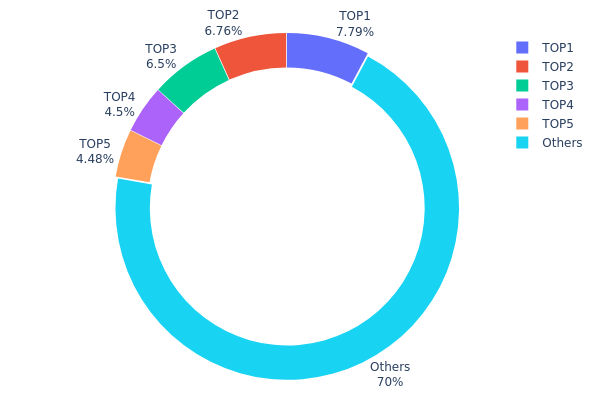
The address holdings distribution map illustrates the concentration pattern of PSTAKE tokens across blockchain addresses, representing how token ownership is distributed among the top holders and the broader market. This metric serves as a critical indicator of decentralization, market structure stability, and potential vulnerability to price manipulation or sudden liquidity shifts.
Current data reveals a moderately distributed token structure, with the top five addresses collectively holding approximately 30% of total PSTAKE supply. The largest holder commands 7.79% of circulating tokens, while the second and third-largest holders account for 6.76% and 6.50% respectively. This concentration level falls within acceptable parameters for established cryptocurrency projects, as no single entity controls an excessive majority of supply. The remaining 69.98% distributed among other addresses indicates meaningful decentralization, suggesting that PSTAKE maintains a relatively healthy token distribution profile that mitigates extreme concentration risks.
However, the cumulative holdings of the top five addresses, totaling approximately 30% of the token supply, warrant careful observation. While this concentration level does not constitute severe centralization, it does create potential channels for coordinated action or significant market impact. The threshold between these major holders and the broader holder base suggests a two-tier market structure: a relatively small group of institutional or major stakeholders, followed by a distributed retail and mid-tier holder base. Such structures typically exhibit moderate price volatility during periods of significant buying or selling pressure from top-tier holders, though the substantial retail participation provides natural support for sustained price floors. Overall, PSTAKE's current distribution reflects a market transitioning toward mature decentralization while retaining sufficient concentration among key stakeholders to facilitate network governance and strategic decision-making.
Click to view current PSTAKE holdings distribution
| Top |
Address |
Holding Qty |
Holding (%) |
| 1 |
0xf89d...5eaa40 |
38965.86K |
7.79% |
| 2 |
0x5bdf...03f7ef |
33820.14K |
6.76% |
| 3 |
0x91d4...c8debe |
32524.51K |
6.50% |
| 4 |
0xc942...157496 |
22487.70K |
4.49% |
| 5 |
0xad94...3da067 |
22402.04K |
4.48% |
| - |
Others |
349799.76K |
69.98% |
II. Core Factors Influencing PSTAKE's Future Price
Supply Mechanism
- Token Release Schedule: PSTAKE has a maximum supply of 500,000,000 tokens with 439,651,042 currently in circulation (87.9% released). According to the tokenomics model, team, treasury, and seed round allocations representing 56% of tokens remain in release cycles, with team token releases scheduled to complete by January 2025. Approximately 13% of tokens (around 65 million PSTAKE) remain to be released over the coming months, with potential airdrops of approximately 20 million tokens to users based on historical patterns.
Technical Development and Ecosystem Building
-
Multi-chain Expansion: pSTAKE Finance currently supports liquid staking for ATOM, BNB, and ETH assets. The protocol is migrating stkATOM and stkXPRT to the Persistence Core-1 Chain, its proprietary blockchain. The team is actively exploring expansion to additional high-potential blockchains with lower staking adoption rates, as current staking ratios for BNB Chain and Cosmos are already elevated, limiting growth from increased staking adoption alone.
-
Cross-chain Use Case Development: stkBNB has achieved broad integration across the ecosystem with diverse application scenarios. However, stkATOM ecosystem expansion remains uncertain, particularly in application development, lacking support from Cosmos official channels, other DeFi projects, and capital partners. The team's independent ecosystem building capabilities require further validation.
-
Ecosystem Partnerships and Liquidity: DYDX community recently voted to stake 5 million $DYDX tokens on pSTAKE Finance with 47.6% support for the proposal. The protocol maintains healthy liquidity for its liquid staking derivatives, with no significant discounts for ATOM and BNB staking positions that would discourage large institutional participation. The protocol supports staking for ATOM, OSMO, DYDX, STARS, BNB, and ETH, with potential future expansion to Solana staking.
Risk Factors and Market Competition
-
Smart Contract Risk: The protocol is vulnerable to smart contract vulnerabilities not only at the project level but also through contagion effects from the same sector. The December 2, 2022 Ankr contract exploit on BNB Chain caused pSTAKE Finance and Stader business volumes to contract by over 70%, with recovery only recently approaching pre-incident levels. Similar incidents could substantially impact pSTAKE Finance's operations.
-
Blockchain Development Risk: pSTAKE Finance's future growth depends significantly on the development of ATOM and BNB chains. If these blockchains fail to achieve substantial growth, the uplift from these primary focus areas will be limited. The team must successfully identify and deploy on emerging, high-potential blockchains with lower staking adoption rates.
-
Industry Price Competition: As PoS blockchain staking ratios increase, intensified competition for limited market share may trigger price wars in the liquid staking sector through reduced staking and unstaking fees, eroding the value capture of the entire ecosystem.
-
Market Position: Currently, pSTAKE Finance ranks third in BNB Chain liquid staking market share, trailing Ankr and Stader. The protocol faces direct competition from Stride and MilkyWay in the Cosmos liquid staking sector while attempting to establish market leadership.
III. 2025-2030 PSTAKE Price Forecast
2025 Outlook
- Conservative Forecast: $0.00194 - $0.00273
- Base Forecast: $0.00273
- Optimistic Forecast: $0.00355
2026-2028 Medium-term Outlook
- Market Stage Expectation: Gradual accumulation phase with steady growth trajectory as ecosystem development progresses and market adoption increases.
- Price Range Predictions:
- 2026: $0.00166 - $0.0042 (15% upside potential)
- 2027: $0.00327 - $0.00547 (34% upside potential)
- 2028: $0.00402 - $0.00594 (67% upside potential)
- Key Catalysts: Enhanced protocol functionality, increased staking participation, broader market recovery, institutional interest in blockchain infrastructure assets.
2029-2030 Long-term Outlook
- Base Case: $0.00468 - $0.00704 (92% growth by 2029)
- Optimistic Scenario: $0.00344 - $0.00885 (125% growth by 2030, assuming sustained network expansion and mainstream adoption)
- Transformational Scenario: $0.00885+ (contingent on breakthrough developments in consensus mechanisms, significant DeFi ecosystem integration, and macroeconomic tailwinds supporting the broader cryptocurrency market)
Note: These forecasts represent technical analysis projections and should not be considered as investment advice. Price predictions are subject to market volatility and unforeseen developments. Users are encouraged to conduct independent research and consider risk management strategies when trading on Gate.com or other platforms.
| 年份 |
预测最高价 |
预测平均价格 |
预测最低价 |
涨跌幅 |
| 2025 |
0.00355 |
0.00273 |
0.00194 |
0 |
| 2026 |
0.0042 |
0.00314 |
0.00166 |
15 |
| 2027 |
0.00547 |
0.00367 |
0.00327 |
34 |
| 2028 |
0.00594 |
0.00457 |
0.00402 |
67 |
| 2029 |
0.00704 |
0.00526 |
0.00468 |
92 |
| 2030 |
0.00885 |
0.00615 |
0.00344 |
125 |
pSTAKE Finance (PSTAKE) Professional Investment Analysis Report
I. Executive Summary
pSTAKE Finance is a liquid staking protocol designed for proof-of-stake (PoS) assets that enables token holders to earn staking rewards while maintaining asset liquidity. By converting staked PoS assets (such as ATOM) into ERC-20 wrapped tokens (pTokens), pSTAKE bridges the Cosmos ecosystem with Ethereum, enhancing capital efficiency and composability across blockchain networks.
Current Market Position (as of December 26, 2025):
- Current Price: $0.002729
- Market Cap: $1,364,500
- 24-Hour Change: -2.25%
- Market Ranking: #2,401
- Total Supply: 500,000,000 PSTAKE
- All-Time High: $1.21 (March 7, 2022)
- All-Time Low: $0.00252015 (December 22, 2025)
II. Project Overview & Fundamentals
Project Introduction
pSTAKE is a liquid staking protocol that unlocks the true potential of staked PoS assets while allowing stakers to maintain liquidity. Users can deposit PoS tokens into the pSTAKE platform to mint 1:1 pegged ERC-20 wrapped tokens (pTokens), such as pATOM. The protocol leverages custom bridges to facilitate Cosmos ecosystem growth while simultaneously improving liquidity and composability for Ethereum-based assets.
Core Value Proposition
-
Liquidity Enhancement: Token holders can stake assets and simultaneously participate in decentralized finance (DeFi) activities without liquidating their staking positions.
-
Cross-Chain Interoperability: pSTAKE connects Cosmos and Ethereum ecosystems through custom bridge infrastructure.
-
Yield Optimization: Users earn staking rewards from the underlying PoS network while retaining liquidity for additional DeFi yield opportunities.
-
Capital Efficiency: Wrapped tokens can be deployed across Ethereum DeFi protocols, generating multiple layers of returns.
Technical Architecture
Token Specifications:
- Contract Address (Ethereum): 0xfB5c6815cA3AC72Ce9F5006869AE67f18bF77006
- Chain: Ethereum (ERC-20)
- Total Supply: 500,000,000 PSTAKE
- Circulating Supply: 500,000,000 PSTAKE (100% circulation)
- Token Holders: 14,131
- Exchange Listings: 6 exchanges (including Gate.com)
Price Trajectory & Volatility
Short-Term Performance:
| Time Period |
Price Change |
Change Amount |
| 1 Hour |
-0.66% |
-$0.000018 |
| 24 Hours |
-2.25% |
-$0.000063 |
| 7 Days |
-17.20% |
-$0.000567 |
| 30 Days |
-74.25% |
-$0.007869 |
| 1 Year |
-95.15% |
-$0.053539 |
Key Observations:
- PSTAKE has experienced significant downward pressure over the long term, declining 95.15% over the past year.
- Recent volatility indicates continued market weakness, with the token reaching its all-time low on December 22, 2025.
- The 24-hour trading volume stands at approximately $591,997, indicating limited liquidity.
Market Capitalization & Dominance
- Market Capitalization: $1,364,500
- Fully Diluted Valuation: $1,364,500 (equivalent due to 100% circulation)
- Market Dominance: 0.000042%
- The project maintains minimal market share relative to the broader cryptocurrency ecosystem.
IV. PSTAKE Professional Investment Strategy & Risk Management
PSTAKE Investment Methodology
(1) Long-Term Holding Strategy
Target Investor Profile:
- Users interested in liquid staking infrastructure exposure
- DeFi protocol developers exploring cross-chain interoperability solutions
- Investors with high risk tolerance and long-term investment horizons
Operational Recommendations:
-
Research Before Investing: Conduct comprehensive due diligence on the protocol's technical implementation, security audits, and team credentials before committing capital.
-
Dollar-Cost Averaging (DCA): Consider accumulating positions over extended periods rather than deploying large capital allocations at single points in time, reducing exposure to volatile price movements.
-
Secure Storage: If acquiring PSTAKE tokens, utilize secure wallet solutions for custody of digital assets.
(2) Active Trading Strategy
Important Note: Given the limited trading volume ($591,997 per 24 hours) and relatively concentrated holder base, active trading in PSTAKE presents significant liquidity challenges and execution risks.
Technical Analysis Considerations:
- Price Chart Analysis: Monitor support/resistance levels at historical price points
- Volume Profile: Track trading volume patterns to identify potential breakout opportunities
- Moving Averages: Utilize multiple timeframe analysis (50-day, 200-day) to assess trend direction
Wave Trading Key Points:
- Entry Signals: Consider accumulation during periods of extreme weakness following negative news or market-wide selloffs
- Exit Management: Establish predetermined profit-taking levels given the asset's historical volatility
V. PSTAKE Potential Risks & Challenges
Market Risks
-
Extreme Price Volatility: PSTAKE has declined 95.15% over the past year, with all-time high of $1.21 declining to current levels of $0.002729, representing massive value destruction for long-term holders.
-
Insufficient Trading Liquidity: 24-hour trading volume of approximately $592,000 is minimal relative to market capitalization, creating execution challenges for significant position sizing.
-
Low Market Adoption: Market ranking of #2,401 and market capitalization of only $1.36 million indicate limited institutional acceptance and mainstream adoption.
Regulatory Risks
-
Evolving Regulatory Framework: Liquid staking protocols operate within an uncertain regulatory environment, with jurisdictions worldwide still developing comprehensive staking asset regulatory guidelines.
-
Cross-Chain Compliance Complexity: Bridge mechanisms connecting Cosmos and Ethereum may face regulatory scrutiny as authorities clarify staking-as-a-service regulatory requirements.
-
Securities Classification Uncertainty: Regulatory bodies may reclassify staking rewards or wrapped token mechanisms, potentially imposing additional compliance burdens.
Technical Risks
-
Smart Contract Vulnerability: Liquid staking protocols involve complex smart contract interactions that could be subject to exploits or unforeseen technical failures.
-
Bridge Security: Custom bridge infrastructure connecting different blockchain networks introduces additional attack surface and potential points of failure.
-
Custody & Validator Risks: Reliance on validator infrastructure in underlying PoS networks introduces counterparty risk and potential slashing events that could impact pSTAKE token value.
VI. Conclusion & Action Recommendations
PSTAKE Investment Value Assessment
pSTAKE Finance represents a specialized infrastructure project targeting the liquid staking segment of the cryptocurrency market. While the underlying concept of liquid staking offers legitimate value propositions for capital efficiency, the PSTAKE token itself has experienced severe depreciation of 95.15% over the past year, falling to near all-time low valuations.
Critical Assessment Points:
- The project addresses a real market need within the DeFi ecosystem
- However, severe price depreciation and minimal market capitalization suggest limited market confidence
- Trading volumes insufficient for institutional participation
- Holder concentration (14,131 addresses) indicates limited distribution
PSTAKE Investment Recommendations
✅ Beginners: Approach with extreme caution. Liquid staking infrastructure is complex, and PSTAKE's weak market performance does not justify position-building for new entrants. Consider learning about the protocol through small exposure rather than significant capital allocation.
✅ Experienced Investors: Position sizing should be minimal relative to overall portfolio allocation. The project's technical merit may warrant tracking, but historical performance suggests waiting for significant value preservation before accumulating positions.
✅ Institutional Investors: Current market capitalization and liquidity levels make institutional adoption impractical. Engagement with the protocol for partnership exploration may be worthwhile, but token acquisition for investment purposes is not recommended at current valuations.
PSTAKE Trading & Participation Methods
-
On-Chain Staking Participation: Users interested in liquid staking exposure can utilize the pSTAKE platform directly to stake ATOM or other PoS assets and receive pTokens, accessing underlying staking yields.
-
Exchange Trading: PSTAKE tokens are available for trading on Gate.com and five additional exchanges, enabling secondary market price discovery (though with significant liquidity constraints).
-
DeFi Protocol Integration: Users holding pTokens can deploy these assets across Ethereum DeFi protocols to generate additional yield through lending, automated market makers (AMMs), or other yield farming opportunities.
Risk Disclosure: Cryptocurrency investments carry extreme risk, including potential total loss of capital. This report does not constitute investment advice. Investors should make decisions based on individual risk tolerance, conduct independent research, and consult professional financial advisors. Never invest more than you can afford to lose completely. The cryptocurrency market is highly speculative and volatile, with regulatory uncertainty affecting all participants.
FAQ
What is a pSTAKE coin?
pSTAKE is a liquid staking protocol enabling users to stake Proof-of-Stake assets and earn rewards while maintaining liquidity. It issues pegged tokens representing staked assets for DeFi yield opportunities across Cosmos and Persistence networks.
What is the current price of PSTAKE and what factors influence it?
PSTAKE's price is influenced by market demand, trading volume, staking rewards, and overall cryptocurrency market trends. Real-time pricing varies based on market conditions and investor sentiment.
What is the price prediction for PSTAKE in 2025?
Based on current market analysis, PSTAKE is projected to trade within a range during 2025, with potential upside momentum as the platform gains adoption. Long-term forecasts suggest significant growth trajectory through 2027 and beyond, though specific 2025 targets vary among analysts.
PSTAKE has demonstrated strong historical performance, outperforming broader crypto markets significantly. Recent 24-hour gains of 19.18% showcase its robust market position among staking tokens.
What are the main risks and opportunities for PSTAKE price movement?
Risks include post-delisting volatility and liquidity concerns. Opportunities include technical rebounds and speculative volume surges. Market sentiment and staking ecosystem developments significantly influence price dynamics.
How does PSTAKE staking work and how does it affect token price?
pSTAKE converts staked assets into tradable liquid tokens(stkTokens), enabling users to earn rewards while accessing DeFi opportunities. This increases token utility and liquidity, driving demand and supporting upward price momentum through expanded use cases.
* The information is not intended to be and does not constitute financial advice or any other recommendation of any sort offered or endorsed by Gate.