This comprehensive article analyzes Quai Network (QUAI) as a next-generation proof-of-work Layer 1 blockchain positioned for decentralized energy-backed currency solutions. Currently trading at $0.1063 with a $50.8 million market cap, QUAI demonstrates significant volatility yet substantial recovery momentum. The analysis examines historical price evolution, current market sentiment (fear index at 44), and token distribution patterns to forecast price movements through 2031. Core influencing factors include supply mechanisms, market sentiment, macroeconomic conditions, and ecosystem development capabilities. The article provides three investment strategies—long-term holding, active trading, and dollar-cost averaging—complemented by comprehensive risk management frameworks suitable for conservative to institutional investors. Professional price predictions range from $0.09987-$0.11383 in 2026 to $0.15769-$0.20022 by 2030-2031, contingent upon adoption rates and regulatory developments. Trading on Gate.com and
Introduction: QUAI's Market Position and Investment Value
Quai Network (QUAI), positioned as a next-generation proof-of-work Layer 1 blockchain designed for a decentralized global monetary system, has gained significant attention since its launch in 2025. As of January 19, 2026, QUAI's market capitalization stands at approximately $50.8 million with a circulating supply of around 477.9 million tokens, while its price maintains around $0.1063. This asset, often recognized as the "world's first decentralized energy dollar," is playing an increasingly important role in merging currency with energy and powering next-generation DeFi solutions.
This article will comprehensively analyze QUAI's price trends from 2026 to 2031, combining historical patterns, market supply and demand dynamics, ecosystem development, and macroeconomic conditions to provide investors with professional price forecasts and practical investment strategies.
I. QUAI Price History Review and Market Status
Historical Price Evolution of QUAI
- 2025: Quai Network launched on the market in February 2025 with a publish price of $0.1, experiencing significant volatility during its initial months. The token reached its all-time high of $0.37141 on February 24, 2025, representing a substantial increase from its launch price. However, the market later corrected, and the price dropped to its all-time low of $0.01801 on November 21, 2025, reflecting an 83% decline from the peak.
Current Market Situation of QUAI
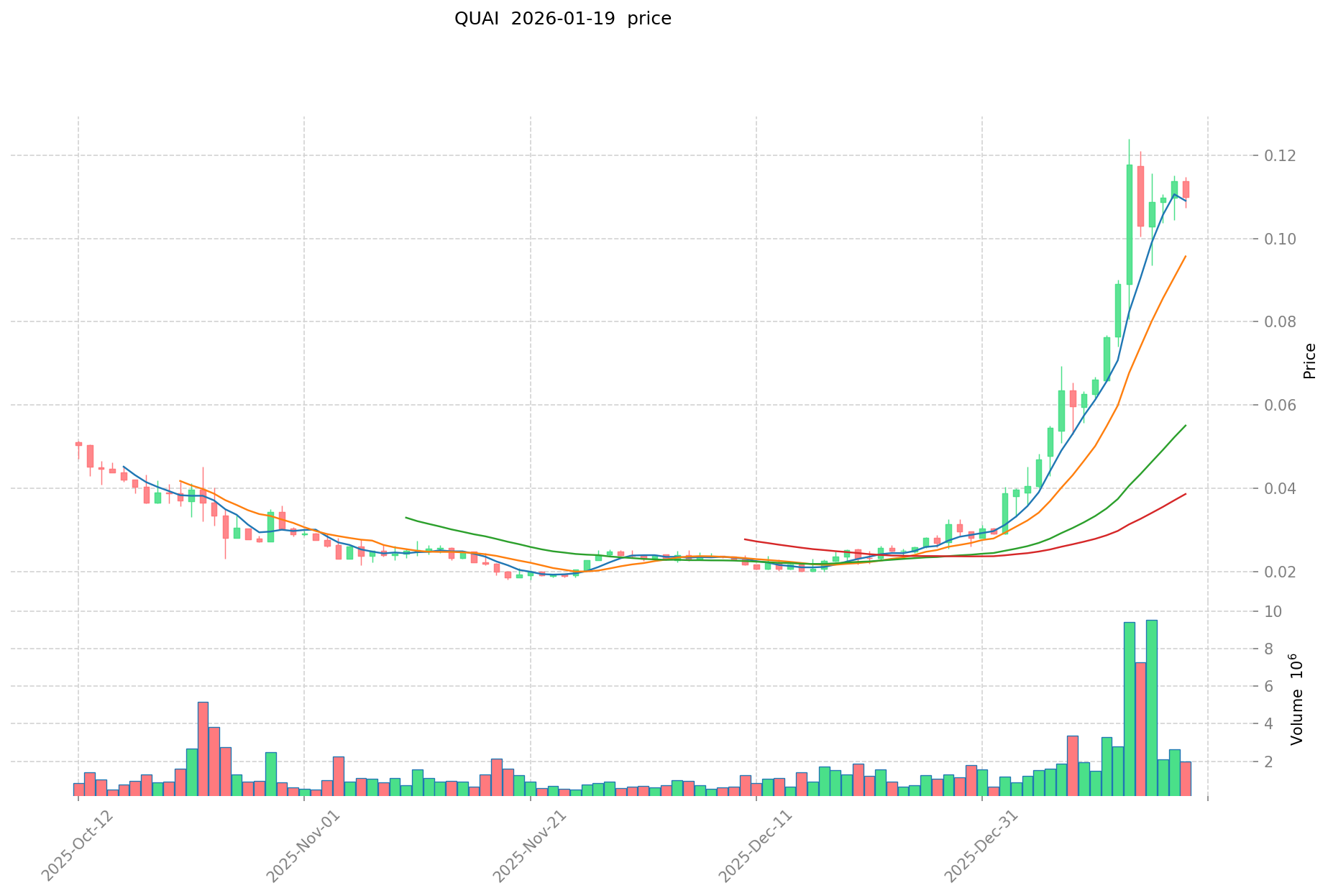
As of January 19, 2026, QUAI is trading at $0.1063, showing a 1.88% increase over the past hour but experiencing a 7.35% decline in the last 24 hours. The token has demonstrated considerable recovery over recent periods, with a 40.18% gain over the past 7 days and a notable 318.68% increase over the past 30 days. The yearly performance shows a 21.01% gain.
The current 24-hour trading volume stands at $251,909.12, with the price fluctuating between a low of $0.10449 and a high of $0.11486 during this period. With a market capitalization of $50.8 million and a circulating supply of 477.9 million QUAI tokens out of a total supply of 3 billion, the market cap to fully diluted valuation ratio sits at 15.93%. The token holds a market dominance of 0.0097% and ranks #518 in the cryptocurrency market.
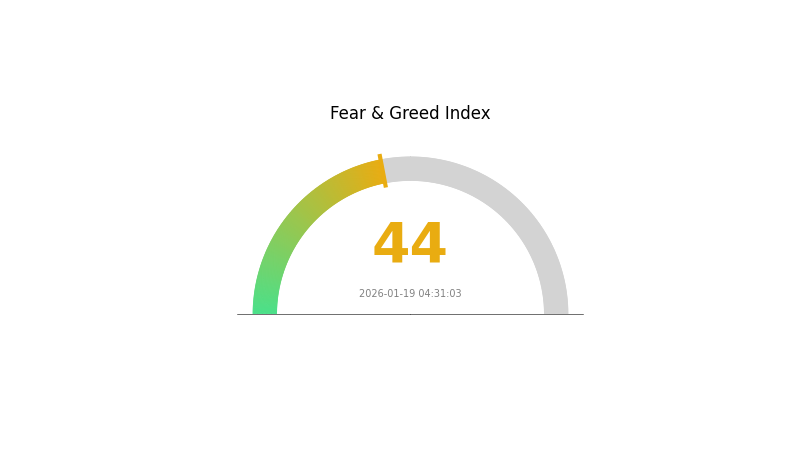
Quai Network is available for trading on 5 exchanges, with Gate.com being one of the platforms supporting QUAI trading. The current market sentiment index indicates a fear level at 44, suggesting cautious investor behavior in the broader market environment.
Click to view the current QUAI market price
QUAI Market Sentiment Indicator
2026-01-19 Fear and Greed Index: 44 (Fear)
Click to view current Fear & Greed Index
The QUAI market is currently experiencing a fear sentiment, with the index standing at 44. This reading suggests investors are adopting a cautious stance, reflecting concerns about market conditions and asset valuations. During periods of fear, risk-averse traders tend to reduce exposure, while opportunistic investors may view the dip as a potential entry point. Monitoring this index helps traders gauge market psychology and make informed decisions aligned with their investment strategies on Gate.com.
QUAI Token Holding Distribution
The holding distribution chart reveals a moderate level of concentration within the QUAI network. The top address holds approximately 15.13% of the total supply, while the top 10 addresses collectively control around 42.67% of all tokens. This concentration pattern suggests a semi-centralized distribution structure, where a relatively small group of major holders possesses significant influence over the circulating supply. However, compared to many emerging projects where top addresses often control over 60-70% of tokens, QUAI demonstrates a more balanced allocation model.
From a market structure perspective, this distribution level presents both opportunities and risks. The current concentration could provide relative price stability during normal market conditions, as major holders typically have longer-term investment horizons. However, the fact that the top 10 addresses control nearly 43% of supply introduces potential volatility risks. Should multiple large holders decide to liquidate simultaneously, the market could experience significant downward pressure. Additionally, this concentration level raises questions about potential coordinated market movements, though it remains below the threshold typically associated with overt market manipulation concerns.
The current distribution pattern reflects a developing on-chain ecosystem that has not yet achieved complete decentralization. While the network shows healthier distribution compared to highly concentrated projects, there remains substantial room for improvement in broadening the holder base. This intermediate state suggests QUAI is transitioning from its early distribution phase toward a more mature market structure, though sustained growth in smaller holder participation will be essential for achieving greater network resilience and reduced concentration risk over time.
Click to view current QUAI Holding Distribution

| Top |
Address |
Holding Qty |
Holding (%) |
II. Core Factors Influencing QUAI's Future Price
Supply Mechanism
- Mining-Based Distribution: QUAI operates on a Proof of Entropy Minima (PoEM) consensus mechanism with merged mining across its multi-chain architecture. The network distributes rewards across Prime, Region, and Zone chains, with varying mining difficulties affecting token issuance rates.
- Token Allocation Structure: According to the tokenomics model, 15% is reserved for strategic partners, 5.5% for infrastructure partners, 4% for core contributors, 2% for exchange liquidity, and 0.5% for testnet participants. This structured distribution aims to support long-term ecosystem development.
- Current Supply Dynamics: The testnet reward program and mainnet launch preparations may influence initial circulation patterns, though specific emission schedules have not been publicly detailed in available materials.
Market Sentiment and Trading Activity
- Trading Volume Impact: QUAI's price is significantly influenced by trading volume fluctuations across participating exchanges. Market liquidity and transaction depth affect price stability and discovery mechanisms.
- Overall Market Sentiment: Broader cryptocurrency market conditions play a substantial role in QUAI's price movements. Investor confidence in Layer-1 blockchain projects and risk appetite in the digital asset space directly correlate with trading patterns.
- Community Engagement: The Galxe social media rewards program, launched in August 2023, has been designed to incentivize early adopter participation and community building, which may contribute to sustained interest in the project.
Macroeconomic Environment
- Interest Rate Cycles: Changes in global interest rates and liquidity conditions affect capital flows into cryptocurrency markets. Monetary policy signals from major central banks influence risk asset valuations, including blockchain tokens.
- Regulatory Developments: Evolving cryptocurrency regulations across jurisdictions may impact trading accessibility, institutional adoption, and overall market sentiment toward blockchain projects.
- Global Economic Conditions: Broader economic indicators, including inflation trends and financial market stability, play a role in determining investor appetite for digital assets and speculative technology investments.
Technical Development and Ecosystem Building
- Multi-Chain Architecture: QUAI's hierarchical blockchain structure, featuring Prime, Region, and Zone layers, enables high throughput of up to 50,000 transactions per second. This technical capability positions the network for scalability as ecosystem demands grow.
- EVM Compatibility: Full Ethereum Virtual Machine compatibility allows developers to deploy decentralized applications with familiar tooling, potentially accelerating ecosystem development and attracting projects from other EVM-compatible chains.
- Testnet Evolution: The network has progressed through multiple testnet phases, including Stone Age and Bronze Age, with the Iron Age testnet launched in September 2023. These testing phases focus on validating the PoEM consensus mechanism, smart contract functionality, and cross-chain operations.
- Dual Token System: The platform implements both QUAI as a functional network token and Qi as an energy-backed stablecoin. This dual-token economic model aims to support diverse use cases within the ecosystem, from transaction processing to value storage.
- Ecosystem Partnerships: Strategic partnerships with infrastructure providers for node hosting, mining pool operations, and RPC access contribute to network decentralization and operational resilience, supporting long-term technical sustainability.
III. 2026-2031 QUAI Price Prediction
2026 Outlook
- Conservative forecast: $0.09987 - $0.10739
- Neutral forecast: $0.10739 average price level
- Optimistic forecast: $0.11383 (requires favorable market conditions and increased adoption)
2027-2029 Outlook
- Market stage expectation: Gradual development phase with moderate volatility and ecosystem expansion
- Price range forecast:
- 2027: $0.07964 - $0.13716
- 2028: $0.09539 - $0.1338
- 2029: $0.09019 - $0.14172
- Key catalysts: Technology improvements, community growth, and potential strategic partnerships driving network utilization
2030-2031 Long-term Outlook
- Baseline scenario: $0.09605 - $0.13528 (assumes steady market conditions and continued project development)
- Optimistic scenario: $0.15769 - $0.20022 (assumes significant ecosystem maturation and broader market acceptance)
- Transformative scenario: Potential to reach $0.20022 by 2030 (requires exceptional adoption rates, major technological breakthroughs, and favorable regulatory environment)
- 2026-01-19: QUAI trading around lower baseline levels as market enters new development cycle
| Year |
Predicted High Price |
Predicted Average Price |
Predicted Low Price |
Price Change |
| 2026 |
0.11383 |
0.10739 |
0.09987 |
1 |
| 2027 |
0.13716 |
0.11061 |
0.07964 |
4 |
| 2028 |
0.1338 |
0.12389 |
0.09539 |
16 |
| 2029 |
0.14172 |
0.12884 |
0.09019 |
21 |
| 2030 |
0.20022 |
0.13528 |
0.09605 |
27 |
| 2031 |
0.18956 |
0.16775 |
0.15769 |
57 |
IV. QUAI Professional Investment Strategies and Risk Management
QUAI Investment Methodology
(1) Long-term Holding Strategy
- Suitable for: Investors seeking exposure to next-generation PoW blockchain infrastructure and decentralized monetary systems
- Operational Recommendations:
- Consider accumulating positions during market corrections, given QUAI's relatively low circulating supply of 15.93% (477.9M out of 3B total supply)
- Monitor the project's development roadmap and DeFi ecosystem expansion to assess long-term value accrual
- Storage Solution: Utilize Gate Web3 Wallet for secure self-custody, ensuring private key control and multi-chain compatibility
(2) Active Trading Strategy
- Technical Analysis Tools:
- Moving Averages: Track short-term (7-day, +40.18%) versus medium-term (30-day, +318.68%) momentum to identify trend reversals
- Volume Analysis: Monitor 24-hour trading volume ($251,909) relative to market cap ($50.8M) to gauge liquidity and trading intensity
- Swing Trading Considerations:
- Set stop-loss orders within the recent 24-hour range ($0.10449-$0.11486) to manage downside risk
- Consider profit-taking strategies near resistance levels, while accounting for the token's high volatility profile
QUAI Risk Management Framework
(1) Asset Allocation Principles
- Conservative Investors: 1-3% of crypto portfolio allocation
- Aggressive Investors: 5-8% of crypto portfolio allocation
- Professional Investors: Up to 10% with active hedging strategies
(2) Risk Hedging Solutions
- Position Sizing: Limit exposure relative to QUAI's market dominance (0.0097%) and moderate liquidity profile
- Diversification: Balance QUAI holdings with established Layer 1 tokens and stablecoins to mitigate sector-specific risks
(3) Secure Storage Solutions
- Non-Custodial Wallet Recommendation: Gate Web3 Wallet for enhanced security and direct asset control
- Multi-Signature Solution: Implement multi-sig configurations for larger holdings to reduce single-point failure risks
- Security Precautions: Verify contract addresses via Quaiscan.io, enable two-factor authentication, and avoid sharing private keys or seed phrases
V. QUAI Potential Risks and Challenges
QUAI Market Risks
- High Volatility: Recent 24-hour decline of -7.35% and 30-day surge of +318.68% demonstrate significant price swings that may challenge risk tolerance
- Limited Trading History: Token launch on January 20, 2025, provides insufficient long-term performance data for comprehensive trend analysis
- Liquidity Constraints: Trading availability on 5 exchanges with moderate 24-hour volume may impact execution quality for larger orders
QUAI Regulatory Risks
- PoW Mechanism Scrutiny: Proof-of-work consensus models face increasing regulatory examination regarding energy consumption and environmental impact
- Decentralized Currency Classification: Positioning as a "decentralized energy dollar" may attract regulatory attention concerning monetary system alternatives
- Cross-Jurisdictional Compliance: Global operational scope requires navigation of evolving regulatory frameworks across multiple regions
QUAI Technical Risks
- Scalability Proof: Claims of "unstoppable performance" and global transaction scaling require ongoing technical validation under real-world conditions
- Network Security: As a next-generation PoW chain, the network must demonstrate sustained hash rate security and resistance to 51% attacks
- Token Unlock Schedule: With only 15.93% circulating supply, future token releases from the remaining 84.07% could create sell pressure if not managed transparently
VI. Conclusion and Action Recommendations
QUAI Investment Value Assessment
Quai Network presents a speculative opportunity within the emerging infrastructure layer focused on merging energy-backed currency models with DeFi functionality. The project's ambitious vision of creating a decentralized energy dollar addresses real-world commerce needs, supported by proof-of-work security mechanisms. However, the limited trading history, concentrated supply distribution (84.07% yet to circulate), and need for ecosystem maturation introduce substantial uncertainty. Short-term volatility remains elevated, while long-term value depends on successful technical implementation, regulatory navigation, and adoption within the DeFi landscape.
QUAI Investment Recommendations
✅ Beginners: Limit initial exposure to 1-2% of total crypto holdings; prioritize education on PoW mechanisms and energy-dollar economics before increasing positions
✅ Experienced Investors: Consider strategic accumulation during market corrections with 3-5% allocation; actively monitor development milestones and ecosystem growth metrics
✅ Institutional Investors: Conduct comprehensive due diligence on technical architecture, tokenomics, and team execution capability; maintain hedged positions with derivatives if available
QUAI Trading Participation Methods
- Spot Trading: Access QUAI trading pairs on Gate.com and 4 other exchanges with competitive fee structures and adequate liquidity for retail orders
- DCA Strategy: Implement dollar-cost averaging to mitigate timing risk given price volatility, accumulating positions gradually over 3-6 month periods
- Portfolio Integration: Combine QUAI with diversified Layer 1 exposure and stablecoins to balance speculative upside with capital preservation
Cryptocurrency investments carry extremely high risks, and this article does not constitute investment advice. Investors should make prudent decisions based on their own risk tolerance and are advised to consult professional financial advisors. Never invest more than you can afford to lose.
FAQ
QUAI reached an all-time high of $0.3634 on February 23, 2025, and hit a low of $0.01825978 on November 21, 2025. Currently trading between $0.02197153 and $0.02514387, showing significant volatility throughout its trading history.
What are the main factors affecting QUAI price?
QUAI price is influenced by market sentiment, trading volume, and technological developments. Macroeconomic conditions, regulatory signals, and global trading activity also significantly impact its price movements.
What are professional analysts' price predictions for QUAI?
Professional analysts predict QUAI could reach as high as 100 USD, with potential lows around 20 USD. These forecasts are based on current market trends and technical analysis of the project's fundamentals and growth potential.
What advantages does QUAI have compared to other Layer 1 public chain tokens?
QUAI leverages a unique pyramid-structured architecture combining proof-of-work, merged mining, and sharding to achieve superior scalability and security. Its layered design enables efficient transaction processing and higher throughput than traditional Layer 1 blockchains.
How do QUAI's technical updates and development roadmap impact its price?
QUAI's technical upgrades enhance market value and competitiveness. Based on predictions, QUAI price is expected to grow significantly, with average price potentially reaching US$0.12369 by 2031 and continuing upward trajectory through 2032, driven by network improvements and ecosystem development.
How to assess the long-term investment value of QUAI?
Evaluate QUAI by analyzing project fundamentals, team expertise, market adoption potential, and technical innovation. Monitor transaction volume trends and network growth metrics. Compare competitive advantages against similar projects. Consider macroeconomic factors and crypto market cycles for comprehensive long-term valuation assessment.
* The information is not intended to be and does not constitute financial advice or any other recommendation of any sort offered or endorsed by Gate.