This comprehensive analysis examines Reserve Rights (RSR) token's market position and investment potential through 2031. Currently trading at $0.002695 with a market cap of $168.58 million, RSR faces significant volatility following an 81.26% decline. The article evaluates RSR's dual-token mechanism supporting the Reserve Protocol stablecoin ecosystem and analyzes price trends influenced by adoption rates, regulatory developments, and DeFi integration. Detailed predictions span 2026-2031, with conservative to optimistic scenarios ranging from $0.00202 to $0.00496. Professional investment strategies include dollar-cost averaging on Gate and active trading approaches, complemented by comprehensive risk management frameworks addressing market volatility, liquidity concerns, and regulatory uncertainties. The analysis targets investors seeking exposure to stablecoin infrastructure while managing high-risk cryptocurrency allocations.
Introduction: RSR's Market Position and Investment Value
Reserve Rights (RSR), as a governance token supporting a distributed stablecoin and digital payment system, has been advancing its mission since its launch in 2019. As of 2026, RSR maintains a market capitalization of approximately $168.58 million, with a circulating supply of about 62.55 billion tokens, and a price hovering around $0.002695. This asset, designed as a "stability mechanism token," is playing an increasingly important role in regions with unreliable financial infrastructure and high inflation rates.
Supported by influential investors including PayPal co-founder Peter Thiel and YCombinator President Sam Altman, the Reserve Protocol aims to create a universal store of value through its dual-token system. RSR serves primarily to maintain the price stability of Reserve tokens, which function as stablecoins that can be held and used similarly to fiat currencies and other digital assets.
This article will comprehensively analyze RSR's price trends from 2026 to 2031, combining historical patterns, market supply and demand dynamics, ecosystem development, and macroeconomic conditions to provide investors with professional price forecasts and practical investment strategies.
I. RSR Price History Review and Market Status
RSR Historical Price Evolution Trajectory
- 2020: On March 16, RSR recorded its historical low point at $0.00121354, reflecting early market positioning during the initial phase of the project.
- 2021: On April 17, RSR reached a notable price level of $0.117424, demonstrating significant market interest during the broader crypto market expansion period.
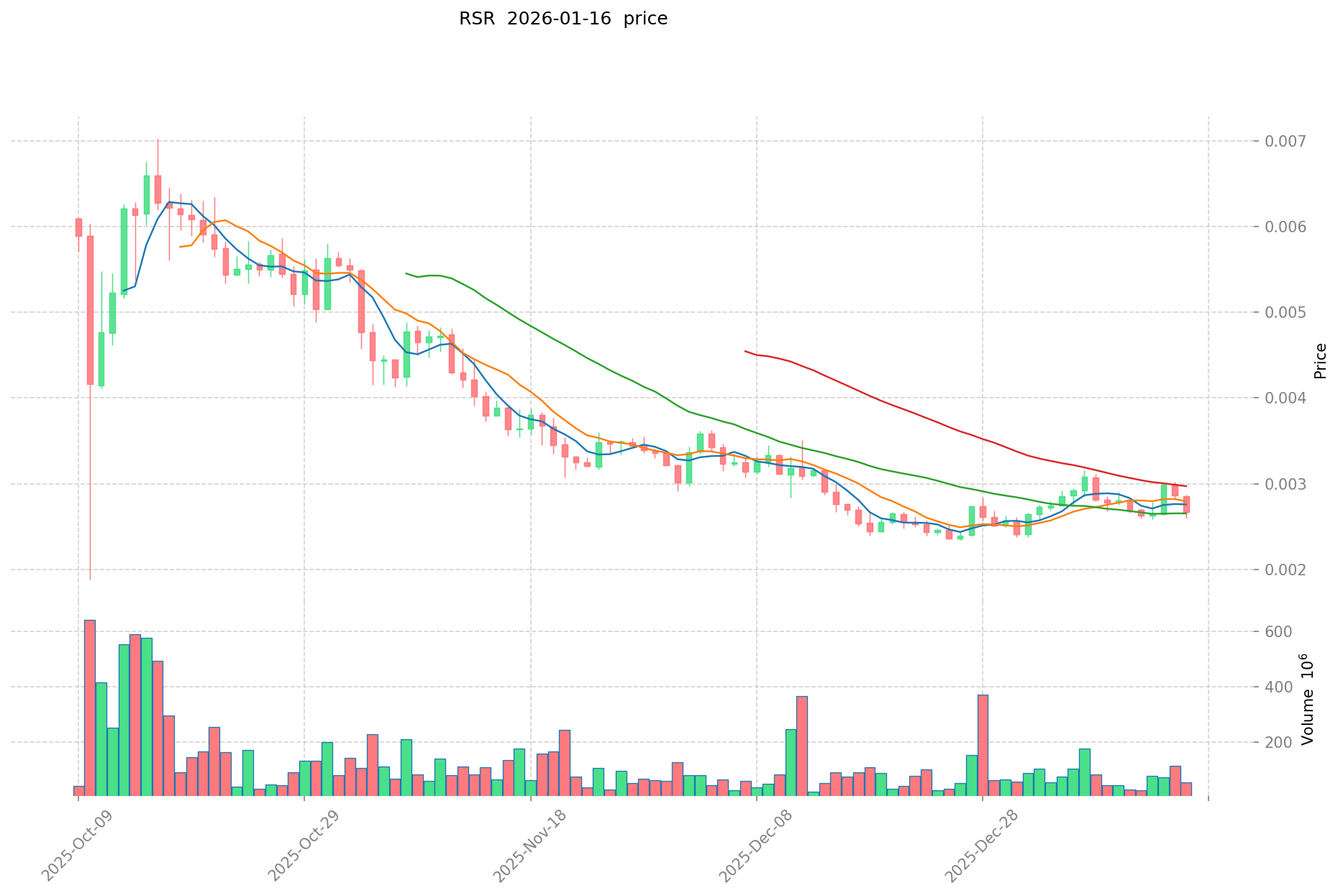
- 2025-2026: The token experienced substantial price adjustment, with the 1-year performance showing a decline of 81.26%, reflecting broader market dynamics and sector-specific developments.
RSR Current Market Status
As of January 16, 2026, RSR is trading at $0.002695, with a 24-hour trading volume of $135,274.06. The token has exhibited recent volatility, with a 24-hour decline of 3.54% and a 7-day decrease of 3.88%. The 24-hour price range spans from $0.002595 to $0.002833.
The current circulating supply stands at 62.55 billion tokens out of a total and maximum supply of 100 billion tokens, representing a circulation ratio of 62.55%. The market capitalization is approximately $168.58 million, while the fully diluted market cap reaches $269.5 million. The market cap to fully diluted valuation ratio is 62.55%, indicating a significant portion of tokens already in circulation.
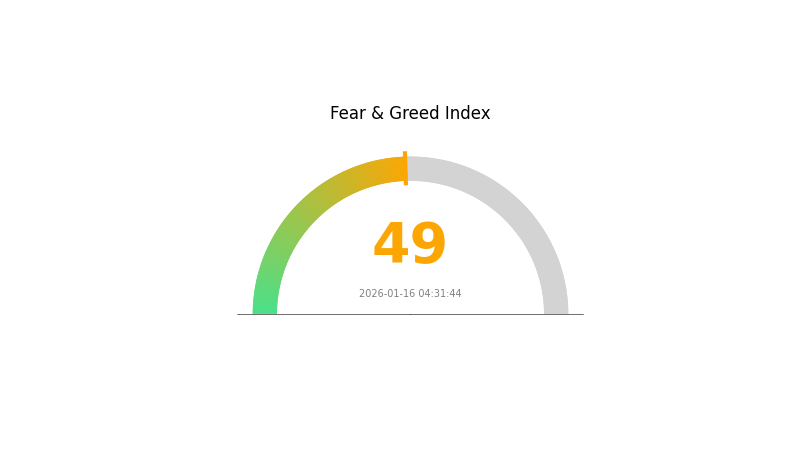
RSR maintains a market dominance of 0.0079% and ranks #268 in the cryptocurrency market. The token is listed on 41 exchanges and has a holder count of 35,541. The Gate Market Emotion Index currently registers at 49, indicating a neutral market sentiment.
Short-term performance shows a 1-hour increase of 0.11% and a 30-day gain of 0.89%, suggesting some recent stabilization in price movement.
Click to view current RSR market price
RSR Market Sentiment Indicator
2026-01-16 Fear & Greed Index: 49 (Neutral)
Click to view the current Fear & Greed Index
The market sentiment remains in neutral territory with a reading of 49, indicating a balanced state between fear and greed. At this level, investors are neither excessively optimistic nor pessimistic, suggesting a period of market consolidation. This neutral sentiment typically reflects uncertainty in price direction, making it an opportune time for careful portfolio assessment and strategic position adjustments on Gate.com's trading platform.
RSR Holdings Distribution
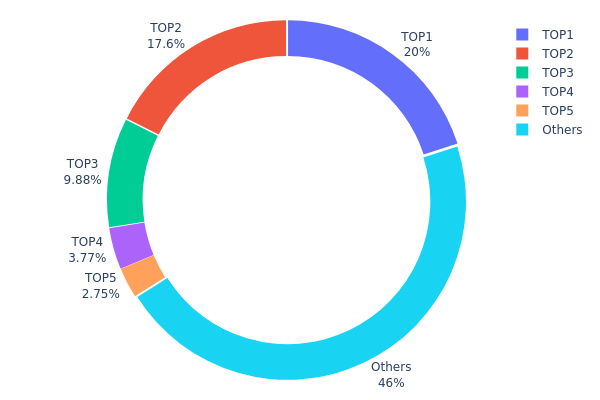
The holdings distribution chart illustrates the concentration of RSR tokens across different wallet addresses, providing insights into the token's ownership structure and decentralization level. Based on the current data, the top 5 addresses collectively hold approximately 54% of the total RSR supply, with the largest single address controlling 20% of all tokens. The second and third largest addresses hold 17.59% and 9.87% respectively, while the remaining addresses outside the top 5 account for 46.03% of the total supply.
This distribution pattern reveals a moderate to high concentration level in RSR's ownership structure. The presence of a single address holding one-fifth of the total supply, combined with the top three addresses controlling nearly half of all tokens, suggests that a relatively small number of entities possess significant influence over the token's market dynamics. Such concentration can amplify price volatility, as large-scale movements by major holders could trigger substantial market reactions. Additionally, this structure may present potential risks regarding market manipulation, as coordinated actions by top holders could disproportionately impact trading patterns and price discovery mechanisms.
From a market structure perspective, the current distribution reflects a partially centralized ecosystem where significant decision-making power remains concentrated among major stakeholders. While the 46% holdings distributed among smaller addresses demonstrates some degree of decentralization, the dominance of top holders indicates that RSR's on-chain structure has room for improvement in achieving broader token distribution. This concentration level is relatively common among utility tokens but warrants monitoring to ensure healthy market development and genuine decentralization over time.
Click to view current RSR Holdings Distribution
| Top |
Address |
Holding Qty |
Holding (%) |
| 1 |
0x6bab...ad81c1 |
20000000.00K |
20.00% |
| 2 |
0x0774...7f7ef8 |
17599573.20K |
17.59% |
| 3 |
0xf977...41acec |
9879149.81K |
9.87% |
| 4 |
0x3154...0f2c35 |
3769759.19K |
3.76% |
| 5 |
0x18ba...1ae7b8 |
2752116.97K |
2.75% |
| - |
Others |
45999400.83K |
46.03% |
II. Core Factors Influencing RSR's Future Price
Supply Mechanism
- Dual-Token Model: RSR operates within Reserve Protocol's dual-token system, where RSR serves as the governance and collateral token supporting the RSV stablecoin. The supply mechanism is designed to absorb volatility and maintain RSV's stability through algorithmic adjustments.
- Current Impact: The token's supply dynamics are closely tied to the Reserve Protocol's growth and RSV adoption. As the protocol expands, RSR's utility in collateralization and governance may influence demand patterns.
Market Demand and Cryptocurrency Trends
- Overall Market Sentiment: RSR's price performance is substantially influenced by broader cryptocurrency market trends and altcoin rotation cycles. Without strong demand catalysts or adoption drivers, price movements may remain range-bound.
- Platform Development: The progress of the Reserve Rights platform plays a significant role in determining token valuation. Continuous development efforts focused on platform security and user experience may contribute to long-term value perception.
Macroeconomic Environment
- Regulatory Landscape: Regulatory developments and policy changes in the cryptocurrency sector represent critical factors affecting RSR's price trajectory. Evolving compliance requirements may impact market confidence and adoption rates.
- Market Volatility: The inherently high volatility of cryptocurrency markets continues to pose challenges. While RSV functions as a stablecoin, market fluctuations and regulatory policy shifts may still influence the broader Reserve ecosystem.
Technical Development and Ecosystem Building
- Blockchain Technology Enhancement: The Reserve team's ongoing commitment to improving the platform's technical infrastructure, including security protocols and system architecture, represents a key factor in the token's potential appreciation.
- Ecosystem Maturity: The completeness and sophistication of RSR's blockchain technology and ecosystem development serve as fundamental elements influencing its growth potential. Technical advancement may strengthen the platform's competitive position in the decentralized finance landscape.
III. 2026-2031 RSR Price Prediction
2026 Outlook
- Conservative prediction: $0.00202 - $0.00269
- Neutral prediction: $0.00269
- Optimistic prediction: $0.00309 (requires favorable market conditions)
2027-2029 Outlook
- Market phase expectation: The token is anticipated to enter a gradual recovery and consolidation phase, with price fluctuations reflecting broader market sentiment and protocol adoption rates.
- Price range predictions:
- 2027: $0.0022 - $0.00338 (approximately 7% potential growth)
- 2028: $0.00232 - $0.00336 (approximately 16% potential growth)
- 2029: $0.00308 - $0.00435 (approximately 20% potential growth)
- Key catalysts: Protocol development milestones, ecosystem expansion, and increasing adoption of stablecoin infrastructure could serve as primary drivers for price appreciation during this period.
2030-2031 Long-term Outlook
- Baseline scenario: $0.00243 - $0.0038 (assuming steady market development and moderate adoption rates)
- Optimistic scenario: $0.0038 - $0.0049 (contingent upon accelerated DeFi integration and enhanced utility)
- Transformative scenario: $0.00435 - $0.00496 (requiring significant breakthroughs in protocol functionality and mainstream acceptance)
- 2026-01-16: RSR trading within the $0.00202 - $0.00309 range (establishing baseline for multi-year projection)
| Year |
Predicted High Price |
Predicted Average Price |
Predicted Low Price |
Price Change |
| 2026 |
0.00309 |
0.00269 |
0.00202 |
0 |
| 2027 |
0.00338 |
0.00289 |
0.0022 |
7 |
| 2028 |
0.00336 |
0.00314 |
0.00232 |
16 |
| 2029 |
0.00435 |
0.00325 |
0.00308 |
20 |
| 2030 |
0.0049 |
0.0038 |
0.00243 |
40 |
| 2031 |
0.00496 |
0.00435 |
0.00261 |
61 |
IV. RSR Professional Investment Strategies and Risk Management
RSR Investment Methodology
(I) Long-term Holding Strategy
- Target Investors: Investors with medium to high risk tolerance who believe in stablecoin infrastructure and decentralized finance ecosystems
- Operational Recommendations:
- Consider dollar-cost averaging (DCA) approach to accumulate RSR positions gradually, particularly during market corrections when the price approaches the historical low range
- Monitor the project's development milestones and Reserve Protocol's adoption metrics to reassess holding positions quarterly
- Storage Solution: Utilize Gate Web3 Wallet for secure storage with multi-signature functionality, ensuring private keys are backed up using encrypted storage methods
(II) Active Trading Strategy
- Technical Analysis Tools:
- Moving Averages: Apply 50-day and 200-day moving averages to identify trend reversals; RSR's current price volatility suggests shorter timeframes (7-day and 30-day MAs) may provide more actionable signals
- Relative Strength Index (RSI): Monitor RSI levels to identify oversold conditions (below 30) for potential entry points, particularly given RSR's 81.26% decline over the past year
- Swing Trading Considerations:
- Focus on the 24-hour price range between $0.002595 and $0.002833 to identify support and resistance levels for short-term trades
- Set stop-loss orders approximately 5-8% below entry points to manage downside risk in this volatile market environment
RSR Risk Management Framework
(I) Asset Allocation Principles
- Conservative Investors: 1-3% of crypto portfolio allocation
- Aggressive Investors: 5-10% of crypto portfolio allocation
- Professional Investors: Up to 15% with active hedging strategies
(II) Risk Hedging Solutions
- Portfolio Diversification: Combine RSR holdings with established cryptocurrencies and stablecoin assets to reduce concentration risk
- Position Sizing: Limit individual position size to no more than 2-5% of total investment capital to mitigate potential losses from adverse price movements
(III) Secure Storage Solutions
- Hot Wallet Recommendation: Gate Web3 Wallet offers convenient access for active trading while maintaining security standards for moderate holdings
- Cold Storage Solution: For larger RSR positions exceeding $10,000, consider hardware wallet storage with offline backup of seed phrases in multiple secure locations
- Security Precautions: Never share private keys or seed phrases; enable two-factor authentication; verify all contract addresses (0x320623b8e4ff03373931769a31fc52a4e78b5d70 for ETH network) before transactions; be vigilant against phishing attempts
V. RSR Potential Risks and Challenges
RSR Market Risks
- Price Volatility: RSR has experienced an 81.26% decline over the past year, indicating substantial price instability that may result in significant capital losses
- Liquidity Concerns: With a 24-hour trading volume of approximately $135,274, lower liquidity levels may lead to wider bid-ask spreads and potential slippage during larger transactions
- Market Capitalization Positioning: Ranked 268th with a market cap of $168.58 million and 0.0079% market dominance, RSR faces competitive pressure from larger-cap projects
RSR Regulatory Risks
- Stablecoin Regulation: As Reserve Protocol operates in the stablecoin space, evolving global regulatory frameworks for stablecoins may impact the project's operational model and token utility
- Compliance Requirements: Potential regulatory scrutiny regarding Reserve's collateralization mechanisms and Reserve Rights Token's role in maintaining price stability may affect future development
- Jurisdictional Restrictions: Changes in cryptocurrency regulations across different regions may limit RSR's accessibility or trading in certain markets
RSR Technical Risks
- Smart Contract Vulnerabilities: As an Ethereum-based token, RSR is subject to potential smart contract exploits or bugs that could affect token security
- Protocol Dependency: RSR's value proposition is closely tied to Reserve Protocol's successful implementation and adoption; technical setbacks in the Reserve system may negatively impact RSR
- Blockchain Network Risks: Dependence on Ethereum network exposes RSR to potential network congestion, high gas fees, and any technical issues affecting the Ethereum blockchain
VI. Conclusion and Action Recommendations
RSR Investment Value Assessment
Reserve Rights (RSR) presents a high-risk, potentially high-reward opportunity within the stablecoin infrastructure sector. While backed by prominent investors including PayPal co-founder Peter Thiel and YCombinator president Sam Altman, RSR's 81.26% decline over the past year and relatively modest market capitalization indicate significant volatility risks. The project's long-term value proposition centers on addressing financial instability in regions with unreliable infrastructure, but near-term price recovery remains uncertain given current market conditions and the token's distance from its historical high of $0.117424.
RSR Investment Recommendations
✅ Beginners: Approach RSR with extreme caution; allocate no more than 1-2% of crypto portfolio and thoroughly research stablecoin mechanisms before investing; consider starting with educational resources about Reserve Protocol's dual-token system
✅ Experienced Investors: Consider small speculative positions (3-5% of crypto portfolio) with strict stop-losses; monitor project development updates and adoption metrics; implement dollar-cost averaging to manage entry-point risk
✅ Institutional Investors: Evaluate RSR as part of a diversified stablecoin infrastructure thesis; conduct comprehensive due diligence on Reserve Protocol's technical architecture and collateralization mechanisms; implement hedging strategies and maintain position limits within risk management frameworks
RSR Trading Participation Methods
- Spot Trading: Access RSR spot markets on Gate.com with 41 exchanges currently supporting RSR trading pairs; utilize limit orders to optimize entry and exit points
- Portfolio Integration: Incorporate RSR into broader DeFi and stablecoin infrastructure investment strategies, balancing exposure with established assets
- Research-Driven Approach: Stay informed about Reserve Protocol developments, partnership announcements, and adoption metrics; join community channels to monitor project progress before making investment decisions
Cryptocurrency investments carry extremely high risks, and this article does not constitute investment advice. Investors should make prudent decisions based on their own risk tolerance and are advised to consult professional financial advisors. Never invest more than you can afford to lose.
FAQ
What is RSR (Reserve Rights)? What are its main functions and uses?
Reserve Rights (RSR) is an ERC-20 token that over-collateralizes Reserve Protocol's stablecoins. Users can stake RSR to earn yields and participate in governance by voting on protocol changes and upgrades.
What are the main factors affecting RSR price?
RSR price is primarily influenced by Reserve Protocol adoption, RSR staking demand, overall crypto market sentiment, and Bitcoin price movements. Network growth and RToken collateralization also play significant roles.
How to conduct RSR price prediction? What are the analysis methods?
RSR price prediction uses technical analysis and statistical modeling. Key methods include moving averages, relative strength index (RSI), trading volume analysis, and trend indicators. Combine multiple approaches for better accuracy.
What are the advantages and disadvantages of RSR compared to other stablecoins or tokens?
RSR's dual-token structure offers flexibility and governance participation. Advantages include decentralized stability mechanisms and holder voting rights. Disadvantages include lower market awareness and smaller market capitalization compared to major competitors.
RSR has demonstrated significant market volatility with notable price fluctuations over time. Historical trends reveal dynamic market cycles, reflecting typical cryptocurrency market behavior characterized by periods of growth and correction, indicating its response to market sentiment and adoption developments.
What are the risks to pay attention to when investing in RSR?
RSR investment carries market volatility risk and regulatory policy risk. Exchange does not guarantee returns or share risk with investors. Investors should exercise caution and understand contract trading risks before participating.
What are RSR's future development prospects and roadmap?
RSR has strong future prospects with growing market demand in the stablecoin sector. As the core asset of the Reserve protocol, RSR is positioned to play an important role in the expanding decentralized finance landscape, with continued development and ecosystem expansion planned.
* The information is not intended to be and does not constitute financial advice or any other recommendation of any sort offered or endorsed by Gate.