This comprehensive analysis examines SAFE token, the industry-standard smart account infrastructure securing over $100 billion in digital assets. Currently trading at $0.19142 with a market cap of $131.56 million, SAFE offers critical account abstraction solutions for Web3 ecosystems. The article provides expert price predictions spanning 2026-2031, ranging from conservative scenarios of $0.17062 to optimistic projections of $0.61241 by 2031. It combines technical analysis, supply-demand dynamics, and macroeconomic factors to inform investment strategies. Key sections include historical price evolution, market sentiment analysis, holder distribution insights, and detailed risk management frameworks. Professional investment methodologies address diverse investor profiles from beginners to institutional participants, while addressing regulatory, technical, and market-concentration risks. Ideal for investors seeking data-driven insights into SAFE's long-term value proposition and portfolio positioning strategies
Introduction: SAFE's Market Position and Investment Value
Safe (SAFE), as a web3 ownership layer securing over $100 billion in digital assets, has been operating since its launch in 2024. As of 2026, Safe has achieved a market capitalization of approximately $131.56 million, with a circulating supply of around 687.28 million tokens, and the price maintaining around $0.19142. This asset, recognized as the "industry-standard smart account infrastructure," is playing an increasingly critical role in account abstraction, decentralized finance, and blockchain security solutions.
This article will comprehensively analyze SAFE's price trends from 2026 to 2031, combining historical patterns, market supply and demand dynamics, ecosystem development, and macroeconomic environment factors to provide investors with professional price forecasts and practical investment strategies.
I. SAFE Price History Review and Market Status
SAFE Historical Price Evolution Trajectory
-
2024: SAFE launched on Gate.com in April with an initial trading price of $2.00, reaching a peak of $4.48 on April 23, 2024. The token experienced considerable volatility during its early trading period as the market assessed the project's value proposition in the account abstraction infrastructure space.
-
2025: The token entered a correction phase following the broader market downturn, with prices declining throughout the year. On December 18, 2025, SAFE recorded its historical low of $0.1189, representing a significant retracement from its all-time high.
-
2026: As of January 17, 2026, SAFE is trading at $0.19142, showing signs of recovery with a 30-day price increase of 47.46%. However, the token remains down 80.56% from its price level one year ago, reflecting the prolonged bear market conditions that characterized 2025.
SAFE Current Market Status
SAFE is currently ranked #311 in the cryptocurrency market with a total market capitalization of approximately $131.56 million. The token's 24-hour trading volume stands at $1.42 million, indicating moderate market activity. With 687.28 million tokens in circulation out of a maximum supply of 1 billion, SAFE has achieved a circulating supply ratio of 68.73%.
The fully diluted valuation (FDV) is approximately $191.42 million, suggesting that the market cap to FDV ratio stands at 68.73%. The project has attracted 11,924 token holders and is listed on 26 exchanges, demonstrating growing adoption within the cryptocurrency ecosystem.
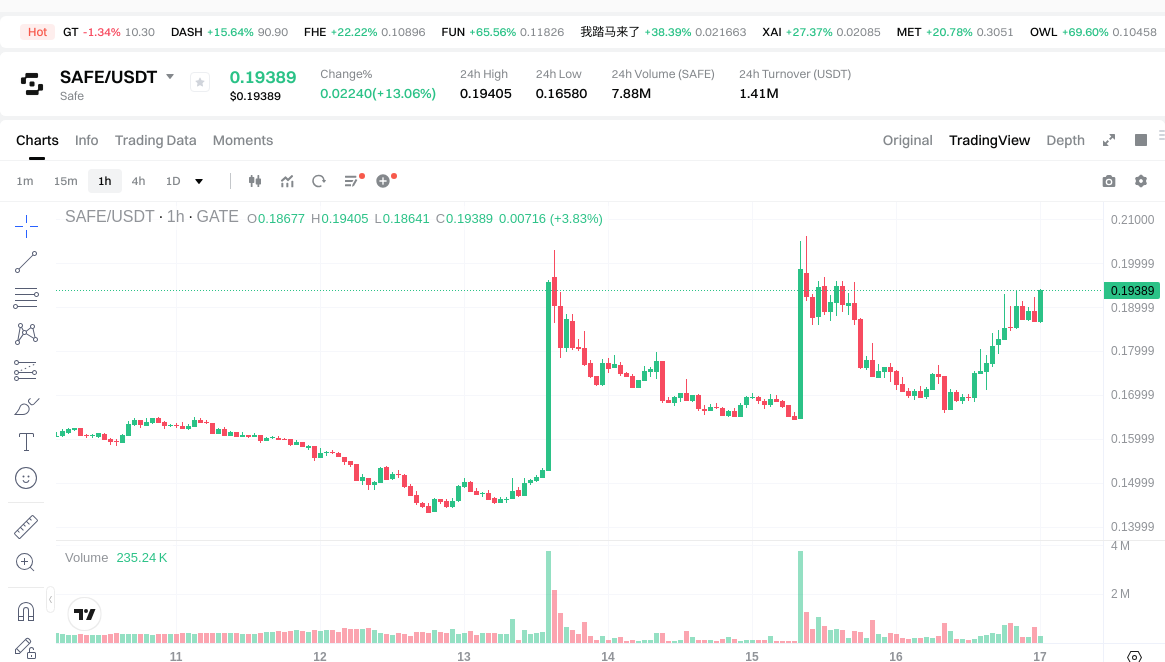
Recent price performance shows positive momentum, with the token gaining 11.16% over the past 24 hours and 17.27% over the past week. The 30-day performance of 47.46% indicates strengthening investor interest. The 24-hour price range fluctuated between $0.1658 and $0.1936, with the current price near the upper end of this range.
Safe continues to position itself as the ownership layer of web3, securing assets valued at over $100 billion. The project encompasses Safe{Core}, a comprehensive account abstraction infrastructure stack, and Safe{Wallet}, an industry-standard multi-signature solution. The platform's development roadmap focuses on transforming every Ethereum account into a smart account, enabling emerging use cases across AI, staking, gaming, SocialFi, DeFi, and payment sectors through features such as gasless transactions, simplified authentication mechanisms, on-ramps, and account recovery options.
Click to view current SAFE market price
SAFE Market Sentiment Index
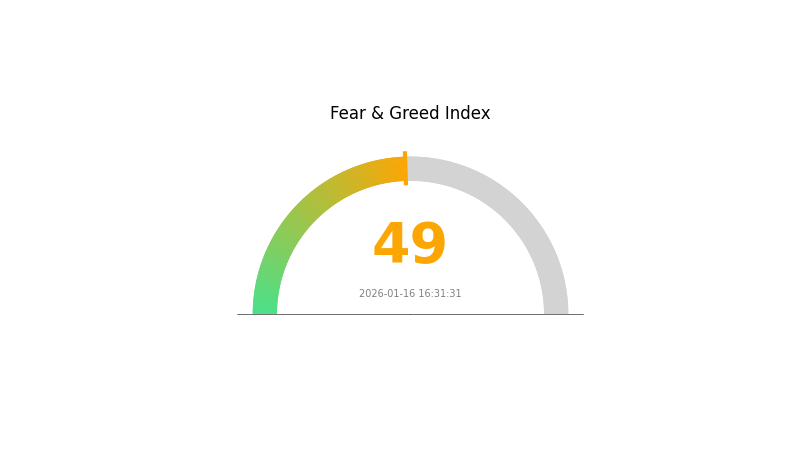
2026-01-16 Fear and Greed Index: 49 (Neutral)
Click to view current Fear & Greed Index
The crypto market is currently in a neutral sentiment state with the Fear and Greed Index at 49. This balanced reading suggests market participants are neither excessively fearful nor overly greedy, indicating a relatively stable market condition. Investors should maintain a cautious yet opportunistic approach, as the neutral stance provides a reasonable environment for both defensive and selective growth strategies. Monitor key support and resistance levels closely during this equilibrium phase.
SAFE Holder Distribution
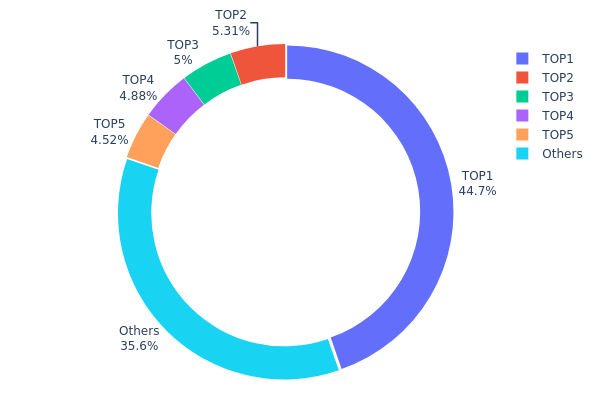
The holder distribution chart illustrates the concentration of token ownership across different wallet addresses, providing crucial insights into the token's decentralization level and potential market manipulation risks. By analyzing the proportion of tokens held by top addresses versus the broader holder base, investors can assess the health of the token's distribution structure and its implications for price stability.
According to the current data, SAFE exhibits a moderate to high concentration pattern. The top holder controls 446,887.73K tokens, representing 44.68% of the total supply—a significant concentration that raises concerns about centralized control. The top five addresses collectively hold 644,095.73K tokens, accounting for 64.39% of the total supply, while the remaining 355,904.27K tokens (35.61%) are distributed among other holders. This distribution pattern indicates that a small number of addresses maintain substantial control over the token supply.
This concentration level presents both opportunities and risks for the market structure. The dominant position of the top holder could lead to increased price volatility if large-scale token movements occur, potentially triggering sharp price swings. Additionally, such concentration heightens the risk of market manipulation, as major holders possess sufficient capacity to influence price discovery. However, if these large holders represent project treasuries, ecosystem funds, or long-term institutional investors, this could signal stability and commitment to the project's development. The current distribution suggests that SAFE's on-chain structure leans toward centralization, which may impact investor confidence and requires close monitoring of large holder activities to assess market health and potential risks.
Click to view current SAFE Holder Distribution
| Top |
Address |
Holding Qty |
Holding (%) |
| 1 |
0x96b7...1ea4ff |
446887.73K |
44.68% |
| 2 |
0x1d4f...fd6f45 |
53140.05K |
5.31% |
| 3 |
0x0b00...d2f888 |
50000.00K |
5.00% |
| 4 |
0xd28b...f56922 |
48822.44K |
4.88% |
| 5 |
0x99a8...a25ee5 |
45245.51K |
4.52% |
| - |
Others |
355904.27K |
35.61% |
II. Core Factors Influencing SAFE's Future Price
Supply Mechanism
-
Central Bank Gold Reserves: Global central banks, particularly those in developing nations, have significantly increased gold purchases. China's central bank gold reserves rose from approximately 64 million ounces in 2022 to about 74 million ounces currently (approximately 2,300 tons), an increase of 10 million ounces over three years. In November 2025, global central banks purchased a net 45 tons of gold.
-
Historical Pattern: Throughout history, increases in central bank gold purchasing have typically supported long-term price appreciation. Between 2008-2011, during the economic recession period, gold prices surged from $700 to $1,900 per ounce, an increase exceeding 170%, driven primarily by liquidity injection and recession-driven safe-haven demand.
-
Current Impact: According to a World Gold Council survey released in June, 95% of surveyed central banks expect global official gold reserves to increase further over the next 12 months, up significantly from 81% last year. Additionally, 43% of surveyed central banks indicated plans to continue increasing gold holdings next year, reaching a historic high compared to just 29% last year.
Institutional and Major Holder Dynamics
-
Institutional Holdings: The United States holds over 8,100 tons of gold reserves, ranking first globally. However, developing countries' central banks have shown considerable momentum in gold accumulation and continue to increase holdings. From 2020 to 2025, enterprise utilization of foreign exchange derivatives for managing exchange rate risks exceeded 1.9 trillion USD, nearly doubling compared to 2020.
-
Enterprise Adoption: Investment demand for gold has demonstrated robust growth momentum. In 2021, global gold investment demand reached 991 tons, rising to 1,182 tons by 2024. Gold ETF performance has been particularly noteworthy, with investment demand shifting from negative drag in 2021 to near-positive contribution in 2024, achieving positive territory this year.
-
National Policy: China's foreign exchange bureau and financial institutions have continuously improved enterprise exchange rate risk management services. Over 120 banks now offer foreign exchange derivative products. The enterprise foreign exchange hedging ratio reached 30% in 2025, an 8 percentage point increase from 2020.
Macroeconomic Environment
-
Monetary Policy Impact: Major global economies have generally entered low interest rate cycles, including the United States and China. The Federal Reserve announced a 25 basis point rate cut in September. Given current U.S. unemployment rates and economic performance have not yet reached expected targets, markets widely anticipate continued rate cuts ahead. Lower real interest rates (averaging -0.5% during 2024-2025) lead gold price increases by 3-6 months.
-
Inflation Hedge Attribute: In low interest rate environments, traditional fixed-income assets become less attractive, prompting investors seeking asset preservation and appreciation to turn toward gold and other safe-haven assets, thereby strengthening market expectations for gold price increases. Historical cases demonstrate that military conflicts escalating often intensify global resource supply-demand tensions, pushing up inflation levels, with gold prices typically rising accordingly as a traditional safe-haven and anti-inflation tool.
-
Geopolitical Factors: Geopolitical risks remain a core driver of gold as a safe-haven asset. Against the backdrop of U.S.-China decoupling concerns and intensifying Cold War-style competition during 2025-2026, geopolitical tensions have amplified short-term volatility. Historical data shows such uncertainty often leads capital flows from equities and other risk assets toward gold, driving prices higher. For instance, during the 2022 Russia-Ukraine conflict, gold prices rose in tandem as global energy prices surged dramatically.
Technical Development and Ecosystem Building
-
Financial Attribute Enhancement: In modern monetary systems, gold's monetary attributes have gradually weakened, but its financial attributes have strengthened significantly. With innovations in financial investment instruments such as futures and ETFs (Exchange-Traded Funds), gold's liquidity and tradability as a financial asset have enhanced substantially, making it a popular choice for investors seeking preservation, appreciation, and even speculation.
-
Supply-Demand Imbalance: From a supply-demand relationship perspective, gold demand continues growing while production increases remain limited. According to statistics, excluding over-the-counter transactions, gold demand increased from 4,026 tons in 2021 to 4,606 tons in 2024, while gold mine production only rose from 3,573 tons to 3,673 tons during the same period. This supply-demand imbalance further drives gold prices upward.
-
Market Infrastructure: In 2025, foreign exchange market trading volume reached 42.6 trillion USD, with enterprise foreign exchange hedging ratios rising to 30%, both reaching historic highs. China's foreign exchange trading volume continues setting new records, with market participants encompassing major domestic financial institutions as well as overseas institutions. Diverse trading entities and expanding market depth enable effective absorption of external environmental changes' impacts.
III. 2026-2031 SAFE Price Prediction
2026 Outlook
- Conservative Prediction: $0.17062 - $0.19389
- Neutral Prediction: Around $0.19389
- Optimistic Prediction: Up to $0.22103 (subject to favorable market conditions and increased adoption)
2027-2029 Outlook
- Market Stage Expectation: Progressive growth phase with gradual market maturation and expanding ecosystem development
- Price Range Predictions:
- 2027: $0.20124 - $0.28422
- 2028: $0.23109 - $0.33189
- 2029: $0.17910 - $0.42463
- Key Catalysts: Potential technological advancements, broader market acceptance, and strategic partnerships that may drive sustained price appreciation
2030-2031 Long-term Outlook
- Baseline Scenario: $0.26756 - $0.35675 (assuming steady ecosystem growth and stable market conditions)
- Optimistic Scenario: $0.35675 - $0.52442 (with accelerated adoption and favorable regulatory environment)
- Transformative Scenario: $0.44058 - $0.61241 (under exceptional market circumstances with significant institutional involvement)
- 2026-01-17: SAFE trading within the projected initial range (early stage of potential multi-year growth trajectory)
| Year |
Predicted High Price |
Predicted Average Price |
Predicted Low Price |
Price Change |
| 2026 |
0.22103 |
0.19389 |
0.17062 |
1 |
| 2027 |
0.28422 |
0.20746 |
0.20124 |
8 |
| 2028 |
0.33189 |
0.24584 |
0.23109 |
28 |
| 2029 |
0.42463 |
0.28887 |
0.1791 |
50 |
| 2030 |
0.52442 |
0.35675 |
0.26756 |
86 |
| 2031 |
0.61241 |
0.44058 |
0.2247 |
130 |
IV. SAFE Professional Investment Strategies and Risk Management
SAFE Investment Methodology
(I) Long-term Holding Strategy
- Target Investors: Suitable for investors who believe in the long-term value proposition of account abstraction infrastructure and multi-signature wallet solutions in the Web3 ecosystem
- Operational Recommendations:
- Consider accumulating SAFE tokens during market corrections, particularly when price approaches key support levels
- Monitor the development progress of Safe{Core} infrastructure and Safe{Wallet} adoption metrics as indicators of long-term value
- Implement a diversified storage solution combining both custodial and non-custodial options
- Storage Solution: Gate Web3 Wallet is recommended for secure self-custody with user-friendly interface and multi-chain support
(II) Active Trading Strategy
- Technical Analysis Tools:
- Moving Averages: Utilize 50-day and 200-day moving averages to identify trend direction and potential entry/exit points
- Volume Analysis: Monitor trading volume patterns to confirm price movements and identify potential breakouts or reversals
- Swing Trading Key Points:
- Pay attention to the high volatility characteristics, with 24-hour price fluctuation ranging between $0.1658 and $0.1936
- Set appropriate stop-loss levels considering the token's historical volatility and recent 7-day gain of 17.27%
SAFE Risk Management Framework
(I) Asset Allocation Principles
- Conservative Investors: 2-3% of crypto portfolio allocation
- Aggressive Investors: 5-8% of crypto portfolio allocation
- Professional Investors: Up to 10-15% of crypto portfolio allocation with active hedging strategies
(II) Risk Hedging Solutions
- Portfolio Diversification: Combine SAFE holdings with blue-chip cryptocurrencies and stablecoins to balance overall portfolio risk
- Position Sizing: Implement dollar-cost averaging to mitigate timing risk and reduce exposure to short-term price volatility
(III) Secure Storage Solutions
- Non-custodial Wallet Recommendation: Gate Web3 Wallet provides secure self-custody with built-in security features and seamless integration
- Hardware Wallet Solution: For large holdings, consider using hardware wallets combined with multi-signature setup for enhanced security
- Security Considerations: Never share private keys, enable two-factor authentication, regularly update wallet software, and verify all transaction details before confirmation
V. SAFE Potential Risks and Challenges
SAFE Market Risks
- High Volatility Risk: SAFE has experienced significant price fluctuations, with a 1-year decline of 80.56% from its peak, indicating substantial volatility
- Liquidity Risk: With a 24-hour trading volume of approximately $1.42 million and market cap of $131.56 million, the token may face liquidity constraints during market stress
- Market Concentration Risk: The circulating supply represents 68.73% of total supply, with potential unlock events potentially impacting price stability
SAFE Regulatory Risks
- Compliance Uncertainty: Evolving regulatory frameworks for Web3 infrastructure and cryptocurrency services may affect the project's operational model
- Multi-jurisdiction Challenges: As a global platform securing over $100 billion in assets, SAFE may face varying regulatory requirements across different jurisdictions
- Smart Contract Regulation: Future regulations targeting DeFi protocols and account abstraction technologies could impact the project's growth trajectory
SAFE Technical Risks
- Smart Contract Vulnerabilities: Despite being an industry-standard multi-signature solution, potential undiscovered vulnerabilities in smart contracts could pose security risks
- Ethereum Dependency: As an ERC-20 token built on Ethereum, SAFE is exposed to underlying blockchain risks including network congestion and scalability limitations
- Competition Risk: The account abstraction and wallet infrastructure space is becoming increasingly competitive, with multiple projects developing similar solutions
VI. Conclusion and Action Recommendations
SAFE Investment Value Assessment
SAFE represents a foundational infrastructure project in the Web3 ecosystem, focusing on account abstraction and smart account solutions. The project's long-term value proposition is supported by its established position as an industry-standard multi-signature wallet solution securing over $100 billion in assets. However, the significant 80.56% decline over the past year and current low price relative to its historical high of $4.48 reflect both market-wide corrections and project-specific challenges. Short-term risks include high volatility, regulatory uncertainty, and competitive pressures, while long-term potential depends on successful adoption of Safe{Core} infrastructure and the broader growth of account abstraction use cases across AI, gaming, DeFi, and payment sectors.
SAFE Investment Recommendations
✅ Beginners: Start with small position sizes (1-2% of crypto portfolio), focus on understanding the project fundamentals, and utilize dollar-cost averaging to build positions gradually while monitoring market conditions
✅ Experienced Investors: Consider moderate allocations (3-5% of crypto portfolio) with active risk management, combining long-term holdings with tactical trading opportunities during volatility spikes
✅ Institutional Investors: Evaluate SAFE as part of a diversified Web3 infrastructure portfolio, with potential allocations of 5-10% combined with comprehensive due diligence on technical roadmap and competitive positioning
SAFE Trading Participation Methods
- Spot Trading: Purchase SAFE tokens directly through Gate.com with competitive trading fees and deep liquidity
- Portfolio Integration: Incorporate SAFE into a broader crypto portfolio alongside complementary Web3 infrastructure projects
- Research-Driven Approach: Stay updated on Safe ecosystem developments, partnership announcements, and adoption metrics to inform investment decisions
Cryptocurrency investment carries extremely high risk, and this article does not constitute investment advice. Investors should make prudent decisions based on their own risk tolerance and are advised to consult professional financial advisors. Never invest more than you can afford to lose.
FAQ
What is the historical price trend of SAFE token? What are the main price drivers?
SAFE token price is currently $0.1695 as of January 16, 2026. Main price drivers include market sentiment, news events, technical analysis patterns, and holder statistics. Trading volume and whale activity significantly influence price trends in the market.
How to conduct SAFE price predictions? What are the common technical analysis and fundamental analysis methods?
Use technical analysis methods like moving averages and RSI indicators to analyze price trends. For fundamental analysis, examine SAFE's tokenomics, ecosystem development, and market adoption. Combine both approaches to identify potential price movements and trading opportunities.
What are the risks of investing in SAFE tokens? What are the main reasons for price fluctuations?
SAFE token risks include market volatility, price manipulation, and regulatory uncertainty. Price fluctuations are primarily driven by market demand, overall crypto market trends, and trading volume changes.
SAFE operates entirely through smart contracts rather than traditional EOA (externally owned accounts), providing enhanced security and advanced features like multi-signature capabilities and account recovery, distinguishing it from other security-focused solutions.
What are SAFE's market prospects? What are its future development directions and application scenarios?
SAFE demonstrates strong market potential with expanding adoption in decentralized finance and asset management. Future development focuses on enhanced security protocols, broader institutional integration, and cross-chain interoperability, positioning SAFE as a critical infrastructure layer in Web3 ecosystems.
Where can SAFE tokens be traded? How is the liquidity?
SAFE tokens are available on multiple exchanges with growing liquidity. Since unlocking in April 2024, trading volume and accessibility have expanded across major platforms. Check current market data for real-time liquidity information and trading pairs.
* The information is not intended to be and does not constitute financial advice or any other recommendation of any sort offered or endorsed by Gate.