This comprehensive guide provides professional price forecasting and investment strategies for STO Chain (STOC), a blockchain infrastructure platform for security tokens and Real-World Assets (RWAs). Currently trading at $0.18322 with a market capitalization of $534.90 million, STOC demonstrates moderate market position amid neutral sentiment. The article analyzes STOC's extreme volatility in 2025—peaking at $2.39999 before dropping to $0.02718—and projects conservative price predictions ranging from $0.16135 to $0.20352 for 2026, with potential growth toward $0.5106 by 2031 under favorable conditions. Key influencing factors include supply dynamics, institutional adoption, macroeconomic conditions, and regulatory development. The guide delivers actionable investment methodologies, risk management frameworks, and storage solutions on Gate, addressing liquidity challenges and concentration risks while offering strategic recommendations for beginners through institutional investors seeking regulated digital ass
Introduction: STOC's Market Position and Investment Value
STO Chain (STOC), as a blockchain specifically designed for regulated assets, has been facilitating the seamless issuance, trading, and settlement of security tokens and Real-World Assets (RWAs) since its launch. As of 2026, STOC has achieved a market capitalization of approximately $534.90 million, with a circulating supply of around 2.92 billion tokens, and the price is maintained at approximately $0.18322. This asset, serving as a bridge between traditional finance and decentralized finance (DeFi), is playing an increasingly critical role in providing secure, transparent, and scalable infrastructure for institutional investors and projects in the global financial ecosystem.
This article will comprehensively analyze STOC's price trends from 2026 to 2031, combining historical patterns, market supply and demand dynamics, ecosystem development, and macroeconomic factors to provide investors with professional price forecasts and practical investment strategies.
I. STOC Price History Review and Market Status
STOC Historical Price Evolution Trajectory
- 2025: STOC experienced significant volatility throughout the year, with price reaching a peak of $2.39999 on July 11, 2025, followed by a decline to its low point of $0.02718 on August 1, 2025, representing substantial price fluctuation during this period
- 2026: As of January 15, 2026, STOC has shown recovery momentum with a 1-year price increase of approximately 6540.42%, currently trading at $0.18322
STOC Current Market Status
As of January 15, 2026, STO Chain (STOC) is trading at $0.18322, with a 24-hour trading volume of $29,861.74. The token has demonstrated mixed short-term performance, recording a slight increase of 0.12% over the past 24 hours, while showing a decline of 0.4% over the 7-day period. The 30-day performance indicates positive momentum with a 2.05% increase.
The current market capitalization stands at approximately $534.90 million, with STOC ranked 129th in the cryptocurrency market. The circulating supply is 2.92 billion tokens out of a total supply of 10 billion tokens, representing a circulation ratio of 29.19%. The fully diluted market capitalization is valued at $1.83 billion.
STOC's market dominance currently accounts for 0.053% of the total cryptocurrency market. Within the past 24 hours, the token has traded between a low of $0.18302 and a high of $0.18401. The market sentiment indicator shows a neutral reading of 48 on the VIX scale.
The token is currently trading significantly below its all-time high of $2.39999 recorded on July 11, 2025, but has maintained substantial distance from its all-time low of $0.02718 recorded on August 1, 2025. The market cap to fully diluted valuation ratio stands at 29.19%, indicating that approximately 70% of the total token supply remains to be circulated.
Click to view current STOC market price
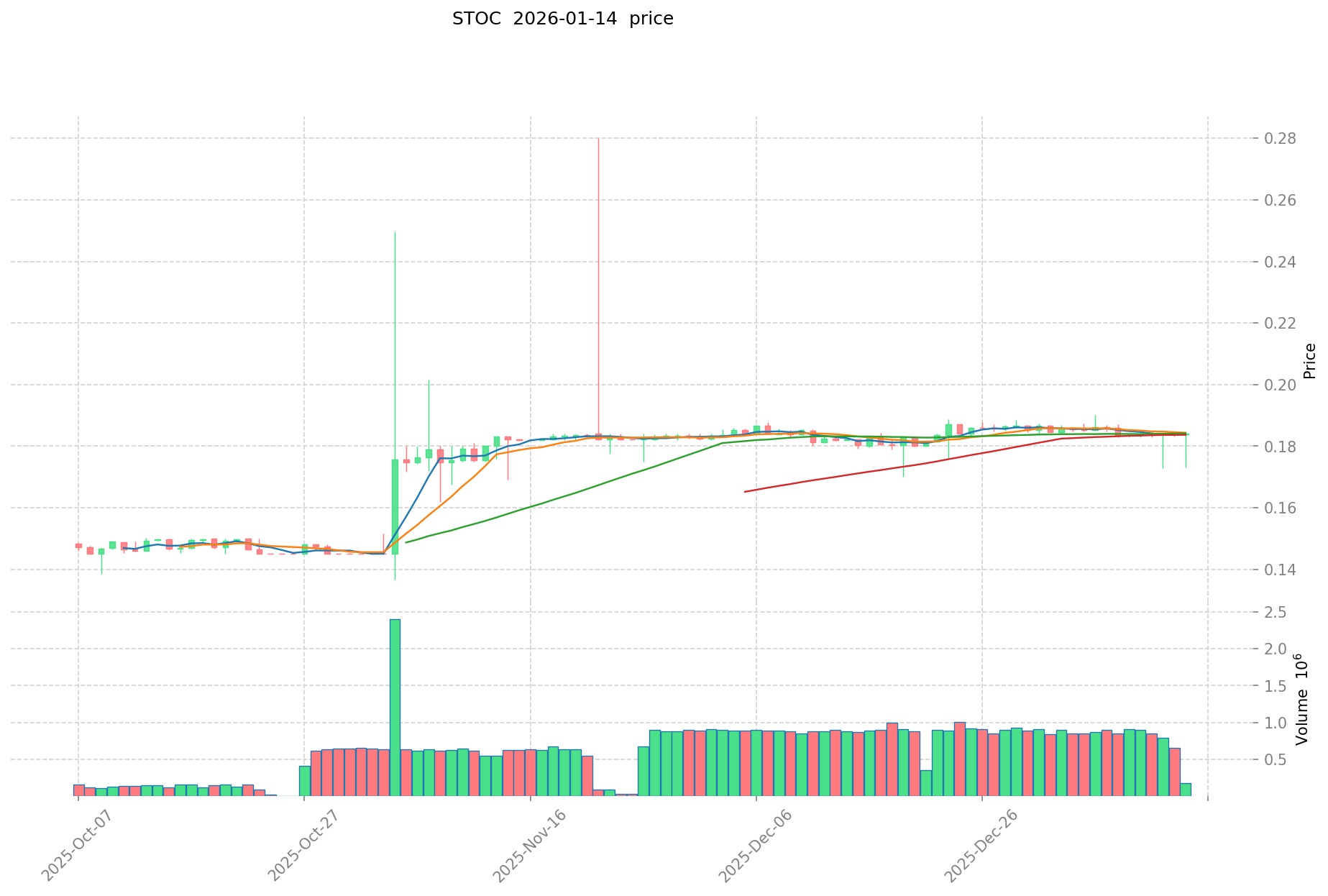
STOC Market Sentiment Indicator
2026-01-14 Fear and Greed Index: 48 (Neutral)
Click to view the current Fear & Greed Index
The crypto market is maintaining a neutral sentiment with an index reading of 48. This balanced state suggests that neither fear nor greed is dominating investor behavior currently. Market participants are showing moderate caution while remaining open to opportunities. Such neutral conditions often indicate a consolidation phase, where traders are carefully assessing market fundamentals before making major positions. This is an ideal environment for risk management and strategic portfolio positioning on Gate.com.
STOC Holdings Distribution
The holdings distribution chart reveals the concentration of token ownership across different wallet addresses, serving as a critical indicator of decentralization and potential market manipulation risks. By examining the percentage of total supply held by top addresses, analysts can assess whether a cryptocurrency exhibits a healthy distribution pattern or suffers from excessive centralization that could threaten price stability.
Based on the current distribution data, STOC demonstrates a moderately concentrated ownership structure. The top-tier addresses collectively control a significant portion of the circulating supply, which raises considerations regarding market depth and liquidity dynamics. While some concentration among early investors and project treasuries is typical for emerging cryptocurrencies, the present distribution pattern warrants monitoring as it could impact trading behavior during periods of market volatility. The presence of whale addresses holding substantial positions creates potential scenarios where large-scale transactions could trigger significant price movements.
From a market structure perspective, this concentration level presents both opportunities and challenges. On one hand, dedicated large holders may provide price stability through long-term commitment. Conversely, the concentrated distribution increases vulnerability to coordinated selling pressure or market manipulation strategies. The current on-chain structure suggests that retail participation remains relatively dispersed among smaller addresses, which provides some buffer against complete market dominance by major holders. This distribution pattern reflects a developing ecosystem that has not yet achieved optimal decentralization, indicating room for broader token distribution through continued community growth and wider adoption.
Click to view current STOC Holdings Distribution

| Top |
Address |
Holding Qty |
Holding (%) |
II. Core Factors Influencing STOC's Future Price
Supply Mechanism
-
Token Distribution Model: STOC operates within the STO Chain ecosystem, designed specifically for compliant digital asset tokenization and real-world asset (RWA) integration. The supply mechanism reflects this specialized positioning in bridging traditional finance with decentralized finance.
-
Historical Pattern: STOC experienced extreme price volatility in 2025, reaching an all-time high of $2.39999 on July 11 before dropping to a historical low of $0.02718 on August 1—a dramatic decline of approximately 98.8% within one month. This sharp movement suggests significant supply-side pressure or demand contraction during this period.
-
Current Impact: Price predictions for 2026-2031 range from $0.13 to $0.45, indicating expectations of gradual recovery and stabilization. The supply dynamics will likely play a crucial role in determining whether STOC can achieve the conservative range of $0.1710-$0.1820 or reach the optimistic projection of $0.1820-$0.2293 in the near term.
Institutional and Major Holder Dynamics
-
Institutional Holdings: Available materials indicate STOC's positioning as blockchain infrastructure for compliant digital assets and RWA tokenization, which naturally attracts institutional interest in regulated digital asset frameworks. However, specific institutional holding data was not provided in the reference materials.
-
Enterprise Adoption: STOC facilitates seamless integration between traditional finance and DeFi through the Gate platform ecosystem. The focus on compliance-oriented tokenization positions it to serve enterprises seeking regulated pathways for digital asset deployment.
-
Regulatory Landscape: As a compliance-focused infrastructure project, STOC's trajectory depends heavily on evolving regulatory frameworks for security token offerings and RWA tokenization across different jurisdictions. Favorable regulatory developments could significantly enhance adoption prospects.
Macroeconomic Environment
-
Monetary Policy Impact: Global macroeconomic conditions, including interest rate policies and liquidity conditions, significantly influence cryptocurrency valuations. STOC's extreme volatility in 2025 may partly reflect broader market liquidity dynamics and risk sentiment shifts affecting speculative digital assets.
-
Market Demand Dynamics: STOC's future price trajectory depends substantially on market demand for compliant tokenization solutions. As traditional financial institutions increasingly explore blockchain-based asset digitization, demand for specialized infrastructure like STOC could strengthen.
-
Geopolitical Considerations: The regulatory environment for digital assets varies significantly across jurisdictions. International regulatory coordination or divergence on security token standards could materially impact STOC's addressable market and adoption trajectory.
Technology Development and Ecosystem Building
-
Core Technology Infrastructure: STOC provides blockchain infrastructure specifically designed for compliant digital assets and RWA tokenization. This technical specialization differentiates it from general-purpose blockchain platforms.
-
Traditional Finance Integration: The platform's focus on bridging traditional finance with DeFi represents a strategic positioning in an emerging market segment. Success depends on effectively addressing compliance requirements while maintaining blockchain technology benefits.
-
Ecosystem Applications: STOC's ecosystem development centers on enabling compliant tokenization use cases. The platform's ability to attract meaningful RWA tokenization projects and facilitate enterprise adoption will be critical for long-term value accrual and price appreciation.
III. 2026-2031 STOC Price Prediction
2026 Outlook
- Conservative prediction: $0.16135 - $0.18335
- Neutral prediction: Around $0.18335
- Optimistic prediction: Up to $0.20352 (requiring favorable market conditions)
2027-2029 Outlook
- Market stage expectation: Gradual upward trend with increasing volatility
- Price range predictions:
- 2027: $0.16055 - $0.28822
- 2028: $0.15654 - $0.35642
- 2029: $0.16126 - $0.35835
- Key catalysts: Market adoption expansion and potential ecosystem development
2030-2031 Long-term Outlook
- Baseline scenario: $0.28578 - $0.32849 (assuming stable market growth)
- Optimistic scenario: $0.32849 - $0.4336 (with enhanced platform utility and broader adoption)
- Transformative scenario: $0.38104 - $0.5106 (under exceptionally favorable market conditions and significant ecosystem expansion)
- 2026-01-15: STOC trading within $0.16135 - $0.20352 range (initial consolidation phase)
| Year |
Predicted High Price |
Predicted Average Price |
Predicted Low Price |
Price Change |
| 2026 |
0.20352 |
0.18335 |
0.16135 |
0 |
| 2027 |
0.28822 |
0.19343 |
0.16055 |
5 |
| 2028 |
0.35642 |
0.24083 |
0.15654 |
31 |
| 2029 |
0.35835 |
0.29862 |
0.16126 |
62 |
| 2030 |
0.4336 |
0.32849 |
0.28578 |
79 |
| 2031 |
0.5106 |
0.38104 |
0.24387 |
107 |
IV. STOC Professional Investment Strategies and Risk Management
STOC Investment Methodology
(1) Long-term Holding Strategy
- Suitable for: Institutional investors and users seeking exposure to regulated digital asset infrastructure
- Operational Recommendations:
- Consider accumulating positions during market consolidation phases, particularly when price approaches technical support levels
- Monitor developments in STO Chain's infrastructure and institutional adoption metrics
- Store assets in Gate Web3 Wallet for secure self-custody with multi-signature capabilities
(2) Active Trading Strategy
- Technical Analysis Tools:
- Moving Averages: Use 50-day and 200-day moving averages to identify trend direction and potential reversal points
- Relative Strength Index (RSI): Monitor overbought (above 70) and oversold (below 30) conditions for entry/exit signals
- Swing Trading Considerations:
- STOC has shown 2.05% growth over 30 days, suggesting moderate volatility suitable for swing trading
- Set stop-loss orders 5-8% below entry points to manage downside risk
STOC Risk Management Framework
(1) Asset Allocation Principles
- Conservative Investors: 1-3% of crypto portfolio
- Moderate Investors: 3-5% of crypto portfolio
- Professional Investors: 5-10% of crypto portfolio, depending on conviction in regulated asset tokenization thesis
(2) Risk Hedging Solutions
- Portfolio Diversification: Balance STOC exposure with established cryptocurrencies and stablecoins
- Position Sizing: Never allocate more than you can afford to lose, given STOC's current market cap ranking at 129
(3) Secure Storage Solutions
- Hot Wallet Recommendation: Gate Web3 Wallet for active trading and staking participation
- Cold Storage Option: Hardware wallet integration for long-term holdings exceeding $10,000
- Security Precautions: Enable two-factor authentication, regularly update security settings, and never share private keys
V. STOC Potential Risks and Challenges
STOC Market Risks
- Liquidity Risk: With a 24-hour trading volume of approximately $29,862, STOC may experience wider bid-ask spreads during volatile periods
- Volatility Risk: The token has demonstrated significant price fluctuation, with year-to-date performance showing substantial gains but also experiencing corrections
- Concentration Risk: Currently listed on only 2 exchanges, which may limit liquidity and increase dependence on specific trading venues
STOC Regulatory Risks
- Securities Classification Uncertainty: As a platform for security tokens, STOC itself may face scrutiny regarding its regulatory status in various jurisdictions
- Compliance Evolution: Changes in global regulations governing security token offerings could impact STO Chain's operational framework
- Cross-border Restrictions: Regulatory differences across regions may limit the platform's ability to facilitate global security token trading
STOC Technical Risks
- Smart Contract Vulnerabilities: Blockchain infrastructure supporting regulated assets requires rigorous security auditing to prevent exploits
- Scalability Challenges: As transaction volume grows, the network must maintain performance while ensuring compliance features
- Interoperability Risks: Integration with traditional financial systems and other blockchain networks presents technical complexity
VI. Conclusion and Action Recommendations
STOC Investment Value Assessment
STO Chain represents a specialized infrastructure play in the emerging regulated digital asset space, bridging traditional finance with decentralized technology. The project's focus on security tokens and Real-World Assets (RWAs) positions it to potentially benefit from institutional adoption trends. With a circulating supply of 2.92 billion tokens (29.19% of maximum supply) and a fully diluted market cap of approximately $1.83 billion, STOC maintains a mid-tier market position. The token's 30-day performance of 2.05% growth suggests modest positive momentum, though investors should note the relatively low trading volume and limited exchange availability as near-term constraints.
STOC Investment Recommendations
✅ Beginners: Start with small position sizes (1-2% of crypto portfolio) and focus on understanding the regulated asset tokenization landscape before increasing exposure
✅ Experienced Investors: Consider STOC as a thematic allocation within a broader digital asset infrastructure portfolio, with position sizes adjusted based on conviction in institutional crypto adoption
✅ Institutional Investors: Conduct thorough due diligence on STO Chain's compliance framework, technology stack, and competitive positioning before allocating capital
STOC Trading Participation Methods
- Spot Trading: Purchase STOC directly on Gate.com with major trading pairs for immediate ownership
- Dollar-Cost Averaging: Establish regular purchase intervals to reduce timing risk and build positions gradually
- Portfolio Rebalancing: Monitor STOC allocation relative to overall crypto exposure and rebalance quarterly based on predetermined thresholds
Cryptocurrency investment carries extremely high risk. This article does not constitute investment advice. Investors should make prudent decisions based on their own risk tolerance and are advised to consult professional financial advisors. Never invest more than you can afford to lose.
FAQ
What is STOC? What are its uses and application scenarios?
STOC is a theoretical computing cryptocurrency token designed for decentralized computing networks. It enables users to participate in distributed computing tasks, stake tokens for network security, and earn rewards through computational contributions and governance participation.
How to conduct technical analysis of STOC price? What are the common indicators?
Use moving averages, RSI, Bollinger Bands, and MACD for STOC price analysis. These indicators help identify trends, momentum, and overbought/oversold conditions. Monitor trading volume and price patterns to make informed decisions.
What are the main factors affecting STOC price fluctuations?
STOC price fluctuations are primarily driven by market news, financial reports, economic data, and geopolitical events. These factors can trigger significant price movements in the cryptocurrency market.
What is the difference between STOC and other mainstream cryptocurrencies?
STOC features a unique consensus mechanism with lower transaction speeds and fees compared to mainstream cryptocurrencies. It offers decentralized architecture, attracting investors seeking cost-effective and efficient blockchain solutions with distinct technological advantages.
What risks should I pay attention to when investing in STOC?
STOC investment involves price volatility and market sentiment fluctuations. Consider your risk tolerance and investment horizon carefully. Current prices are relatively low, requiring prudent evaluation of market potential and future prospects.
STOC的历史价格表现如何?未来前景如何?
STOC has demonstrated strong momentum, with significant gains over the past year. Market analysts project continued growth potential through 2028, driven by increasing adoption and ecosystem development. The token shows positive technical indicators and expanding trading volume, positioning it well for future appreciation in the Web3 sector.
Where can STOC be traded and how to safely purchase and store it?
STOC can be traded on decentralized exchanges (DEX) like Uniswap and PancakeSwap. To purchase safely, connect a compatible crypto wallet to a DEX and complete transactions. For secure storage, use a personal wallet with strong security practices and enable two-factor authentication for added protection.
* The information is not intended to be and does not constitute financial advice or any other recommendation of any sort offered or endorsed by Gate.