This comprehensive STX price analysis examines Stacks token's market position as a Bitcoin Layer 2 solution, currently trading at $0.39 with a market cap of $709.7 million. The article delivers professional price forecasts spanning 2026-2031, predicting potential growth from $0.29-$0.57 (2026) to $0.63-$1.16 (2031), driven by ecosystem development and Bitcoin DeFi adoption. Core analysis covers supply mechanisms, institutional dynamics, technical innovations including sBTC, and macroeconomic factors influencing STX valuation. Investment strategies address three investor profiles with specific allocation recommendations, risk management frameworks, and secure custody solutions via Gate Web3 Wallet. The article balances growth opportunities against significant risks including 73.2% annual decline and regulatory uncertainty, providing actionable guidance for beginners through institutional investors navigating the volatile Bitcoin infrastructure sector.
Introduction: STX's Market Position and Investment Value
Stacks (STX), positioned as a decentralized application platform that empowers a new internet where users control their own data, has been developing since its inception in 2017. As of 2026, STX has achieved a market capitalization of approximately $709.7 million, with a circulating supply of around 1.82 billion tokens, and its price maintained at approximately $0.39. This asset, often described as the "blockchain browser" that bridges Bitcoin's security with smart contract functionality, is playing an increasingly vital role in the decentralized application ecosystem and Bitcoin Layer-2 solutions.
This article will comprehensively analyze STX's price trends from 2026 to 2031, combining historical patterns, market supply and demand dynamics, ecosystem development, and macroeconomic environment factors to provide investors with professional price forecasts and practical investment strategies.
I. STX Price History Review and Current Market Status
STX Historical Price Evolution Trajectory
- 2020: STX reached its all-time low of $0.04559639 on March 13, marking a significant price bottom during early market development
- 2024: On April 1, STX achieved its all-time high of $3.86, representing substantial growth from its historical low point
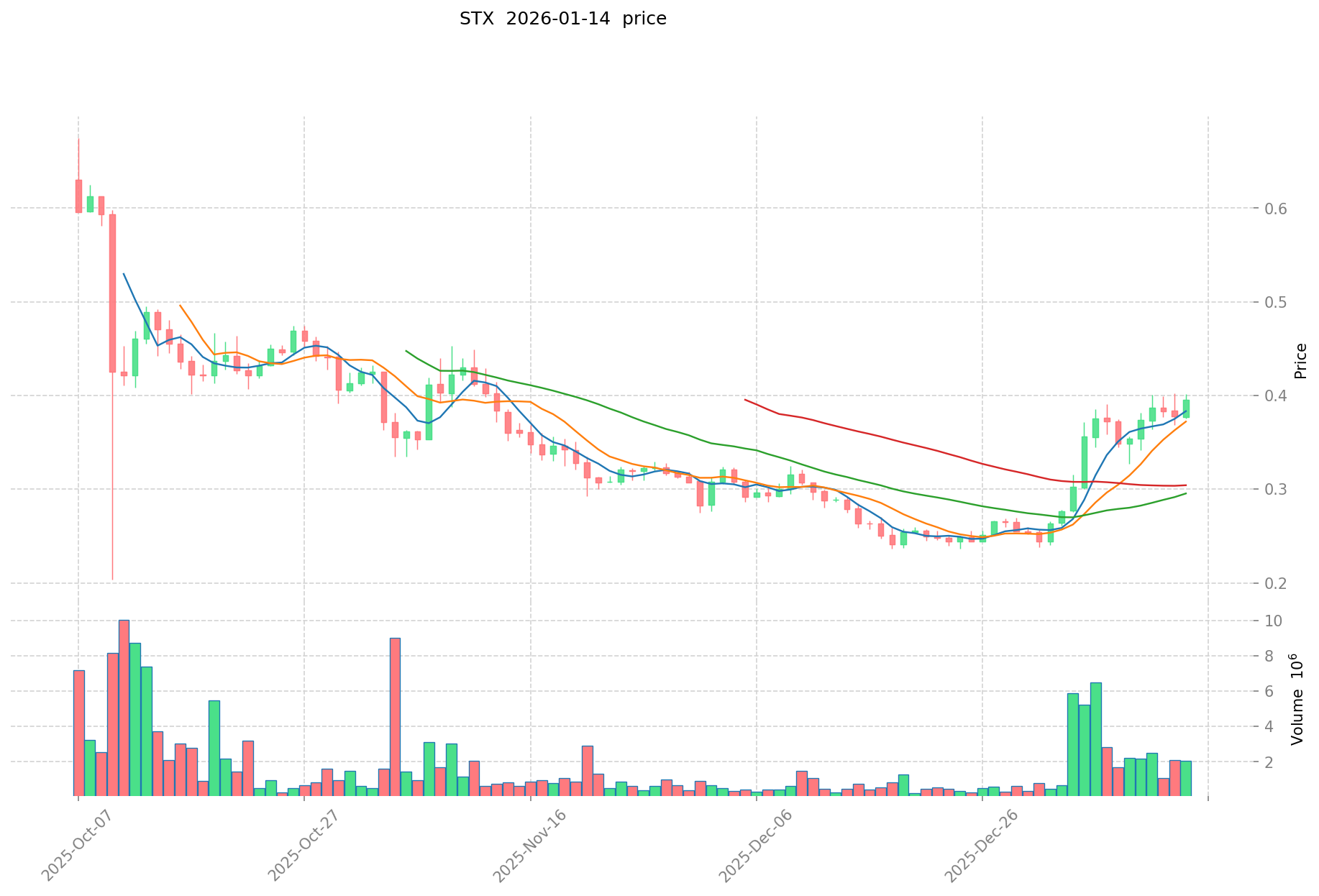
- 2025-2026: Following the peak, the token experienced a notable correction, with the price declining to approximately $0.3893 by January 2026
STX Current Market Status
As of January 14, 2026, STX is trading at $0.3893, showing mixed short-term and long-term performance indicators. The token has demonstrated relative stability in the immediate term, with a slight decline of 0.23% over the past 24 hours and 0.36% in the last hour. The 24-hour trading range spans from $0.3857 to $0.4014, indicating moderate intraday volatility.
From a medium-term perspective, STX has shown positive momentum with a 7.35% increase over the past week and a substantial 38.26% gain over the last 30 days. However, the annual performance reveals a significant correction of 73.2% from its previous levels, reflecting broader market adjustments following the April 2024 peak.
STX currently holds the 108th position in market capitalization rankings, with a total market cap of approximately $709.7 million. The circulating supply stands at 1.823 billion tokens, representing over 100% of the maximum supply of 1.818 billion tokens. The 24-hour trading volume reaches $1.86 million, with the token listed on 34 exchanges. The market capitalization to fully diluted valuation ratio stands at 100%, indicating full token circulation. STX maintains a market dominance of 0.020% within the broader cryptocurrency ecosystem.
Click to view current STX market price
STX Market Sentiment Indicator
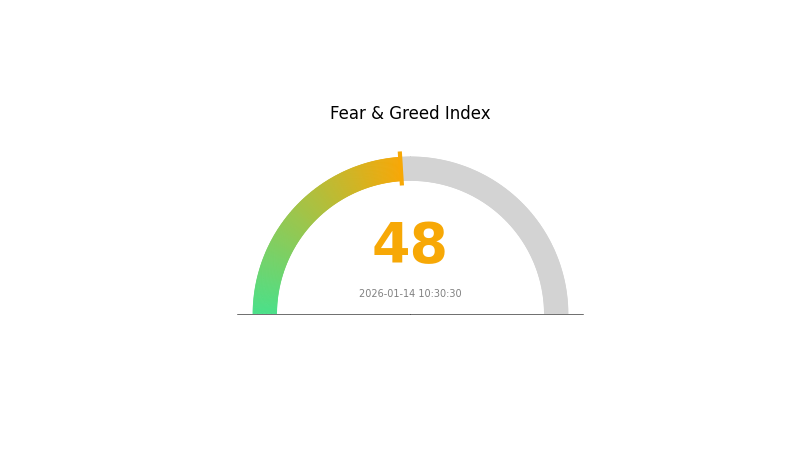
2026-01-14 Fear & Greed Index: 48 (Neutral)
Click to view the current Fear & Greed Index
The STX market is currently displaying a neutral sentiment with a fear and greed index reading of 48. This balanced positioning suggests that market participants are maintaining a cautious yet optimistic stance, with neither excessive fear nor unbridled greed dominating investor behavior. At this neutral level, traders should remain vigilant while continuing to monitor price action and fundamental developments. This presents a stable environment for both conservative positioning and calculated opportunities, though investors should stay alert to potential sentiment shifts.
STX Holdings Distribution
The STX holdings distribution chart illustrates the concentration of token ownership across different wallet addresses within the Stacks ecosystem. This metric serves as a critical indicator of decentralization and market structure, revealing how tokens are dispersed among various stakeholders including institutional investors, long-term holders, and retail participants.
Based on the current distribution data, STX demonstrates a moderate concentration pattern in its top addresses. While the largest holders maintain significant positions, the overall distribution suggests a relatively balanced ecosystem compared to many other layer-2 protocols. This distribution characteristic indicates that no single entity or small group possesses overwhelming control over the circulating supply, which reduces the potential for market manipulation and enhances the network's resilience against coordinated sell pressure.
The current address distribution reflects a maturing market structure for STX. The presence of diversified holdings across multiple addresses suggests growing adoption and institutional participation, which typically contributes to improved liquidity and price stability. This decentralization level supports the network's long-term sustainability and aligns with the fundamental principles of blockchain technology. The relatively dispersed ownership structure also indicates healthy on-chain activity, as tokens are actively distributed among various participants rather than concentrated in a few wallets, thereby strengthening the overall ecosystem stability.
Click to view the current STX Holdings Distribution

| Top |
Address |
Holding Qty |
Holding (%) |
II. Core Factors Influencing STX's Future Price
Supply Mechanism
- Proof of Transfer (PoX) Mining Model: Stacks employs a unique Proof of Transfer consensus mechanism where miners transfer Bitcoin to participate in mining and earn STX token rewards. This model creates a direct economic link between Bitcoin and STX, with new tokens generated through initial distribution and ongoing mining activities.
- Historical Pattern: The inflation model is designed with a progressive reduction approach, featuring a total supply cap of approximately 1.818 billion STX tokens. This controlled supply mechanism has historically provided support for price stability during periods of network growth.
- Current Impact: The gradual reduction in token issuance, combined with the staking rewards system where STX holders can lock tokens to earn Bitcoin rewards, creates deflationary pressure that may support price appreciation over time.
Institutional and Whale Dynamics
- Institutional Holdings: Current market capitalization stands at approximately 1.104 billion USD, with significant trading volume exceeding 33 million USD in 24-hour periods, indicating substantial institutional interest in the Bitcoin Layer 2 ecosystem.
- Enterprise Adoption: The Stacks ecosystem has attracted active participation from developer tool providers and DeFi protocol builders, with a strong community presence across Twitter, Reddit, and Telegram platforms involving tens of thousands of users.
- National Policy: As Bitcoin spot ETF approvals continue to drive institutional adoption of Bitcoin-related assets, Stacks benefits from its position as a leading Bitcoin Layer 2 solution, though regulatory uncertainty remains a consideration for all cryptocurrency projects.
Macroeconomic Environment
- Monetary Policy Impact: The cryptocurrency market remains highly influenced by macroeconomic factors, including central bank policies and global liquidity conditions. Bitcoin's status as a core long-term asset under the "compliant ETF + institutional allocation + global inflation expectations" framework provides indirect support for STX.
- Inflation Hedge Properties: As Bitcoin is increasingly viewed as digital gold and a store of value, Stacks' integration with Bitcoin's network positions it to potentially benefit from Bitcoin's inflation hedge characteristics, particularly during periods of monetary expansion.
- Geopolitical Factors: Global economic conditions and market sentiment shifts can impact STX price volatility, with the tight correlation between Bitcoin and STX prices meaning that positive developments in Bitcoin adoption generally support STX valuation.
Technical Development and Ecosystem Building
- Smart Contract Integration with Bitcoin: Stacks has successfully introduced smart contract functionality to the Bitcoin blockchain through innovative technical architecture, using the Clarity programming language to enable contracts that can read Bitcoin state and settle transactions on Bitcoin.
- sBTC Pegged Asset Launch: The development of sBTC, a decentralized Bitcoin-pegged asset operating on the Stacks chain, unlocks Bitcoin as a programmable productive asset. This 1:1 peg mechanism enables Bitcoin to enter the DeFi space while inheriting Bitcoin's security properties through hash anchoring.
- Ecosystem Applications: The Stacks ecosystem has experienced strong development momentum, with Total Value Locked showing growth trends and numerous DeFi protocols built on Bitcoin attracting attention. The flywheel effect is driven by both the Stacking mechanism (earning BTC rewards by locking STX) and the expanding DeFi opportunities through sBTC integration.
III. 2026-2031 STX Price Prediction
2026 Outlook
- Conservative prediction: $0.296-$0.389
- Neutral prediction: $0.389-$0.479
- Optimistic prediction: $0.479-$0.572 (requires favorable market conditions and ecosystem expansion)
2027-2029 Mid-term Outlook
- Market stage expectation: Potential transition from accumulation phase to moderate growth cycle, with gradual ecosystem maturation and increased network activity
- Price range predictions:
- 2027: $0.457-$0.716
- 2028: $0.473-$0.814
- 2029: $0.600-$0.876
- Key catalysts: Bitcoin ecosystem development, smart contract adoption growth, and broader institutional awareness of Bitcoin Layer 2 solutions
2030-2031 Long-term Outlook
- Baseline scenario: $0.538-$0.941 (assuming steady ecosystem growth and sustained market interest)
- Optimistic scenario: $0.791-$1.161 (assuming accelerated Bitcoin DeFi adoption and significant protocol upgrades)
- Transformational scenario: Potentially exceeding $1.16 (under conditions of mass adoption of Bitcoin-native smart contracts and major institutional integration)
- 2031-12-31: STX $0.632-$1.161 (representing 120% cumulative growth from 2026 baseline)
| Year |
Predicted High Price |
Predicted Average Price |
Predicted Low Price |
Price Change |
| 2026 |
0.57227 |
0.3893 |
0.29587 |
0 |
| 2027 |
0.71637 |
0.48079 |
0.45675 |
22 |
| 2028 |
0.81407 |
0.59858 |
0.47288 |
52 |
| 2029 |
0.87584 |
0.70632 |
0.60037 |
79 |
| 2030 |
0.94139 |
0.79108 |
0.53793 |
101 |
| 2031 |
1.16075 |
0.86623 |
0.63235 |
120 |
IV. STX Professional Investment Strategy and Risk Management
STX Investment Methodology
(I) Long-term Holding Strategy
- Target Investors: Investors who believe in blockchain infrastructure development and decentralized application ecosystems, with medium to long-term investment horizons
- Operational Recommendations:
- Consider accumulating positions during market corrections when STX trades below key support levels
- Monitor the development progress of Stacks ecosystem and adoption of Clarity smart contracts
- Implement periodic review of holdings based on project milestones and network activity
- Storage Solution: Utilize Gate Web3 Wallet for secure custody with multi-signature options and hardware wallet integration for larger holdings
(II) Active Trading Strategy
- Technical Analysis Tools:
- Moving Averages: Apply 50-day and 200-day moving averages to identify trend direction and potential reversal points
- Relative Strength Index (RSI): Monitor overbought conditions above 70 and oversold conditions below 30 for entry and exit signals
- Swing Trading Key Points:
- Focus on the 7-day performance which has shown a 7.35% increase, indicating potential short-term momentum
- Set stop-loss orders at 5-8% below entry price to manage downside risk
- Monitor daily trading volume of approximately $1.86 million for liquidity assessment
STX Risk Management Framework
(I) Asset Allocation Principles
- Conservative Investors: 2-5% of crypto portfolio allocation
- Aggressive Investors: 5-10% of crypto portfolio allocation
- Professional Investors: Up to 15% with active hedging strategies
(II) Risk Hedging Solutions
- Diversification Strategy: Balance STX holdings with established cryptocurrencies and stablecoins
- Position Sizing: Avoid concentration risk by limiting single position exposure
(III) Secure Storage Solutions
- Hot Wallet Recommendation: Gate Web3 Wallet for active trading and regular transactions with built-in security features
- Cold Storage Solution: Hardware wallet integration for long-term holdings exceeding $10,000
- Security Precautions: Enable two-factor authentication, regularly update wallet software, never share private keys, and be vigilant against phishing attempts
V. STX Potential Risks and Challenges
STX Market Risks
- High Volatility: STX has experienced a -73.2% decline over the past year, demonstrating significant price volatility
- Liquidity Concerns: With a 24-hour trading volume of approximately $1.86 million, liquidity may be limited during market stress periods
- Market Capitalization Risk: Ranked at #108 with a market cap of approximately $710 million, STX faces competition from larger blockchain platforms
STX Regulatory Risks
- Evolving Crypto Regulations: Changes in regulatory frameworks across different jurisdictions may impact STX's adoption and trading accessibility
- Compliance Requirements: Increased regulatory scrutiny on cryptocurrency projects could affect operational flexibility
- Jurisdictional Uncertainty: Varying legal interpretations of decentralized applications and smart contracts may create compliance challenges
STX Technical Risks
- Smart Contract Vulnerabilities: Despite using the Clarity programming language, smart contracts may contain undiscovered bugs or exploits
- Network Security: As a blockchain infrastructure, Stacks faces ongoing security challenges related to consensus mechanism (PoX) and network attacks
- Scaling Limitations: Technical constraints may impact the platform's ability to handle increased transaction volumes and application deployment
VI. Conclusion and Action Recommendations
STX Investment Value Assessment
Stacks (STX) presents a unique value proposition as a blockchain infrastructure focused on decentralized applications with built-in privacy features and the Clarity smart contract language. The platform's vision of enabling a decentralized internet where users control their data addresses significant market needs. However, the substantial -73.2% decline over the past year and relatively modest market capitalization indicate considerable short-term risks. The recent 30-day performance showing a 38.26% increase suggests potential recovery momentum, but investors should approach with caution given the volatile nature of the asset.
STX Investment Recommendations
✅ Beginners: Start with a small allocation (1-3% of crypto portfolio), focus on education about the Stacks ecosystem, and use dollar-cost averaging to build positions gradually while maintaining holdings in Gate Web3 Wallet
✅ Experienced Investors: Consider a moderate allocation (3-7% of crypto portfolio) with active monitoring of technical indicators, ecosystem developments, and market sentiment while implementing stop-loss strategies
✅ Institutional Investors: Evaluate STX as part of a diversified blockchain infrastructure portfolio (5-10% allocation), conduct thorough due diligence on technical architecture and team, and implement sophisticated risk management protocols
STX Trading Participation Methods
- Spot Trading: Purchase STX directly on Gate.com with competitive trading pairs and liquidity
- Staking Programs: Explore staking opportunities within the Stacks ecosystem to earn potential yields
- DeFi Integration: Participate in decentralized finance applications built on Stacks platform for additional utility
Cryptocurrency investment carries extremely high risks, and this article does not constitute investment advice. Investors should make prudent decisions based on their own risk tolerance and are advised to consult professional financial advisors. Never invest more than you can afford to lose.
FAQ
What is STX token and what is its purpose?
STX is the native token of Stacks platform used for executing smart contracts, processing transactions, and registering new digital assets on Bitcoin protocol.
How much will STX price reach in 2024?
STX price showed mixed performance in 2024. Market analysis suggested potential movement toward $2-3 range, though actual performance depended on market conditions, Bitcoin correlation, and network adoption developments. Predictions varied widely among analysts.
What factors influence STX price?
STX price is influenced by blockchain technology development, Bitcoin integration, market sentiment, trading volume, supply and demand dynamics, and ecosystem growth. Smart contract functionality improvements and adoption rates also play key roles in price movements.
What are the risks of investing in STX?
STX investment carries market volatility risk, regulatory uncertainty in crypto sector, and smart contract technical risks. Price fluctuations can be significant, and the DeFi ecosystem faces evolving compliance challenges. Conduct thorough research before investing.
What advantages does STX have compared to Bitcoin and Ethereum?
STX leverages Bitcoin's security as a Layer 2 solution, offering faster transaction speeds and lower fees. Its unique Proof-of-Transfer mechanism ties Bitcoin to consensus, enhancing scalability. The Nakamoto upgrade further improves block times and DeFi capabilities on Bitcoin.
What are the historical highest and lowest prices of STX?
STX reached its all-time high of 308.93 USD on December 11, 2025, and its all-time low of 2.98 USD on January 23, 2009.
What are the development prospects of the Stacks ecosystem?
Stacks has strong development prospects as a Bitcoin Layer 2 solution enabling smart contracts and DApps on Bitcoin. Its innovative approach enhances Bitcoin's functionality and attracts developer interest, positioning it as a key player in the Bitcoin ecosystem expansion.
* The information is not intended to be and does not constitute financial advice or any other recommendation of any sort offered or endorsed by Gate.