This comprehensive guide analyzes Bittensor (TAO) price trajectory from 2026 to 2031, combining historical patterns, market dynamics, and ecosystem development. Currently trading at $286.70 with a $2.75 billion market cap, TAO represents an innovative decentralized machine learning platform at the intersection of blockchain and AI. The article examines core factors including supply mechanisms, institutional dynamics, macroeconomic influences, and technical developments to provide professional price forecasts. It presents multi-scenario predictions ranging from conservative to optimistic outlooks, alongside practical investment strategies including dollar-cost averaging and active trading approaches. Risk management frameworks address volatility, liquidity concerns, and regulatory uncertainties, while detailed guidance on secure storage via Gate Web3 Wallet supports long-term holding strategies for all investor types.
Introduction: TAO's Market Position and Investment Value
Bittensor (TAO), as a decentralized machine learning network built on blockchain technology, has established itself as a pioneering platform for AI development since its launch. As of January 2026, Bittensor maintains a market capitalization of approximately $2.75 billion with a circulating supply of around 9.60 million tokens, trading at $286.70. This asset, recognized as an innovative solution for collaborative machine learning, is playing an increasingly vital role in the decentralized artificial intelligence ecosystem.
Currently ranking 40th in the cryptocurrency market with a market share of 0.18%, TAO demonstrates steady trading activity with 24-hour volume reaching $2.69 million. The project operates on a self-governing, tokenized market system that incentivizes participants for their contributions to the network's machine learning capabilities. With over 418,915 holders and availability on 32 exchanges including Gate.com, Bittensor has cultivated a substantial community presence in the crypto space.
This article will comprehensively analyze TAO's price trajectory from 2026 through 2031, combining historical patterns, market supply-demand dynamics, ecosystem development, and macroeconomic factors to provide investors with professional price forecasts and practical investment strategies. Whether you are a long-term holder or short-term trader, this guide aims to offer valuable insights into TAO's investment potential in the evolving decentralized AI landscape.
I. TAO Price History Review and Market Status
TAO Historical Price Evolution Trajectory
- 2023: Early development phase, price established a foundation around $21.43 in September, marking the historical low point during the initial market entry period
- 2024: Significant market expansion occurred, with price reaching $795.6 in April, representing substantial growth momentum during the bull market cycle
- 2025-2026: Market adjustment phase, price decreased from previous peaks to current levels around $286.7, reflecting broader market consolidation trends
TAO Current Market Status
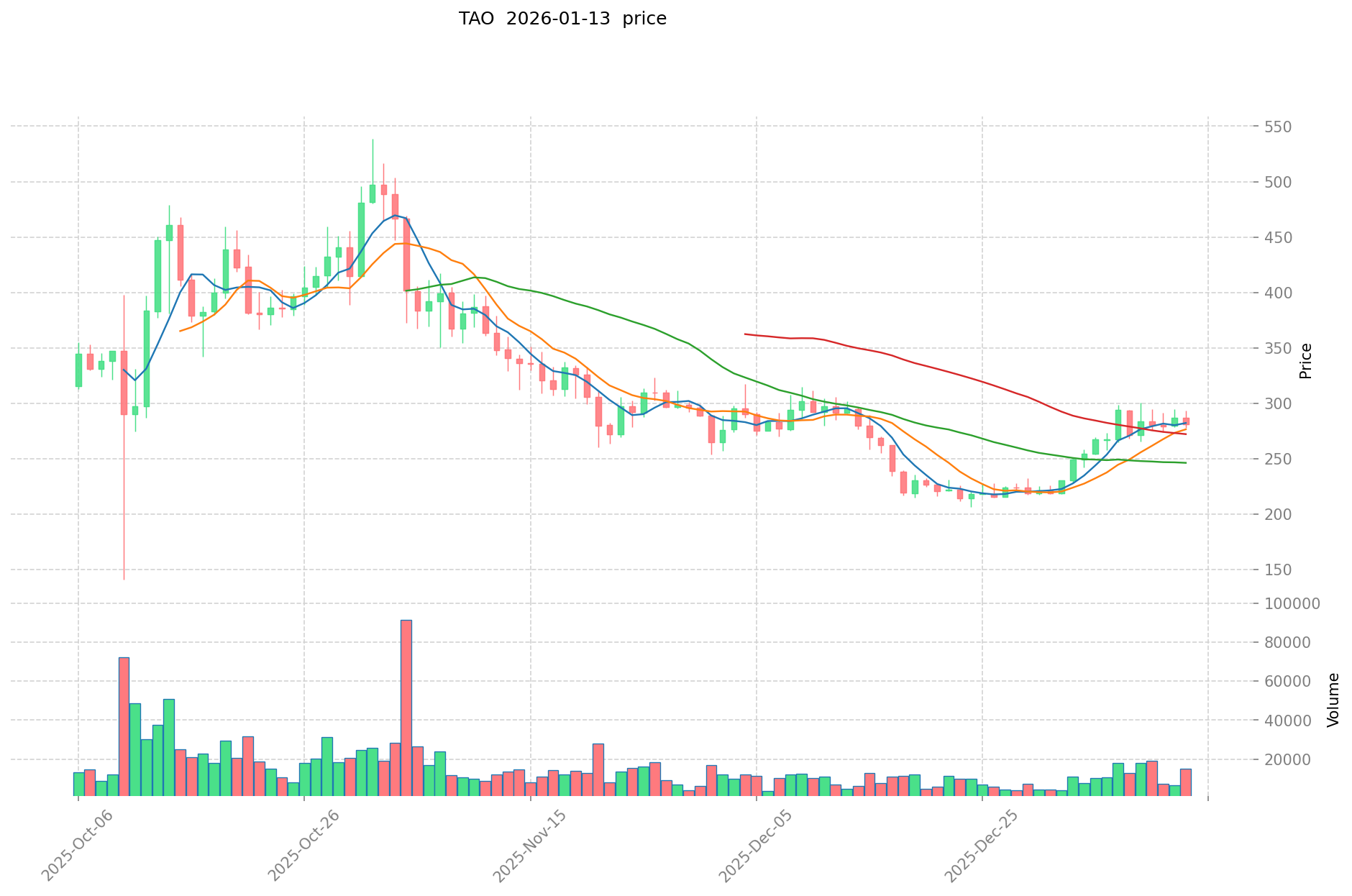
As of January 14, 2026, Bittensor (TAO) is trading at $286.7, with a 24-hour trading volume of $2,686,208.69. The token has shown relatively stable short-term performance with a 0.1% increase over the past 24 hours, trading within a daily range between $277.9 and $289.8.
The current market capitalization stands at $2.75 billion, with TAO ranking 40th among cryptocurrencies and holding a 0.18% market dominance. The circulating supply represents 9,597,491 tokens out of a maximum supply of 21,000,000, indicating a circulation ratio of approximately 45.7%. The fully diluted market cap is valued at $6.02 billion.
Recent price movements show mixed trends across different timeframes. The 1-hour change indicates a positive momentum of 0.49%, while the 7-day performance reflects a decrease of 2.27%. The 30-day trend shows a decline of 1.11%, and the 1-year performance demonstrates a decrease of 35.92% from previous levels.
The token has experienced significant price discovery since its launch, with the current price representing an 184% increase from its initial offering price of $100.93. Market sentiment indicators currently show a fear level of 26, suggesting cautious positioning among market participants. TAO is actively traded across 32 exchanges, with a holder base of 418,915 participants, indicating substantial community engagement in the decentralized machine learning network ecosystem.
Click to view current TAO market price
TAO Market Sentiment Indicator
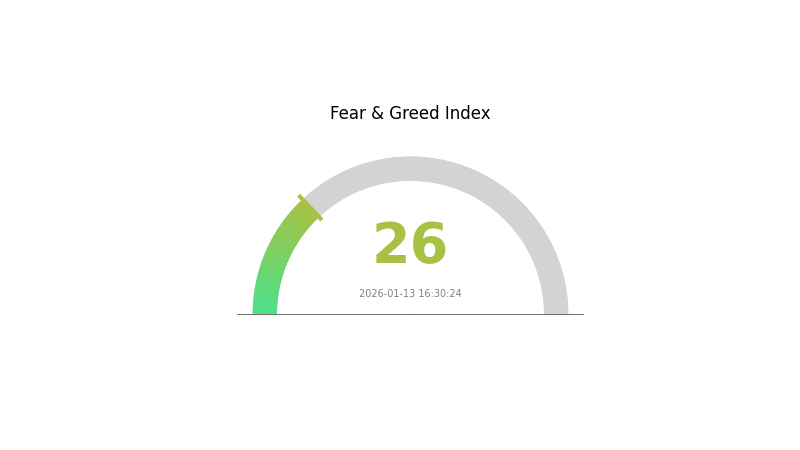
2026-01-13 Fear and Greed Index: 26 (Fear)
Click to view current Fear & Greed Index
The crypto market is currently experiencing heightened fear sentiment with an index reading of 26. This level indicates significant market anxiety and bearish positioning among investors. When fear dominates the market, it often creates potential buying opportunities for long-term investors, as assets may be undervalued. However, traders should remain cautious and monitor key support levels closely. The prevailing fear sentiment suggests that market participants are taking a defensive stance, with reduced risk appetite. Consider dollar-cost averaging strategies during such periods to mitigate timing risk in volatile market conditions.
TAO Holding Distribution
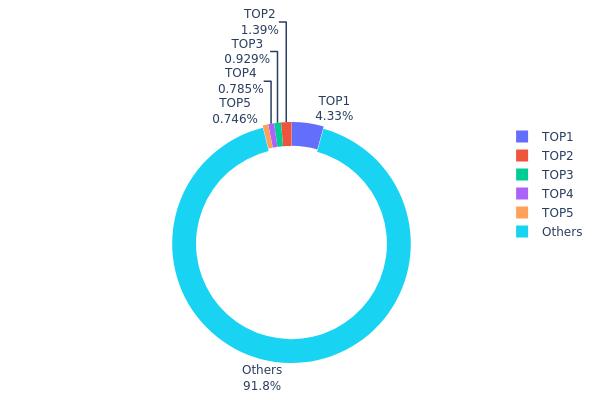
The holding distribution chart illustrates the concentration of TAO tokens across different addresses on the network, serving as a crucial metric for assessing decentralization and potential market manipulation risks. Based on the current data, the top 5 addresses collectively hold approximately 1.716 million TAO, representing 8.14% of the total supply, while the remaining 91.86% is distributed among other addresses.
This distribution pattern reveals a relatively balanced ownership structure with moderate decentralization. The largest holder controls 908.38K TAO (4.32%), which is significantly lower than typical thresholds that would raise concerns about market manipulation. The gradual decrease in holdings from the first to fifth position—ranging from 4.32% to 0.74%—indicates no extreme concentration among top holders. Such a distribution suggests that no single entity possesses sufficient leverage to unilaterally influence price movements or exercise excessive control over network governance.
From a market structure perspective, this holding distribution positively impacts TAO's stability and credibility. The dispersed ownership reduces the likelihood of sudden large-scale sell-offs that could trigger price volatility, while simultaneously supporting genuine price discovery through organic market dynamics. The relatively high percentage (91.86%) held by addresses outside the top tier demonstrates broad community participation and strengthens the network's resilience against coordinated manipulation attempts. This distribution pattern reflects a maturing ecosystem with healthy on-chain fundamentals and sustainable growth potential.
Click to view current TAO Holding Distribution
| Top |
Address |
Holding Qty |
Holding (%) |
| 1 |
5Hd2ze...86pg4N |
908.38K |
4.32% |
| 2 |
5GH2aU...A8R54n |
291.74K |
1.38% |
| 3 |
5GaTCa...WDy3iJ |
195.13K |
0.92% |
| 4 |
5HbUBh...XjJ329 |
164.75K |
0.78% |
| 5 |
5Gs1zP...V1kUNA |
156.58K |
0.74% |
| - |
Others |
19283.41K |
91.86% |
II. Core Factors Influencing TAO's Future Price
Supply Mechanism
- Halving Schedule: TAO follows a halving mechanism similar to Bitcoin, with approximately one TAO minted per block every 12 seconds, distributing around 7,200 TAO daily. The total supply is capped at 21 million tokens. The first halving event was expected around September 2025, which periodically reduces block rewards to manage inflation and maintain long-term value.
- Historical Pattern: The halving mechanism creates scarcity over time, potentially supporting price appreciation as circulating supply growth slows while demand continues.
- Current Impact: TAO tokens used for registration recycling are burned back into unissued supply, causing halving intervals to gradually extend. This dynamic adjustment mechanism reflects network demand and economic dynamics.
Institutional and Major Holder Dynamics
- Institutional Holdings: According to available data, OpenTensor Foundation holds approximately 20% of network ownership, representing a significant concentration of validation power within the ecosystem.
- Enterprise Adoption: The Bittensor network operates as an open marketplace where developers can monetize AI models, potentially attracting AI research laboratories and open-source developers through economic incentives.
- Regulatory Environment: The broader cryptocurrency market sentiment is influenced by regulatory developments, though specific national policies regarding TAO were not detailed in the materials.
Macroeconomic Environment
- Market Sentiment Impact: As an AI-related cryptocurrency project, TAO's price tends to follow the overall AI sector's momentum. When market enthusiasm for AI concepts increases, capital flows more readily into such assets.
- Bitcoin Correlation: TAO exhibits characteristics common to altcoins—when Bitcoin experiences significant volatility, independent price movements of altcoins are often suppressed. Monitoring Bitcoin's key support and resistance levels provides context for TAO's potential movements.
- Geopolitical Factors: The intersection of blockchain technology and artificial intelligence creates exposure to both technological innovation trends and broader market conditions affecting risk assets.
Technical Development and Ecosystem Building
- Revolution Upgrade and Subnet Introduction: Launched on October 2nd, this upgrade introduced "subnets" as a groundbreaking concept, providing developers unprecedented autonomy in shaping incentive mechanisms and establishing markets within the Bittensor ecosystem. A specialized programming language was introduced for formulating incentive systems, enabling developers to create and implement custom mechanisms.
- Yuma Consensus Mechanism: Bittensor employs a hybrid consensus mechanism combining Proof of Work (PoW) and Proof of Stake (PoS) elements. This approach distributes computational resources across a broad node network, naturally scaling to accommodate increasingly large workloads as more nodes integrate.
- Ecosystem Applications: The network facilitates a decentralized AI marketplace where miners host machine learning models contributing to an intelligence pool. These models analyze extensive text data, extract semantics, and generate valuable insights across various domains. Validators are incentivized with TAO tokens to rank miners based on their "intelligence contributions," ensuring high-quality AI models emerge and improve service quality across the network.
III. 2026-2031 TAO Price Prediction
2026 Outlook
- Conservative Prediction: $182.46 - $260
- Neutral Prediction: $260 - $285.1
- Optimistic Prediction: $285.1 - $307.91 (contingent on favorable market conditions and ecosystem development)
2027-2029 Outlook
- Market Phase Expectation: The TAO token may enter a gradual growth phase, potentially supported by broader adoption of decentralized AI infrastructure and ecosystem maturation
- Price Range Predictions:
- 2027: $260.92 - $397.32
- 2028: $190.8 - $409.35
- 2029: $260.91 - $468.88
- Key Catalysts: Expansion of the Bittensor network, increased demand for decentralized machine learning solutions, potential integration with major AI platforms, and overall crypto market sentiment
2030-2031 Long-term Outlook
- Base Scenario: $275.28 - $423.51 (assuming steady network growth and sustained interest in decentralized AI)
- Optimistic Scenario: $423.51 - $559.03 (assuming accelerated adoption and favorable regulatory environment)
- Transformative Scenario: $491.27 - $569.87 (under conditions of breakthrough technological advancement and widespread institutional adoption)
- 2026-01-14: TAO trading within projected range as the token continues to establish its position in the decentralized AI sector
| Year |
Predicted High Price |
Predicted Average Price |
Predicted Low Price |
Price Change |
| 2026 |
307.91 |
285.1 |
182.46 |
0 |
| 2027 |
397.32 |
296.5 |
260.92 |
3 |
| 2028 |
409.35 |
346.91 |
190.8 |
21 |
| 2029 |
468.88 |
378.13 |
260.91 |
31 |
| 2030 |
559.03 |
423.51 |
275.28 |
47 |
| 2031 |
569.87 |
491.27 |
270.2 |
71 |
IV. TAO Professional Investment Strategies and Risk Management
TAO Investment Methodology
(1) Long-term Holding Strategy
- Suitable for: Investors who believe in the long-term potential of decentralized AI infrastructure and are comfortable with market volatility
- Operational Recommendations:
- Consider dollar-cost averaging (DCA) to reduce timing risk, given TAO's historical price fluctuations between $21.43 and $795.6
- Maintain a portfolio review schedule aligned with major Bittensor network upgrades and ecosystem developments
- Storage Solutions: Use Gate Web3 Wallet for secure self-custody, ensuring private key management follows industry best practices
(2) Active Trading Strategy
- Technical Analysis Tools:
- Moving Averages: Monitor 50-day and 200-day moving averages to identify potential trend reversals, particularly relevant given TAO's -35.92% yearly performance
- Volume Analysis: Track the 24-hour trading volume ($2.69M) relative to market cap to assess liquidity and potential price movements
- Swing Trading Key Points:
- Identify support levels around recent lows ($277.9 in 24h range) and resistance near recent highs ($289.8)
- Monitor short-term price movements, noting the +0.49% hourly change versus -2.27% weekly performance for entry/exit timing
TAO Risk Management Framework
(1) Asset Allocation Principles
- Conservative Investors: 2-5% of crypto portfolio allocation
- Aggressive Investors: 8-15% of crypto portfolio allocation
- Professional Investors: Up to 20% with active hedging strategies
(2) Risk Hedging Solutions
- Portfolio Diversification: Balance TAO exposure with other AI-related tokens and established cryptocurrencies to mitigate sector-specific risks
- Position Sizing: Limit single-position exposure considering TAO's 0.18% market dominance and mid-cap status (ranking #40)
(3) Secure Storage Solutions
- Self-Custody Recommended: Gate Web3 Wallet offers non-custodial storage with multi-layer security features
- Hardware Wallet Integration: Consider cold storage solutions for holdings intended for long-term investment
- Security Precautions: Enable two-factor authentication, regularly update security software, and never share private keys or seed phrases
V. TAO Potential Risks and Challenges
TAO Market Risks
- High Volatility: TAO has experienced significant price fluctuations, from an all-time high of $795.6 (April 2024) to current levels around $286.7, representing a -35.92% decline over the past year
- Liquidity Concerns: With a 24-hour trading volume of $2.69M relative to a market cap of $2.75B, sudden large transactions could impact price stability
- Market Capitalization Gap: The current market cap represents only 45.7% of fully diluted valuation ($6.02B), suggesting potential dilution pressure as more tokens enter circulation
TAO Regulatory Risks
- AI Regulation Uncertainty: As governments develop frameworks for artificial intelligence governance, decentralized AI networks like Bittensor may face evolving compliance requirements
- Token Classification: Regulatory interpretation of TAO's utility within the network could impact its trading status across different jurisdictions
- Cross-border Compliance: With 32 exchanges listing TAO and 418,915 holders, international regulatory coordination challenges may arise
TAO Technical Risks
- Network Scalability: As a decentralized machine learning network, Bittensor must maintain performance as participation scales, which could affect token utility and value
- Competition: The AI and machine learning sector is rapidly evolving, with numerous projects competing for market share and developer attention
- Smart Contract Security: While blockchain-based, the complexity of Bittensor's neural network implementation introduces potential technical vulnerabilities that require ongoing audits
VI. Conclusion and Action Recommendations
TAO Investment Value Assessment
Bittensor (TAO) represents an innovative approach to decentralized machine learning infrastructure, positioning itself at the intersection of blockchain technology and artificial intelligence. The project's long-term value proposition centers on creating an open, collaborative ecosystem for AI development, potentially capturing value as decentralized AI adoption grows. However, short-term risks include significant price volatility (down 35.92% year-over-year), market uncertainty, and the challenges inherent in emerging technology adoption. The token's limited circulating supply (45.7% of max supply) and capped total supply of 21 million tokens introduce deflationary characteristics, though this also means potential dilution as more tokens vest.
TAO Investment Recommendations
✅ Beginners: Start with small allocation (1-3% of crypto portfolio), focus on education about Bittensor's technology, and use dollar-cost averaging on Gate.com to build position gradually while learning market dynamics
✅ Experienced Investors: Consider moderate allocation (5-10%) with active monitoring of network metrics, developer activity, and ecosystem growth; employ technical analysis for tactical positioning around key support/resistance levels
✅ Institutional Investors: Conduct thorough due diligence on Bittensor's technical architecture, evaluate position sizing relative to AI sector exposure, and implement hedging strategies to manage downside risk while capturing potential upside from decentralized AI adoption
TAO Trading Participation Methods
- Spot Trading: Direct purchase and sale of TAO tokens on Gate.com, suitable for all investor types seeking straightforward exposure to price movements
- Portfolio Integration: Include TAO as part of a diversified cryptocurrency portfolio focusing on AI and infrastructure themes, balancing risk across multiple assets
- Research-Based Approach: Monitor Bittensor's GitHub activity, network participation metrics, and ecosystem developments to inform investment timing and sizing decisions
Cryptocurrency investment carries extremely high risk, and this article does not constitute investment advice. Investors should make prudent decisions based on their own risk tolerance, and it is recommended to consult professional financial advisors. Never invest more than you can afford to lose.
FAQ
What are the main factors that influence TAO token price movements?
TAO token price is influenced by market demand, network adoption, AI computing activity, competition from alternative projects, macroeconomic conditions, and sentiment shifts in the crypto market.
TAO has demonstrated strong performance, rising 8.7% over the past week and currently trading at $286.95, outperforming many competing AI-related cryptocurrencies. This reflects growing market recognition of TAO's advanced AI capabilities and technological innovations.
What are expert price predictions for TAO in 2024 and 2025?
TAO reached an all-time high of $795.6 in 2024. For 2025, experts predict significant volatility with prices fluctuating between $300 and $500.
What are the risks and uncertainties in TAO price forecasting?
TAO price forecasting faces regulatory uncertainty, extreme market volatility, and intense competition from other AI tokens. Network adoption rates, macro economic conditions, and technological developments significantly impact price predictions.
How does TAO's tokenomics and supply mechanism affect its long-term price potential?
TAO's limited max supply and low inflation rate create conditions for long-term price appreciation. The transparent token distribution mechanism builds trust and reduces project risk, while the stable supply model supports sustained value growth.
* The information is not intended to be and does not constitute financial advice or any other recommendation of any sort offered or endorsed by Gate.