This comprehensive analysis examines UDS (Undeads Games) price trends and investment opportunities from 2026 to 2031. Currently trading at $2.37 with a market cap of $295.13 million, UDS is a pioneering GameFi token bridging entertainment and cryptocurrency earnings. The article evaluates historical price evolution, macroeconomic influences including Federal Reserve policy and geopolitical factors, and technical ecosystem development. Price predictions range from $1.89-$2.51 in 2026 to $2.73-$4.46 by 2030-2031 under various scenarios. Professional investment strategies include long-term holding and active trading approaches, complemented by comprehensive risk management frameworks addressing liquidity concerns and regulatory uncertainties. Suitable for investors seeking GameFi exposure on platforms like Gate.
Introduction: UDS Market Position and Investment Value
Undeads Games (UDS), as a pioneering GameFi token bridging entertainment and cryptocurrency earnings, has achieved significant milestones since its inception in 2022. As of 2026, UDS has reached a market capitalization of approximately $295.13 million, with a circulating supply of around 124.55 million tokens, and the price maintains at approximately $2.37. This asset, recognized as a "next-generation GameFi ecosystem token", is playing an increasingly critical role in the post-apocalyptic zombie-themed gaming and player-driven economy sector.
This article will comprehensively analyze UDS price trends from 2026 to 2031, combining historical patterns, market supply and demand dynamics, ecosystem development, and macroeconomic environment factors to provide investors with professional price forecasts and practical investment strategies.
I. UDS Price History Review and Market Status
UDS Historical Price Evolution Trajectory
- 2024: Token launched in April with an initial offering price of $0.5, establishing the project's baseline valuation
- 2024: Price reached historical low of $0.0409 on October 29, reflecting early market volatility and adjustment period
- 2025: Significant market momentum drove price to all-time high of $3.496 on December 2, representing a substantial appreciation from launch levels
UDS Current Market Situation
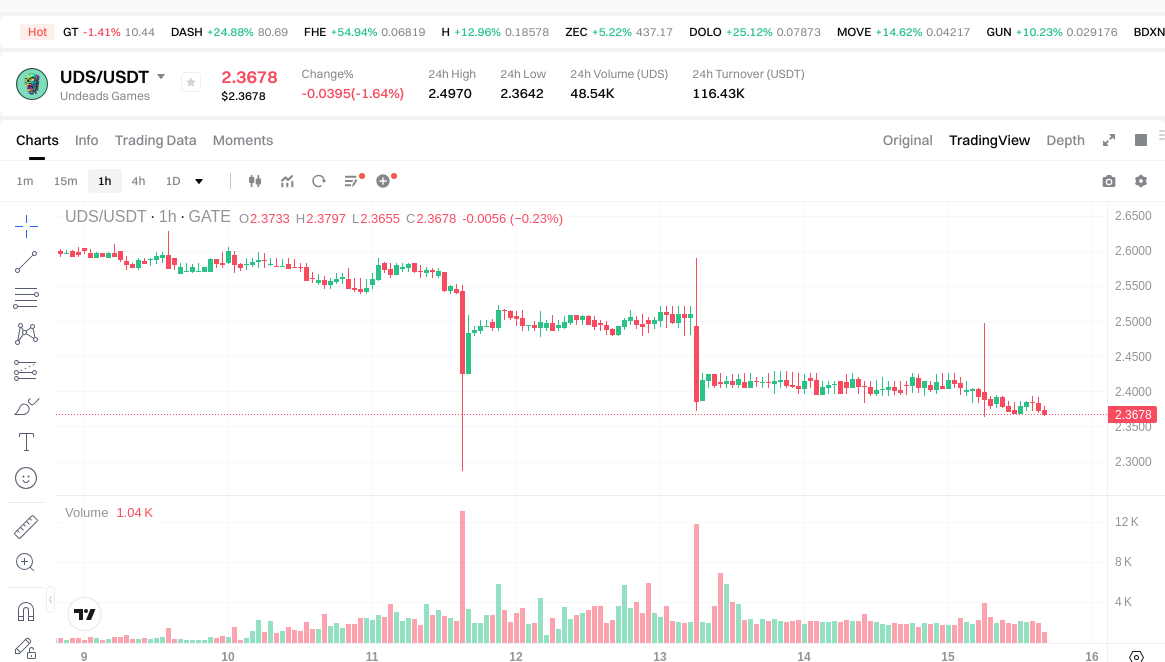
As of January 15, 2026, UDS is trading at $2.3696, positioned within its established trading range. The token has demonstrated notable price movements across multiple timeframes, with a 24-hour trading volume of $116,587.72.
The circulating supply stands at 124,548,848.75 UDS tokens, representing approximately 49.82% of the maximum supply of 250,000,000 tokens. This translates to a circulating market capitalization of $295.13 million and a fully diluted valuation of $592.4 million.
Recent price performance shows short-term consolidation, with the 1-hour change at -0.5% and 24-hour movement at -1.95%. The 7-day and 30-day periods reflect declines of 8.75% and 10.9% respectively. However, the 1-year performance demonstrates substantial growth of 2,243.81%, indicating strong long-term momentum despite recent corrections.
The token maintains a market capitalization ranking of #190 among tracked assets, with a market share of 0.017%. Current trading activity has established a 24-hour range between $2.3642 and $2.497.
Click to view current UDS market price
UDS Market Sentiment Index
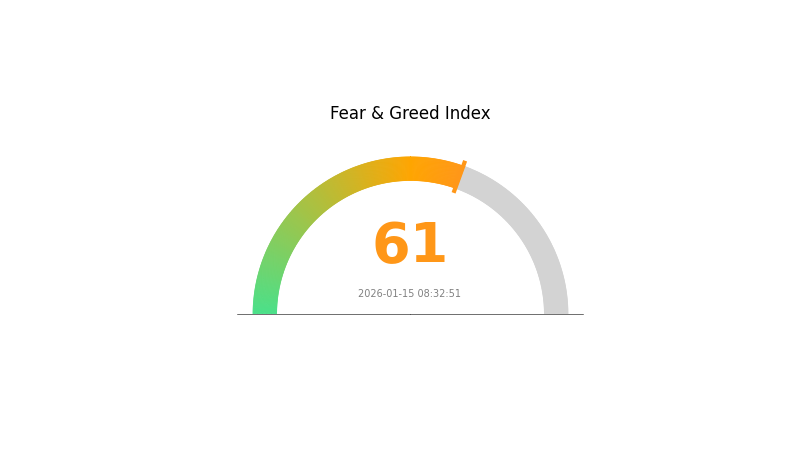
2026-01-15 Fear and Greed Index: 61 (Greed)
Click to view the current Fear & Greed Index
The cryptocurrency market is currently displaying strong greed sentiment, with the Fear and Greed Index reaching 61 points. This indicates elevated market optimism and increased investor appetite for risk. During periods of heightened greed, traders often exhibit increased buying activity and portfolio expansion. However, investors should remain cautious, as extreme greed can sometimes precede market corrections. It's advisable to maintain a balanced investment strategy and avoid making impulsive decisions driven by market enthusiasm. Consider diversifying your portfolio and setting clear risk management parameters to navigate this bullish phase effectively.
UDS Holding Distribution
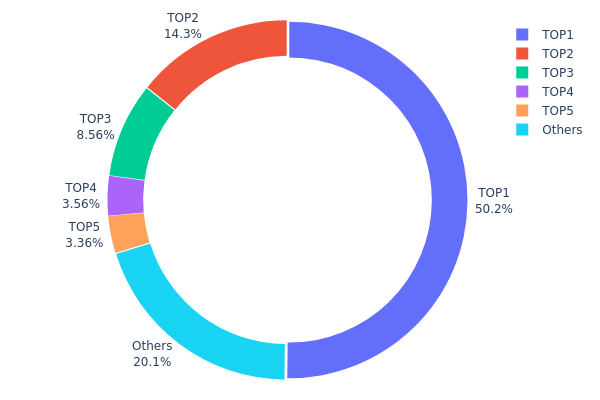
The holding distribution chart illustrates the concentration of token ownership across different addresses within the UDS ecosystem. This metric serves as a crucial indicator of decentralization and potential market manipulation risks. By examining the proportion of tokens held by top addresses, analysts can assess whether the token supply is widely distributed among numerous participants or concentrated within a limited number of wallets.
According to the current data, UDS exhibits a notably high concentration pattern, with the top address alone controlling 125,451.15K tokens, representing 50.18% of the total supply. The top five addresses collectively hold 199,865.85K tokens, accounting for 79.94% of the circulating supply, while the remaining addresses collectively hold only 20.06%. This distribution pattern indicates significant centralization, which could substantially impact market dynamics and price stability.
Such concentrated holdings present several implications for market structure. First, the dominant position of the top address creates potential single-point risk, where large-scale token movements could trigger significant price volatility. Second, when combined with the second and third largest holders at 14.28% and 8.56% respectively, these major stakeholders possess considerable influence over market direction and liquidity. This concentration level may also deter institutional investors who typically prefer assets with broader distribution to minimize counterparty risk and ensure sufficient market depth for large transactions.
Click to view current UDS Holding Distribution
| Top |
Address |
Holding Qty |
Holding (%) |
| 1 |
0xd321...e493a2 |
125451.15K |
50.18% |
| 2 |
0xb705...12964e |
35700.00K |
14.28% |
| 3 |
0x6f2a...125b6d |
21405.23K |
8.56% |
| 4 |
0x4792...af938b |
8900.00K |
3.56% |
| 5 |
0x0642...ccbf51 |
8409.47K |
3.36% |
| - |
Others |
50134.15K |
20.06% |
II. Core Factors Influencing UDS Future Price Trends
Macroeconomic Environment
-
Federal Reserve Monetary Policy: The Federal Reserve's monetary policy serves as the most direct driver of USD movements. Interest rate adjustments directly impact the dollar's attractiveness to international capital. When the Fed raises rates, higher yields on dollar-denominated assets attract capital inflows, typically strengthening the dollar index. Conversely, rate cuts may trigger capital outflows and weaken the dollar. Market participants closely monitor the Fed's "dot plot" projections and policy statements for directional signals. As of 2026, with inflation gradually cooling toward target levels, the market anticipates potential rate cuts, though robust labor market performance provides rationale for maintaining current rates to consolidate anti-inflation gains.
-
Inflation Dynamics: Inflation levels significantly influence USD valuation. High inflation may compel the Fed to maintain or accelerate rate hikes, supporting dollar strength. Core Personal Consumption Expenditures (PCE) and Consumer Price Index (CPI) serve as key metrics. Data exceeding expectations could delay rate-cut expectations and pressure risk assets short-term, while sustained cooling reinforces dovish sentiment. During periods of dollar strength, import costs decline, easing domestic price pressures; conversely, a weaker dollar may elevate inflation through higher import prices.
-
Geopolitical Factors: The dollar traditionally functions as a safe-haven asset during global uncertainty. Regional conflicts, political instability, or financial crises often drive capital toward dollar-denominated assets, creating a "global chaos strengthens the dollar" dynamic. However, when risk originates from the U.S. itself, this safe-haven characteristic may invert. For instance, following Moody's downgrade of U.S. sovereign credit rating from Aaa to Aa1 in May 2025 due to fiscal deficit concerns, the dollar index declined approximately 10.6% from year-start highs, with speculative net short positions reaching USD 17.32 billion.
Institutional and Major Holder Dynamics
-
Major Economy Trade Relations: As a relative metric, the dollar index reflects U.S. economic performance versus major trading partners. Strong U.S. economic data—such as robust non-farm payrolls, declining unemployment, strong GDP growth, or elevated inflation—typically signals outperformance versus other economies, bolstering dollar confidence. Conversely, weak U.S. data amid stronger foreign economic conditions may pressure the index downward.
-
Central Bank Policy Divergence: Dollar strength is influenced by comparative monetary policies across major economies. For example, when the European Central Bank signals dovish intentions, euro weakness can passively elevate the dollar index even without changes in U.S. fundamentals. Mid-2024 saw the dollar index rise from approximately 102 to 106 points following clear ECB dovish signals.
-
Reserve Currency Status: The dollar's role as the world's primary reserve currency and international trade settlement medium ensures sustained structural demand. However, emerging explorations of alternative payment systems—whether through Central Bank Digital Currencies (CBDCs) or existing cryptocurrency networks—could challenge dollar hegemony over the long term.
Technical Development and Ecosystem Construction
-
U.S. Economic Data Leadership: Employment data strength may signal economic overheating, prompting market expectations of Fed rate hikes and supporting dollar appreciation. Conversely, weakening employment data typically erodes dollar confidence and pressures the index lower. Key leading indicators include Purchasing Managers' Index (PMI) and Consumer Confidence Index, which help anticipate economic temperature shifts.
-
Dollar Index Composition: The index comprises six major currencies—euro (57.6% weight), Japanese yen (13.6%), British pound (11.9%), Canadian dollar (9.1%), Swedish krona (4.2%), and Swiss franc (3.6%). Established in 1973 following the Bretton Woods system collapse with a base value of 100, the index has experienced significant volatility, reaching a peak of approximately 164.72 in February 1985 and a trough of roughly 70.70 in March 2008 during the subprime mortgage crisis.
-
Policy Uncertainty Impact: U.S. administrative policy direction significantly affects dollar confidence. Policy reversals, particularly regarding trade relations and tariffs, create market volatility. While tariffs may improve trade balance expectations short-term, supporting the dollar, extensive tariff implementation disrupting global supply chains can undermine investor confidence in U.S. economic prospects, weakening the currency.
III. 2026-2031 UDS Price Prediction
2026 Outlook
- Conservative Prediction: $1.89-$2.37
- Neutral Prediction: $2.37
- Optimistic Prediction: $2.51 (requires favorable market conditions)
2027-2029 Outlook
- Market Stage Expectation: Potential gradual growth phase with moderate volatility, as the project continues to develop its ecosystem and expand adoption
- Price Range Prediction:
- 2027: $1.39-$2.54
- 2028: $2.26-$2.76
- 2029: $1.99-$3.44
- Key Catalysts: Market adoption acceleration, technological improvements, and broader ecosystem development could serve as primary driving factors
2030-2031 Long-term Outlook
- Baseline Scenario: $2.73-$3.73 (assuming steady market growth and sustained project development)
- Optimistic Scenario: $3.38-$4.46 (assuming strong ecosystem expansion and increased mainstream adoption)
- Transformative Scenario: Above $4.46 (requires exceptional market conditions, major partnerships, and significant technological breakthroughs)
- 2026-01-15: UDS shows potential for gradual appreciation with predicted average price around $2.37 (early-stage growth phase)
| Year |
Predicted High Price |
Predicted Average Price |
Predicted Low Price |
Price Change |
| 2026 |
2.50987 |
2.3678 |
1.89424 |
0 |
| 2027 |
2.53639 |
2.43883 |
1.39014 |
2 |
| 2028 |
2.76125 |
2.48761 |
2.26373 |
4 |
| 2029 |
3.438 |
2.62443 |
1.99457 |
10 |
| 2030 |
3.7284 |
3.03122 |
2.72809 |
27 |
| 2031 |
4.46134 |
3.37981 |
2.77144 |
42 |
IV. UDS Professional Investment Strategy and Risk Management
UDS Investment Methodology
(1) Long-term Holding Strategy
- Target Audience: Investors who believe in the long-term potential of blockchain gaming and GameFi ecosystems, particularly those interested in innovative gaming experiences combining traditional gameplay with cryptocurrency earning mechanisms.
- Operational Recommendations:
- Consider accumulating UDS during market corrections or consolidation periods, as the token has shown significant volatility with a 52-week range between $0.0409 and $3.496.
- Monitor the project's partnership developments and game release milestones, as collaborations with industry leaders like Warner Bros may drive long-term value.
- Storage Solution: Utilize secure wallet solutions such as Gate Web3 Wallet for convenient management, or consider hardware wallet options for larger holdings to ensure maximum security of your UDS tokens.
(2) Active Trading Strategy
- Technical Analysis Tools:
- Moving Averages: Track 50-day and 200-day moving averages to identify potential trend reversals, particularly given the token's historical volatility.
- Volume Analysis: Monitor daily trading volumes (currently around $116,587) relative to the token's circulating supply of 124.55 million to gauge market interest and potential price movements.
- Swing Trading Key Points:
- Consider the token's recent price performance showing declines of 1.95% (24H), 8.75% (7D), and 10.9% (30D) when identifying potential entry points.
- Pay attention to broader GameFi sector trends and gaming industry news that may impact UDS price action.
UDS Risk Management Framework
(1) Asset Allocation Principles
- Conservative Investors: 1-3% of crypto portfolio allocation
- Aggressive Investors: 5-8% of crypto portfolio allocation
- Professional Investors: Up to 10-15% with active hedging strategies
(2) Risk Hedging Solutions
- Portfolio Diversification: Balance UDS holdings with other gaming tokens and established cryptocurrencies to reduce sector-specific risk.
- Position Sizing: Implement graduated entry strategies rather than lump-sum investments, given the token's price volatility and relatively low market cap of approximately $295 million.
(3) Secure Storage Solutions
- Hot Wallet Recommendation: Gate Web3 Wallet for active traders requiring frequent access and transaction capabilities.
- Cold Storage Option: For long-term holders, consider transferring significant UDS holdings to hardware wallet solutions for enhanced security.
- Security Precautions: Always verify contract addresses (0x712bd4beb54c6b958267d9db0259abdbb0bff606 for Ethereum), enable two-factor authentication, and never share private keys or seed phrases.
V. UDS Potential Risks and Challenges
UDS Market Risks
- Gaming Sector Volatility: The GameFi and blockchain gaming sector experiences significant cyclical trends, which may impact UDS price stability independent of project fundamentals.
- Competition Risk: The blockchain gaming space is becoming increasingly crowded with numerous projects competing for player attention and investment capital.
- Liquidity Concerns: With a circulating supply representing approximately 49.82% of total supply and trading volume around $116,587, liquidity may be limited during market stress periods.
UDS Regulatory Risks
- Gaming Token Classification: Evolving regulations regarding cryptocurrency-based gaming rewards and play-to-earn mechanisms may impact the project's operational model.
- Cross-border Gaming Regulations: As a global gaming platform, Undeads Games may face varying regulatory requirements across different jurisdictions.
- Securities Compliance: Potential classification of gaming tokens under securities laws in certain regions could affect token utility and distribution.
UDS Technical Risks
- Smart Contract Security: As an ERC-20 token, UDS relies on Ethereum blockchain security and smart contract code integrity.
- Game Development Execution: The project's value proposition depends heavily on successful development and launch of engaging gaming experiences.
- Integration Challenges: Technical difficulties in implementing seamless cryptocurrency earning mechanisms within gaming environments may affect user adoption.
VI. Conclusion and Action Recommendations
UDS Investment Value Assessment
Undeads Games (UDS) represents an interesting opportunity within the blockchain gaming sector, particularly for investors attracted to the convergence of traditional gaming entertainment and cryptocurrency earning mechanisms. The project's partnerships with established entertainment industry players like Warner Bros suggest potential for mainstream appeal. However, investors should note that the token has experienced considerable price fluctuations, currently trading at $2.3696 with a market cap of approximately $295 million. The significant year-over-year return of 2,243.81% indicates strong historical performance, though recent short-term declines suggest caution is warranted. The relatively low circulating supply ratio of 49.82% means future token unlocks could impact price dynamics.
UDS Investment Recommendations
✅ Beginners: Consider starting with a small allocation (1-2% of crypto portfolio) and focus on understanding the GameFi sector before increasing exposure. Use platforms like Gate.com for simplified purchasing and storage options such as Gate Web3 Wallet.
✅ Experienced Investors: Evaluate UDS as part of a diversified gaming token portfolio, monitoring project milestones, partnership announcements, and game release schedules. Consider dollar-cost averaging strategies to mitigate volatility risk.
✅ Institutional Investors: Conduct thorough due diligence on the project's tokenomics, vesting schedules, and long-term roadmap. Consider the broader GameFi market cycle position and potential for mainstream gaming audience adoption.
UDS Trading Participation Methods
- Spot Trading: Access UDS spot markets on Gate.com and other supporting exchanges for direct token ownership and immediate settlement.
- Strategic Accumulation: Implement systematic purchase plans during market consolidation periods to build positions over time while managing entry price risk.
- Portfolio Integration: Include UDS as part of a broader blockchain gaming and metaverse investment strategy, balancing exposure across multiple gaming projects and blockchain ecosystems.
Cryptocurrency investment carries extremely high risks. This article does not constitute investment advice. Investors should make prudent decisions based on their own risk tolerance and are advised to consult professional financial advisors. Never invest more than you can afford to lose.
FAQ
What is UDS? What are its uses and value sources?
UDS is a unified diagnostic services protocol standard for vehicle diagnostics and communication, part of ISO 14229. It enables consistent diagnostic services, improves vehicle repair efficiency, and provides standardized vehicle fault detection and resolution solutions.
What factors affect UDS price?
UDS price is influenced by market sentiment, trading volume, regulatory policies, adoption rates, and macroeconomic conditions. Positive developments drive prices up, while security issues and negative news may cause declines.
How to conduct UDS price prediction? What analysis methods are available?
UDS price prediction combines technical analysis using moving averages and RSI indicators, statistical modeling with historical data analysis, and market trend evaluation. Analyze trading volume, market sentiment, and on-chain metrics to forecast price movements effectively.
What is the historical price trend of UDS? What major price movements have occurred in the past?
UDS has experienced significant volatility, reaching an all-time high of $3.156 and a low of $0.04. Recently, the token traded between $2.5624 and $2.6195 within 24 hours, demonstrating active market dynamics and investor interest.
What are the risks of investing in UDS for price prediction trading?
UDS price prediction trading involves market volatility risk, liquidity risk, and potential loss of principal. Price fluctuations can be rapid and unpredictable. Carefully assess your risk tolerance and investment experience before participating in price prediction activities.
UDS demonstrates distinct price volatility driven by its innovative unlocking mechanism and Plasma integration. Its unique tokenomics create differentiated market dynamics, potentially offering stronger growth opportunities compared to conventional similar tokens in the sector.
* The information is not intended to be and does not constitute financial advice or any other recommendation of any sort offered or endorsed by Gate.