This comprehensive analysis examines Uniswap (UNI) token dynamics, currently trading at $5.52 with a $3.5 billion market cap, providing investors with multi-year price forecasts and actionable strategies through 2031. The article synthesizes UNI's historical trajectory from its $1.03 launch price to $44.92 peak, analyzing current market conditions including the 59.48% annual decline and the Fear and Greed Index at 26. Key value drivers include proposed fee-switch burn mechanisms, Uniswap protocol upgrades (V3 and V4), and the Unichain Layer 2 expansion, which collectively strengthen long-term utility. Price forecasts range from $2.89-$6.66 in 2026 to $6.60-$15.17 by 2031, contingent on DeFi adoption and protocol innovation. The guide addresses investment methodologies for different investor profiles, risk management frameworks, and secure storage via Gate Web3 Wallet, while highlighting regulatory, technical, and competitive risks inherent in DeFi infrastructure investments.
Introduction: UNI's Market Position and Investment Value
Uniswap (UNI), as the first automated market-making protocol built on the Ethereum blockchain, has established itself as a pioneering force in decentralized finance since its launch in 2020. As of January 2026, UNI maintains a market capitalization of approximately $3.5 billion, with a circulating supply of around 634.68 million tokens, and the price holding steady near $5.52. This asset, recognized as a cornerstone of decentralized exchange infrastructure, is playing an increasingly vital role in facilitating permissionless trading and liquidity provision across the DeFi ecosystem.
This article will comprehensively analyze UNI's price trajectory from 2026 to 2031, integrating historical patterns, market supply-demand dynamics, ecosystem development, and macroeconomic conditions to provide investors with professional price forecasts and practical investment strategies.
I. UNI Price History Review and Current Market Status
UNI Historical Price Evolution Trajectory
- 2020: Uniswap protocol launched on September 16, 2020, with UNI token starting at an initial low of $1.03
- 2021: Market momentum during the DeFi boom drove prices significantly higher, reaching a peak of $44.92 on May 3, 2021
- 2022-2025: Following the broader crypto market cycle correction, UNI experienced substantial decline, with price retracing from historical highs
UNI Current Market Status
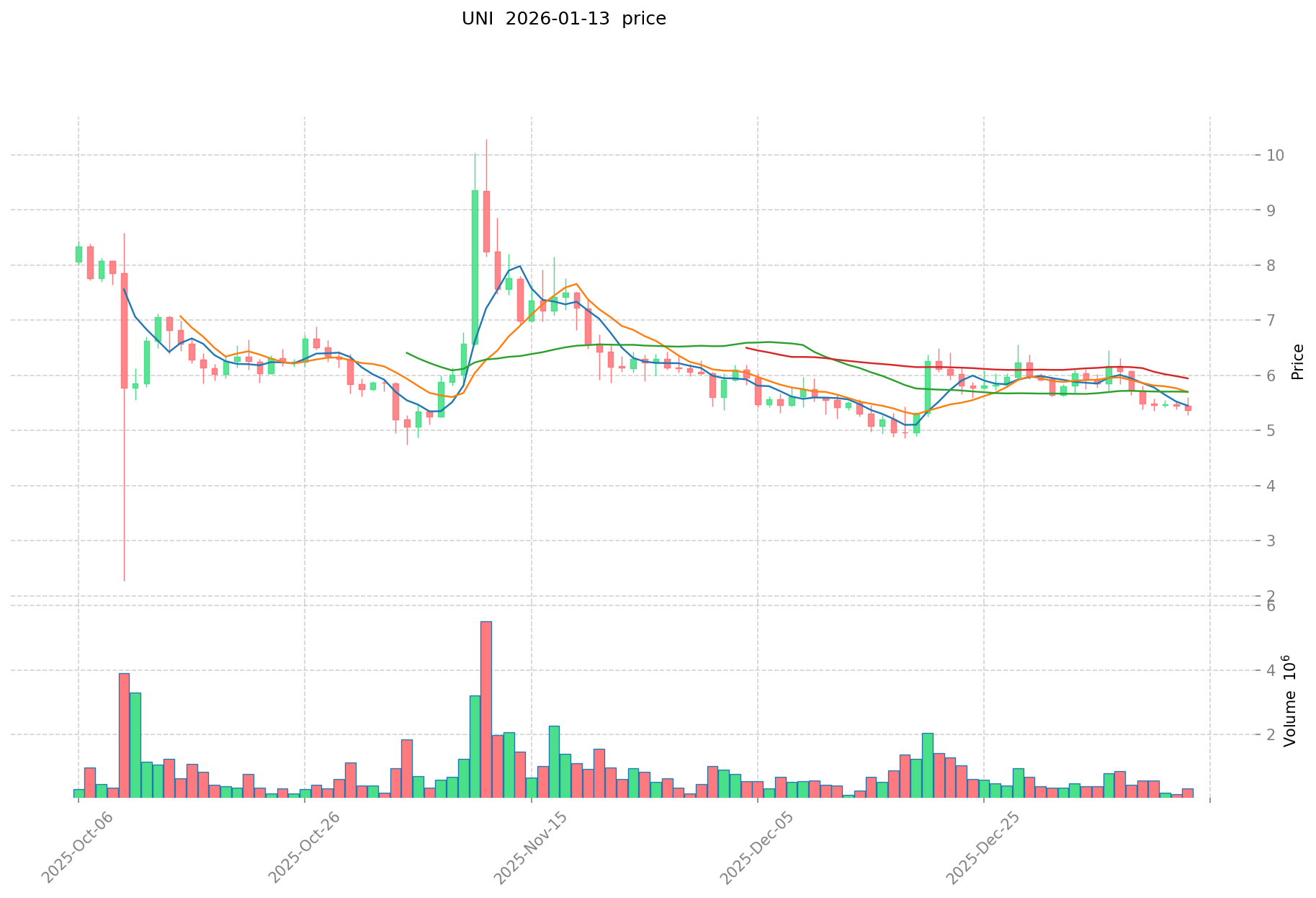
As of January 13, 2026, UNI is trading at $5.519, representing a 24-hour increase of 3.85%. The token shows mixed short-term performance with a 1-hour gain of 0.92%, while experiencing a 7-day decline of 10.24%. Over the past 30 days, UNI has posted a modest increase of 1.73%.
The token's current price reflects a significant distance from its historical peak of $44.92, indicating an overall downward trajectory over the longer term, with a 1-year decline of 59.48%. The 24-hour trading range spans from $5.282 to $5.525.
Uniswap maintains a market capitalization of approximately $3.50 billion, with a circulating supply of 634.68 million tokens representing 63.47% of the total supply of 899.76 million tokens. The fully diluted market capitalization stands at approximately $4.97 billion, with a maximum supply capped at 1 billion tokens. The token's market dominance is 0.15%, and it ranks 37th by market capitalization.
The 24-hour trading volume reaches approximately $1.49 million, with UNI listed on 68 exchanges and supported by 66,356 token holders. The current market sentiment indicator shows a fear index of 26, reflecting a cautious market environment.
UNI is deployed on the Ethereum blockchain with the contract address 0x1f9840a85d5af5bf1d1762f925bdaddc4201f984.
Click to view current UNI market price
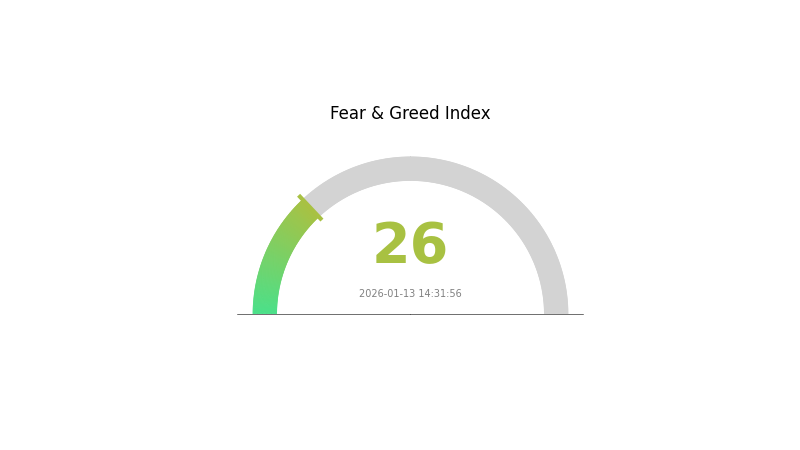
UNI Market Sentiment Index
2026-01-13 Fear and Greed Index: 26 (Fear)
Click to view the current Fear & Greed Index
Market Analysis:
The current Fear and Greed Index stands at 26, indicating a fear-dominated market sentiment. This level suggests investors are experiencing heightened anxiety and risk aversion in the cryptocurrency market. During such periods, market volatility typically increases as participants become more cautious about their positions. Traders should exercise prudence and consider defensive strategies. However, extreme fear often presents contrarian opportunities for long-term investors with conviction. Monitor key support levels closely and avoid emotional decision-making in this uncertain environment.
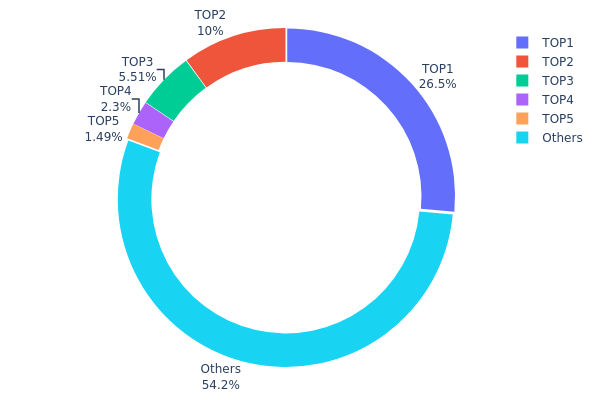
UNI Holding Distribution
The holding distribution chart reveals the concentration of token ownership across different addresses on the blockchain, providing crucial insights into the decentralization level and market structure of UNI. According to the latest data, the top address holds approximately 264.63 million UNI tokens, accounting for 26.46% of the total supply, while the top five addresses collectively control 45.77% of the circulating supply. Notably, the second-largest holding address (0x0000...00dead) represents tokens that have been permanently burned, removing 10.02% from active circulation. Beyond the top five addresses, the remaining 54.23% is distributed among numerous smaller holders, indicating a relatively fragmented ownership structure outside the major concentration points.
This distribution pattern reveals a moderate level of centralization in UNI's token structure. While the dominance of the top address at 26.46% suggests significant influence from a single entity—likely a treasury, foundation wallet, or major institutional holder—the substantial proportion held by smaller addresses demonstrates reasonable decentralization at the broader market level. The presence of burned tokens as the second-largest holder effectively reduces the circulating supply available for trading, which could positively impact price dynamics through scarcity effects. However, the combined 35.75% held by the top three active addresses (excluding the burn address) indicates that coordinated actions or large-scale movements from these major holders could generate considerable market volatility.
From a market structure perspective, this distribution presents both stability and risk factors. The diversified holdings among the "Others" category (54.23%) provide a cushion against complete market manipulation by a single entity, supporting UNI's positioning as a governance token for a decentralized protocol. However, investors should remain cognizant that significant selling pressure from top addresses could trigger cascading effects on market sentiment and price action. The current structure reflects a balance typical of established DeFi governance tokens, where protocol treasuries and early stakeholders maintain substantial positions while community distribution continues to expand through liquidity mining and governance participation.
Click to view current UNI Holding Distribution
| Top |
Address |
Holding Qty |
Holding (%) |
| 1 |
0x1a9c...be35bc |
264634.86K |
26.46% |
| 2 |
0x0000...00dead |
100217.58K |
10.02% |
| 3 |
0xf977...41acec |
55131.02K |
5.51% |
| 4 |
0x61cb...2096eb |
23047.48K |
2.30% |
| 5 |
0x5069...680f7e |
14880.12K |
1.48% |
| - |
Others |
542088.93K |
54.23% |
II. Core Factors Influencing UNI's Future Price
Supply Mechanism
- Token Burn Proposal: A governance proposal is under consideration to implement a fee switch mechanism that would programmatically burn UNI tokens. If approved, the fee switch will be gradually rolled out, initially applying to V2 and V3 pools on Ethereum mainnet that account for 80-95% of liquidity provider fees. All fees generated by the new fee switch will be used to burn UNI tokens, thereby accumulating value for token holders.
- Current Impact: This proposed mechanism represents a shift toward value accrual for token holders, as historically, revenue has primarily benefited equity investors rather than token holders. The burn mechanism could reduce circulating supply and potentially support price appreciation.
Institutional and Major Holder Dynamics
- Organizational Structure: Uniswap operates with a dual capital structure, serving both equity investors and token holders. Uniswap Labs has accumulated approximately 132 million dollars from interface and wallet fees since 2023.
- Governance Transition: The current governance proposal (receiving strong support) would redirect the focus of Uniswap Labs toward serving DAO and token holders, though this would result in the loss of interface, wallet, and API fee revenues for Uniswap Labs.
Macroeconomic Environment
- Monetary Policy Impact: Global economic conditions, inflation rates, and monetary policy influence investor behavior and indirectly affect cryptocurrency prices, including UNI.
- Market Sentiment: Despite broader market speculation shifting toward other platforms, potential policy support and improving market sentiment could provide opportunities for price recovery.
Technical Development and Ecosystem Building
- Version Upgrades: Uniswap has released multiple protocol versions, with V3 (launched May 2021) currently handling 68.7% of trading volume, V4 (launched January 2025) accounting for 24.9%, and V2 (launched May 2020) maintaining 6.3% of volume.
- Concentrated Liquidity (V3): This feature allows liquidity providers to deploy capital within specific price ranges rather than across the entire price curve, enabling more efficient capital utilization and deeper liquidity provision.
- Hooks Feature (V4): Introduced in the V4 version, hooks enable enhanced customization and functionality within the protocol.
- Unichain Layer 2: Launched nine months ago, Unichain serves as a general-purpose Ethereum Layer 2 solution, expanding the ecosystem's capabilities.
- Cross-Chain Standards: Uniswap Labs proposed ERC-7683 to play a core role in the Ethereum Foundation's open intent framework, standardizing cross-chain intents to improve user experience for applications and users.
- Ecosystem Application: Since its 2018 launch, the protocol has generated over 3.3 trillion dollars in trading volume and 4.7 billion dollars in trading fees, demonstrating strong ecosystem adoption and utility.
III. 2026-2031 UNI Price Forecast
2026 Outlook
- Conservative Forecast: $2.89 - $4.22
- Neutral Forecast: $4.22 - $5.55
- Optimistic Forecast: $5.55 - $6.66 (contingent on sustained DeFi sector growth and protocol adoption)
2027-2029 Mid-term Outlook
- Market Stage Expectation: UNI may enter a phase of consolidation and gradual appreciation, potentially influenced by broader crypto market cycles and Uniswap protocol upgrades
- Price Range Forecast:
- 2027: $4.09 - $7.94 (representing approximately 10% increase from 2026 baseline)
- 2028: $3.79 - $8.07 (reflecting approximately 27% growth trajectory)
- 2029: $6.79 - $9.51 (indicating approximately 36% cumulative advancement)
- Key Catalysts: Protocol governance developments, liquidity provision enhancements, and potential integration with emerging blockchain ecosystems
2030-2031 Long-term Outlook
- Baseline Scenario: $5.46 - $8.53 by 2030 (assuming steady market maturation and consistent protocol utility)
- Optimistic Scenario: $8.53 - $12.11 by 2030 (presumes accelerated DeFi adoption and favorable regulatory environment)
- Transformative Scenario: $10.32 - $15.17 by 2031 (requires exceptional market conditions, widespread institutional adoption, and significant protocol innovations achieving approximately 86% growth from baseline)
- 2026-01-13: UNI trading within initial forecast parameters as market establishes positioning for multi-year trajectory
| Year |
Predicted High Price |
Predicted Average Price |
Predicted Low Price |
Price Change |
| 2026 |
6.66 |
5.55 |
2.886 |
0 |
| 2027 |
7.9365 |
6.105 |
4.09035 |
10 |
| 2028 |
8.07386 |
7.02075 |
3.79121 |
27 |
| 2029 |
9.50961 |
7.54731 |
6.79258 |
36 |
| 2030 |
12.11041 |
8.52846 |
5.45821 |
54 |
| 2031 |
15.16956 |
10.31943 |
6.60444 |
86 |
IV. UNI Professional Investment Strategies and Risk Management
UNI Investment Methodology
(1) Long-Term Holding Strategy
- Target Investors: Investors seeking exposure to decentralized exchange infrastructure with medium to long-term horizons
- Operational Recommendations:
- Consider dollar-cost averaging (DCA) to mitigate timing risk during accumulation phases
- Monitor Uniswap protocol developments and governance proposals that may impact token utility
- Evaluate storage solutions: Gate Web3 Wallet offers convenient access for active management
(2) Active Trading Strategy
- Technical Analysis Tools:
- Moving Averages: Monitor 50-day and 200-day moving averages to identify potential trend reversals
- Volume Analysis: Correlate trading volume patterns with price movements to validate breakout signals
- Swing Trading Key Points:
- Current 24H volatility range ($5.282-$5.525) suggests opportunities for short-term position adjustments
- 7-day decline of 10.24% may present potential entry points for traders comfortable with elevated volatility
UNI Risk Management Framework
(1) Asset Allocation Principles
- Conservative Investors: 2-5% of crypto portfolio allocation
- Aggressive Investors: 8-15% of crypto portfolio allocation
- Professional Investors: Up to 20% with appropriate hedging strategies
(2) Risk Hedging Solutions
- Portfolio Diversification: Combine UNI exposure with stablecoins and other established crypto assets
- Position Sizing: Limit single-position exposure based on volatility metrics and personal risk tolerance
(3) Secure Storage Solutions
- Hot Wallet Recommendation: Gate Web3 Wallet for convenient trading and staking access
- Cold Storage Solution: Consider hardware wallet solutions for long-term holdings exceeding trading reserves
- Security Precautions: Enable two-factor authentication, verify contract addresses (0x1f9840a85d5af5bf1d1762f925bdaddc4201f984), and avoid sharing private keys
V. UNI Potential Risks and Challenges
UNI Market Risks
- Volatility Risk: 1-year decline of 59.48% demonstrates significant downside exposure during adverse market conditions
- Competition Risk: Emerging DEX protocols may capture market share from Uniswap ecosystem
- Liquidity Risk: Trading volume fluctuations could impact price stability during periods of market stress
UNI Regulatory Risks
- DeFi Regulatory Uncertainty: Evolving regulatory frameworks for decentralized exchanges may impact protocol operations
- Token Classification Risk: Potential changes in regulatory treatment of governance tokens across jurisdictions
- Compliance Requirements: Increasing regulatory scrutiny may necessitate protocol adaptations affecting token economics
UNI Technical Risks
- Smart Contract Risk: Potential vulnerabilities in Ethereum-based protocol despite established track record
- Network Congestion: High Ethereum gas fees during network congestion may reduce Uniswap protocol attractiveness
- Protocol Upgrade Risk: Implementation challenges or community disagreements regarding protocol improvements
VI. Conclusion and Action Recommendations
UNI Investment Value Assessment
Uniswap (UNI) represents exposure to decentralized exchange infrastructure with a market capitalization of approximately $3.5 billion and 63.47% of maximum supply in circulation. The protocol's established position in DeFi infrastructure provides long-term value proposition, though the 59.48% annual decline reflects broader market headwinds. Short-term volatility remains elevated with 10.24% weekly decline, requiring careful risk management for new positions.
UNI Investment Recommendations
✅ Beginners: Start with small allocations (1-3% of crypto portfolio), utilize Gate Web3 Wallet for secure storage, and focus on understanding protocol fundamentals before increasing exposure
✅ Experienced Investors: Consider strategic accumulation during market weakness, implement technical analysis for entry timing, and maintain diversified DeFi token exposure
✅ Institutional Investors: Evaluate UNI as DeFi infrastructure allocation, implement hedging strategies using derivatives where available, and monitor governance developments for protocol risk assessment
UNI Trading Participation Methods
- Spot Trading: Direct purchase on Gate.com with 68 exchange listings providing liquidity options
- Wallet Storage: Gate Web3 Wallet enables secure self-custody with convenient trading access
- Portfolio Integration: Combine UNI holdings with complementary DeFi protocol tokens for sector diversification
Cryptocurrency investments carry extremely high risks. This article does not constitute investment advice. Investors should make prudent decisions based on their own risk tolerance and are advised to consult professional financial advisors. Never invest more than you can afford to lose.
FAQ
What is UNI token? What is the purpose of Uniswap's token?
UNI is Uniswap's governance token enabling holders to vote on platform decisions and participate in protocol development. It grants voting rights for future upgrades and strategic directions of the Uniswap decentralized exchange protocol.
What are the main factors affecting UNI price?
UNI price is primarily influenced by token scarcity, institutional investment, macroeconomic environment, DeFi ecosystem development, trading volume, and market sentiment towards decentralized finance innovation.
How to analyze UNI's technical aspects to predict price trends?
Analyze UNI using key technical indicators like RSI to gauge overbought/oversold conditions, monitor trading volume and price momentum, examine support and resistance levels, and track moving averages. These signals help identify potential price direction and market strength.
What advantages does UNI have compared to other DEX tokens like SUSHI and AAVE?
UNI benefits from Uniswap's pioneering market position on Ethereum with the largest DEX ecosystem, strong backing from top-tier investors like Andreessen Horowitz and Paradigm, and superior liquidity depth. UNI offers efficient trading with established security and continuous protocol upgrades.
What is the price prediction and future outlook for UNI in 2024?
UNI is predicted to reach approximately 55.51 USD by 2029, with annual average prices around 37.31 USD. Even in conservative scenarios, UNI demonstrates significant growth potential, with long-term prospects for substantial appreciation.
What are the risks to pay attention to when investing in UNI tokens?
UNI token investments carry risks including market volatility, smart contract vulnerabilities, and fake token scams. Since anyone can create tokens, verify authenticity carefully. Regulatory changes and liquidity risks also exist in crypto markets.
* The information is not intended to be and does not constitute financial advice or any other recommendation of any sort offered or endorsed by Gate.