This comprehensive guide analyzes USD Coin (USDC), the leading dollar-pegged stablecoin with a $74.34 billion market cap, providing professional price forecasts and investment strategies for 2026-2031. The article examines USDC's historical price movements, current market status ranking 7th globally, and core factors influencing its value including supply dynamics, institutional adoption, macroeconomic conditions, and technological developments like Circle's Cross-Chain Transfer Protocol. With $18.3 trillion in 2025 transaction volume and 99.98% reserve backing, USDC maintains stable $1.00 parity through all forecast periods. The guide addresses supply-demand mechanics, regulatory frameworks including the GENIUS Act, and ecosystem growth across 17+ blockchain networks. It delivers actionable investment strategies for beginners, experienced, and institutional investors, complemented by risk management frameworks covering regulatory, technical, and market risks. Additionally, the article clarifies USDC's compet
Introduction: USDC's Market Position and Investment Value
USD Coin (USDC), as a fully collateralized U.S. dollar-pegged stablecoin, has established itself as a cornerstone of digital asset markets since its launch in 2018. As of 2026, USDC has achieved a market capitalization of approximately $74.34 billion, with a circulating supply of around 74.34 billion tokens, maintaining its price near $1.00. This asset, recognized as one of the most transparent and widely adopted stablecoins in the cryptocurrency ecosystem, plays an increasingly vital role in DeFi protocols, cross-border payments, and institutional digital asset operations.
This article will comprehensively analyze USDC's price trends from 2026 through 2031, incorporating historical patterns, market supply-demand dynamics, ecosystem development, and macroeconomic conditions to provide investors with professional price forecasts and practical investment strategies.
I. USDC Price History Review and Market Status
USDC Historical Price Evolution Trajectory
- 2019: USDC reached its historical high of $1.17 on May 8, with price demonstrating volatility in its early stage
- 2023: Market turbulence led to USDC experiencing its historical low of $0.877647 on March 11, reflecting significant market pressure
- 2018-2026: As a stablecoin pegged to the US dollar, USDC has maintained relative stability around the $1.00 mark throughout most of its operational period
USDC Current Market Status
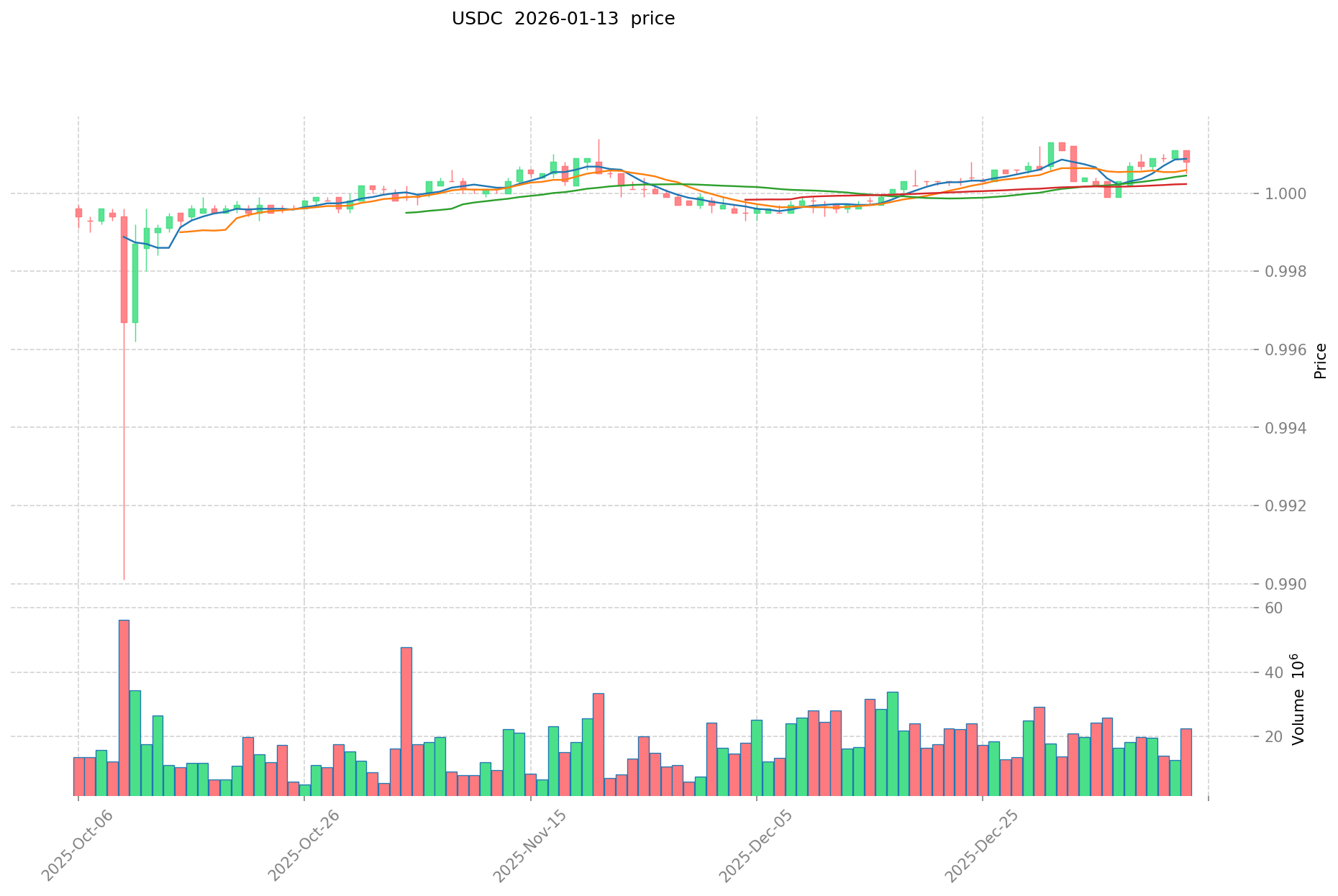
As of January 13, 2026, USDC is trading at $1.00, demonstrating its core function as a dollar-pegged stablecoin. The token shows minimal price fluctuation, with a 24-hour high of $1.0011 and a 24-hour low of $1.0005.
Over recent periods, USDC has exhibited slight variations: a decline of 0.0048% in the past hour, a decrease of 0.02% over 24 hours, while showing modest gains of 0.09% over 7 days and 0.11% over 30 days. The annual change stands at 0.03%.
USDC currently ranks 7th in the cryptocurrency market by market capitalization, with a total market cap of approximately $74.34 billion and a 24-hour trading volume of $23.98 million. The circulating supply stands at 74.34 billion USDC, representing 99.98% of the total supply of 74.36 billion tokens. Market dominance is recorded at 2.28%, with 5,843,307 holders.
The token is deployed across multiple blockchain networks including Ethereum, Arbitrum, Base, BNB Smart Chain, Avalanche C-Chain, Polygon, Solana, and others, demonstrating broad multi-chain compatibility. USDC operates through the Centre consortium's framework, providing detailed financial and operational transparency while collaborating with various banking institutions and audit teams.
Click to view the current USDC market price
USDC Market Sentiment Indicator
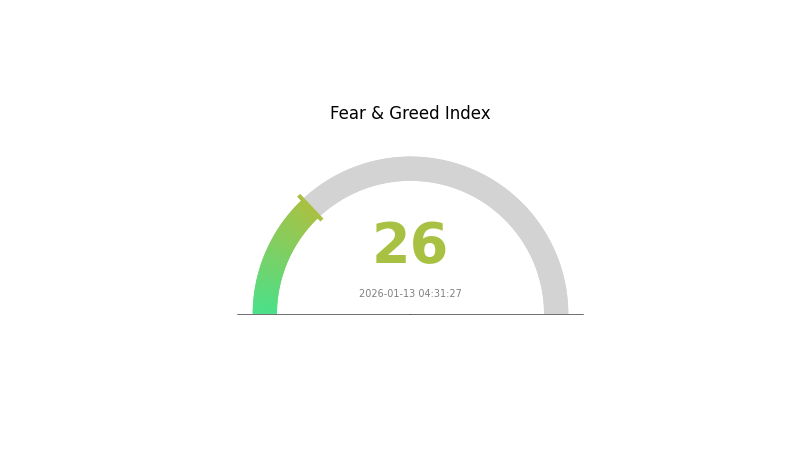
2026-01-13 Fear and Greed Index: 26 (Fear)
Click to view current Fear & Greed Index
Today's cryptocurrency market shows a fear sentiment with an index reading of 26. This indicates heightened market anxiety and cautious investor behavior. During such fear periods, experienced traders often view this as a potential buying opportunity, as extreme fear can signal oversold conditions. However, risk management remains crucial as downward pressure may continue. Investors should carefully assess their risk tolerance and consider dollar-cost averaging strategies rather than making large lump-sum purchases. Monitor key support levels and market catalysts closely for potential trend reversals.
USDC Holding Distribution
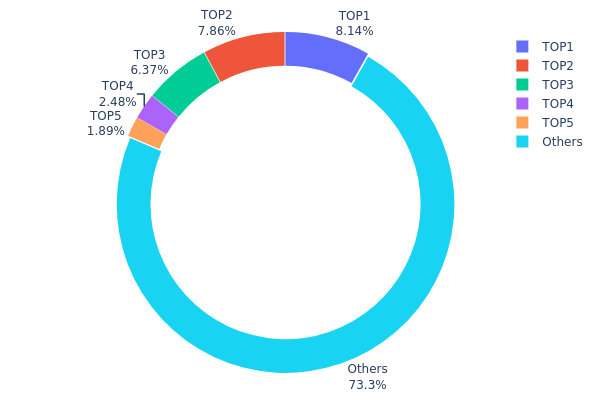
The holding distribution chart provides a quantitative view of token concentration across wallet addresses, revealing the degree of decentralization within the network. This metric is crucial for assessing whether a cryptocurrency's supply is broadly distributed among numerous holders or concentrated within a few major addresses, which can significantly impact market stability and manipulation risks.
According to the current data, the top five addresses collectively hold approximately 2,374,478.19K USDC, representing 26.71% of the total supply, while the remaining 73.29% is distributed among other addresses. The largest holder controls 8.13% of the supply, followed closely by the second-largest at 7.86%. This distribution pattern suggests a moderate level of concentration, which is relatively common for stablecoins where large institutional custodians, exchanges, and treasury operations typically dominate the top holdings.
This distribution structure indicates a relatively healthy decentralization level for a stablecoin. While the top addresses hold significant portions, the majority of supply (73.29%) remains distributed across the broader network, reducing single-point-of-failure risks. The absence of extreme concentration (no single address holding over 10%) suggests that USDC's on-chain infrastructure maintains reasonable resilience against potential manipulation or sudden liquidity shocks from individual large holders.
Click to view current USDC Holding Distribution
| Top |
Address |
Holding Qty |
Holding (%) |
| 1 |
5tzFki...UvuAi9 |
722505.23K |
8.13% |
| 2 |
7VHUFJ...or4BmE |
698103.45K |
7.86% |
| 3 |
H8BgJg...NX5hss |
565681.66K |
6.36% |
| 4 |
AVzP2G...NWQK49 |
220413.77K |
2.48% |
| 5 |
41zCUJ...xTwePu |
167774.08K |
1.88% |
| - |
Others |
6506034.42K |
73.29% |
II. Core Factors Influencing USDC's Future Price
Supply Mechanism
-
Supply-Demand Dynamics in DeFi: USDC's supply is directly tied to demand in decentralized finance (DeFi) applications. When market participants increase usage of USDC in DeFi lending, trading, and liquidity provision, demand rises, which can push prices slightly above the $1 peg. Conversely, reduced DeFi activity can lead to decreased demand and potential downward pressure.
-
Historical Patterns: Past events demonstrate USDC's sensitivity to reserve backing and market confidence. During the Silicon Valley Bank (SVB) collapse in March 2023, USDC temporarily depegged to $0.878 when Circle's cash reserves were frozen at the failed bank. The price recovered to near $1 after the Federal Reserve, Treasury, and FDIC implemented a joint rescue plan on March 13.
-
Current Impact: USDC's supply continues to expand through institutional adoption and regulatory clarity. According to 2025 data, USDC recorded $18.3 trillion in transaction volume, leading the stablecoin market. This growth trajectory, supported by favorable U.S. policies under the Trump administration, suggests sustained demand pressure that supports price stability near the $1 peg.
Institutional and Major Holder Dynamics
-
Institutional Holdings: Major financial institutions have increasingly integrated USDC into their operations. Circle's partnership with Coinbase enables revenue sharing from USDC interest income, with Coinbase offering up to 4% APY to USDC holders. Additionally, institutional players utilize USDC through Coinbase Prime for advanced trading, custody, and staking services.
-
Corporate Adoption: Leading corporations are exploring USDC for payments and settlements. Standard Chartered, Walmart, and Amazon have begun investigating stablecoin issuance and usage. The Trump family's crypto project World Liberty Financial launched the USD1 stablecoin in March 2025, further validating institutional interest.
-
National Policy: The U.S. Senate passed the GENIUS Act in June 2025, establishing a regulatory framework for stablecoins. This legislation provides clear legal standards requiring USDC reserves to be backed 100% by U.S. dollar assets, including cash and short-term Treasuries, explicitly excluding cryptocurrencies like Bitcoin. Circle's Chief Strategy Officer Dante Disparte emphasized that users choose USDC for "the deepest global liquidity and highest level of regulatory trust."
Macroeconomic Environment
-
Monetary Policy Impact: Federal Reserve policy expectations influence USDC demand. As the Fed approaches potential rate cuts, investors seek stable dollar-denominated assets. USDC benefits from its positioning as a digital dollar, particularly attractive to residents in countries experiencing inflation and economic instability who seek convenient access to U.S. dollar exposure.
-
Inflation Hedge Properties: While USDC maintains a stable $1 peg rather than appreciating like traditional inflation hedges, it serves as a reliable store of value during periods of local currency depreciation. The stablecoin provides users in economically volatile regions with a means to preserve purchasing power through dollar exposure.
-
Geopolitical Factors: Rising geopolitical uncertainty has accelerated stablecoin adoption. According to Artemis co-founder Anthony Yim, the digital dollar is achieving mass adoption especially in contexts of heightened geopolitical instability. This trend supports sustained demand for USDC as a safe-haven digital asset.
Technological Development and Ecosystem Building
-
Cross-Chain Transfer Protocol (CCTP): Circle's Cross-Chain Transfer Protocol enables USDC to be burned on one blockchain and atomically minted on another without requiring bridges. This innovation enhances cross-chain compatibility and reduces friction in multi-chain environments, expanding USDC's utility across different blockchain ecosystems.
-
Visa Tokenized Asset Platform (VTAP): Visa launched VTAP in October 2024, offering banks stablecoin-as-a-service capabilities. The platform supports API-driven USDC minting, burning, and management with built-in compliance and cross-chain interoperability. VTAP's first partner, BBVA, plans to pilot euro and dollar stablecoin issuance on Ethereum in 2025. This infrastructure connects USDC to Visa's network of 80 million merchants, supporting both fiat and stablecoin settlement.
-
Ecosystem Applications: USDC has become the preferred stablecoin for DeFi platforms, driving high transaction volumes through frequent trading activity. Integration into major wallets like MetaMask and Phantom, fintech applications via Stripe, and even Telegram bot transfers expands USDC's practical use cases. Traditional financial institutions are also connecting to USDC payments through Visa's Universal Payment Channels, enabling merchants to accept stablecoin payments and convert to fiat currency seamlessly.
III. 2026-2031 USDC Price Forecast
2026 Outlook
- Conservative forecast: $1.00
- Neutral forecast: $1.00
- Optimistic forecast: $1.00
As a stablecoin pegged to the US dollar, USDC is designed to maintain a stable value of approximately $1.00. The forecast data reflects this fundamental characteristic, with all scenarios converging at the $1.00 mark throughout the year.
2027-2029 Outlook
- Market stage expectation: Continued stability phase with maintained peg to USD
- Price range forecast:
- 2027: $1.00
- 2028: $1.00
- 2029: $1.00
- Key catalysts: Regulatory compliance, reserve transparency, and sustained market confidence in Circle's backing mechanisms
The mid-term outlook for USDC remains anchored to its core function as a reliable digital dollar equivalent. The consistency in pricing across these years underscores the token's primary purpose of providing stability rather than speculative returns.
2030-2031 Long-term Outlook
- Baseline scenario: $1.00 (assuming maintained regulatory compliance and full reserve backing)
- Optimistic scenario: $1.00 (under conditions of enhanced institutional adoption)
- Transformational scenario: $1.00 (even with widespread mainstream payment integration)
USDC's long-term value proposition centers on its ability to maintain the dollar peg rather than price appreciation. The stability observed through 2031 reflects the token's design as a medium of exchange and store of value pegged to fiat currency, making it fundamentally different from volatile cryptocurrencies that seek price growth.
| Year |
Predicted High Price |
Predicted Average Price |
Predicted Low Price |
Price Change |
| 2026 |
1 |
1 |
1 |
0 |
| 2027 |
1 |
1 |
1 |
0 |
| 2028 |
1 |
1 |
1 |
0 |
| 2029 |
1 |
1 |
1 |
0 |
| 2030 |
1 |
1 |
1 |
0 |
| 2031 |
1 |
1 |
1 |
0 |
IV. USDC Professional Investment Strategies and Risk Management
USDC Investment Methodology
(I) Long-Term Holding Strategy
- Target Investors: Risk-averse investors seeking capital preservation and stable value storage
- Operational Recommendations:
- Utilize USDC as a stable reserve asset in cryptocurrency portfolios to hedge against market volatility
- Consider deploying USDC in DeFi lending protocols to generate passive yield while maintaining dollar exposure
- Storage Solution: Use Gate Web3 Wallet for secure multi-chain USDC storage with support for 17+ blockchain networks including Ethereum, Solana, Polygon, and Arbitrum
(II) Active Trading Strategy
- Technical Analysis Tools:
- Price Stability Monitoring: Track USDC's trading range (current 24H high: $1.0011, low: $1.0005) to identify arbitrage opportunities when price deviates from $1.00 peg
- Volume Analysis: Monitor 24-hour trading volume ($23.98M) and market depth across 66 exchanges to assess liquidity conditions
- Swing Trading Key Points:
- Capitalize on minor price fluctuations during high volatility periods in the broader crypto market
- Utilize USDC as a safe harbor during market downturns, then redeploy capital when market conditions stabilize
USDC Risk Management Framework
(I) Asset Allocation Principles
- Conservative Investors: 40-60% in USDC as stable reserve
- Aggressive Investors: 10-20% in USDC for portfolio rebalancing flexibility
- Professional Investors: 15-30% in USDC for liquidity management and trading opportunities
(II) Risk Hedging Solutions
- Portfolio Diversification: Combine USDC with other stablecoins to mitigate single-issuer risk
- Multi-Chain Deployment: Distribute USDC holdings across multiple blockchain networks (Ethereum, Solana, Polygon, Arbitrum, Base) to reduce smart contract risk
(III) Secure Storage Solutions
- Hardware Wallet Recommendation: Gate Web3 Wallet provides institutional-grade security with multi-signature support and secure key management
- Multi-Chain Storage Solution: Leverage USDC's deployment across 17+ blockchain networks for diversified custody across ETH, BSC, AVAX_C, MATIC, SOL, and other major chains
- Security Precautions: Verify contract addresses before transactions, use only official blockchain explorers (Etherscan, Solscan, Polygonscan, etc.), and enable two-factor authentication on all wallet interfaces
V. USDC Potential Risks and Challenges
USDC Market Risks
- Competitive Pressure: USDC holds 2.28% market dominance but faces competition from other stablecoins in a dynamic market environment
- Liquidity Fluctuations: Trading volume variations may impact execution efficiency during periods of market stress
- Price Volatility: While designed to maintain $1.00 parity, minor deviations can occur (historical range: $0.877647 - $1.17)
USDC Regulatory Risks
- Regulatory Framework Evolution: Stablecoin regulations continue to develop globally, which may impact operational requirements
- Compliance Requirements: Circle operates under U.S. money transmission frameworks, and changes in regulatory standards could affect USDC issuance and redemption mechanisms
- Jurisdictional Variations: Different countries maintain distinct regulatory approaches to stablecoins, potentially affecting cross-border usability
USDC Technical Risks
- Smart Contract Vulnerabilities: With deployments across 17+ blockchain networks, each contract implementation carries inherent smart contract risk
- Cross-Chain Bridge Security: Multi-chain operations require bridge protocols that may introduce additional security considerations
- Network Congestion: During high-demand periods, transaction costs and confirmation times may increase on congested blockchain networks
VI. Conclusion and Action Recommendations
USDC Investment Value Assessment
USDC represents a foundational infrastructure asset in the digital currency ecosystem, offering dollar-pegged stability with extensive cross-chain compatibility. With a market capitalization exceeding $74.3 billion, circulating supply of 74.34 billion tokens across 17+ blockchain networks, and integration with 66 exchanges, USDC provides substantial liquidity and accessibility. The stablecoin's 99.98% market cap to fully diluted valuation ratio indicates minimal supply overhang. Short-term price movements remain negligible (-0.02% in 24H, +0.09% in 7D), reflecting its core function as a stable value transfer mechanism. Long-term value proposition centers on its role as a liquidity bridge, collateral asset, and dollar-denominated settlement layer in decentralized finance applications.
USDC Investment Recommendations
✅ Beginners: Start with small allocations (5-10% of crypto portfolio) to understand stablecoin mechanics, use USDC for portfolio rebalancing, and store in Gate Web3 Wallet for secure multi-chain access
✅ Experienced Investors: Maintain 15-25% USDC allocation for tactical trading opportunities, explore DeFi yield strategies, and leverage cross-chain capabilities for arbitrage and liquidity provision
✅ Institutional Investors: Deploy USDC as treasury management solution, utilize for programmatic trading and settlement, and implement multi-signature custody through enterprise-grade wallet infrastructure
USDC Trading Participation Methods
- Spot Trading: Execute USDC pairs on Gate.com and other major exchanges with deep liquidity pools
- DeFi Integration: Deploy USDC in lending protocols, liquidity pools, and yield farming strategies across supported networks
- Cross-Chain Operations: Transfer USDC between 17+ supported blockchains (ETH, BSC, SOL, MATIC, ARBITRUM, BASE, AVAX_C, etc.) based on transaction cost and speed requirements
Cryptocurrency investment carries extreme risk. This article does not constitute investment advice. Investors should make prudent decisions based on their personal risk tolerance and are advised to consult professional financial advisors. Never invest more than you can afford to lose.
FAQ
Why is USDC's price always stable at 1 USD? Will its price fluctuate?
USDC maintains a 1 USD price through full asset backing and reserve collateralization. While minor price variations may occur due to market conditions, arbitrage mechanisms ensure it quickly returns to the 1 USD peg.
What are the advantages and risks of USDC compared to other stablecoins such as USDT and DAI?
USDC excels in compliance and reserve transparency with 80% short-term treasuries. USDT dominates high-frequency trading but carries higher regulatory risks. DAI offers decentralization but faces collateral volatility. Choose based on your priority: compliance, liquidity, or decentralization.
What are the main factors affecting USDC price and value?
USDC price and value are primarily influenced by its stability against the US dollar, market capitalization, trading volume, and its role in DeFi applications. These factors collectively determine USDC's market dynamics and adoption levels.
What are the prospects for USDC in 2024-2025? Will its circulation continue to grow?
USDC shows strong growth momentum. Circulation surged over 78% in 2024, outpacing other major stablecoins. Monthly trading volume reached 1 trillion USD in November 2024. Adoption is accelerating across web3 ecosystems, indicating continued expansion ahead.
What is USDC depegging risk? Has it occurred historically?
USDC depegging risk refers to potential deviation from its 1 USD peg. Historically, USDC experienced a 12% decline in 2023 during banking turmoil. Such events may recur based on market conditions.
* The information is not intended to be and does not constitute financial advice or any other recommendation of any sort offered or endorsed by Gate.