This comprehensive guide analyzes Ethena's USDE synthetic stablecoin, offering expert price predictions from 2026-2031 based on historical trends, market dynamics, and ecosystem development. USDE, currently trading near $1.00 with a $6.38 billion market cap, is positioned as a censorship-resistant, delta-hedged stablecoin solution. The article provides detailed price forecasts ranging from conservative to optimistic scenarios, institutional adoption insights, and practical investment strategies for beginners through professional traders. Detailed risk analysis covers depeg events, regulatory challenges, and technical vulnerabilities. Whether you're seeking stablecoin exposure or yield opportunities through Gate.com, this guide delivers actionable insights on USDE's market positioning, hedging mechanisms, and strategic allocation recommendations for diversified cryptocurrency portfolios.
Introduction: USDE's Market Position and Investment Value
Ethena USDe (USDE), as the first censorship-resistant, scalable, and stable crypto-native synthetic dollar solution, has been making notable progress since its launch in 2023. As of 2026, USDE maintains a market capitalization of approximately 6.38 billion USD, with a circulating supply of around 6.38 billion tokens, and its price remains stable near 0.9999 USD. This asset, recognized as a "delta-hedged synthetic stablecoin," is playing an increasingly vital role in decentralized finance and on-chain financial applications.
This article will comprehensively analyze USDE's price trends from 2026 to 2031, combining historical patterns, market supply and demand dynamics, ecosystem development, and macroeconomic conditions to provide investors with professional price forecasts and practical investment strategies.
I. USDE Price History Review and Market Status
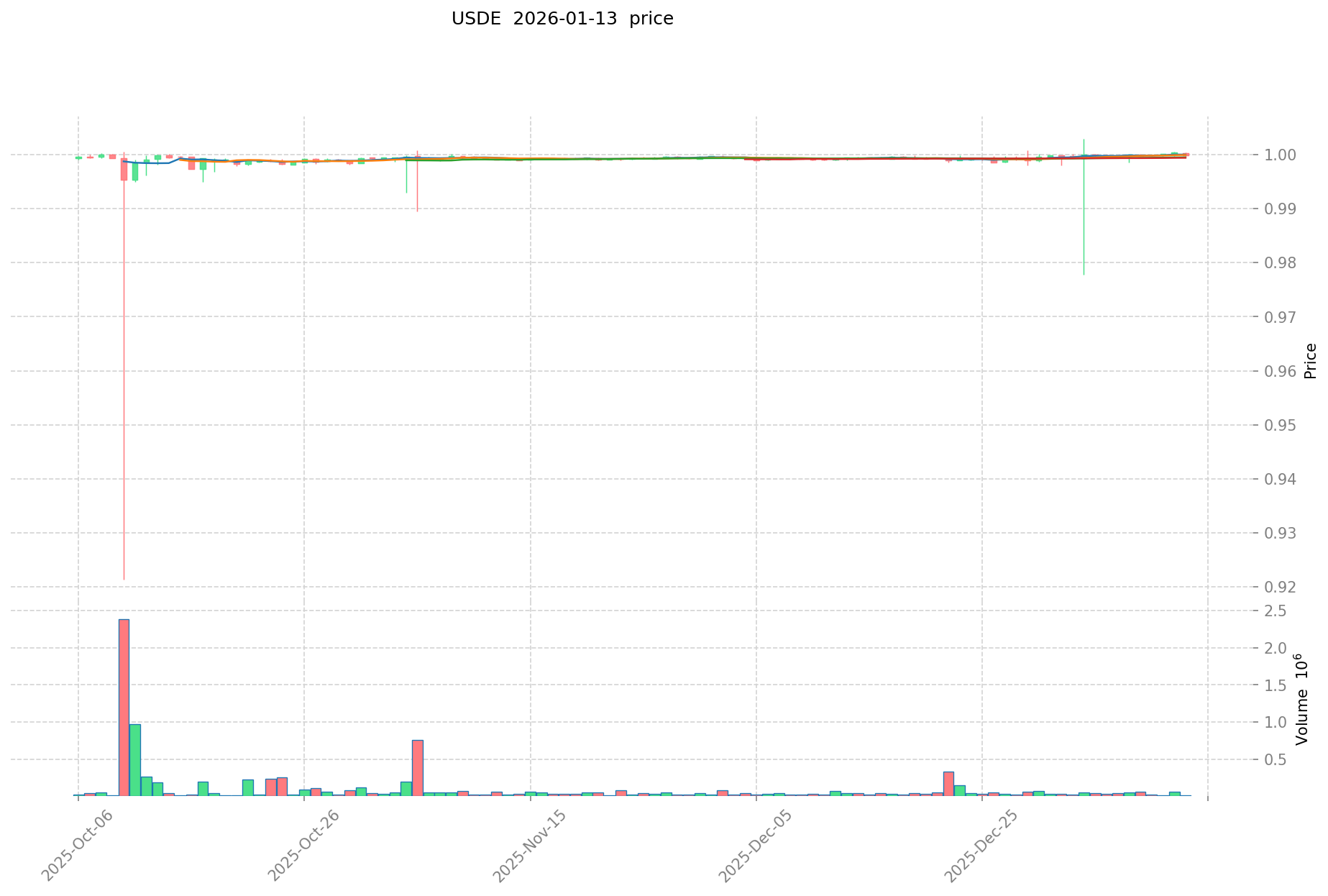
USDE Historical Price Evolution Trajectory
- 2023: USDE launched in December 2023 at an initial price of 1 USD, marking the introduction of Ethena's synthetic dollar as a censorship-resistant stablecoin solution
- 2024: In November 2024, USDE reached a historical high of 1.5 USD, demonstrating significant price volatility during market expansion
- 2025: Throughout October 2025, USDE experienced market corrections, with the price declining to a historical low of 0.9213 USD
USDE Current Market Status
As of January 13, 2026, USDE is trading at 0.9999 USD, showing a slight increase of 0.01% over the past 24 hours. The token demonstrates relatively stable short-term performance, with a 24-hour trading range between 0.9998 USD and 1 USD. Over the past hour, the price has declined by 0.048%, while maintaining modest gains of 0.01% over the past week.
Looking at longer timeframes, USDE has recorded increases of 0.069% over the past 30 days and 0.06% over the past year, indicating gradual recovery from previous lows. The current market capitalization stands at approximately 6.38 billion USD, with USDE ranking 24th among cryptocurrencies and holding a 0.17% market dominance.
The circulating supply of USDE is approximately 6.38 billion tokens, with a total supply of 5.83 billion tokens and no maximum supply limit. The token maintains strong liquidity with a 24-hour trading volume of 15,039.19 USD. Currently, USDE is supported by 4,174 holders across multiple blockchain networks.
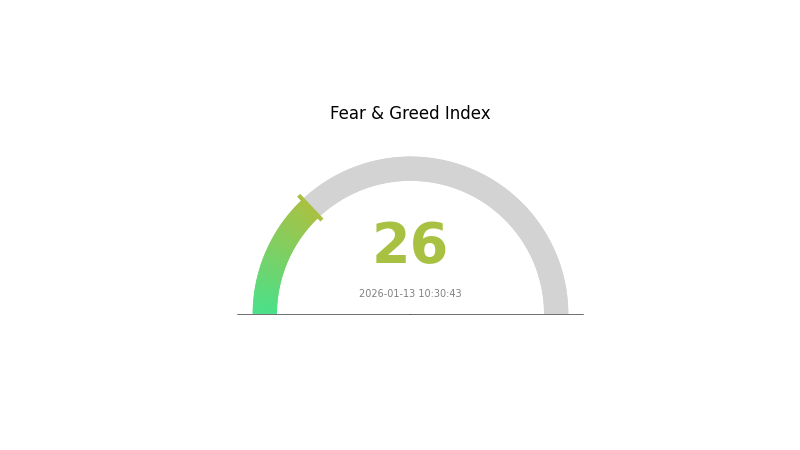
Market sentiment data indicates a Fear index reading of 26, reflecting cautious investor behavior in the current market environment. The fully diluted market capitalization equals the current market capitalization at approximately 5.82 billion USD.
Click to view the current USDE market price
USDE Market Sentiment Index
2026-01-13 Fear and Greed Index: 26 (Fear)
Click to view current Fear & Greed Index
The cryptocurrency market is currently experiencing significant fear sentiment with an index reading of 26. This indicates heightened market anxiety and risk-averse behavior among investors. During such periods, market volatility tends to increase, and asset prices may face downward pressure. Cautious investors typically reduce their positions or seek safer assets, while more aggressive traders may identify potential buying opportunities at lower valuations. The current fear environment suggests investors should carefully evaluate their risk tolerance and portfolio allocation before making trading decisions on Gate.com.
USDE Holder Distribution
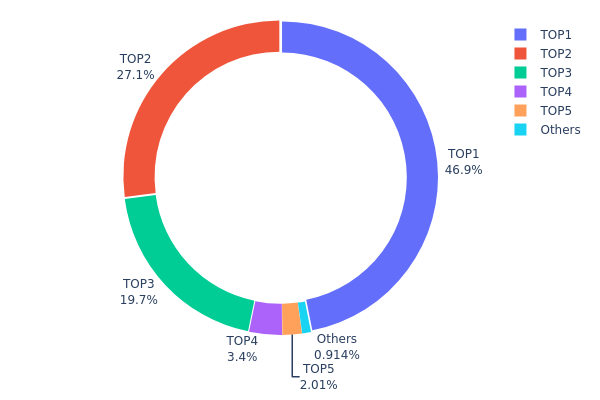
The holder distribution chart illustrates how USDE tokens are allocated across different wallet addresses, providing insight into the degree of centralization or decentralization within the token's ecosystem. This metric serves as a crucial indicator of market structure, as concentrated holdings may suggest higher vulnerability to large-scale sell pressure or potential price manipulation.
Based on current on-chain data, USDE exhibits a highly concentrated distribution pattern. The top three addresses collectively control 93.66% of the total circulating supply, with the largest holder alone accounting for 46.89% (92,715.90K tokens), followed by 27.09% and 19.68% respectively. The fourth and fifth largest addresses hold 3.39% and 2.01%, while all remaining addresses combined represent merely 0.94% of total supply. This extreme concentration significantly exceeds the typical distribution patterns observed in mature cryptocurrency projects.
Such concentrated ownership structure presents notable implications for market dynamics. The dominant position of the top three holders creates substantial asymmetric risk, as coordinated or individual large-scale liquidations could trigger severe price volatility and liquidity crises. Additionally, this concentration level raises concerns regarding true decentralization and governance power distribution. From a market structure perspective, the limited dispersion among ordinary holders suggests restricted organic adoption and constrained trading activity outside these major positions. While concentrated holdings may indicate strong conviction from early investors or strategic partners, it simultaneously exposes the token to elevated systematic risks that potential investors should carefully evaluate.
Click to view current USDE holder distribution
| Top |
Address |
Holding Qty |
Holding (%) |
| 1 |
UQC90N...f3_NUx |
92715.90K |
46.89% |
| 2 |
UQDYh9...d344Mm |
53581.41K |
27.09% |
| 3 |
UQCnzJ...VEzssh |
38917.41K |
19.68% |
| 4 |
EQChGu...qnpZXW |
6721.91K |
3.39% |
| 5 |
EQBSNX...dWRO6M |
3979.19K |
2.01% |
| - |
Others |
1806.96K |
0.94% |
II. Core Factors Influencing USDE's Future Price
Supply Mechanism
- Elastic Supply System: Market demand fluctuations automatically adjust USDE supply scale, continuously maintaining the peg to the US dollar.
- Historical Pattern: The elastic supply mechanism has effectively stabilized USDE price around $1, reducing volatility during market fluctuations.
- Current Impact: The elastic supply mechanism is expected to continue maintaining price stability near the $1 anchor point, helping to mitigate the impact of market volatility on USDE.
Institutional and Major Holder Dynamics
- Institutional Holdings: Understanding who holds cryptocurrency is crucial for comprehending its price movements. Holder statistics reveal the latest trends among USDE holders, including the number of addresses, whale activities, and large holder concentration. An increase in the number of holders may indicate growing confidence, while whale sell-offs could signal potential price declines.
- Enterprise Adoption: USDe, the synthetic dollar of the Ethena protocol, has become the third-largest stablecoin with a market capitalization exceeding $10.2 billion, demonstrating significant institutional and market adoption.
- National Policy: Regulatory changes and broader market trends play significant roles in influencing USDE's price trajectory.
Macroeconomic Environment
- Monetary Policy Impact: USDE's future price is influenced by institutional adoption and regulatory frameworks. Federal Reserve monetary policy expectations and interest rate environments significantly affect stablecoin market dynamics.
- Inflation Hedging Attributes: In high-inflation countries, stablecoins have become important assets for wealth preservation, offering alternatives to volatile local currencies.
- Geopolitical Factors: International situations and global economic uncertainty impact market sentiment and trader behavior, which in turn influences USDE's market performance.
Technological Development and Ecosystem Construction
- Delta-Neutral Hedging Strategy: USDe employs a delta-neutral strategy combining spot holdings with perpetual contract short positions to maintain dollar peg and generate real yields, even in highly volatile market environments.
- Off-Exchange Settlement (OES): OES services provided by institutions custody assets on-chain and map amounts to centralized exchanges for margin provision, preserving DeFi characteristics while isolating on-chain funds from exchanges, thereby reducing risks of fund misappropriation and insolvency.
- Ecosystem Applications: USDe has been integrated into DeFi protocols such as Curve and Pendle, satisfying different application scenario needs while potentially enhancing sUSDe yield rates through diverse use cases.
III. 2026-2031 USDE Price Forecast
2026 Outlook
- Conservative prediction: $0.88991 - $0.9999
- Neutral prediction: Around $0.9999
- Optimistic prediction: Up to $1.09989 (requires sustained market stability and increasing adoption)
The 2026 forecast suggests USDE will maintain relative price stability, with projections indicating minimal deviation from its baseline value. The predicted average price of $0.9999 reflects expectations of steady performance, while the potential high of $1.09989 represents approximately 10% upside under favorable conditions.
2027-2029 Mid-term Outlook
- Market stage expectation: Gradual appreciation phase with expanding ecosystem integration
- Price range predictions:
- 2027: $0.56694 - $1.51185, average $1.0499 (5% price change)
- 2028: $0.67886 - $1.9085, average $1.28087 (28% price change)
- 2029: $1.5309 - $2.32824, average $1.59469 (59% price change)
- Key catalysts: Progressive market adoption, technological developments, and broader cryptocurrency sector growth momentum
The mid-term forecast indicates an accelerating growth trajectory, with year-over-year price changes showing significant expansion from 5% in 2027 to 59% by 2029. This progression suggests increasing market confidence and wider ecosystem utilization.
2030-2031 Long-term Outlook
- Baseline scenario: $1.4711 - $2.45183 (assumes continued market maturation and stable regulatory environment)
- Optimistic scenario: $1.96146 - $2.93484 (assumes enhanced utility and broader institutional adoption)
- Transformative scenario: Potential to reach $2.93484 by 2031 (requires exceptional favorable conditions including major platform integrations and significant market expansion)
- 2026-01-13: USDE trading within initial forecast parameters (early-stage price discovery phase)
| Year |
Predicted High Price |
Predicted Average Price |
Predicted Low Price |
Price Change |
| 2026 |
1.09989 |
0.9999 |
0.88991 |
0 |
| 2027 |
1.51185 |
1.0499 |
0.56694 |
5 |
| 2028 |
1.9085 |
1.28087 |
0.67886 |
28 |
| 2029 |
2.32824 |
1.59469 |
1.5309 |
59 |
| 2030 |
2.45183 |
1.96146 |
1.4711 |
96 |
| 2031 |
2.93484 |
2.20665 |
1.16952 |
120 |
IV. USDE Professional Investment Strategies and Risk Management
USDE Investment Methodology
(I) Long-term Holding Strategy
- Target Investors: Investors seeking stable value preservation and those interested in stablecoin exposure within the crypto ecosystem
- Operational Recommendations:
- Establish positions gradually during periods when USDe maintains its peg stability around the dollar mark
- Monitor the protocol's delta-hedging mechanisms and collateral backing transparency on-chain
- Storage Solution: Utilize Gate Web3 Wallet for secure custody with multi-signature protection options
(II) Active Trading Strategy
- Technical Analysis Tools:
- Price Deviation Monitoring: Track USDe's deviation from the peg to identify arbitrage opportunities when price moves away from nominal value
- Volume Analysis: Monitor the trading volume trends on Gate.com to assess market liquidity and trading momentum
- Swing Trading Essentials:
- Focus on brief price deviations from the peg that typically revert to mean
- Implement tight stop-loss orders given the stablecoin's limited price fluctuation range
USDE Risk Management Framework
(I) Asset Allocation Principles
- Conservative Investors: 5-10% as part of stablecoin holdings within overall crypto portfolio
- Aggressive Investors: 15-25% for liquidity management and trading pair purposes
- Professional Investors: Variable allocation based on market-making and arbitrage strategies
(II) Risk Hedging Solutions
- Diversification Across Stablecoins: Combine USDe with other established stablecoin assets to mitigate protocol-specific risks
- Collateral Monitoring: Regularly review Ethena's published on-chain collateral data and hedging positions
(III) Secure Storage Solutions
- Hot Wallet Recommendation: Gate Web3 Wallet for active trading and DeFi participation with convenient access
- Cold Storage Solution: Transfer significant holdings to hardware wallet solutions for long-term custody
- Security Precautions: Enable two-factor authentication, verify contract addresses on Etherscan before transactions, and maintain offline backup of recovery phrases
V. USDE Potential Risks and Challenges
USDE Market Risks
- Depeg Events: USDe may experience temporary deviations from its dollar peg during extreme market volatility or liquidity stress
- Liquidity Concerns: Trading volume of approximately 15,039 USDT over 24 hours indicates moderate liquidity that may impact large transactions
- Competition Pressure: Presence in a crowded stablecoin market with established competitors may affect adoption and growth trajectory
USDE Regulatory Risks
- Stablecoin Oversight: Evolving global regulations regarding stablecoin issuance and operations may impact Ethena's operational framework
- Compliance Requirements: Potential future requirements for reserve audits, licensing, or regulatory reporting could affect the protocol
- Jurisdictional Restrictions: Certain regions may implement restrictions on synthetic dollar products or delta-hedging mechanisms
USDE Technical Risks
- Smart Contract Vulnerabilities: As an ERC-20 token deployed on Ethereum, USDe faces inherent smart contract security risks
- Oracle Dependencies: The delta-hedging mechanism relies on accurate price feeds and oracle data that could be subject to manipulation
- Collateral Management: The effectiveness of maintaining the peg depends on proper execution of hedging strategies and collateral sufficiency
VI. Conclusion and Action Recommendations
USDE Investment Value Assessment
Ethena USDe presents a novel approach to stablecoin design through its censorship-resistant and delta-hedged structure backed by staked Ethereum collateral. With a market capitalization exceeding 6.38 billion USD and ranking at position 24, USDe has established notable market presence since its launch. The protocol's emphasis on transparency and on-chain verifiability offers potential value for investors seeking alternative stablecoin exposure. However, the relatively recent launch in December 2023 means limited long-term track record, and the synthetic nature introduces complexities compared to traditional fiat-backed stablecoins. Short-term risks include potential depegging events and the need to monitor the effectiveness of the hedging mechanisms.
USDE Investment Recommendations
✅ Beginners: Start with small allocations to understand stablecoin mechanics, limit exposure to 5% of crypto portfolio, and use USDe primarily for learning about DeFi applications
✅ Experienced Investors: Consider USDe as part of diversified stablecoin holdings, monitor on-chain transparency data regularly, and evaluate opportunities for yield generation within the Ethena ecosystem
✅ Institutional Investors: Assess USDe for treasury management and trading operations, conduct thorough due diligence on collateral mechanisms, and consider integration possibilities with existing DeFi strategies
USDE Trading Participation Methods
- Spot Trading: Purchase USDe directly on Gate.com with competitive pricing and liquidity for immediate exposure
- DeFi Integration: Utilize USDe in decentralized finance protocols for lending, borrowing, or liquidity provision on Ethereum network
- Portfolio Diversification: Include USDe alongside other stablecoin holdings to spread protocol-specific risks while maintaining dollar-denominated exposure
Cryptocurrency investment carries extreme risks, and this article does not constitute investment advice. Investors should make prudent decisions based on their own risk tolerance and are advised to consult professional financial advisors. Never invest more than you can afford to lose.
FAQ
What is USDe and how does it differ from other stablecoins?
USDe is a fully collateralized stablecoin maintained through delta-neutral strategy. Unlike algorithmic stablecoins such as UST, USDe is backed by real assets and derivatives, providing greater stability and security for users.
USDE reached its all-time high on January 4, 2026, followed by a sharp decline to record lows. The past year shows volatile price fluctuations with no clear directional trend, characterized by significant swings between peaks and troughs.
What are the main factors affecting USDE price?
USDE price is primarily influenced by supply and demand dynamics, market sentiment driven by news and investor confidence, regulatory developments including policy changes, institutional adoption rates, and broader macroeconomic trends such as inflation and interest rates.
What are expert predictions for USDE's future price?
Experts predict USDE will maintain stable value around $1.00 as a stablecoin, with potential upside driven by increased adoption and institutional interest in yield-bearing stablecoins. Long-term growth depends on Ethena protocol expansion and broader crypto market developments.
Is USDe safe as an investment variety? What risks should be noted?
USDe offers attractive yields through delta-neutral design, but carries risks including smart contract vulnerabilities, market volatility, and unproven long-term mechanisms. Conduct thorough research before investing.
How to buy and trade USDE? Which exchanges support USDE trading?
You can purchase USDE through major cryptocurrency platforms by creating an account, adding a payment method, and executing trades. USDE is available on multiple exchanges and decentralized platforms. Simply search for USDE trading pairs and execute your desired trade volume.
What is the supply of USDE? Is there inflation risk?
USDE supply exceeds 2.2 billion dollars. Inflation risk depends on market demand and competition. Currently, there is no clear inflation risk assessment.
* The information is not intended to be and does not constitute financial advice or any other recommendation of any sort offered or endorsed by Gate.