The article offers a detailed analysis of Zulu Network (ZULU)'s price trends and investment strategies for the years 2025 to 2030. It reviews ZULU's market evolution, current status, and forecasted price trajectories, providing investors with insight into potential opportunities and risks in the Bitcoin DePIN sector. Highlighting key factors such as technological development, market dynamics, and sentiment indicators, it caters to both novice and experienced investors keen on navigating cryptocurrency investments. The structure emphasizes historical price analysis, fundamental insights, and practical strategies for maximizing investment value.
Introduction: ZULU's Market Position and Investment Value
Zulu Network (ZULU) stands as the first Native Bitcoin DePIN Layer optimized for AI and DePIN implementations. Since its launch in November 2024, the project has established itself as an innovative blockchain protocol combining Bitcoin's security with EVM infrastructure flexibility. As of December 26, 2025, ZULU's fully diluted valuation has reached approximately $11.10 million, with a circulating supply of 144.5 million tokens trading at around $0.011095 per token. This pioneering asset is playing an increasingly critical role in enabling users to stake assets, facilitate operation of various DePIN and AI protocols, and earn rewards on the Bitcoin Network.
This article will provide a comprehensive analysis of ZULU's price trends from 2025 through 2030, integrating historical patterns, market supply-demand dynamics, ecosystem development, and macroeconomic factors to deliver professional price forecasting and practical investment strategies for investors seeking exposure to the emerging Bitcoin DePIN sector.
Zulu Network (ZULU) Market Analysis Report
I. ZULU Price History Review and Current Market Status
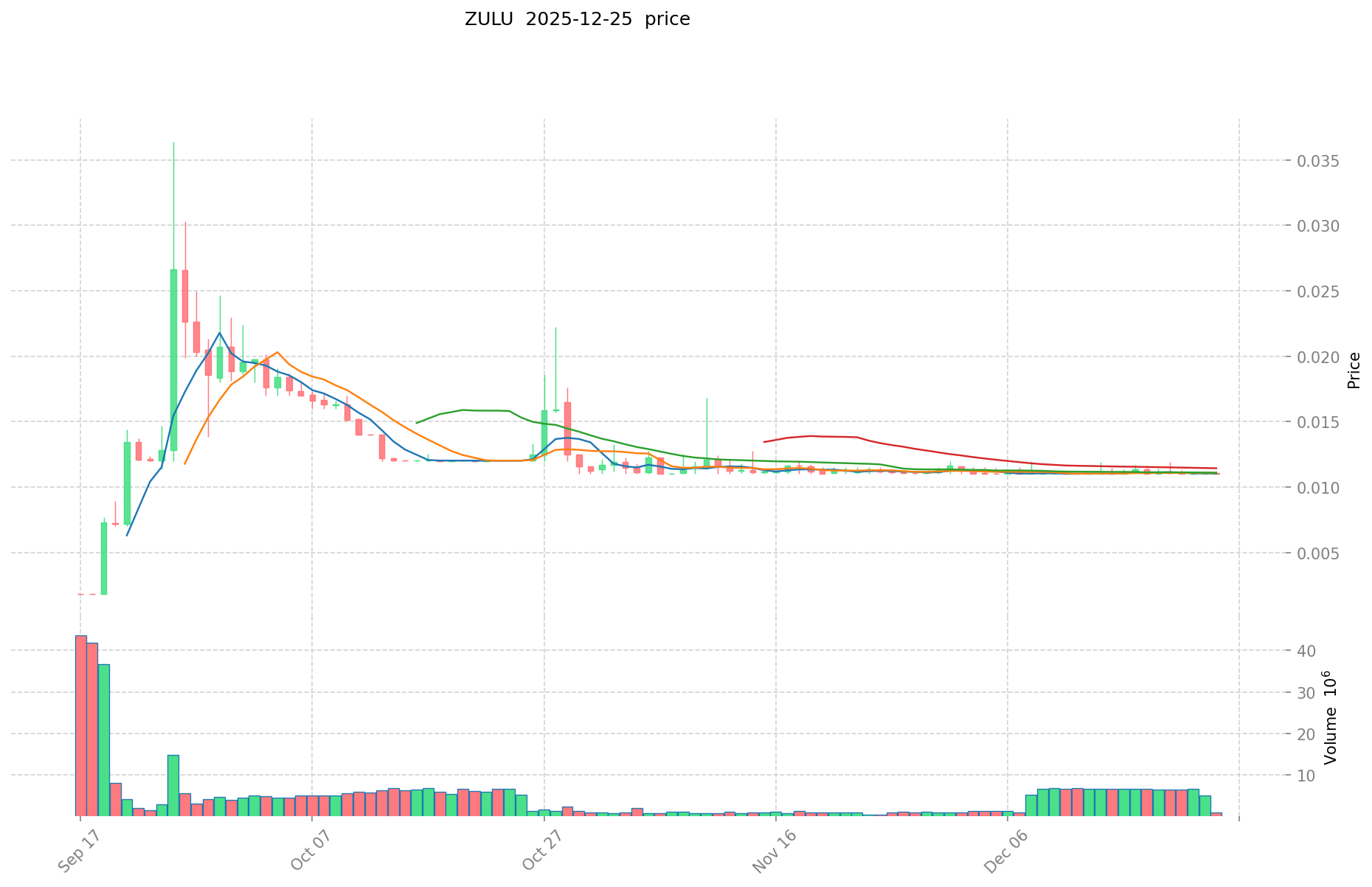
ZULU Historical Price Evolution
-
November 2024: Project launch and market entry, price reached all-time high of $0.27599 on November 11, 2024, reflecting strong initial market enthusiasm for the native Bitcoin DePIN layer protocol.
-
July 2025: Market correction phase, price declined to all-time low of $0.001313 on July 10, 2025, representing a significant pullback from peak levels amid broader market volatility.
-
December 2025: Recovery and stabilization, price currently trading at $0.011095, showing gradual recovery from the July lows.
ZULU Current Market Status
As of December 26, 2025, ZULU is trading at $0.011095, with a market capitalization of approximately $1,603,227.50 and a fully diluted valuation (FDV) of $11,095,000.00. The token ranks at #2,283 in the cryptocurrency market by capitalization, with a market dominance of 0.00034%.
Over the past 24 hours, ZULU has demonstrated modest upward movement, gaining 0.86%. Weekly performance shows a smaller advance of 0.35%, while monthly metrics reflect a slight decline of -0.65%. On a year-to-date basis, the token has appreciated significantly by 14.97% since its November 2024 launch.
The circulating supply stands at 144,500,000 ZULU out of a total supply of 1,000,000,000 tokens, representing 14.45% of total supply currently in circulation. Daily trading volume reached $12,481.49, with 375 unique holders actively participating in the network.
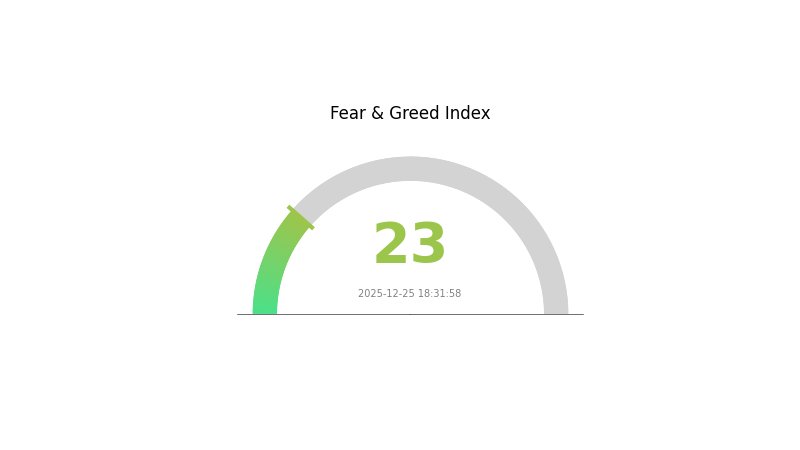
Current market sentiment reflects "Extreme Fear" conditions with a VIX reading of 23, suggesting heightened risk aversion across cryptocurrency markets.
Click to view current ZULU market price
ZULU Market Sentiment Indicator
2025-12-25 Fear and Greed Index: 23 (Extreme Fear)
Click to view current Fear & Greed Index
The crypto market is currently experiencing extreme fear, with the Fear and Greed Index plummeting to 23. This significant drop signals heightened market anxiety and pessimism among investors. During periods of extreme fear, market volatility tends to increase sharply, creating both substantial risks and potential opportunities for experienced traders. Investors should exercise caution and conduct thorough due diligence before making investment decisions. Consider using Gate.com's market data tools to monitor real-time sentiment shifts and make informed trading strategies during this turbulent market phase.
ZULU Holdings Distribution
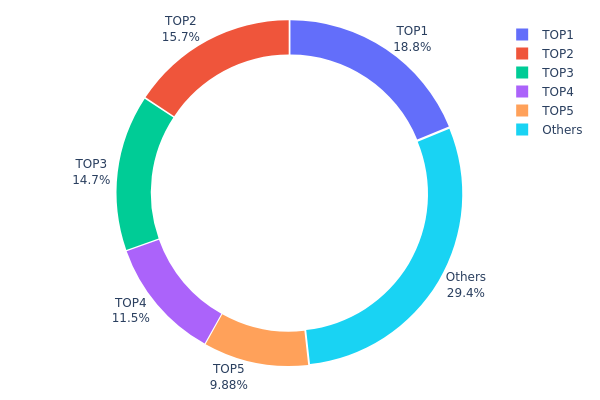
The address holdings distribution chart illustrates the concentration of ZULU tokens across the blockchain network by tracking the top individual wallet addresses and their respective token quantities. This metric serves as a critical indicator for assessing the degree of decentralization, potential market manipulation risks, and overall ecosystem health of the ZULU token.
Analysis of the current distribution data reveals moderate concentration characteristics. The top five addresses collectively hold approximately 70.54% of the circulating supply, with the largest holder commanding 18.78% of total tokens. While the leading address demonstrates significant influence, the distribution pattern is not severely skewed, as the remaining 29.46% of tokens are dispersed among numerous smaller addresses. This fragmentation among the "Others" category suggests that ZULU maintains a reasonably distributed holder base beyond its major stakeholders.
The concentration dynamics present a balanced but noteworthy market structure. With the top holder representing less than one-fifth of total supply and the top five accounts comprising under three-quarters, ZULU demonstrates neither extreme centralization nor complete decentralization. However, the substantial combined weight of the leading five addresses warrants careful monitoring for potential coordinated selling pressure or strategic token accumulation that could influence market pricing and volatility. The relatively even distribution from positions two through five indicates no singular dominant actor, which mitigates single-point-of-failure risks while the broader holder base provides resilience against sudden market disruptions.
Click to view current ZULU holdings distribution
| Top |
Address |
Holding Qty |
Holding (%) |
| 1 |
0xbc3a...a3ba67 |
169108.33K |
18.78% |
| 2 |
0xcc7f...f3d882 |
141666.67K |
15.74% |
| 3 |
0xf8f6...bd53ea |
132000.00K |
14.66% |
| 4 |
0x7005...594fe0 |
103333.34K |
11.48% |
| 5 |
0xc882...84f071 |
88953.27K |
9.88% |
| - |
Others |
264938.40K |
29.46% |
II. Core Factors Influencing ZULU's Future Price
Technology Development and Ecosystem Building
-
Bitcoin Layer 2 Solutions: Zulu Network is pioneering Bitcoin Layer 2 solutions, offering enhanced transaction speed and cost efficiency. These improvements are critical factors for widespread adoption and long-term price sustainability.
-
Ecosystem Expansion: Zulu Network is preparing for major milestones in 2024, including expanding its ecosystem through strategic partnerships and investments. The network aims to bridge DeFi, DePIN, and AI projects across platforms, attracting numerous prominent investors and partners.
-
Ecosystem Applications: ZULU tokens can be utilized for asset staking, facilitating DePIN and AI protocols, earning rewards, and participating in the decentralized economy. Users can stake, participate in DePIN protocols, and develop dApps within the Zulu ecosystem, combining Bitcoin's security with innovation.
Market Dynamics and Investor Sentiment
-
Current Market Position: Zulu Network currently trades at $0.01108661 with a 24-hour price change of 0.85%. The token has experienced significant historical volatility, ranging from an all-time high of $0.146745 to a low of $0.00131433, with a current circulating supply of 144.50M ZULU and market cap of $1,602,055.
-
Market Participation: Zulu Network remains an actively traded cryptocurrency with ongoing market participation and ecosystem development. However, investments in ZULU are inherently volatile and should align with individual risk tolerance. Independent research (DYOR) and careful market analysis are essential before making investment decisions.
III. 2025-2030 ZULU Price Forecast
2025 Outlook
- Conservative Forecast: $0.00965 - $0.01100
- Neutral Forecast: $0.01100 - $0.01232
- Optimistic Forecast: $0.01232 (requiring sustained market sentiment and positive ecosystem developments)
2026-2028 Mid-term Outlook
- Market Stage Expectation: Gradual recovery phase with potential consolidation, characterized by incremental growth and market maturation.
- Price Range Forecast:
- 2026: $0.00691 - $0.01522 (5% upside potential)
- 2027: $0.01131 - $0.01938 (21% upside potential)
- 2028: $0.01412 - $0.01856 (48% upside potential)
- Key Catalysts: Ecosystem expansion, increased adoption on trading platforms like Gate.com, strategic partnerships, and broader cryptocurrency market recovery cycles.
2029-2030 Long-term Outlook
- Base Case: $0.01417 - $0.01749 (57% upside potential by 2029), establishing sustainable trading range with institutional interest growth.
- Optimistic Case: $0.01535 - $0.02540 (64% upside potential by 2030), driven by strong token utility adoption and mainstream market integration.
- Transformation Case: $0.0254+ (extreme upside scenario), contingent upon breakthrough developments in protocol functionality, major exchange listings, and significant market capitalization expansion.
The forecast trajectory indicates a multi-year accumulation phase transitioning into potential appreciation cycles, with 2030 representing a critical inflection point for asset valuation.
| 年份 |
预测最高价 |
预测平均价格 |
预测最低价 |
涨跌幅 |
| 2025 |
0.01232 |
0.0111 |
0.00965 |
0 |
| 2026 |
0.01522 |
0.01171 |
0.00691 |
5 |
| 2027 |
0.01938 |
0.01346 |
0.01131 |
21 |
| 2028 |
0.01856 |
0.01642 |
0.01412 |
48 |
| 2029 |
0.01906 |
0.01749 |
0.01417 |
57 |
| 2030 |
0.0254 |
0.01828 |
0.01535 |
64 |
Zulu Network (ZULU) Investment Analysis Report
I. Project Overview
Project Introduction
Zulu Network is the first native Bitcoin DePIN layer optimized for AI and DePIN implementations. The protocol combines Bitcoin's security with EVM infrastructure flexibility to create a decentralized economy focused on AI and physical infrastructure.
Key features include:
- Native Bitcoin Integration: Built specifically for the Bitcoin network while maintaining EVM compatibility
- Asset Staking: Users can stake assets to facilitate operation of various DePIN and AI protocols
- Earnings Mechanism: Participants earn rewards directly on the Bitcoin network
- DePIN Focus: Designed to empower decentralized physical infrastructure innovations
| Metric |
Value |
| Token Symbol |
ZULU |
| Token Standard |
ERC-20 |
| Current Price |
$0.011095 |
| Market Capitalization |
$1,603,227.50 |
| Fully Diluted Valuation |
$11,095,000 |
| Circulating Supply |
144,500,000 ZULU |
| Total Supply |
1,000,000,000 ZULU |
| Market Dominance |
0.00034% |
| Current Rank |
#2283 |
Current Market Status (As of December 26, 2025)
- Current Price: $0.011095
- 24-Hour Change: +0.86%
- 7-Day Change: +0.35%
- 30-Day Change: -0.65%
- 1-Year Change: +14.97%
Historical Price Levels
- All-Time High (ATH): $0.27599 (November 11, 2024)
- All-Time Low (ATL): $0.001313 (July 10, 2025)
- Distance from ATH: -95.98%
- Distance from ATL: +743.76%
Trading Metrics
- 24-Hour Trading Volume: $12,481.49
- Market Capitalization: $1,603,227.50
- Circulating Supply Ratio: 14.45%
- Token Holders: 375
- Available Exchanges: 1
- Launch Price: $0.10
Market Analysis
Zulu Network exhibits characteristics of an early-stage project with significant price volatility. The token experienced a notable decline from its ATH of $0.27599 to current levels, representing a substantial correction phase. However, the positive 1-year return of 14.97% indicates underlying demand despite market headwinds. The relatively low trading volume suggests limited liquidity, which amplifies price volatility and slippage risks for traders.
III. Fundamental Analysis
Project Strengths
-
Innovative Technology: First-mover advantage as a native Bitcoin DePIN layer with EVM compatibility represents a novel approach to blockchain infrastructure.
-
Dual-Layer Security: Combines Bitcoin's proven security model with EVM's development flexibility, potentially offering best-of-both-worlds infrastructure.
-
Timely Market Position: Launched during peak DePIN interest, positioning the project to capture emerging infrastructure opportunities in AI and physical assets.
-
Clear Use Case: Staking mechanism provides tangible utility for users seeking yield on decentralized physical infrastructure networks.
Project Challenges
-
Early Development Stage: With only 375 token holders and minimal trading volume, the project remains in nascent stages with uncertain adoption trajectory.
-
Limited Liquidity: Single exchange listing significantly restricts trading options and increases execution risk for investors.
-
Extreme Price Volatility: The 95.98% decline from ATH suggests significant market uncertainty and potential overvaluation at launch.
-
Competitive Landscape: Other DePIN and infrastructure projects exist with greater funding and established networks, creating competitive pressures.
-
Execution Risk: Success depends on achieving technical milestones, developer adoption, and real-world DePIN protocol integration.
IV. ZULU Professional Investment Strategy and Risk Management
ZULU Investment Methodology
(1) Long-Term Holding Strategy
-
Target Audience: Risk-tolerant investors with 2-5 year investment horizons, institutional DeFi researchers, and technology-focused cryptocurrency enthusiasts.
-
Operational Guidelines:
- Dollar-cost averaging (DCA): Implement weekly or monthly purchases to reduce timing risk given the project's early-stage volatility
- Thesis alignment: Maintain positions only if you believe in the fundamental value of Bitcoin-native DePIN infrastructure long-term
- Portfolio allocation: Limit ZULU to 1-3% of total cryptocurrency portfolio due to early-stage risk profile
-
Storage Solutions: Self-custodial wallets such as Gate Web3 wallet for ongoing access and reward claiming; maintain comprehensive backup of private keys in secure, offline storage locations.
(2) Active Trading Strategy
ZULU Risk Management Framework
(1) Asset Allocation Principles
-
Conservative Investors: 0-1% allocation - ZULU represents high-risk experimental infrastructure; minimal exposure appropriate for capital preservation focused portfolios.
-
Growth-Oriented Investors: 1-3% allocation - Accept higher volatility in exchange for potential upside if DePIN adoption materializes; maintain stop-loss orders at 25-30% below entry price.
-
Specialized/Technical Investors: 2-5% allocation - Can justify higher allocation if maintaining active research on DePIN developments and protocol integration progress.
(2) Risk Hedging Approaches
-
Portfolio Diversification: Combine ZULU with established Bitcoin and Ethereum positions to reduce single-asset concentration risk and benefit from correlation dynamics.
-
Position Sizing: Scale trade sizes inversely to volatility; reduce position size during periods of extreme price swings exceeding 10% daily movements.
(3) Secure Storage Solutions
-
Web3 Wallet Implementation: Gate Web3 Wallet provides user-friendly interface with seed phrase backup, hardware wallet integration capabilities, and transaction signing security; ideal for active staking participation and protocol interaction.
-
Self-Custody Best Practices: Maintain complete control of private keys through mnemonic phrases stored offline; never share access credentials through digital channels.
-
Security Considerations: Be aware of smart contract risks inherent to ERC-20 token interactions; verify contract addresses on Etherscan before transactions; never approve unlimited token spending to unvetted protocols.
V. ZULU Potential Risks and Challenges
ZULU Market Risk
-
Extreme Volatility: 95.98% decline from ATH demonstrates market participants' willingness to abandon positions rapidly; susceptible to panic selling during broader cryptocurrency market downturns.
-
Limited Liquidity: Single exchange listing and low trading volume mean large orders create substantial slippage; potential difficulty exiting positions at favorable prices during market stress.
-
Speculative Demand: Early-stage pricing may reflect speculation rather than fundamental DePIN adoption; risk of value erosion if hype cycle concludes without meaningful protocol adoption.
ZULU Regulatory Risk
-
DePIN Regulatory Uncertainty: Regulatory frameworks for physical infrastructure networks remain undefined in most jurisdictions; potential future regulations could impact project viability or token utility.
-
Securities Classification: Depending on staking mechanism structure and governance rights, ZULU could face securities regulation challenges in various jurisdictions, potentially restricting trading or use cases.
-
Cross-Border Compliance: Operating as Bitcoin-native infrastructure creates jurisdictional complexities; changes in Bitcoin regulation could indirectly impact Zulu Network's operational landscape.
ZULU Technical Risk
-
Smart Contract Vulnerability: ERC-20 implementation on Ethereum introduces technical risks; potential code vulnerabilities could result in fund loss despite Bitcoin-level security intentions.
-
Bitcoin Interoperability Challenges: Achieving seamless Bitcoin integration while maintaining EVM compatibility presents ongoing technical challenges; failed implementation could undermine core value proposition.
-
Protocol Adoption Risk: Success requires DePIN projects to build on Zulu infrastructure; failure to attract protocol developers would eliminate primary revenue and utility mechanisms.
VI. Conclusion and Action Recommendations
ZULU Investment Value Assessment
Zulu Network presents a technologically innovative approach to DePIN infrastructure by combining Bitcoin's security with EVM flexibility. However, the project remains in very early developmental stages with unproven market demand, minimal liquidity, and significant execution risks. The 95.98% decline from launch pricing reflects substantial uncertainty regarding long-term viability.
From a fundamental perspective, the long-term value case depends entirely on whether real-world DePIN protocols and AI applications meaningfully adopt Zulu's infrastructure and whether users substantially stake assets through the platform. Short-term risks significantly outweigh near-term upside potential given the asset's nascent stage, volatile price action, and limited trading options.
ZULU Investment Recommendations
✅ Beginners: Maintain zero-to-minimal exposure while monitoring project development; consider 0.1-0.5% allocation only after establishing foundational Bitcoin and Ethereum positions; prioritize learning about DePIN mechanics before committing capital.
✅ Experienced Investors: Implement small 1-3% position sizing with dollar-cost averaging strategy; set strict stop-loss orders at -30% to -40% below entry levels; actively research protocol adoption progress and team execution; consider allocation justified only if maintaining convictions about Bitcoin-native infrastructure significance.
✅ Institutional Investors: Focus on partnership development opportunities rather than direct token acquisition; evaluate whether Zulu infrastructure aligns with existing DeFi or infrastructure fund mandates; engage directly with project team regarding adoption roadmap before significant capital allocation.
ZULU Trading Participation Methods
-
Direct Token Purchase: Purchase ZULU through Gate.com exchange, currently the primary trading venue; use limit orders to control execution prices and minimize slippage given low liquidity conditions.
-
Staking and Protocol Participation: Engage directly with Zulu Network staking mechanisms to earn protocol rewards; requires technical proficiency with smart contract interaction and understanding of specific DePIN protocol requirements.
-
Dollar-Cost Averaging Strategy: Execute recurring purchases over extended periods to reduce timing risk and average entry prices; particularly appropriate given price volatility and early-stage uncertainty surrounding project trajectory.
Cryptocurrency investment carries extreme risk. This report does not constitute investment advice. Investors must make decisions based on personal risk tolerance and should consult professional financial advisors. Never invest capital that you cannot afford to lose completely. The cryptocurrency market is highly speculative, and early-stage projects like Zulu Network present heightened risks of total capital loss.
FAQ
How much is Zulu crypto worth?
Zulu crypto is currently worth $0.0110 as of December 25, 2025. It has increased by 0.14% over the past 24 hours. The all-time high reached $0.250.
What is ZULU cryptocurrency and what is its use case?
ZULU is a Bitcoin Layer 2 network enabling developers to build DeFi, NFTs, and GameFi applications. It enhances Bitcoin's scalability and transaction efficiency for native projects and BRC-20 tokens.
What is the price prediction for ZULU in 2024/2025?
ZULU is projected to reach approximately $0.000001 in 2025, with potential range between $0.000001 as low and high estimates. Market momentum and adoption rates will influence actual price movements during this period.
Is ZULU a good investment and what are the risks?
ZULU offers strong potential with low entry barriers for investors. Key risks include market volatility, trader performance dependency, and crypto market fluctuations. Conduct thorough research before investing.
How does ZULU compare to other cryptocurrencies?
ZULU distinguishes itself through its focus on decentralized finance solutions. While it has a smaller market cap than major cryptocurrencies like Dogecoin, ZULU offers unique utility and community-driven development, positioning it as an emerging alternative in the crypto ecosystem.
What factors influence ZULU's price movements?
ZULU's price is influenced by market sentiment, trading volume, project developments, adoption trends, and broader cryptocurrency market conditions. Positive announcements and increased ecosystem activity typically drive price appreciation.
* The information is not intended to be and does not constitute financial advice or any other recommendation of any sort offered or endorsed by Gate.