This comprehensive analysis examines ACA token's price dynamics and investment potential from 2026 through 2031. As Polkadot's native DeFi hub, ACA powers decentralized exchanges, stablecoins, and liquid staking protocols, currently trading at $0.006658 with a $7.77 million market cap. The article evaluates historical price trends, supply-demand mechanics, and macroeconomic factors affecting valuation, projecting prices ranging from $0.005 to $0.01433 across the forecast period. Professional investment strategies address long-term holding and active trading approaches, with detailed risk management frameworks for conservative, aggressive, and institutional investors. Key risks including market volatility, regulatory challenges, and ecosystem dependency require careful consideration. Practical recommendations guide investors through spot trading on Gate and DeFi participation, emphasizing thorough due diligence before allocating capital to this specialized cryptocurrency asset.
Introduction: ACA's Market Position and Investment Value
Acala (ACA), positioned as Polkadot's distributed finance network and liquidity hub, has been serving as a layer-1 smart contract platform since its launch in 2022. As of 2026, ACA maintains a market capitalization of approximately $7.77 million, with a circulating supply of around 1.17 billion tokens, and the price stabilizes at approximately $0.0066. This asset, recognized as a utility token powering Polkadot's DeFi ecosystem, is playing an increasingly important role in decentralized finance applications, including the Acala Swap decentralized exchange, Acala Dollar stablecoin (aUSD), and DOT Staking liquidity solutions.
This article will comprehensively analyze ACA's price trends from 2026 to 2031, combining historical patterns, market supply and demand dynamics, ecosystem development, and macroeconomic conditions to provide investors with professional price forecasts and practical investment strategies.
I. ACA Price History Review and Market Status
ACA Historical Price Evolution Trajectory
- 2022: Reached a significant milestone on January 25, with price movements reflecting early market activity following its launch in January 2022.
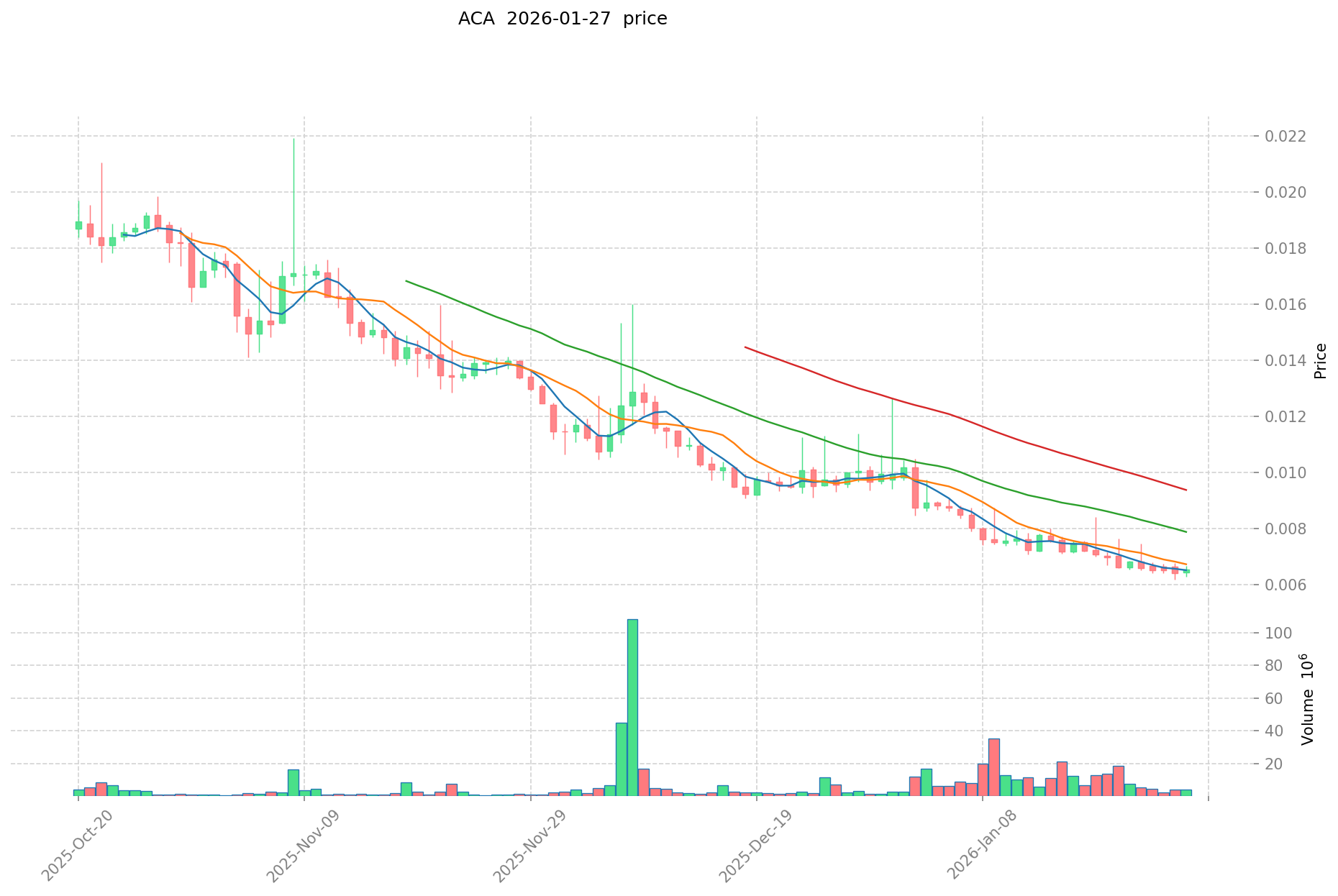
- 2026: Experienced notable price fluctuations, with the token recording its lowest historical level at $0.00626543 on January 26.
ACA Current Market Situation
As of January 27, 2026, ACA is trading at $0.006658, showing a 24-hour increase of 3.32%. The token has demonstrated mixed short-term performance, with a 1-hour gain of 0.35%, while facing a 7-day decline of 4.93%. Over the past 30 days, the token has decreased by 32.30%.
The current market capitalization stands at $7,767,666.62, with a 24-hour trading volume of $21,898.48. The circulating supply represents 1,166,666,660 ACA tokens, accounting for 72.92% of the maximum supply of 1,600,000,000 tokens. The fully diluted market cap is valued at $10,652,800.
Within the past 24 hours, ACA has traded between a low of $0.006296 and a high of $0.006675. The token maintains a market dominance of 0.00034% and is currently ranked at position 1330 in the overall cryptocurrency market. The current market sentiment index registers at 29, indicating a fear sentiment among market participants.
Click to view the current ACA market price
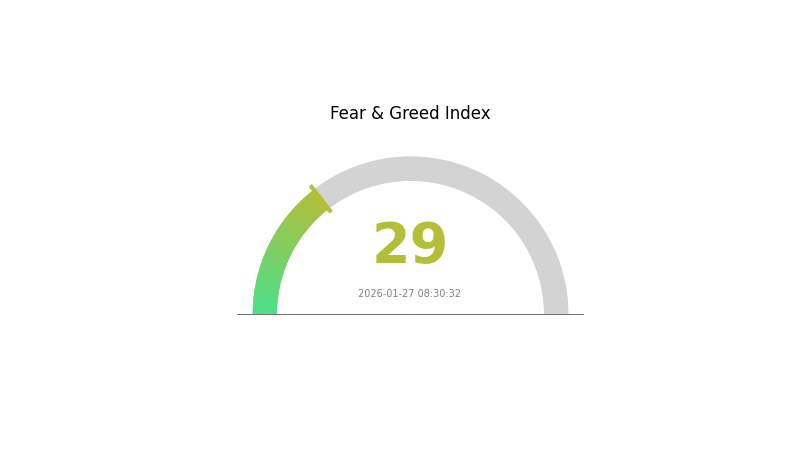
ACA 市场情绪指标
2026-01-27 Fear and Greed Index: 29 (Fear)
Click to view current Fear & Greed Index
The cryptocurrency market is currently experiencing a fear sentiment with an index reading of 29. This low score indicates heightened market anxiety and risk aversion among investors. When the Fear and Greed Index remains in the fear zone, it often signals potential buying opportunities for long-term investors, as assets may be undervalued. However, traders should exercise caution and conduct thorough research before making investment decisions. Monitor the index closely as market sentiment can shift rapidly based on macroeconomic conditions, regulatory developments, and major news events in the crypto space.
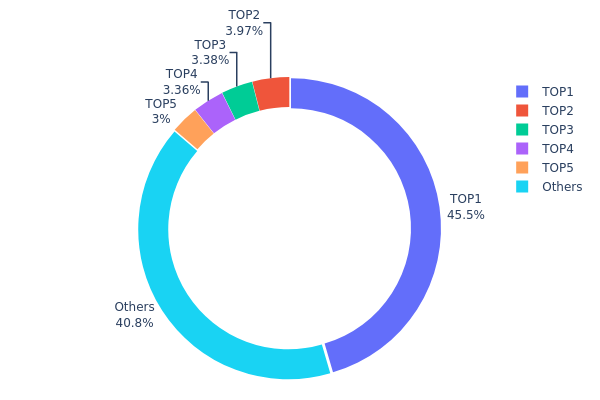
ACA Holding Distribution
The holding distribution chart illustrates the concentration of token ownership across different wallet addresses within the network. This metric serves as a critical indicator of decentralization levels and potential market manipulation risks. By examining the percentage of total supply held by top addresses versus smaller holders, analysts can assess the health and stability of the token's ecosystem structure.
Based on the current data, ACA demonstrates a notably concentrated holding pattern. The top address alone controls approximately 568.25 million tokens, representing 45.48% of the total supply—a substantial concentration that raises immediate concerns about centralization. The top five addresses collectively hold 739.43 million tokens, accounting for 59.16% of the circulating supply. This leaves only 40.84% distributed among all remaining addresses, indicating a highly centralized ownership structure that deviates significantly from the decentralized ideals typically expected in blockchain networks.
This concentration level presents several implications for market dynamics. The dominant position of the largest holder creates asymmetric power dynamics, where a single entity possesses sufficient holdings to significantly influence price movements through large-scale transactions. Such concentration increases vulnerability to price manipulation and heightens volatility risks, as coordinated actions by major holders could trigger substantial market reactions. Additionally, this distribution pattern may discourage broader community participation and reduce liquidity depth, as retail investors might perceive heightened risks associated with concentrated ownership structures.
Click to view current ACA Holding Distribution
| Top |
Address |
Holding Qty |
Holding (%) |
| 1 |
21B8m9...sY4oYA |
568252.59K |
45.48% |
| 2 |
23M5tt...rJ2A1i |
49551.45K |
3.96% |
| 3 |
26JqMK...3hQ9Ti |
42170.45K |
3.37% |
| 4 |
23M5tt...JPon69 |
41954.53K |
3.35% |
| 5 |
23M5tt...4hDSDJ |
37504.39K |
3.00% |
| - |
Others |
509994.73K |
40.84% |
II. Core Factors Affecting ACA's Future Price
Supply Mechanism
-
Production Capacity Adjustments: The 7-ACA industry has experienced significant supply-side changes due to environmental pressures and rising costs. Since 2014, major producers including Fukang Pharmaceutical and Shandong Qilu have exited 7-ACA production, shifting to domestic procurement instead.
-
Historical Patterns: Historical data shows that production disruptions and capacity exits have led to supply constraints, typically resulting in upward price pressure. The 2019 Xiangshui explosion incident caused domestic 4-AA manufacturers to halt quotations due to tight supply, subsequently driving price increases.
-
Current Impact: Supply-side constraints remain a key factor, with environmental regulations continuing to affect production capacity. The market has shown relatively stable pricing with minor fluctuations, suggesting supply-demand dynamics are gradually reaching equilibrium.
Macroeconomic Environment
-
Policy Impact: Healthcare policy changes, particularly regarding insurance reimbursement rates and cost structures, can influence market demand patterns. The Affordable Care Act (ACA) has introduced various cost considerations for the healthcare sector.
-
Cost Pressures: Rising production costs, including raw material expenses and environmental compliance costs, have been persistent factors affecting pricing. Manufacturing facilities face ongoing pressure to balance cost management with regulatory requirements.
-
Global Health Events: The materials indicate that global health situations can impact demand patterns and pricing dynamics, though specific effects vary based on the nature and duration of such events.
Market Demand Dynamics
-
Stable Demand Base: The pharmaceutical raw materials sector generally maintains relatively stable demand from downstream applications, providing a foundation for price support.
-
Supply-Demand Balance: Current market conditions suggest a period of low-level volatility, with prices maintaining stability following adjustments from previous disruptions.
-
Production Disruptions: Unexpected events affecting production facilities can create temporary supply shortages, leading to short-term price fluctuations and market adjustments.
III. 2026-2031 ACA Price Prediction
2026 Outlook
- Conservative prediction: $0.005 - $0.00667
- Neutral prediction: $0.00667
- Optimistic prediction: $0.00733 (requires favorable market conditions)
2027-2029 Outlook
- Market stage expectation: The token is anticipated to enter a gradual growth phase with increased adoption and ecosystem development
- Price range predictions:
- 2027: $0.00581 - $0.01022
- 2028: $0.00517 - $0.00887
- 2029: $0.00691 - $0.01031
- Key catalysts: Ecosystem expansion, technological improvements, and broader market recovery could serve as primary price drivers during this period
2030-2031 Long-term Outlook
- Baseline scenario: $0.00648 - $0.00953 (assuming steady ecosystem growth and moderate market conditions)
- Optimistic scenario: $0.01119 - $0.01286 (assuming accelerated adoption and favorable regulatory environment)
- Transformative scenario: $0.01433 (under exceptionally favorable conditions including significant partnership announcements and mass adoption)
- 2026-01-27: ACA trading within the predicted range of $0.005 - $0.00733 (establishing baseline for future growth trajectory)
| Year |
Predicted High Price |
Predicted Average Price |
Predicted Low Price |
Price Change |
| 2026 |
0.00733 |
0.00667 |
0.005 |
0 |
| 2027 |
0.01022 |
0.007 |
0.00581 |
5 |
| 2028 |
0.00887 |
0.00861 |
0.00517 |
29 |
| 2029 |
0.01031 |
0.00874 |
0.00691 |
31 |
| 2030 |
0.01286 |
0.00953 |
0.00648 |
43 |
| 2031 |
0.01433 |
0.01119 |
0.00616 |
68 |
IV. ACA Professional Investment Strategy and Risk Management
ACA Investment Methodology
(I) Long-term Holding Strategy
- Suitable for: Investors seeking exposure to Polkadot's DeFi ecosystem with a multi-year investment horizon
- Operational Recommendations:
- Consider accumulating positions during market downturns, particularly when price approaches historical support levels
- Monitor key developments in Polkadot ecosystem upgrades and Acala protocol enhancements
- Storage Solution: Utilize Gate Web3 Wallet for secure self-custody with multi-chain support, or consider hardware wallet integration for larger holdings
(II) Active Trading Strategy
- Technical Analysis Tools:
- Volume Analysis: Track the 24-hour trading volume ($21,898.48) relative to historical averages to identify potential breakout or breakdown scenarios
- Support and Resistance Levels: Monitor the 24-hour range ($0.006296 - $0.006675) for potential trading boundaries
- Swing Trading Essentials:
- Given the 3.32% 24-hour gain, watch for potential profit-taking near resistance levels
- Consider the 7-day decline of -4.93% when establishing medium-term position sizing
ACA Risk Management Framework
(I) Asset Allocation Principles
- Conservative Investors: 1-3% of crypto portfolio allocation
- Aggressive Investors: 5-8% of crypto portfolio allocation
- Professional Investors: May allocate up to 10% with active hedging strategies
(II) Risk Hedging Solutions
- Portfolio Diversification: Balance ACA exposure with other Polkadot ecosystem tokens and established Layer-1 assets
- Position Sizing: Scale positions gradually rather than deploying capital in single transactions
(III) Secure Storage Solutions
- Hot Wallet Recommendation: Gate Web3 Wallet for active trading and DeFi interaction with Acala protocols
- Cold Storage Solution: Hardware wallet integration for long-term holdings exceeding $1,000
- Security Considerations: Never share private keys, enable two-factor authentication, and verify all transaction addresses before confirming
V. ACA Potential Risks and Challenges
ACA Market Risks
- High Volatility: ACA has experienced a 90.75% decline over the past year, indicating significant price instability
- Low Liquidity: With a market cap of approximately $7.77 million and 24-hour volume of $21,898, the token may experience substantial slippage on larger trades
- Market Capitalization Ranking: Currently ranked #1330, indicating limited market attention compared to major cryptocurrencies
ACA Regulatory Risks
- DeFi Protocol Compliance: Evolving regulations around decentralized finance protocols may impact Acala's operations
- Cross-border Token Status: Regulatory treatment of utility tokens varies significantly across jurisdictions
- Stablecoin Regulations: Acala's aUSD stablecoin may face increased regulatory scrutiny as global stablecoin frameworks develop
ACA Technical Risks
- Smart Contract Vulnerabilities: As a DeFi platform, Acala faces inherent risks associated with smart contract exploits
- Polkadot Ecosystem Dependency: ACA's success is closely tied to the overall adoption and technical performance of the Polkadot network
- EVM Compatibility Challenges: While Acala EVM+ aims for Ethereum compatibility, technical implementation risks remain
VI. Conclusion and Action Recommendations
ACA Investment Value Assessment
ACA represents a specialized investment in Polkadot's DeFi infrastructure, offering exposure to decentralized exchange, stablecoin, and liquid staking protocols. The long-term value proposition depends on Polkadot ecosystem growth and Acala's ability to attract developer activity. However, the token's 90.75% one-year decline and relatively low market capitalization present substantial short-term risks. The circulating supply represents 72.92% of maximum supply, suggesting limited additional dilution risk.
ACA Investment Recommendations
✅ Beginners: Limit exposure to less than 2% of total crypto portfolio; prioritize learning about DeFi mechanics before investing
✅ Experienced Investors: Consider small speculative positions (3-5% allocation) with defined entry/exit strategies based on technical levels
✅ Institutional Investors: Conduct thorough due diligence on Acala's protocol metrics, developer activity, and competitive positioning within Polkadot ecosystem
ACA Trading Participation Methods
- Spot Trading: Available on Gate.com and 15 other exchanges with current price around $0.006658
- DeFi Integration: Interact directly with Acala Swap DEX for native protocol participation
- Staking Options: Explore liquid staking opportunities through Acala's LDOT mechanism for DOT holders
Cryptocurrency investment carries extremely high risk, and this article does not constitute investment advice. Investors should make cautious decisions based on their own risk tolerance and are advised to consult professional financial advisors. Never invest more than you can afford to lose.
FAQ
How to predict ACA coin price trend in the future?
ACA is projected to reach ¥19.45 by 2027, showing strong growth potential. With a market cap ranking of 866, the token demonstrates solid momentum. Price movements depend on network adoption, trading volume, and overall market conditions.
What are the main factors affecting ACA coin price?
ACA price is primarily influenced by Acala DeFi platform adoption rate and total value locked (TVL) growth. Polkadot ecosystem development, parachain auction progress, and trading volume also significantly impact price movements.
What price could ACA reach this year?
Based on current market trends, ACA could potentially reach a high of $0.390205 in 2026. Price predictions suggest it may fluctuate between $0.0236039 and $0.0059065 throughout the year, depending on market conditions.
What advantages does ACA coin have compared to other mainstream cryptocurrencies?
ACA provides efficient decentralized finance services with cross-chain interoperability and highly programmable smart contracts. It holds significant advantages within the Polkadot ecosystem, offering superior scalability and DeFi functionality compared to mainstream alternatives.
What are the technical foundations and application scenarios of ACA coin?
ACA is the native token of Acala Network, a DeFi platform built on Polkadot. It powers liquidity mining, lending protocols, and stablecoin issuance. Applications include decentralized finance services, NFT ecosystems, and gaming economies within the Acala network.
What risks should I pay attention to when investing in ACA coins?
ACA coin carries high market volatility risk. Prices can fluctuate significantly in short periods. It's recommended to diversify your portfolio and avoid investing all funds in a single asset. Conduct thorough research before investing.
ACA币的历史价格表现如何?
ACA coin has shown volatility in recent months. As of late December 2025, prices fluctuated between 0.00976 and 0.011358. The token experienced upward momentum followed by normal market corrections, demonstrating typical crypto market dynamics with varying trading volumes.
What are professional analysts' price predictions for ACA coin?
Professional analysts predict ACA could reach ¥19.45 by 2027, with future price expectations around ¥0.08703. ACA is anticipated to maintain strong growth momentum based on its market position.
* The information is not intended to be and does not constitute financial advice or any other recommendation of any sort offered or endorsed by Gate.