This comprehensive analysis examines AO's market position and investment outlook from 2026 to 2031. Currently trading at $5.06 with a $29.70 million market cap, AO represents a decentralized computing platform experiencing significant recovery from its October 2025 low of $3.8. The article evaluates AO's price trajectory, analyzing historical patterns and supply dynamics while projecting conservative estimates of $2.89-$5.06 for 2026, with potential growth to $9.94 by 2031. Professional investment strategies include long-term holding and active trading approaches, complemented by comprehensive risk management frameworks. The analysis addresses market volatility, liquidity constraints, and regulatory uncertainties while providing actionable recommendations for beginners, experienced investors, and institutions. Trading is available on Gate.com and six other exchanges. Investors should conduct thorough due diligence before allocating capital to this higher-risk infrastructure asset.
Introduction: AO's Market Position and Investment Value
AO (AO), as a decentralized computing system, has been making notable progress in the blockchain infrastructure space since its emergence. As of 2026, AO's market capitalization has reached approximately $29.70 million, with a circulating supply of around 5.87 million tokens, and the price is maintained at approximately $5.06. This asset, characterized as a "parallel process computing platform," is playing an increasingly important role in decentralized computation and message-passing infrastructure.
Currenting trading at a significant discount from its historical high of $28.32 recorded in March 2025, AO presents both opportunities and challenges for investors. With a maximum supply cap of 21 million tokens and current circulation representing about 27.94% of the fully diluted market cap, the token's supply dynamics suggest potential room for value appreciation as the ecosystem develops.
This article will comprehensively analyze AO's price trends from 2026 to 2031, combining historical patterns, market supply and demand dynamics, ecosystem development, and macroeconomic environmental factors to provide investors with professional price forecasts and practical investment strategies.
I. AO Price History Review and Market Status
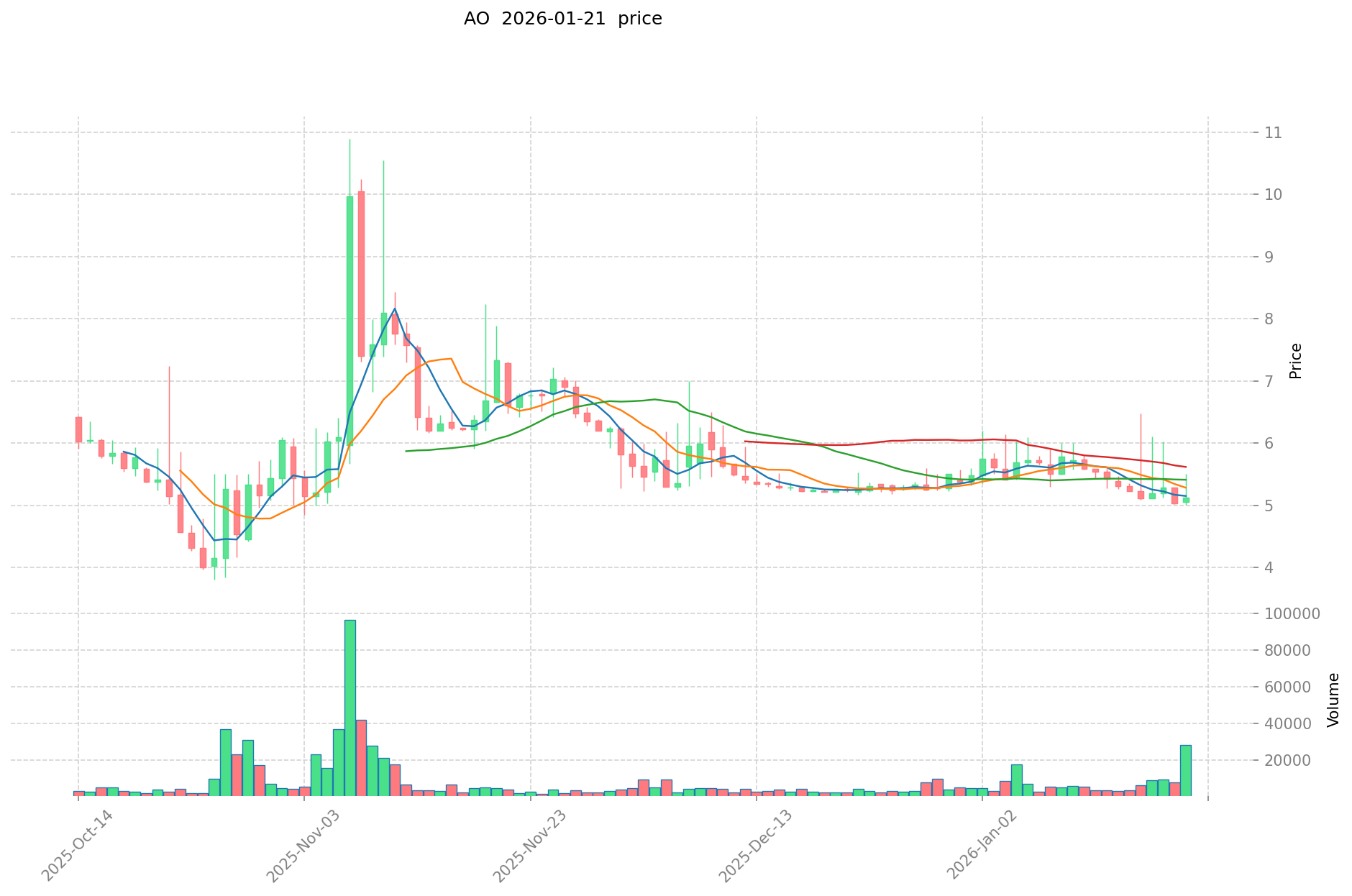
AO Historical Price Evolution Trajectory
- March 2025: AO reached a peak price level of $28.32, marking a significant milestone in its market performance during the early stages of 2025
- October 2025: The token experienced a substantial correction, declining to its lowest recorded level of $3.8, representing a notable market adjustment phase
- January 2026: Following the October low point, AO has shown recovery signs, currently trading at approximately $5.06, indicating a modest rebound from the bottom
AO Current Market Situation
As of January 21, 2026, AO is trading at $5.06, demonstrating a 0.61% increase over the past 24 hours. The token's 24-hour trading range has fluctuated between $5.01 and $5.22, with a total trading volume of $115,585.38.
The current market capitalization stands at approximately $29.70 million, with a circulating supply of 5.87 million tokens representing 27.94% of the total supply. The fully diluted market cap is calculated at $18.05 million, based on a maximum supply of 21 million tokens. AO's market dominance accounts for 0.00057% of the overall cryptocurrency market.
Over the past week, AO has experienced a 6.23% decline, while the 30-day performance shows a 3.49% decrease. The token is currently trading approximately 82.12% below its historical peak of $28.32 recorded in March 2025, yet maintains a 33.24% premium above its October 2025 low of $3.8.
The broader market sentiment indicator reflects an "Extreme Fear" reading of 24 on the volatility index, suggesting cautious investor behavior across the cryptocurrency sector. AO is currently listed on 7 exchanges, with Gate.com being one of the primary trading platforms for the token.
Click to view current AO market price
AO Market Sentiment Indicator
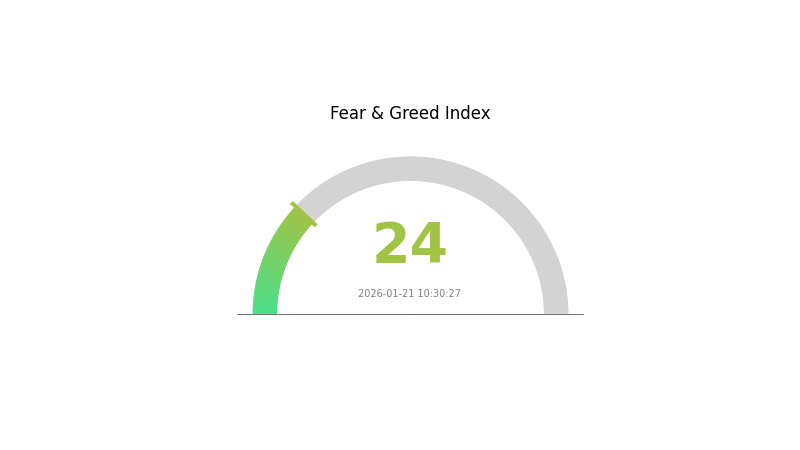
2026-01-21 Fear and Greed Index: 24 (Extreme Fear)
Click to view current Fear & Greed Index
The crypto market is experiencing extreme fear with the index at 24, indicating significant market pessimism. Such extreme fear levels typically present contrarian opportunities for long-term investors, as markets tend to overreact to negative catalysts. However, caution remains warranted until clearer stabilization signals emerge. Monitor key support levels and adjust portfolio allocation based on your risk tolerance.
AO Holder Distribution
The holder distribution chart reflects the concentration level of token holdings across different addresses on the blockchain, serving as a crucial indicator for evaluating the degree of decentralization and potential market manipulation risks within a cryptocurrency ecosystem. By analyzing the proportion of tokens held by top addresses, investors can assess whether the market structure exhibits healthy distribution or excessive concentration that may pose systemic risks.
Based on current on-chain data, AO demonstrates a relatively concentrated holding pattern among its top addresses. The top 10 addresses collectively control a significant portion of the total token supply, indicating that a small number of entities possess substantial influence over the token's market dynamics. This concentration level suggests that AO is still in a stage where token distribution has not fully matured, with wealth remaining relatively centralized among early participants, project team members, or large institutional investors.
From a market structure perspective, this concentration pattern presents both opportunities and challenges. On one hand, concentrated holdings may provide price stability during periods of low liquidity, as major holders typically have longer-term investment horizons. On the other hand, excessive concentration increases the risk of significant price volatility, as large-scale sell-offs by whale addresses could trigger cascading liquidations and market panic. Additionally, this distribution structure makes the token more vulnerable to potential manipulation, particularly during periods of low trading volume when concentrated holders can more easily influence price movements.
Click to view current AO Holder Distribution

| Top |
Address |
Holding Qty |
Holding (%) |
II. Core Factors Influencing AO's Future Price
Based on the available materials, there is insufficient specific information about AO's supply mechanisms, institutional dynamics, macroeconomic positioning, or technical developments to provide a comprehensive analysis of the core factors that may influence its future price.
Without concrete data regarding supply schedules, major holder activities, adoption metrics, or ongoing technical upgrades, it would be inappropriate to speculate on these critical price drivers. A thorough price analysis requires verifiable information about tokenomics, ecosystem development, and market positioning that is not present in the current reference materials.
III. 2026-2031 AO Price Prediction
2026 Outlook
- Conservative prediction: $2.89 - $5.06
- Neutral prediction: $5.06 average
- Optimistic prediction: Up to $7.44 (requires favorable market conditions)
The year 2026 presents a relatively wide price range for AO, with estimates spanning from $2.89 to $7.44. The average predicted price of approximately $5.06 suggests moderate growth potential as the project continues to develop its ecosystem and expand its user base.
2027-2029 Mid-term Outlook
- Market stage expectation: Gradual growth phase with increasing adoption
- Price range predictions:
- 2027: $5.63 - $6.63, with an average of $6.25 (23% change)
- 2028: $5.35 - $8.31, with an average of $6.44 (27% change)
- 2029: $4.72 - $10.69, with an average of $7.37 (45% change)
- Key catalysts: Enhanced network effects, technological improvements, and broader crypto market recovery
The mid-term period shows a progressive upward trajectory, with 2029 potentially marking a significant milestone as the predicted average price could reach $7.37. The widening price range in 2029 reflects increased market volatility and the potential for substantial growth if adoption accelerates.
2030-2031 Long-term Outlook
- Baseline scenario: $6.50 - $10.84 (assuming steady ecosystem development)
- Optimistic scenario: $9.03 - $11.92 (under conditions of strong market adoption)
- Transformational scenario: Potential to reach upper ranges if breakthrough developments materialize
By 2030, AO's predicted average price could climb to $9.03, representing a 78% change from the 2026 baseline. Looking further ahead to 2031, the token might achieve an average price of $9.94, with optimistic projections extending to $11.92, marking a 96% overall change. These long-term forecasts suggest sustained growth potential, though actual performance will depend on market conditions, technological advancement, and the project's ability to deliver on its roadmap.
2026-01-21: AO trading at baseline levels as the project enters its growth phase
| Year |
Predicted High Price |
Predicted Average Price |
Predicted Low Price |
Price Change |
| 2026 |
7.44261 |
5.063 |
2.88591 |
0 |
| 2027 |
6.62797 |
6.25281 |
5.62752 |
23 |
| 2028 |
8.3081 |
6.44039 |
5.34552 |
27 |
| 2029 |
10.69266 |
7.37425 |
4.71952 |
45 |
| 2030 |
10.84014 |
9.03345 |
6.50408 |
78 |
| 2031 |
11.92416 |
9.9368 |
8.14817 |
96 |
IV. AO Professional Investment Strategies and Risk Management
AO Investment Methodology
(1) Long-term Holding Strategy
- Target Investors: Investors with a long-term vision who believe in decentralized computing infrastructure and parallel processing technology
- Operational Recommendations:
- Consider accumulating positions during market corrections when the price approaches historical support levels
- Monitor the project's technological development progress and ecosystem expansion as key indicators for position adjustment
- Recommended storage solution: Use Gate Web3 Wallet for secure asset custody with multi-signature functionality
(2) Active Trading Strategy
- Technical Analysis Tools:
- Moving Averages: Observe 50-day and 200-day moving averages to identify trend directions and potential reversal points
- Volume Analysis: Monitor 24-hour trading volume fluctuations to assess market liquidity and participation intensity
- Swing Trading Key Points:
- Pay attention to the price range between the current price of $5.063 and recent 24-hour high of $5.216 for short-term trading opportunities
- Set stop-loss levels based on volatility, considering the 24-hour range of approximately 4% as a reference
AO Risk Management Framework
(1) Asset Allocation Principles
- Conservative Investors: 1-3% of total crypto portfolio
- Aggressive Investors: 5-10% of total crypto portfolio
- Professional Investors: May allocate up to 15% based on comprehensive research and risk assessment
(2) Risk Hedging Solutions
- Diversification Strategy: Combine AO with established cryptocurrencies to balance portfolio risk exposure
- Position Sizing: Implement gradual accumulation strategy rather than single large position entries
(3) Secure Storage Solutions
- Hot Wallet Recommendation: Gate Web3 Wallet for convenient trading and staking activities
- Security Considerations: Enable two-factor authentication, regularly backup wallet credentials, and never share private keys with anyone
V. AO Potential Risks and Challenges
AO Market Risks
- Volatility Risk: The token has experienced significant price fluctuations, with a historical high of $28.32 and low of $3.8, indicating substantial volatility
- Liquidity Risk: With a current market cap of approximately $29.7 million and ranking at 716, liquidity may be limited compared to top-tier assets
- Market Sentiment: Low market share of 0.00057% suggests vulnerability to broader market sentiment shifts and limited trading depth
AO Regulatory Risks
- Regulatory Uncertainty: Decentralized computing systems may face evolving regulatory frameworks across different jurisdictions
- Compliance Evolution: Changes in crypto asset regulations could impact project operations and token utility
- Jurisdictional Variations: Different regulatory approaches globally may affect accessibility and adoption rates
AO Technical Risks
- Network Security: As with any blockchain-based system, potential vulnerabilities in the parallel processing architecture require ongoing security audits
- Scalability Challenges: The effectiveness of the message-passing layer and parallel process coordination needs continuous validation at scale
- Competition Risk: The decentralized computing space faces competition from established and emerging projects with similar objectives
VI. Conclusion and Action Recommendations
AO Investment Value Assessment
AO presents an interesting opportunity in the decentralized computing sector with its unique parallel processing architecture. The current circulating supply represents approximately 27.94% of the maximum supply of 21 million tokens, suggesting potential supply expansion considerations. With a current price significantly below its historical high, the token may appeal to investors seeking exposure to decentralized infrastructure projects. However, the relatively low market capitalization and limited exchange listings (7 exchanges) indicate this remains a higher-risk investment suitable for those with appropriate risk tolerance.
AO Investment Recommendations
✅ Beginners: Start with minimal allocation (under 2% of crypto portfolio), focus on learning about the project fundamentals, and use Gate Web3 Wallet for secure storage
✅ Experienced Investors: Consider strategic accumulation during market dips, actively monitor technological developments and ecosystem growth, and implement position sizing strategies
✅ Institutional Investors: Conduct thorough due diligence on the parallel processing technology, assess long-term viability of the decentralized computing model, and consider gradual position building with appropriate risk controls
AO Trading Participation Methods
- Spot Trading: Direct purchase and holding through Gate.com for straightforward exposure to price movements
- Dollar-Cost Averaging: Regular periodic purchases to mitigate timing risk and smooth entry price over time
- Strategic Accumulation: Building positions during market corrections or when key technological milestones are achieved
Cryptocurrency investment carries extremely high risks, and this article does not constitute investment advice. Investors should make prudent decisions based on their own risk tolerance and are advised to consult professional financial advisors. Never invest more than you can afford to lose.
FAQ
What is AO? What are its uses and value?
AO is a decentralized computing protocol enabling scalable, permanent data storage and computation on blockchain. It provides infrastructure for autonomous agents, smart contracts, and distributed applications, offering efficiency gains and transparent value exchange within Web3 ecosystems.
How has AO's price history evolved? What level is it currently at?
AO has experienced significant growth since launch, with price appreciation driven by ecosystem expansion. Currently trading in mid-range levels, showing strong momentum with increased trading volume. The token demonstrates solid fundamentals and growing adoption in the network.
What are the main factors affecting AO price?
AO price is primarily influenced by network demand, transaction volume, ecosystem development, market sentiment, Bitcoin correlation, token supply dynamics, and adoption growth within the Arweave ecosystem.
What is the AO price prediction for 2024?
Based on market analysis, AO was projected to reach $5-8 in 2024, driven by increased adoption and ecosystem development. Actual performance depended on network growth and market conditions during that period.
What are the advantages of AO compared to other cryptocurrencies such as Arweave and SOL?
AO offers superior scalability through its innovative atomic compute architecture, enabling parallel processing and higher transaction throughput. It provides better cost efficiency with lower fees than SOL, while maintaining Arweave's decentralized storage benefits. AO's modular design allows flexible smart contract execution without blockchain constraints.
What are the risks of investing in AO? What should I pay attention to?
AO faces market volatility risks from adoption uncertainty and competitive pressure. Monitor tokenomics changes, network security updates, and ecosystem developments. Diversify your portfolio and only invest what you can afford to lose. Stay informed on technical developments and market sentiment.
What is AO's technical development roadmap and future prospects?
AO focuses on decentralized computing infrastructure with continuous optimization of parallel processing capabilities. The roadmap emphasizes scalability improvements, enhanced data availability, and ecosystem expansion. Future prospects are strong with growing adoption in AI computing and dApp development, positioning AO as a key infrastructure layer in Web3.
* The information is not intended to be and does not constitute financial advice or any other recommendation of any sort offered or endorsed by Gate.