This comprehensive guide analyzes Moon App (APP), an Injective-focused launchpad superapp integrating on-chain trading bots, providing expert price forecasts and investment strategies through 2031. The article reviews APP's market position, current trading at $0.0001576 with extreme market pessimism (Fear Index: 6), and examines key influencing factors including supply dynamics, macroeconomic conditions, and ecosystem development. Detailed price predictions span from conservative estimates ($0.00009-$0.00016 in 2026) to optimistic long-term scenarios ($0.00034 by 2031), offering 53-57% growth potential. Professional investment methodologies, risk management frameworks, and security solutions via Gate Web3 Wallet are provided for different investor profiles. The analysis addresses regulatory uncertainties, technical vulnerabilities, and liquidity constraints while recommending cautious participation and strict risk controls for this high-volatility, low-cap digital asset.
Introduction: APP's Market Position and Investment Value
Moon App (APP), as an Injective-focused launchpad superapp integrating advanced on-chain trading bots, has been developing since its launch in January 2024. As of February 2026, APP maintains a market capitalization of approximately $312,985, with a circulating supply of around 1.99 billion tokens, and the price stabilizes at approximately $0.0001576. This asset, recognized as a comprehensive trading tool platform, is playing an increasingly important role in decentralized finance and on-chain trading automation.
This article will comprehensively analyze APP's price trends from 2026 to 2031, combining historical patterns, market supply and demand dynamics, ecosystem development, and macroeconomic environment factors to provide investors with professional price forecasts and practical investment strategies.
I. APP Price History Review and Market Status
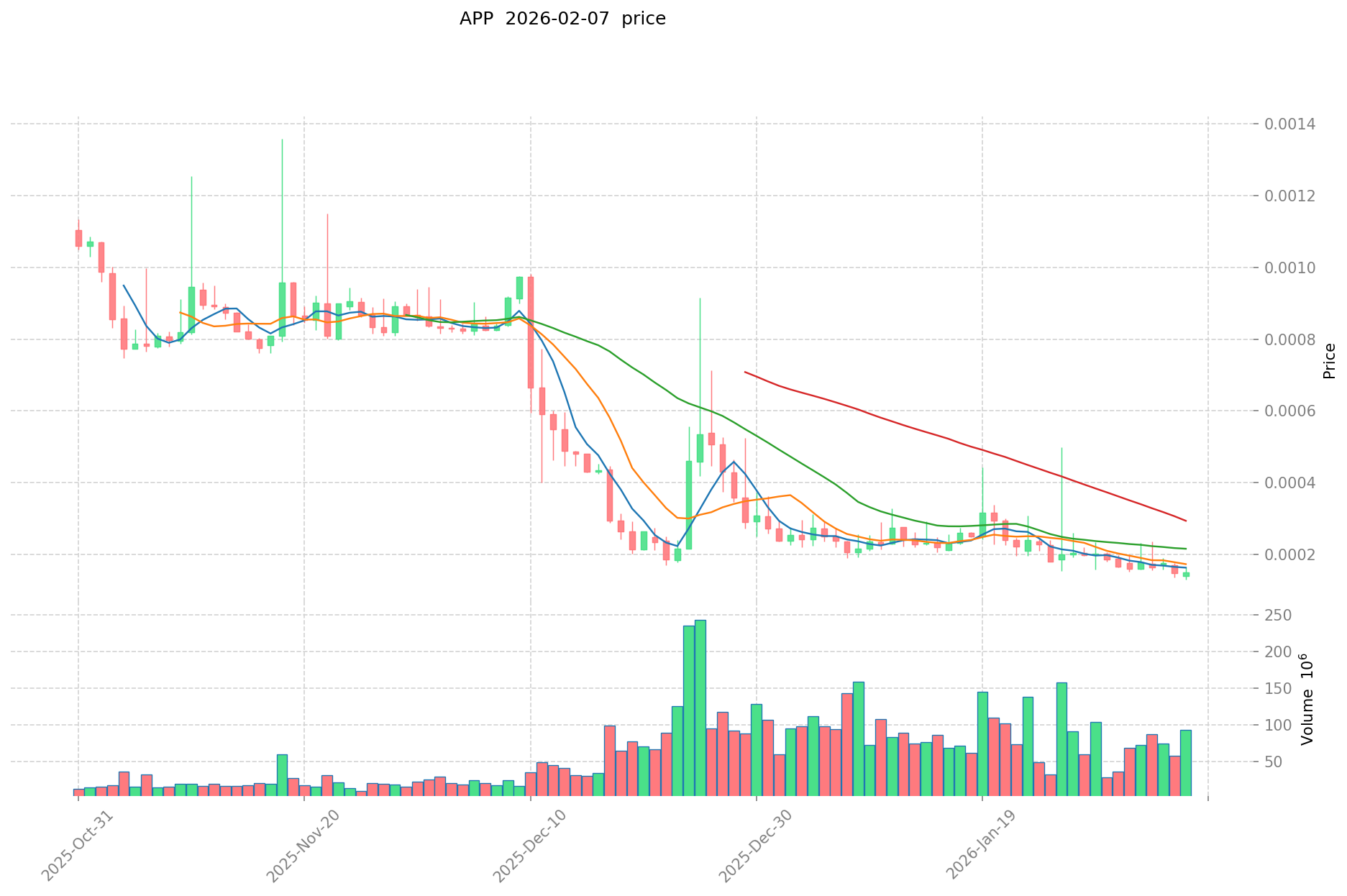
APP Historical Price Evolution Trajectory
- 2024: Token launched in January with an initial offering price of $0.0067, reaching an all-time high of $0.051 on January 16, 2024, representing significant growth in the early trading period
- 2025-2026: Price experienced substantial downward pressure, declining approximately 95.32% from peak levels over the past year
- 2026: On February 6, 2026, APP recorded its all-time low at $0.0001293, marking the lowest point in its trading history
APP Current Market Situation
As of February 7, 2026, APP is trading at $0.0001576, showing a 24-hour increase of 6.55% with a trading volume of $14,553.13. The token has demonstrated recent volatility, with a 1-hour gain of 5.84% and a 7-day decline of 21.87%.
The circulating supply stands at approximately 1.99 billion tokens out of a maximum supply of 3 billion tokens, representing a circulation ratio of 66.2%. The current market capitalization is approximately $312,984.93, with a fully diluted valuation of $472,800. The 24-hour trading range spans from $0.0001293 to $0.000163.
APP maintains a presence across 3 exchanges and has approximately 1,860 token holders. The market cap to fully diluted valuation ratio stands at 66.2%, indicating that a significant portion of the total supply is already in circulation. Market dominance remains minimal at 0.000018% of the overall cryptocurrency market.
Click to view current APP market price
APP Market Sentiment Indicator
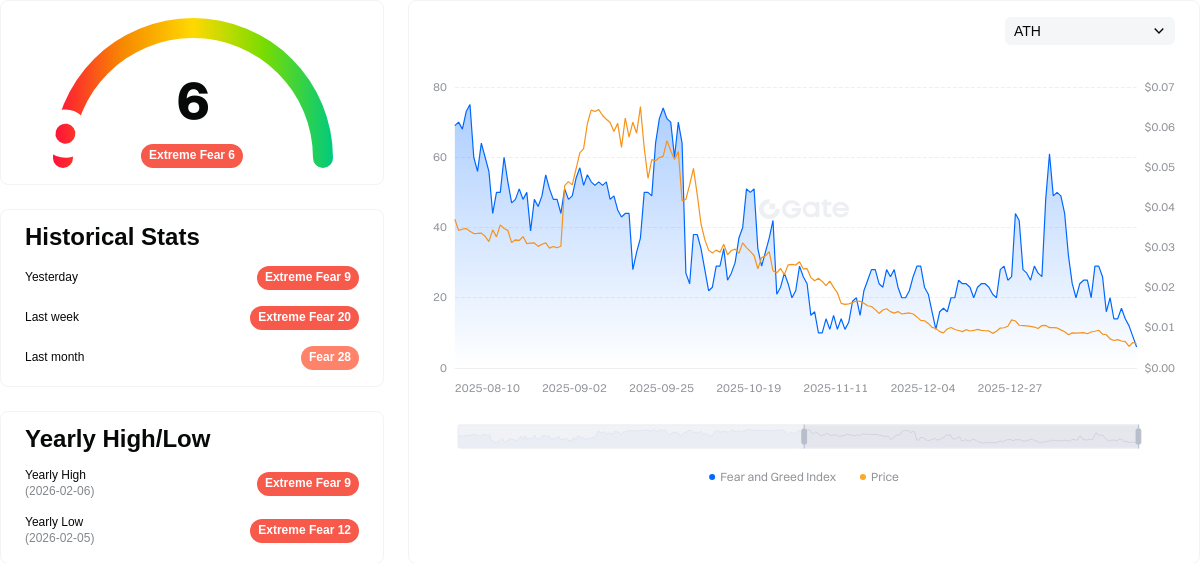
2026-02-07 Fear and Greed Index: 6 (Extreme Fear)
Click to view the current Fear & Greed Index
The crypto market is experiencing extreme fear, with the Fear and Greed Index hitting just 6 points. This exceptionally low reading signals severe market pessimism and panic selling across the board. When fear reaches these extreme levels, seasoned investors often view it as a potential buying opportunity, as markets are typically oversold. However, caution remains warranted as further downside risks may persist. Monitor key support levels closely and consider dollar-cost averaging if you're looking to accumulate positions during this highly volatile period.
APP Holdings Distribution
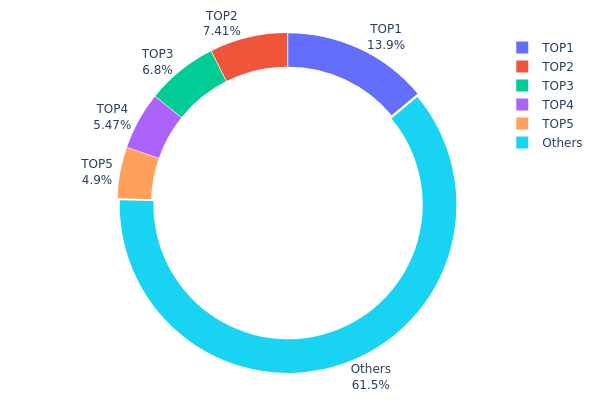
The holdings distribution chart illustrates how APP tokens are allocated across different wallet addresses, providing insight into the degree of decentralization and concentration risk within the token's ecosystem. By examining the top holders and their respective percentages, analysts can assess whether token ownership is broadly distributed or concentrated among a few major participants, which directly impacts market stability and price dynamics.
Based on the current data, APP exhibits a moderate to high concentration level among top addresses. The largest holder controls approximately 13.94% of the total supply (418,461.96K tokens), while the top five addresses collectively hold 38.5% of the circulating supply. The remaining 61.5% is distributed among other addresses, suggesting that while a significant portion exists outside major holders, the concentration among top wallets remains notable. This distribution pattern indicates that APP has not achieved complete decentralization, with substantial influence residing in relatively few addresses.
This concentration level presents both opportunities and risks for market participants. The dominance of top holders may lead to increased price volatility, as large-scale movements by these addresses could significantly impact liquidity and market sentiment. Additionally, concentrated holdings raise concerns about potential market manipulation or coordinated selling pressure during unfavorable conditions. However, if these major addresses represent strategic partners, long-term investors, or protocol treasury wallets rather than speculative traders, the concentration may contribute to price stability by reducing circulating supply. Market participants should monitor on-chain movements from these top addresses closely, as their trading activities often serve as leading indicators for broader market trends.
Click to view current APP Holdings Distribution
| Top |
Address |
Holding Qty |
Holding (%) |
| 1 |
0x4a12...00a795 |
418461.96K |
13.94% |
| 2 |
0x0529...c553b7 |
222312.97K |
7.41% |
| 3 |
0x0d07...b492fe |
203989.36K |
6.79% |
| 4 |
0x74de...a2f9a1 |
164168.05K |
5.47% |
| 5 |
0x58ed...a36a51 |
146900.76K |
4.89% |
| - |
Others |
1844166.90K |
61.5% |
II. Core Factors Influencing APP's Future Price
Supply Mechanism
-
Token Supply Dynamics: The analysis of APP's price trajectory requires understanding its supply characteristics. While specific supply mechanisms were not detailed in available materials, market fundamentals suggest that token distribution patterns and release schedules play crucial roles in price formation.
-
Historical Patterns: According to market research data, supply-side adjustments in cryptocurrency markets have historically triggered significant price movements. The correlation between circulating supply changes and valuation shifts remains a consistent pattern across digital assets.
-
Current Impact: Market liquidity conditions and token velocity metrics continue to influence APP's short-term price behavior, though specific quantitative data on recent supply changes requires further monitoring.
Institutional and Major Holder Dynamics
-
Institutional Positioning: The cryptocurrency market has witnessed increasing institutional participation, with major investment funds allocating portions of portfolios to digital assets. This trend reflects growing recognition of blockchain technology's potential value proposition.
-
Enterprise Adoption: While specific enterprise implementations of APP were not identified in reference materials, the broader blockchain adoption trend shows companies exploring decentralized solutions for operational efficiency and transparency enhancement.
-
National Policy Framework: Global regulatory environments continue evolving, with various jurisdictions developing frameworks for digital asset oversight. Policy clarity remains a key factor influencing institutional confidence and market participation levels.
Macroeconomic Environment
-
Monetary Policy Impact: Central bank policy trajectories significantly affect cryptocurrency valuations. According to financial market analysis, expectations regarding Federal Reserve rate decisions influence risk asset pricing, including digital currencies. Data indicates that monetary easing cycles historically correlate with increased cryptocurrency market activity.
-
Inflation Hedge Attributes: Research suggests cryptocurrencies exhibit characteristics as alternative stores of value during periods of currency depreciation concerns. Market behavior during inflationary environments shows investors seeking assets outside traditional monetary systems.
-
Geopolitical Factors: International tensions and trade policy uncertainties create market volatility that affects cryptocurrency pricing. Analysis indicates that geopolitical risk events can trigger both safe-haven flows and risk-off positioning in digital asset markets.
Technological Development and Ecosystem Building
-
Infrastructure Enhancement: The cryptocurrency sector continues experiencing technological advancement through scalability improvements and user experience optimization. These developments support broader adoption potential and network effect realization.
-
Integration Capabilities: Cross-platform compatibility and interoperability features represent important technical considerations for long-term ecosystem sustainability and utility expansion.
-
Ecosystem Applications: The decentralized application landscape demonstrates ongoing innovation, though specific APP-related projects require dedicated research beyond current material scope. The broader DApp ecosystem growth indicates increasing blockchain utility beyond speculative trading.
III. 2026-2031 APP Price Prediction
2026 Outlook
- Conservative prediction: $0.00009 - $0.00016
- Neutral prediction: $0.00016 (average market scenario)
- Optimistic prediction: $0.00023 (requires favorable market conditions and increased adoption)
The 2026 forecast suggests a potential decline of approximately 1% compared to previous levels, reflecting cautious market sentiment. The price is expected to fluctuate within a relatively narrow range, with the low end at $0.00009 and the high end reaching $0.00023.
2027-2029 Outlook
- Market stage expectation: Gradual recovery and consolidation phase with progressive growth momentum
- Price range prediction:
- 2027: $0.00012 - $0.00021, with an average of $0.00019 (21% increase)
- 2028: $0.00016 - $0.00024, with an average of $0.0002 (25% increase)
- 2029: $0.00016 - $0.00026, with an average of $0.00022 (40% increase)
- Key catalysts: Enhanced ecosystem development, broader market adoption, and improved platform utility driving sustained price appreciation
This mid-term period demonstrates a recovery trajectory with consistent year-over-year growth, suggesting increasing market confidence and expanding user base.
2030-2031 Long-term Outlook
- Baseline scenario: $0.00021 - $0.00025 (assuming steady ecosystem growth and stable market conditions)
- Optimistic scenario: $0.00025 - $0.00034 (assuming accelerated adoption and favorable regulatory environment)
- Transformative scenario: Up to $0.00034 (under exceptionally favorable conditions including major partnerships and breakthrough technological advancements)
- 2026-02-07: APP trading within the predicted range as the market evaluates long-term growth potential
The long-term forecast indicates potential appreciation of 53-57% by 2030-2031 compared to 2026 baseline levels. The year 2031 shows particular promise with a predicted high of $0.00034 and an average of $0.00025, representing the strongest growth potential in the forecast period. However, investors should note the wider price range in 2031 ($0.00014 - $0.00034), indicating increased volatility and market uncertainty during this extended timeframe.
| Year |
Predicted High Price |
Predicted Average Price |
Predicted Low Price |
Price Change |
| 2026 |
0.00023 |
0.00016 |
0.00009 |
-1 |
| 2027 |
0.00021 |
0.00019 |
0.00012 |
21 |
| 2028 |
0.00024 |
0.0002 |
0.00016 |
25 |
| 2029 |
0.00026 |
0.00022 |
0.00016 |
40 |
| 2030 |
0.00025 |
0.00024 |
0.00021 |
53 |
| 2031 |
0.00034 |
0.00025 |
0.00014 |
57 |
IV. APP Professional Investment Strategy and Risk Management
APP Investment Methodology
(1) Long-term Holding Strategy
- Suitable for: Investors with a long-term perspective on blockchain infrastructure development and DeFi trading bot technology
- Operational Recommendations:
- Consider dollar-cost averaging (DCA) to mitigate volatility risks in the current market environment
- Monitor the development progress of Moon App's Injective-based superapp features and trading bot integration
- Implement a secure storage solution using Gate Web3 Wallet for long-term asset custody
(2) Active Trading Strategy
- Technical Analysis Tools:
- Volume Analysis: Monitor the 24-hour trading volume ($14,553) relative to market cap to identify potential breakout patterns
- Support and Resistance Levels: Track the 24-hour range ($0.0001293-$0.000163) to establish entry and exit points
- Swing Trading Considerations:
- Pay attention to short-term volatility, as indicated by recent 1-hour (+5.84%) and 24-hour (+6.55%) price movements
- Set stop-loss orders to manage downside risk, particularly given the 7-day (-21.87%) and 30-day (-29.099%) negative trends
APP Risk Management Framework
(1) Asset Allocation Principles
- Conservative Investors: 1-3% of cryptocurrency portfolio allocation
- Moderate Investors: 3-5% of cryptocurrency portfolio allocation
- Aggressive Investors: 5-10% of cryptocurrency portfolio allocation, with active monitoring
(2) Risk Hedging Solutions
- Position Sizing: Limit individual position exposure to avoid over-concentration in low-cap assets
- Portfolio Diversification: Balance APP holdings with established cryptocurrencies and stablecoins
(3) Secure Storage Solutions
- Hot Wallet Recommendation: Gate Web3 Wallet for convenient trading access and integrated security features
- Cold Storage Option: Consider hardware wallet solutions for long-term holdings exceeding $1,000
- Security Precautions: Enable two-factor authentication, regularly update security protocols, and never share private keys or seed phrases
V. APP Potential Risks and Challenges
APP Market Risks
- High Volatility: APP has experienced significant price fluctuations, with a 1-year decline of -95.32% from initial listing
- Low Liquidity: With a market capitalization of approximately $312,985 and relatively modest 24-hour trading volume, liquidity constraints may impact trade execution
- Market Cap Risk: Ranking at #3498 with a 0.000018% market dominance indicates limited institutional interest and higher susceptibility to market manipulation
APP Regulatory Risks
- DeFi Trading Bot Scrutiny: Automated trading tools, including sniping and sandwich bots, may face regulatory examination in various jurisdictions
- Compliance Uncertainty: Evolving regulations surrounding cryptocurrency trading platforms and DeFi protocols could impact project operations
- Cross-Border Operations: Multi-chain deployment across ETH and BSC networks may introduce complex regulatory compliance requirements
APP Technical Risks
- Smart Contract Vulnerabilities: As an ERC20 token deployed on multiple chains, potential security risks exist in contract implementations
- Platform Dependency: Heavy reliance on Injective blockchain infrastructure means technical issues or network disruptions could affect functionality
- Integration Complexity: The superapp's multiple features (limit orders, presale sniping, liquidity sniping) increase the attack surface and potential failure points
VI. Conclusion and Action Recommendations
APP Investment Value Assessment
APP (RWAX) presents a high-risk investment opportunity in the DeFi trading tools sector. While the project offers innovative on-chain trading bot functionality integrated with Injective, significant concerns exist. The token has declined -95.32% from its all-time high of $0.051, reflecting challenging market conditions and limited adoption. The current market cap of $312,985 and circulation ratio of 66.2% indicate a relatively small-scale project with constrained liquidity. Recent short-term price recovery (+6.55% in 24 hours) suggests speculative interest, but persistent negative trends over 7-day (-21.87%) and 30-day (-29.099%) periods warrant caution. The project's viability depends on successful execution of its superapp roadmap and broader adoption of its trading bot features.
APP Investment Recommendations
✅ Beginners: Avoid or limit exposure to under 1% of total crypto portfolio due to extreme volatility and limited liquidity. Focus on understanding DeFi mechanics before participating.
✅ Experienced Investors: Consider small speculative positions (2-5% of crypto portfolio) only if familiar with DeFi trading bots and prepared for potential total loss. Employ strict risk management with predetermined exit strategies.
✅ Institutional Investors: Exercise extreme caution given low market cap, limited liquidity, and insufficient track record. Conduct thorough due diligence on smart contract audits, team credentials, and regulatory compliance before any allocation.
APP Trading Participation Methods
- Centralized Exchange Trading: APP is available on Gate.com with trading pairs providing direct access to the token
- Decentralized Trading: Interact directly with the smart contract on Ethereum (0xC5d27F27F08D1FD1E3EbBAa50b3442e6c0D50439) or BSC network through compatible DEX platforms
- Dollar-Cost Averaging: Implement systematic small purchases over extended periods to mitigate entry timing risk and reduce volatility impact
Cryptocurrency investment carries extreme risk, and this article does not constitute investment advice. Investors should make decisions prudently based on their own risk tolerance and are advised to consult professional financial advisors. Never invest more than you can afford to lose.
FAQ
What is APP price prediction and how does it work?
APP price prediction uses machine learning algorithms to analyze historical market data and identify patterns. It forecasts future price movements by processing trading volume, market trends, and on-chain metrics to deliver accurate predictions automatically.
What are the main methods and models used for APP price prediction?
Main methods include machine learning techniques like Decision Tree Learning(DML), ElasticNet, and Random Forest. Ensemble methods and technical analysis based on trading volume, market sentiment, and historical price data enhance prediction accuracy.
Technical analysis tools like TradingView, on-chain analytics platforms such as Glassnode and Nansen, and AI-powered prediction models offer valuable insights. Combine on-chain metrics, trading volume analysis, and market sentiment indicators for more accurate price forecasting of APP tokens.
How accurate are current APP price prediction models and what are their limitations?
Current APP price prediction models achieve moderate accuracy but face significant limitations including overfitting, poor generalizability, and high sensitivity to market volatility. Models struggle to adapt to sudden price changes and market shocks, making them less reliable during extreme conditions.
What factors influence APP pricing and how do they affect predictions?
APP pricing is driven by market demand, trading volume, tokenomics, project developments, and overall market sentiment. Higher volume and positive news typically push prices up, while reduced activity and bearish events drive them down. These factors combined determine price movement patterns.
How do machine learning and AI improve APP price prediction?
Machine learning and AI enhance APP price prediction by analyzing complex market patterns and historical data with greater accuracy. They process real-time information, identify trend signals, and minimize prediction errors far beyond traditional methods, delivering more precise price forecasts.
What are the risks and challenges in relying on APP price predictions?
APP price predictions face risks from market volatility, data accuracy limitations, and potential manipulation. Predictions may not capture sudden market shifts or unexpected events, making them unreliable as sole decision factors for trading strategies.
How can businesses use APP price prediction for competitive advantage and revenue optimization?
Businesses leverage APP price prediction to optimize pricing strategies, anticipate market movements, and adjust revenue models dynamically. By analyzing price trends and consumer demand patterns, companies can maximize profitability, reduce risks, and maintain competitive market positioning through data-driven decision-making.
* The information is not intended to be and does not constitute financial advice or any other recommendation of any sort offered or endorsed by Gate.