This comprehensive analysis examines Bifrost (BNC), a cross-chain liquid staking protocol within the Polkadot ecosystem, providing detailed price predictions from 2026 to 2031 based on historical patterns and market dynamics. Currently trading near $0.0554 with a market cap of $2.19 million, BNC faces significant recovery challenges after declining 72.78% annually. The article combines technical analysis, ecosystem development assessment, and macroeconomic factors to forecast price ranges: conservative estimates suggest $0.05185-$0.05516 for 2026, with potential growth to $0.08324-$0.13081 by 2031 under optimistic scenarios. Investors can trade BNC on Gate.com; this guide offers long-term holding strategies, active trading methodologies, comprehensive risk management frameworks, and practical investment recommendations aligned with different risk profiles and market conditions.
Introduction: BNC's Market Position and Investment Value
Bifrost (BNC), as a cross-chain liquidity staking protocol within the Polkadot ecosystem, has been developing innovative DeFi infrastructure since its inception in 2019. As of February 2026, BNC's market capitalization stands at approximately $2.19 million, with a circulating supply of around 39.48 million tokens, and the price maintaining near $0.0554. This asset, known as the "Rainbow Bridge" connecting staking liquidity across multiple blockchains, is playing an increasingly important role in the liquid staking derivatives sector and cross-chain DeFi applications.
This article will comprehensively analyze BNC's price trends from 2026 to 2031, combining historical patterns, market supply and demand dynamics, ecosystem development, and macroeconomic conditions to provide investors with professional price forecasts and practical investment strategies.
I. BNC Price History Review and Market Status
BNC Historical Price Evolution Trajectory
- 2021: Bifrost (BNC) reached a notable price level during the broader crypto market expansion, with the token touching $6.14 on November 3, 2021
- 2022-2025: The token experienced significant market corrections aligned with broader crypto market cycles, gradually declining from previous levels
- 2026: As of February 1, 2026, the token recorded a historical low price point at $0.054807, reflecting the extended downward trend in the market
BNC Current Market Situation
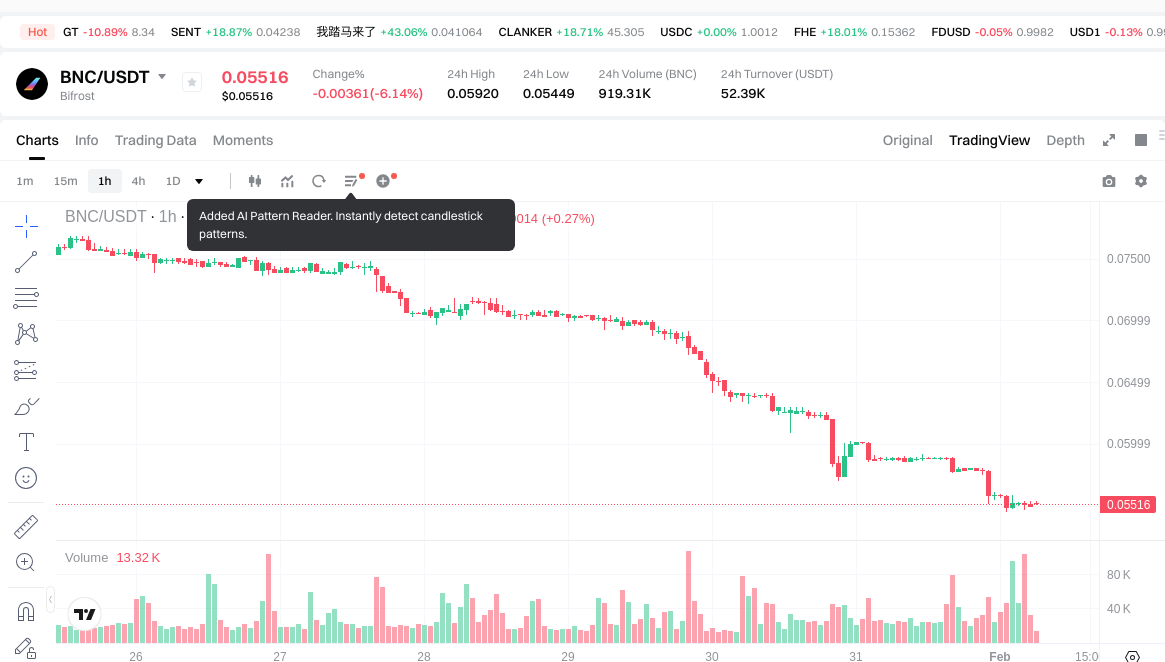
As of February 1, 2026, BNC is trading at $0.05538, showing mixed short-term momentum. The token has demonstrated a slight recovery of 0.24% over the past hour, suggesting some intraday buying interest. However, the broader timeframe reveals continued downward pressure, with the token declining 6.4% over the past 24 hours.
The weekly and monthly perspectives show more pronounced declines, with BNC falling 26.57% over the past 7 days and 37.45% over the past 30 days. The annual performance indicates a substantial contraction of 72.78% from year-ago levels, reflecting the challenging market environment for the project.
The token's 24-hour trading range has been between $0.05449 and $0.0592, with total trading volume reaching $52,413.61. BNC currently has a circulating supply of 39,478,940.56 tokens out of a maximum supply of 80,000,000, representing a circulation rate of approximately 49.35%. The market capitalization stands at $2,186,343.73, with a fully diluted valuation of $4,430,400. The token ranks #1995 in the overall crypto market and maintains a market dominance of 0.00016%.
Bifrost remains actively traded on 6 exchanges and has attracted a holder base of 3,546 addresses. The current market environment reflects an "Extreme Fear" sentiment according to the volatility index reading of 20, which may be influencing broader crypto market trading behavior.
Click to view the current BNC market price
BNC Market Sentiment Indicator
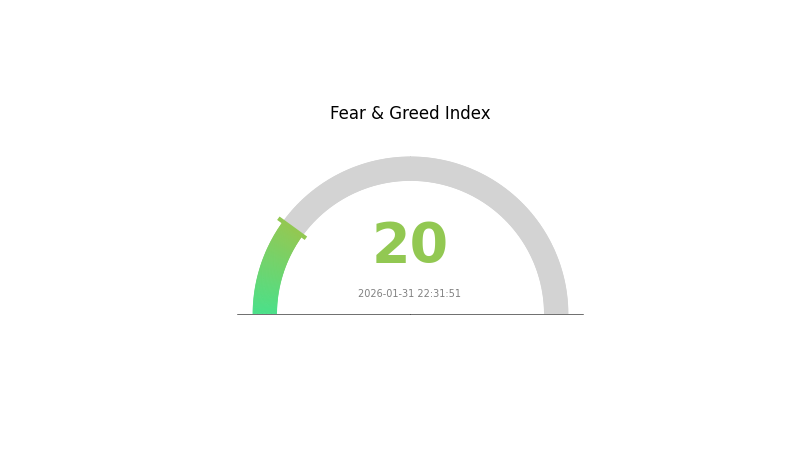
2026-01-31 Fear and Greed Index: 20 (Extreme Fear)
Click to view the current Fear & Greed Index
The cryptocurrency market is experiencing extreme fear, with the Fear and Greed Index reading at 20, indicating strong bearish sentiment. When the index falls this low, it often presents contrarian opportunities for long-term investors, as excessive fear typically precedes market bounces. However, traders should remain cautious and monitor key support levels closely. Consider dollar-cost averaging strategies and maintaining proper risk management during periods of heightened uncertainty. Stay informed through Gate.com's market sentiment tools for real-time analysis.
BNC Holdings Distribution
The holdings distribution chart illustrates the concentration of BNC tokens across different wallet addresses, revealing how token ownership is distributed among holders. This metric serves as a critical indicator of decentralization and potential market control within the BNC ecosystem.
Based on current on-chain data, BNC exhibits a moderate concentration pattern where top addresses collectively hold a significant portion of the circulating supply. While this level of concentration is not uncommon for emerging crypto assets, it does suggest that a relatively small number of addresses maintain substantial influence over the token's liquidity and price dynamics. The presence of whale addresses holding considerable percentages indicates potential vulnerability to large-scale sell pressure if these holders decide to liquidate their positions.
From a market structure perspective, the current distribution pattern implies that BNC's price movements could experience heightened volatility during periods of major holder activity. The concentration of tokens in fewer addresses may facilitate more pronounced price swings, as large transactions from top holders can significantly impact market depth. Additionally, this structure could potentially expose the market to coordination risks, though it's worth noting that such distribution patterns often evolve toward greater decentralization as projects mature and token circulation increases through broader market participation.
Click to view current BNC Holdings Distribution

| Top |
Address |
Holding Qty |
Holding (%) |
II. Core Factors Influencing BNC's Future Price
Supply Mechanism
- Market Demand and Adoption: BNC's price trajectory is shaped by evolving market demand patterns and adoption trends across different user segments. The growth dynamics reflect how effectively the token integrates into broader blockchain ecosystems.
- Historical Patterns: The cryptocurrency market has demonstrated cyclical behavior, with institutional participation and regulatory clarity playing pivotal roles in price movements. Past cycles show that technological maturation often precedes significant valuation shifts.
- Current Implications: As blockchain infrastructure advances and user adoption expands, BNC's positioning within decentralized finance applications may influence its supply-demand equilibrium in the evolving digital asset landscape.
Institutional and Major Holder Dynamics
- Institutional Interest: The digital asset treasury model pioneered by companies like MicroStrategy has created new pathways for traditional investors to gain exposure to cryptocurrency markets through publicly traded equities. This approach enables institutions that face direct cryptocurrency investment constraints to participate indirectly.
- Enterprise Adoption: The growth of stablecoin infrastructure and real-world asset tokenization represents significant enterprise-level engagement with blockchain technology. Projects developing native stablecoin solutions are addressing gaps in ecosystem liquidity and financial infrastructure.
- Regulatory Environment: The regulatory landscape remains a critical factor affecting market direction. While Bitcoin and Ethereum benefit from growing institutional acceptance, the broader regulatory framework continues to evolve, impacting market sentiment and institutional participation patterns.
Macroeconomic Environment
- Monetary Policy Impact: Central bank policy decisions, including interest rate trajectories and inflation management strategies, create backdrop conditions for digital asset valuations. The "higher for longer" rate policy approach influences risk asset allocations across traditional and crypto markets.
- Inflation Hedge Characteristics: Cryptocurrencies have exhibited varying degrees of correlation with traditional inflation hedges. The scarcity mechanisms embedded in certain token designs position them as potential stores of value during periods of monetary expansion.
- Geopolitical Factors: Global financial system dynamics, including the internationalization of payment systems and cross-border capital flows, affect cryptocurrency adoption patterns. Stablecoins, for instance, function as tools for dollar globalization, expanding U.S. currency influence in international trade.
Technological Development and Ecosystem Building
- Multi-Chain Architecture Evolution: Advanced blockchain systems are implementing sophisticated multi-chain frameworks to address different technical requirements and application scenarios. These architectures enable enhanced scalability while supporting diverse use cases from decentralized storage to layer-2 solutions.
- AI and Blockchain Integration: The convergence of artificial intelligence and blockchain technology represents a significant developmental frontier. AI agents conducting high-frequency microtransactions may drive substantial transaction volume growth, with blockchain infrastructure naturally suited to handle such activity patterns at scale.
- Ecosystem Applications: The shift from centralized to decentralized exchange models reflects user preference evolution toward greater asset control and autonomy. While centralized platforms currently serve as primary entry points for newcomers, decentralized alternatives are gaining traction as user experience improvements reduce friction and enhance accessibility.
III. 2026-2031 BNC Price Forecast
2026 Outlook
- Conservative forecast: $0.05185 - $0.05516
- Neutral forecast: $0.05516
- Optimistic forecast: $0.07447 (requires favorable market conditions and increased adoption)
2027-2029 Outlook
- Market stage expectation: transitional phase with gradual upward momentum as the project potentially expands its ecosystem and user base
- Price range forecast:
- 2027: $0.03889 - $0.0862
- 2028: $0.04228 - $0.09287
- 2029: $0.06483 - $0.09429
- Key catalysts: sustained project development, strategic partnerships, broader market recovery, and enhanced utility within the BNC ecosystem
2030-2031 Long-term Outlook
- Baseline scenario: $0.07853 - $0.0937 (assuming steady ecosystem growth and stable market conditions)
- Optimistic scenario: $0.08324 - $0.13081 (contingent on significant protocol upgrades, increased institutional interest, and favorable regulatory developments)
- Transformational scenario: potential to reach upper bounds of $0.13081 by 2031 (requires breakthrough partnerships, mainstream adoption, and exceptional market conditions)
- 2026-02-01: BNC trading within the projected range of $0.05185 - $0.07447 (early-stage forecast period with baseline expectations)
| Year |
Predicted High Price |
Predicted Average Price |
Predicted Low Price |
Price Change |
| 2026 |
0.07447 |
0.05516 |
0.05185 |
0 |
| 2027 |
0.0862 |
0.06481 |
0.03889 |
17 |
| 2028 |
0.09287 |
0.07551 |
0.04228 |
36 |
| 2029 |
0.09429 |
0.08419 |
0.06483 |
52 |
| 2030 |
0.0937 |
0.08924 |
0.07853 |
61 |
| 2031 |
0.13081 |
0.09147 |
0.08324 |
65 |
IV. BNC Professional Investment Strategy and Risk Management
BNC Investment Methodology
(1) Long-term Holding Strategy
- Suitable for: Investors who believe in Polkadot ecosystem growth and liquid staking infrastructure development
- Operation recommendations:
- Consider accumulating positions during market downturns, given the recent 26.57% decline over 7 days and 37.45% decline over 30 days
- Monitor Bifrost's vToken adoption across the Polkadot ecosystem and expansion to additional PoS chains
- Storage solution: Gate Web3 Wallet offers secure storage options for BNC tokens with convenient access to DeFi functionalities
(2) Active Trading Strategy
- Technical analysis tools:
- Volume analysis: Current 24-hour trading volume of $52,413.61 indicates moderate liquidity for position management
- Price range monitoring: Track the 24-hour range between $0.05449 (low) and $0.0592 (high) for entry and exit points
- Swing trading considerations:
- Recent volatility presents opportunities, with 1-hour movements showing +0.24% gains amid broader downtrends
- Consider correlation with DOT price movements, as Bifrost operates as a Polkadot parachain
BNC Risk Management Framework
(1) Asset Allocation Principles
- Conservative investors: 1-3% portfolio allocation
- Moderate investors: 3-5% portfolio allocation
- Aggressive investors: 5-10% portfolio allocation with active monitoring
(2) Risk Hedging Approaches
- Diversification across Polkadot ecosystem projects: Balance BNC holdings with other parachain tokens
- Position sizing discipline: Given the significant decline from all-time high of $6.14 to current price of $0.05538, implement strict stop-loss levels
(3) Secure Storage Solutions
- Hot wallet recommendation: Gate Web3 Wallet provides convenient access for active trading and DeFi participation
- Cold storage approach: Consider hardware wallets for long-term holdings exceeding short-term trading needs
- Security precautions: Never share private keys, enable two-factor authentication, and verify transaction details before confirming
V. BNC Potential Risks and Challenges
BNC Market Risks
- High volatility: BNC has declined 72.78% over the past year, reflecting significant market risk exposure
- Liquidity concerns: With a market cap of $2.19 million and ranking of 1995, limited liquidity may impact large position exits
- Competitive pressure: Multiple liquid staking solutions compete across various blockchain ecosystems
BNC Regulatory Risks
- DeFi regulatory uncertainty: Evolving regulatory frameworks for staking derivatives may impact Bifrost's operations
- Cross-chain compliance: As Bifrost operates across 9+ blockchains, regulatory requirements vary by jurisdiction
- Token classification uncertainty: Regulatory treatment of staking derivative tokens remains under development in many regions
BNC Technical Risks
- Smart contract vulnerabilities: DeFi protocols face ongoing risks from potential code exploits
- Parachain dependency: Bifrost's security relies on Polkadot's shared security model and relay chain functionality
- Cross-chain bridge risks: Operating across multiple blockchains introduces potential vulnerabilities in bridge infrastructure
VI. Conclusion and Action Recommendations
BNC Investment Value Assessment
Bifrost (BNC) positions itself as infrastructure for liquid staking across the Polkadot ecosystem and beyond, with support for 9+ blockchains. The project addresses a meaningful need by providing vTokens that allow users to maintain liquidity while earning staking rewards. However, the significant price decline of 72.78% over one year and current proximity to all-time lows ($0.054807) reflects substantial market challenges. The relatively small market cap of $2.19 million and circulating supply of 39.48 million tokens (49.35% of max supply) indicate moderate token distribution. Long-term value depends on adoption of vTokens across PoS networks, growth of the StakeFi ecosystem, and sustained development of Polkadot parachain functionality.
BNC Investment Recommendations
✅ Beginners: Consider observing market performance before allocating significant capital; if interested, limit exposure to a small percentage of portfolio and use Gate Web3 Wallet for secure storage
✅ Experienced investors: May consider strategic accumulation during continued downtrends, monitoring technical support levels and ecosystem development milestones
✅ Institutional investors: Conduct thorough due diligence on protocol security audits, vToken adoption metrics, and competitive positioning within the liquid staking sector
BNC Trading Participation Methods
- Spot trading: Available on Gate.com with BNC trading pairs for direct purchase and sale
- DeFi integration: Utilize BNC within the Bifrost ecosystem to mint vTokens and participate in liquid staking
- Dollar-cost averaging: Consider systematic accumulation strategies to mitigate timing risk given current volatility
Cryptocurrency investment carries extremely high risk, and this article does not constitute investment advice. Investors should make prudent decisions based on their own risk tolerance and are advised to consult professional financial advisors. Never invest more than you can afford to lose.
FAQ
What is BNC? What are its uses and value?
BNC is a utility token in the Web3 ecosystem designed for decentralized finance operations. Its primary value lies in governance participation, transaction facilitation, and ecosystem incentives. BNC holders gain access to exclusive features and benefits within the protocol, making it integral to the platform's functionality and community engagement.
BNC is currently trading at 0.06377 USD with a market cap of 2.84M USD. The 24-hour trading volume reaches 996,412.79 USD, showing stable market performance. Historical price data reflects gradual market development in the Web3 sector.
What are professional analysts' price predictions for BNC in the future?
Professional analysts predict BNC future prices ranging from $0.33 to $0.65 based on historical patterns and advanced analytical models. These predictions align with current market trends and technical analysis frameworks.
What are the main factors affecting BNC price?
BNC price is primarily influenced by market demand, trading volume, project developments, regulatory changes, macroeconomic conditions, and overall cryptocurrency market sentiment. Increased adoption and positive news typically drive price upward, while market corrections and regulatory uncertainty may create downward pressure.
What are the risks to pay attention to when investing in BNC?
BNC investment carries market volatility risk and technology risk. Prices may fluctuate significantly. Ensure platform security to prevent hacking. Conduct thorough research and only invest what you can afford to lose.
What are the advantages or disadvantages of BNC compared to similar cryptocurrencies?
BNC offers higher trading volume and liquidity with tight integration to Binance, providing lower transaction fees. It has greater stability and market recognition. Main disadvantage is its dependence on the Binance ecosystem.
* The information is not intended to be and does not constitute financial advice or any other recommendation of any sort offered or endorsed by Gate.