This comprehensive guide provides expert analysis and price forecasts for Bancor Network Token (BNT) from 2026 through 2031. The article examines BNT's market position at $0.42, analyzes historical price evolution, and evaluates core factors influencing future performance including supply mechanisms, ecosystem development, and macroeconomic conditions. It delivers detailed price predictions across conservative, neutral, and optimistic scenarios, while offering professional investment strategies for different investor profiles—from beginners to institutional participants. The guide covers spot trading on Gate, DeFi participation, active trading techniques, and risk management frameworks. Additionally, it addresses critical risks including market liquidity concerns, regulatory uncertainties, and technical vulnerabilities. Designed for investors seeking exposure to decentralized liquidity protocols, this analysis equips readers with actionable insights for informed BNT investment decisions.
Introduction: BNT's Market Position and Investment Value
Bancor (BNT), as a decentralized liquidity protocol designed to provide automated market-making solutions, has been evolving in the DeFi ecosystem since its launch in 2017. As of 2026, BNT maintains a market capitalization of approximately $46.1 million, with a circulating supply of around 109.67 million tokens, and the price hovering around $0.42. This asset, recognized for its innovative automated liquidity mechanism, continues to play a role in decentralized token exchange and liquidity provision within the broader cryptocurrency landscape.
This article will comprehensively analyze BNT's price trajectory from 2026 to 2031, combining historical patterns, market supply and demand dynamics, ecosystem development, and macroeconomic conditions to provide professional price forecasts and practical investment strategies for investors.
I. BNT Price History Review and Current Market Status
BNT Historical Price Evolution Trajectory
- 2017: Bancor launched with an initial offering price of $3.8575, marking its entry into the decentralized exchange protocol space
- 2018: The token experienced significant growth momentum, reaching an all-time high of $10.72 on January 9, 2018, during the broader cryptocurrency market rally
- 2020: Market turbulence led to substantial price decline, with BNT recording its all-time low of $0.120935 on March 13, 2020, amid global market uncertainty
- 2023-2024: The token exhibited volatility patterns, with price fluctuations reflecting ongoing developments in the DeFi sector
- 2025-2026: Recent performance shows mixed signals, with year-over-year metrics indicating continued market adjustment
BNT Current Market Status
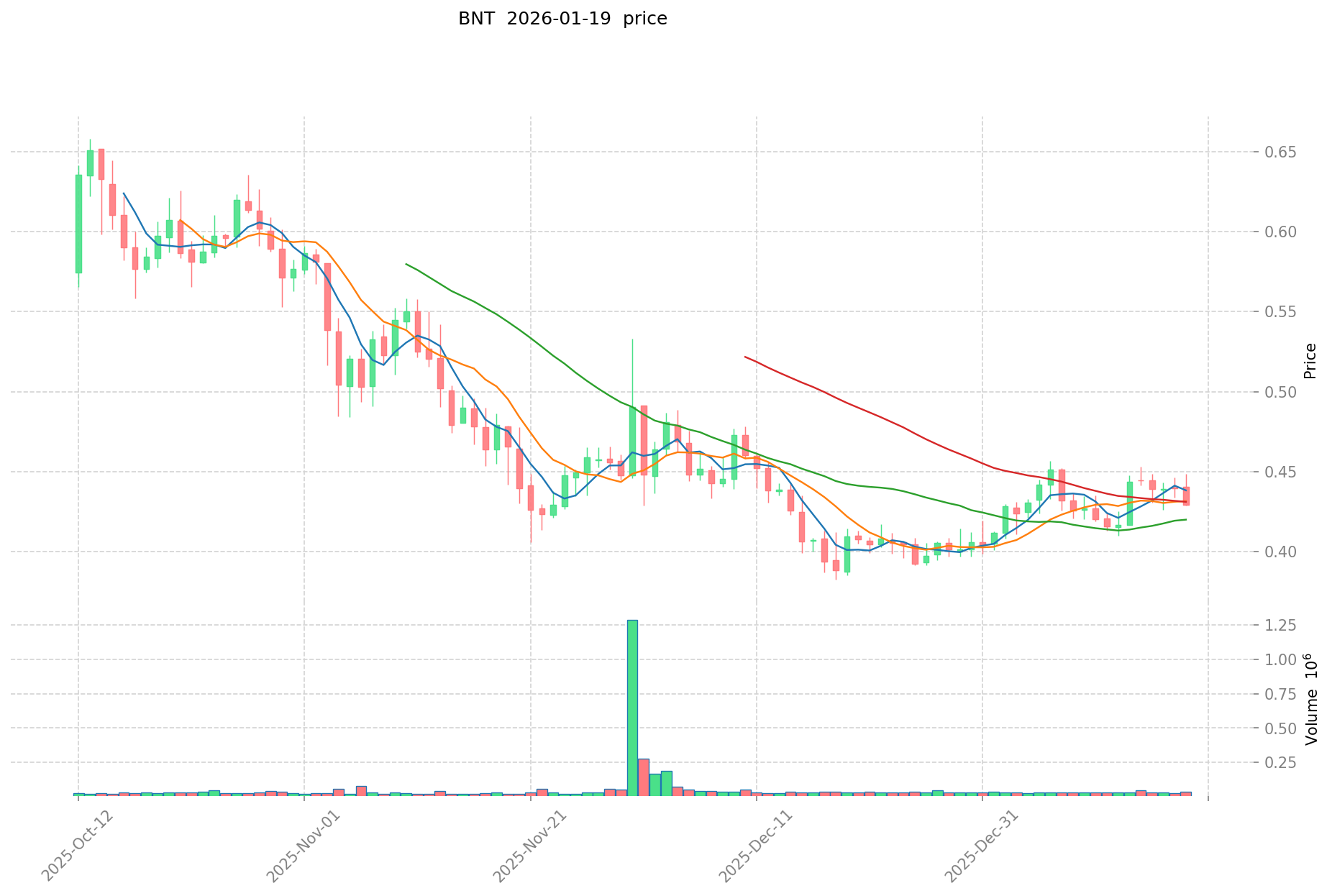
As of January 19, 2026, BNT is trading at $0.4204, representing a decline of approximately 89.08% from its historical peak. The token's 24-hour trading range spans from $0.4132 to $0.4484, with trading volume reaching $16,627.01.
The market capitalization stands at approximately $46.10 million, with a circulating supply of 109,665,600.79 BNT tokens, accounting for 99.21% of the maximum supply of 110,542,364.64 tokens. The fully diluted valuation closely aligns with the current market cap at 99.21%, indicating near-complete token circulation.
Short-term price movements show mixed directional signals: the 1-hour change registers at -0.1%, while the 24-hour period reflects a -4.38% decrease. However, the 7-day performance indicates a positive movement of 1.13%, and the 30-day trend shows a gain of 2.74%. The annual comparison reveals a decline of -39.23%, suggesting ongoing market adjustment.
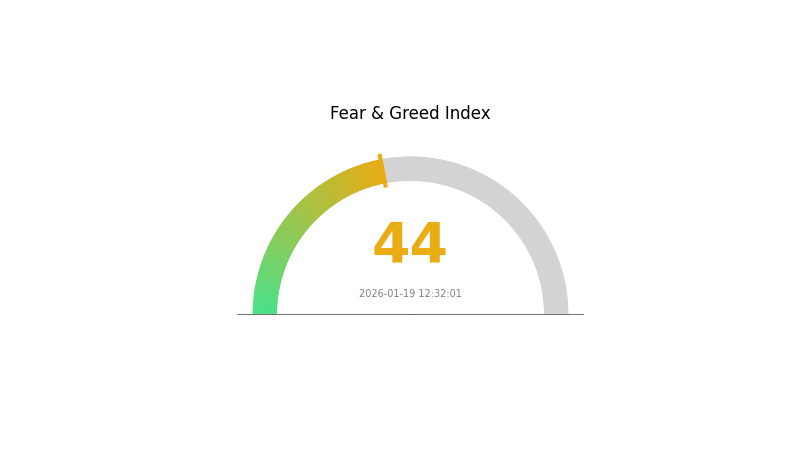
Bancor currently maintains listings across 29 cryptocurrency exchanges and has attracted a holder base of 38,514 addresses. The token's market dominance stands at 0.0013%, positioning it at rank 551 in the broader cryptocurrency market. Market sentiment indicators reflect a fear reading of 44 on the volatility index.
Click to view current BNT market price
BNT Market Sentiment Index
2026-01-19 Fear and Greed Index: 44 (Fear)
Click to view current Fear & Greed Index
Current market sentiment shows pronounced fear with an index reading of 44, indicating heightened investor anxiety and risk aversion across the cryptocurrency market. This fear-driven sentiment typically reflects concerns about market volatility, regulatory developments, or macroeconomic headwinds. During such periods, investors may consider accumulating quality assets at potentially favorable prices, while maintaining prudent risk management strategies. Market participants should monitor sentiment shifts closely, as fear periods often present contrarian opportunities for long-term investors with strong conviction and adequate capital reserves.
BNT Holding Distribution
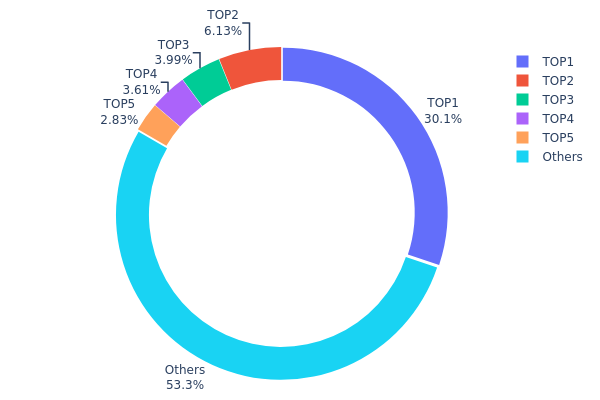
The holding distribution chart reflects the concentration of token holdings across different wallet addresses, serving as a critical indicator for assessing the degree of decentralization and potential market manipulation risks within the BNT ecosystem. According to the latest on-chain data, the top holder controls 33,064.03K BNT (30.14% of total supply), while the top five addresses collectively hold 51,226.09K BNT, accounting for 46.68% of the circulating supply. This concentration level suggests a moderate to high degree of centralization, with nearly half of the token supply controlled by a small group of major holders.
The current holding structure presents both opportunities and challenges for BNT's market dynamics. The dominant position of the top address, holding over 30% of supply, creates potential price stability risks as large-scale movements from this wallet could trigger significant market volatility. Meanwhile, the "Others" category representing 53.32% of holdings indicates a relatively diverse distribution among smaller participants, which provides some level of decentralization. However, the combined influence of the top five addresses remains substantial enough to potentially impact trading sentiment and liquidity patterns on centralized exchanges like Gate.com, particularly during periods of increased market uncertainty.
From a structural stability perspective, this holding distribution pattern reflects the typical characteristics of DeFi protocol tokens, where treasury addresses, liquidity pools, and early investors often maintain significant positions. The relatively balanced split between major holders (46.68%) and the broader community (53.32%) suggests a transitional phase in BNT's maturation process. As the ecosystem continues to develop and token distribution becomes more dispersed through organic trading activity and protocol incentives, we may observe a gradual improvement in decentralization metrics, ultimately contributing to enhanced market resilience and reduced susceptibility to single-entity price manipulation.
Click to view current BNT Holding Distribution
| Top |
Address |
Holding Qty |
Holding (%) |
| 1 |
0x6497...2bc373 |
33064.03K |
30.14% |
| 2 |
0xe331...9d45cb |
6725.77K |
6.13% |
| 3 |
0x02f6...ec1430 |
4380.42K |
3.99% |
| 4 |
0x9eab...2593b7 |
3955.85K |
3.60% |
| 5 |
0xf727...b587a7 |
3100.02K |
2.82% |
| - |
Others |
58439.51K |
53.32% |
II. Core Factors Influencing BNT's Future Price
Supply Mechanism
- Fixed Supply Model: BNT operates with a fixed supply mechanism, which means it is not subject to inflationary pressures that typically affect tokens with unlimited or expanding supply schedules.
- Historical Pattern: The fixed supply structure has historically contributed to BNT's price stability during periods of increased market demand, as scarcity dynamics can support valuation when adoption grows.
- Current Impact: The fixed supply continues to position BNT as a token potentially resilient to inflation-related devaluation, though price movements remain highly sensitive to broader market sentiment and DeFi sector dynamics.
Institutional and Major Holder Activity
Due to limited information in the provided materials regarding institutional holdings, enterprise adoption, or national policy impacts specific to BNT, this section has been omitted.
Macroeconomic Environment
- Monetary Policy Impact: BNT's price remains sensitive to external financial factors, including monetary policy shifts, regulatory developments, and political events that influence the broader cryptocurrency market.
- Volatility and Risk: The cryptocurrency market's inherent volatility means BNT can experience significant price fluctuations driven by changing macroeconomic conditions and investor sentiment.
- Market Sentiment Correlation: Price movements are closely tied to overall industry trends, with BNT often reflecting shifts in risk appetite and confidence in the decentralized finance sector.
Technology Development and Ecosystem Growth
- Bancor Protocol Integration: BNT is the native token of the Bancor protocol, which leverages smart contracts on blockchain networks to embed price discovery and liquidity mechanisms directly into tokens.
- DeFi Market Demand: The token's value is influenced by demand within the decentralized finance ecosystem, with platform updates and technological improvements serving as potential catalysts for price action.
- Ecosystem Applications: BNT can be used for governance within the Bancor platform, allowing holders to participate in protocol decision-making, which may enhance long-term engagement and utility.
III. 2026-2031 BNT Price Prediction
2026 Outlook
- Conservative prediction: $0.327 - $0.395
- Neutral prediction: $0.395 - $0.420
- Optimistic prediction: $0.420 - $0.445 (requires favorable market conditions and sustained trading volume)
2027-2029 Outlook
- Market stage expectation: The token is anticipated to enter a gradual growth phase, with potential acceleration in adoption and ecosystem development during this period.
- Price range predictions:
- 2027: $0.315 - $0.605
- 2028: $0.446 - $0.669
- 2029: $0.546 - $0.677
- Key catalysts: Expansion of DeFi protocols utilizing the token, increased liquidity provision incentives, and broader integration within decentralized trading platforms.
2030-2031 Long-term Outlook
- Baseline scenario: $0.572 - $0.635 (assuming steady market growth and consistent protocol development)
- Optimistic scenario: $0.635 - $0.686 (assuming accelerated adoption of decentralized liquidity solutions and favorable regulatory environment)
- Transformational scenario: $0.686 - $0.707 (requires significant breakthroughs in DeFi infrastructure and mainstream institutional adoption)
- 2026-01-19: BNT $0.420 (positioned at mid-range of projected annual average, reflecting current market consolidation)
| Year |
Predicted High Price |
Predicted Average Price |
Predicted Low Price |
Price Change |
| 2026 |
0.44467 |
0.4195 |
0.32721 |
0 |
| 2027 |
0.60492 |
0.43209 |
0.31542 |
2 |
| 2028 |
0.66887 |
0.5185 |
0.44591 |
23 |
| 2029 |
0.6768 |
0.59368 |
0.54619 |
41 |
| 2030 |
0.68606 |
0.63524 |
0.57172 |
51 |
| 2031 |
0.7069 |
0.66065 |
0.4096 |
57 |
IV. BNT Professional Investment Strategy and Risk Management
BNT Investment Methodology
(1) Long-Term Holding Strategy
- Target Investors: Investors seeking exposure to decentralized liquidity protocols with a medium to long-term perspective, comfortable with DeFi protocol risks
- Operational Recommendations:
- Consider accumulating positions during market corrections, with BNT currently trading at $0.4204, significantly below its historical peak
- Monitor the protocol's liquidity performance and ecosystem developments, particularly updates to the Bancor network
- Storage Solution: Gate Web3 Wallet offers secure storage options for BNT tokens on the Ethereum network (contract address: 0x1F573D6Fb3F13d689FF844B4cE37794d79a7FF1C)
(2) Active Trading Strategy
- Technical Analysis Tools:
- Moving Averages: Track short-term (7-day: +1.13%) and medium-term (30-day: +2.74%) price trends to identify potential entry and exit points
- Volume Analysis: Monitor the 24-hour trading volume of $16,627 to gauge market participation and liquidity conditions
- Swing Trading Points:
- Consider the 24-hour price range between $0.4132 (low) and $0.4484 (high) for identifying support and resistance levels
- Be mindful of the recent 24-hour decline of -4.38% when planning position entries
BNT Risk Management Framework
(1) Asset Allocation Principles
- Conservative Investors: 1-3% of crypto portfolio allocation
- Aggressive Investors: 3-7% of crypto portfolio allocation
- Professional Investors: Up to 10% of crypto portfolio allocation, with active monitoring of protocol developments
(2) Risk Hedging Solutions
- Diversification Strategy: Balance BNT holdings with other DeFi tokens and established cryptocurrencies to reduce protocol-specific risk
- Position Sizing: Implement gradual accumulation rather than single large positions, considering BNT's market cap of approximately $46.1 million
(3) Secure Storage Solutions
- Web3 Wallet Recommendation: Gate Web3 Wallet provides secure storage for BNT tokens with support for Ethereum-based assets
- Cold Storage Option: For larger holdings, consider hardware wallet solutions that support ERC-20 tokens
- Security Precautions: Always verify contract addresses (0x1F573D6Fb3F13d689FF844B4cE37794d79a7FF1C), enable two-factor authentication, and never share private keys or seed phrases
V. BNT Potential Risks and Challenges
BNT Market Risks
- Liquidity Concerns: With a circulating supply of approximately 109.67 million BNT and a relatively modest 24-hour trading volume, the token may experience higher volatility during market stress
- Price Volatility: BNT has shown a 1-year decline of -39.23%, indicating sensitivity to broader market conditions and DeFi sector sentiment
- Competition Risk: The decentralized exchange and liquidity protocol space has become increasingly competitive, potentially impacting BNT's market position
BNT Regulatory Risks
- DeFi Regulatory Uncertainty: Evolving regulatory frameworks for decentralized finance protocols could impact Bancor's operations and BNT's utility
- Token Classification Issues: Potential regulatory scrutiny regarding the classification of DeFi tokens may introduce compliance challenges
- Cross-Border Compliance: As a protocol operating across multiple jurisdictions, Bancor may face varying regulatory requirements that could affect its development trajectory
BNT Technical Risks
- Smart Contract Vulnerabilities: As with all DeFi protocols, potential security vulnerabilities in Bancor's smart contracts could pose risks to users and token value
- Protocol Upgrade Challenges: Changes to the Bancor protocol mechanism, including its automated market maker (AMM) model, may introduce unforeseen technical complications
- Network Dependency: BNT operates on the Ethereum network, making it subject to network congestion, gas fee fluctuations, and potential technical issues on the underlying blockchain
VI. Conclusion and Action Recommendations
BNT Investment Value Assessment
Bancor (BNT) represents an established player in the decentralized liquidity protocol space, with its innovative automated market maker mechanism addressing liquidity challenges for various tokens. The protocol's asynchronous price discovery model differentiates it from traditional exchanges. However, with BNT currently trading at $0.4204—significantly below its historical high of $10.72—investors should carefully weigh the protocol's long-term value proposition against near-term performance challenges, including the -39.23% decline over the past year. The market cap to fully diluted valuation ratio of 99.21% suggests limited additional token supply pressure, while the circulating ratio of 99.21% indicates most tokens are already in circulation.
BNT Investment Recommendations
✅ Beginners: Start with a small allocation (1-2% of crypto portfolio) to gain exposure to DeFi liquidity protocols. Focus on understanding Bancor's mechanism and monitor protocol developments before increasing position size.
✅ Experienced Investors: Consider BNT as a tactical allocation (3-5% of crypto portfolio) within a diversified DeFi portfolio. Actively monitor protocol metrics, liquidity performance, and competitive positioning while employing appropriate risk management techniques.
✅ Institutional Investors: Evaluate BNT's role in a broader DeFi infrastructure allocation strategy. Conduct thorough due diligence on protocol security, governance mechanisms, and long-term viability while considering the relatively modest market cap of $46.1 million.
BNT Trading Participation Methods
- Spot Trading: Purchase and hold BNT tokens through Gate.com, which supports BNT trading with various trading pairs
- DeFi Participation: Engage directly with the Bancor protocol to provide liquidity or utilize its exchange features, understanding the associated smart contract risks
- Gradual Accumulation: Implement dollar-cost averaging strategies to build positions over time, reducing the impact of short-term price volatility
Cryptocurrency investment carries extremely high risks, and this article does not constitute investment advice. Investors should make prudent decisions based on their own risk tolerance and are advised to consult professional financial advisors. Never invest more than you can afford to lose.
FAQ
What is BNT (Bancor Network Token) and what is its purpose?
BNT is the governance and utility token of Bancor Network, a decentralized finance protocol. It enables liquidity provision, trading facilitation, and protocol governance within the Bancor ecosystem.
What are the main factors affecting BNT price?
BNT price is primarily influenced by supply mechanics and scarcity, institutional investment adoption, macroeconomic environment, technology development, market demand, and trading volume in the ecosystem.
What is the price prediction for BNT in 2024-2025?
BNT's 2025 price prediction ranges from 0.764176 USD to 1.493122 USD, representing a potential increase of 167.41% based on market analysis.
What are the advantages and disadvantages of BNT compared to other DeFi tokens?
BNT offers strong utility paired with every liquidity pool, supporting diverse yield farming strategies. However, it carries higher risk than pure governance tokens and may lag competitors in stability and liquidity depth.
What are the risks of investing in BNT?
BNT investment carries market volatility risk, potential capital loss, and system technical risks. Market fluctuations and trading system performance may impact returns. Investors should carefully assess market conditions before investing.
What are the latest developments of the Bancor Protocol?
Bancor Protocol continues optimizing its decentralized exchange functionality, enhancing market efficiency and fairness. Recent updates include advanced smart contract features and improved user experience for seamless token trading and liquidity provision.
How does BNT liquidity mining mechanism work?
Bancor's liquidity mining uses reward multipliers to amplify BNT rewards up to 2x, incentivizing users to provide liquidity. Rewards are distributed based on staked token amounts and duration held.
How to buy and store BNT tokens?
Create a free account on a crypto exchange, select BNT to purchase, complete payment, then store BNT in your wallet or transfer to cold storage for security.
* The information is not intended to be and does not constitute financial advice or any other recommendation of any sort offered or endorsed by Gate.